

Explore More Possibilities for Your Business
Full-cycle scenario construction to meet your needs from App research, development, and release to operation.
Ready for your soaring growth
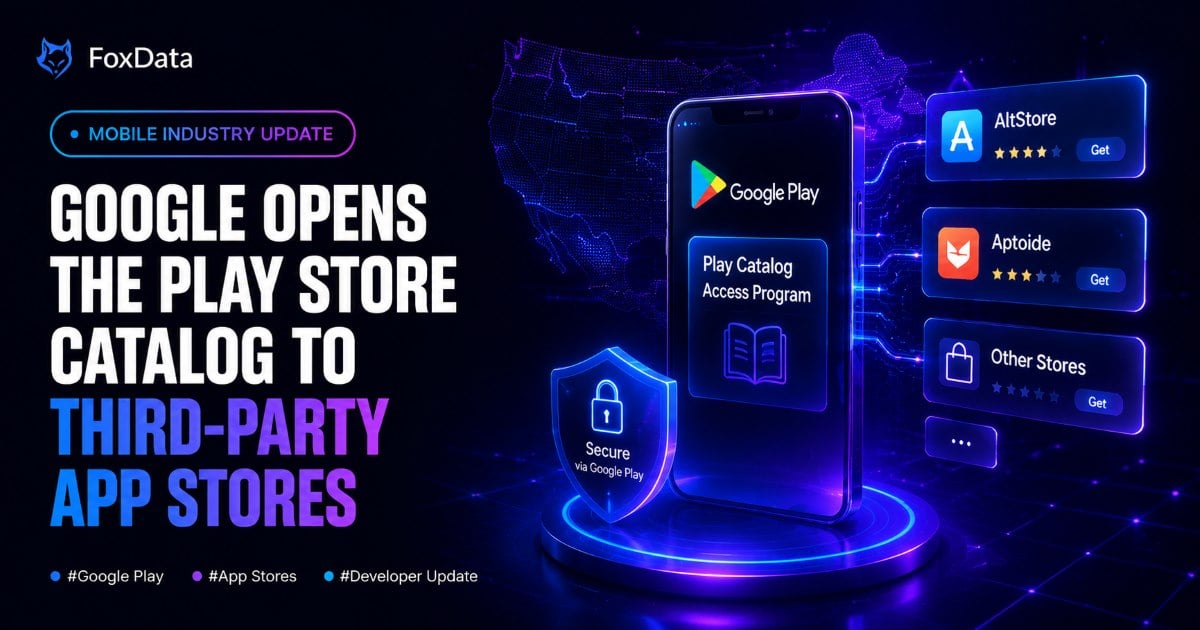
Starting July 22, 2026, Google will begin sharing your app and game listings — name, icon, description, screenshots, and videos — with any third-party US Android app store enrolled in its new Play Catalog Access Program.
The change stems directly from the Epic v. Google antitrust order and was first flagged to developers on June 22, 2026, giving a 30-day window to opt out before the default "opt-in" behavior kicks in.
For app marketers and ASO teams, this isn't just a legal footnote — it changes who controls your metadata, where your listing can appear, and how discovery and brand risk need to be monitored going forward. Here's exactly what's changing, what your options are, and what to do before the deadline.
The Play Catalog Access Program is Google's mechanism for complying with the US court order in the Epic Games v. Google antitrust case. Rather than requiring every third-party Android app store to independently scrape or rebuild app listings, Google will now expose a feed of developer-approved (or default-included) US app and game metadata to any third-party store that formally registers for the program.
Once a third-party store enrolls, it can surface your app's name, icon, description, screenshots, and promotional video inside its own storefront — effectively giving competing Android marketplaces a ready-made catalog on day one, without the years-long bootstrapping problem alternative stores have historically faced. Critically, the download itself is not decentralized: when a user installs your app through one of these third-party listings, the transaction is still fulfilled through Google Play, under Google Play's standard terms, and Google Play's service fee still applies. In other words, this is a discovery and distribution change, not (yet) a payments or billing change.
Developers manage their participation entirely inside Play Console, under Settings > Catalog Settings, where three options are available. If no option is selected by July 22, Google defaults every US listing to being shared.
The listing package third-party stores receive mirrors what already lives on your Play Store page: app/game title, icon, written description, screenshots, and any promotional video assets. No pricing, review, or ranking data is part of the feed — this is purely the ASO-facing creative and metadata layer, the same assets your team already tunes for Play Store conversion rate optimization.
A user browsing a registered third-party store sees your listing rendered natively in that store's UI, but tapping "install" routes the transaction back through Google Play. That means Play Protect scanning and Google's standard security review still apply to the install itself — the third-party store is functioning more as a discovery front end than as an independent distribution channel, at least for stores that stay compliant with the program's rules.
Four things determine what happens to your listing after July 22:
| Feature | Before July 22, 2026 | After July 22, 2026 | Impact |
|---|---|---|---|
| Listing visibility | Google Play only | Google Play + enrolled third-party US stores | Broader discovery surface, less control over context |
| Metadata ownership | Fully controlled via Play Console | Same assets, redistributed to external storefronts | ASO assets now live in environments you don't manage |
| Install/download path | Google Play only | Still fulfilled via Google Play, even from third-party listings | Play Protect and service fee still apply |
| Default developer status | N/A | Opt-in by default unless changed | Passive developers are automatically included |
| Content policy coverage | Google Play policies apply | Third-party stores may apply their own, separate policies | Brand and compliance risk outside Google's review |
There is no cost to opt out, opt in selectively, or do nothing — the "cost" is entirely strategic. The opt-out window closes July 22, 2026, and the setting lives in Play Console under Settings > Catalog Settings. Google has said the choice can be changed at any time going forward, so this isn't a one-shot, irreversible decision — but whatever setting is active on July 22 determines your default exposure from day one of the program.
For everyday Android users, the visible change is subtle at first: third-party app stores will start looking more like Google Play, with recognizable app names, icons, and screenshots instead of sparse or incomplete listings. That should make legitimate third-party stores more usable and easier to trust. The tradeoff is that as users get more comfortable browsing outside Google Play, they may also become more comfortable installing from storefronts that don't apply the same content review standards. Since the install itself still routes through Google Play in compliant scenarios, users retain Play Protect scanning — but only for stores that follow the program's rules, which won't cover every third-party marketplace that pops up in this newly opened landscape.
Third-party US Android app stores can begin accessing enrolled developers' Play Store listings starting July 22, 2026. Google notified developers of the change on June 22, 2026, giving a 30-day window to review and adjust Catalog Settings before the rollout.
No. Choosing any of the three Catalog Settings options — publish to all, manage individually, or opt out entirely — is free and can be changed at any time in Play Console.
No. Even when a download originates from a third-party store's listing, the transaction is still completed through Google Play under Google Play's existing terms, and the standard service fee continues to apply.
Apple's ecosystem remains considerably more closed; the Epic v. Apple ruling did not produce an equivalent catalog-sharing mandate. Google's changes stem from a separate case, Epic v. Google, where courts found Google's Play Store practices anticompetitive in ways the Apple ruling did not replicate.
Log into Play Console before July 22, review Settings > Catalog Settings, and make an explicit choice rather than relying on the default. Pair that decision with a fresh audit of your listing metadata and screenshots, since those assets are about to reach a wider, less controlled set of storefronts.
July 22, 2026 marks the point where Google Play's app and game catalog stops being exclusive to Google Play - a direct consequence of the Epic v. Google antitrust order. Whether that's an opportunity or a risk depends entirely on the choice developers make in Play Console before the deadline, and on how well their ASO metadata is prepared for a wider, less controlled discovery surface. FoxData will continue tracking how third-party store visibility affects keyword rankings and install attribution in the weeks following rollout — bookmark this page for updates.
© 2020-2026 FoxData. All Rights Reserved.