





Explore More Possibilities for Your Business
Full-cycle scenario construction to meet your needs from App research, development, and release to operation.
Ready for your soaring growth
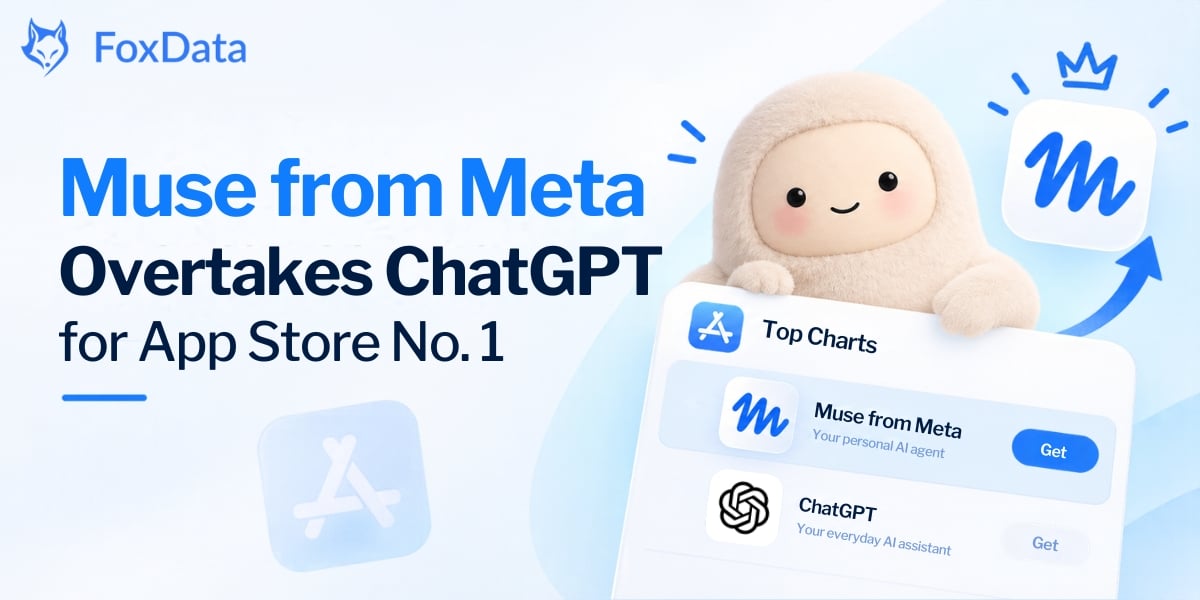
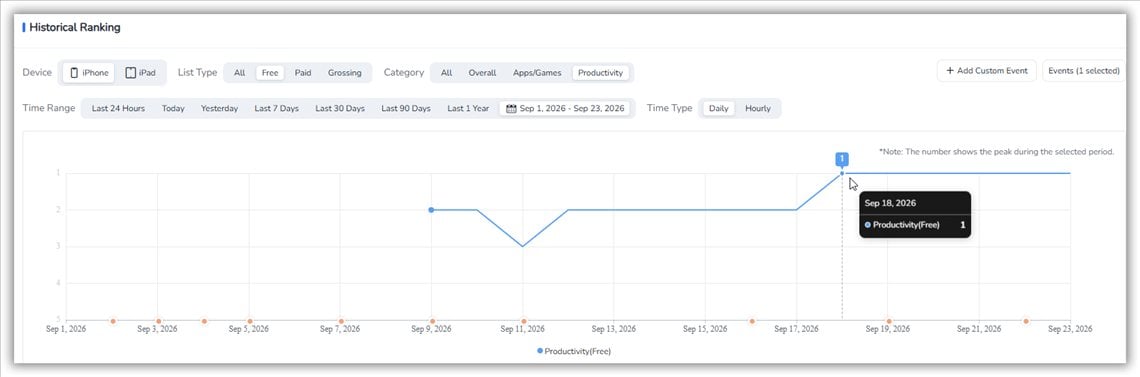
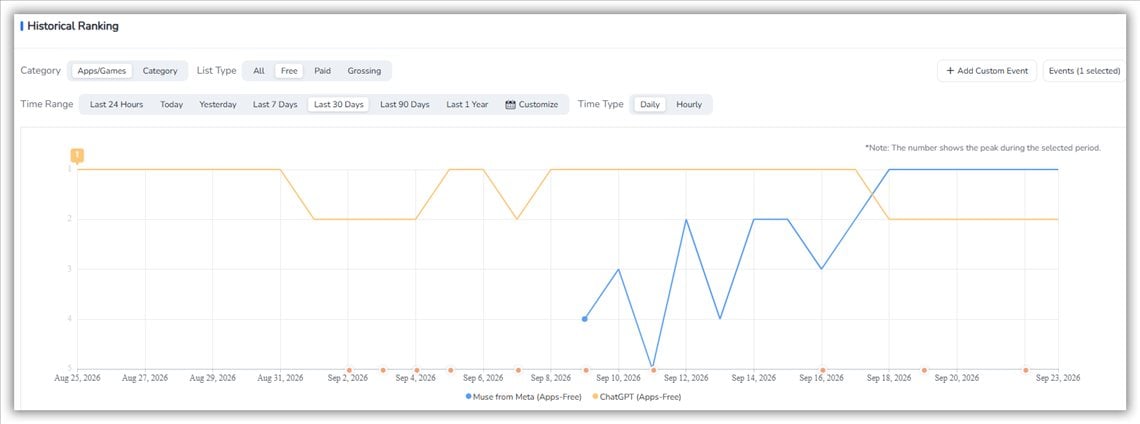
Muse reached No. 1 on the U.S. App Store ten days after launch by stacking four things that rarely align for a new app at once: Meta's built-in audience across Facebook, Instagram, and WhatsApp; a product pitch built around doing tasks rather than answering questions; a news cycle that kept finding new angles, from the Amazon block to the Shopify deal and Wall Street upgrades; and a free tier that let people try an agent with zero commitment.
None of that guarantees Muse will retain the users it just acquired. A launch-week chart position and a habit-forming product are two different things, and the data that helps tell them apart sits below the ranking chart, in keyword visibility, review sentiment, and day-30 retention.
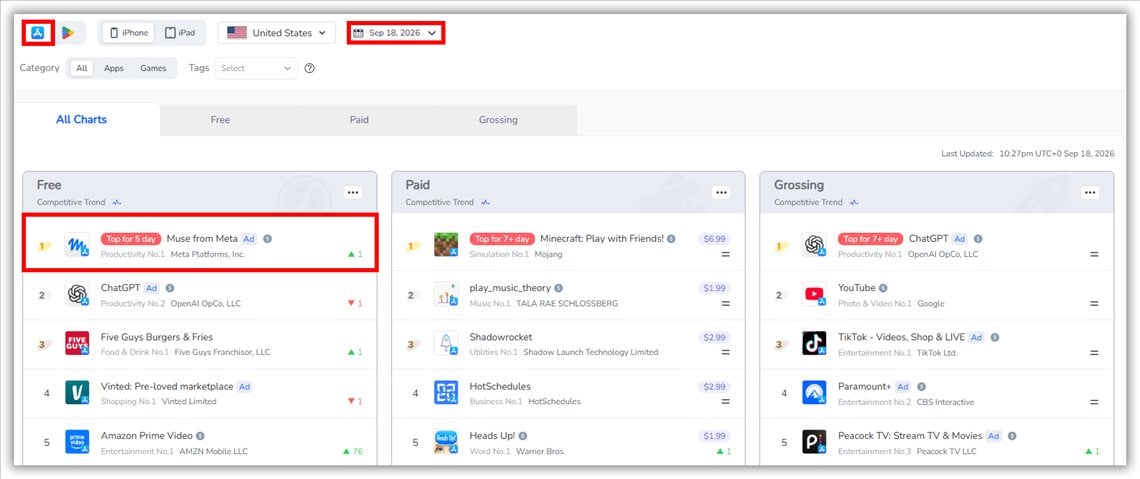
Source: FoxData—Top Charts
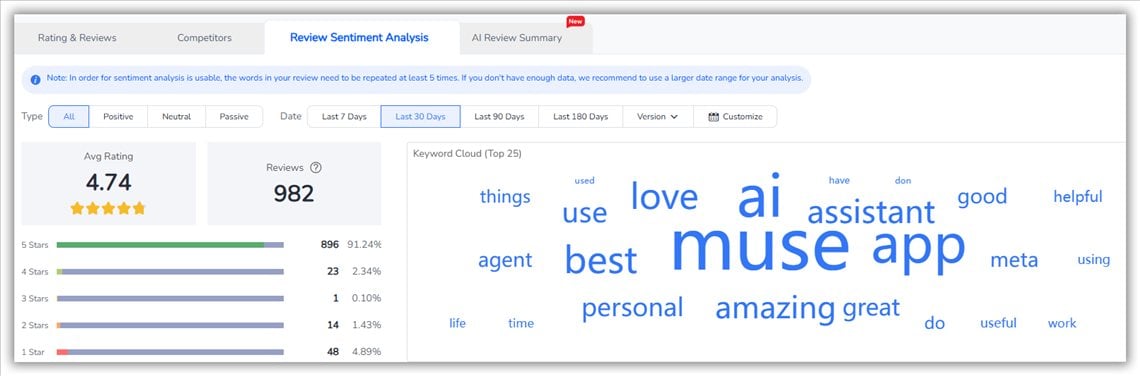
Muse is Meta's personal AI agent, launched on September 8, 2026, on iOS, Android, WhatsApp, and the web, with Canada added on September 18. According to FoxData's Rating & Reviews, it holds a 4.88-star rating from 35.3K App Store reviews, with more than 30K receiving 5-star ratings.
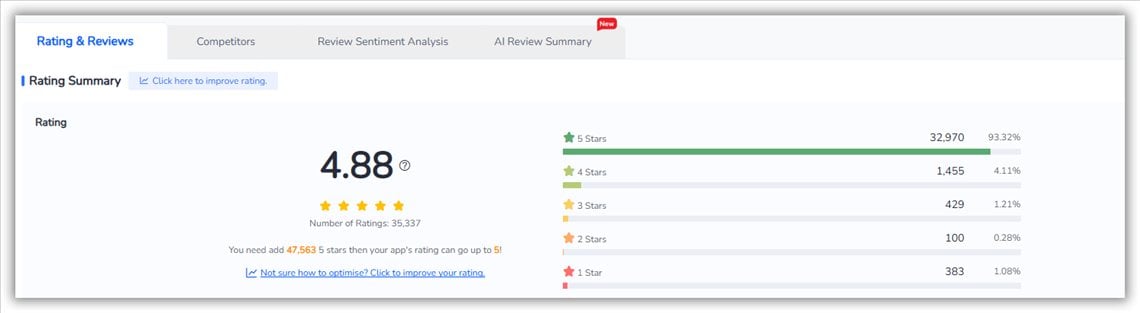
Source: FoxData Rating & Reviews — Muse from Meta
Where a chatbot answers questions, Muse is built to finish tasks: opening a browser, filling out forms, sending emails, booking reservations, comparing prices, tracking expenses, and buying things with the user's approval. It runs on Muse Spark, the model family Meta built for this kind of real-world, multi-step work.
The app connects to email, calendar, Instagram, Facebook, health data and financial accounts, with per-service permission controls. Meta isolates each user's agent inside its own virtual machine (Muse Secure VM), adds a separate review layer (Sentinel) that checks actions before they go out to the internet, and routes payments through Stripe Link's one-time-use virtual cards so Muse never sees raw payment details.
Pricing has three tiers: a free tier with usage limits, Power Plan at $20/month, and Maximum Plan at $100/month, the last still in limited rollout. The Mac app, released September 17–18, extends Muse to local files, Mail, Messages, Calendar and Notes; a version for Meta's AI glasses is planned.
Content will be displayed after page load
|
Date |
Event |
What It Signals |
|
Sept 8 |
Muse launches on iOS, Android, WhatsApp and web in the U.S. |
Immediate chart entry off Meta's own distribution |
|
Sept 11 |
Muse climbs to No. 2 on the U.S. iOS Free Apps chart |
Fast early velocity, still trailing ChatGPT |
|
Sept 13–17 |
Ranking holds near the top |
Sustained momentum rather than a single-day spike |
|
Sept 17–18 |
Mac app ships; Muse takes No. 1 on U.S. iOS Free Apps, ahead of ChatGPT; Canada launch same window |
Desktop coverage and a new market add fresh press hooks right as the app takes the top spot |
|
Sept 21–22 |
Muse holds No. 1 on both the U.S. App Store and Google Play; Meta shares jump roughly 11% |
Cross-platform No. 1 — this isn't just an iOS early-adopter story |
What this table doesn't show matters just as much: a No. 1 free-chart position measures download velocity, not retention, daily usage, or revenue. It's a snapshot. Whether the breakout holds depends on signals that sit below the chart — which is what the rest of this piece digs into.

Raw download totals between Muse and its competitors need context before they're comparable. ChatGPT launched on mobile in May 2023, iOS-only but globally available. Muse launched on iOS and Android simultaneously, but only in the U.S. and Canada — opposite trade-offs that make an apples-to-apples read tricky without adjusting for them.
|
App |
Positioning |
Core Value |
Agentic Depth |
Launch Footprint |
|
Muse (Meta) |
Personal AI agent |
Executes tasks across connected apps |
Browser control, form-filling, shopping, booking, background completion |
iOS + Android + WhatsApp, U.S./Canada only |
|
ChatGPT |
AI assistant |
Information, reasoning, content generation |
Limited; mostly conversational with tool-use add-ons |
iOS-only at launch, global |
|
Claude (Anthropic) |
AI assistant |
Analysis, writing, coding, research |
Limited agentic capability |
iOS + Android |
|
Gemini (Google) |
AI assistant |
Google-ecosystem integration |
Some agentic capability via Google services |
iOS + Android |
|
Grok (xAI) |
AI assistant |
Real-time info, conversation |
Limited |
iOS + Android |
ChatGPT maintained a relatively consistent download level throughout the period, with its highest point reaching 103,097 downloads around September 10. Muse from Meta followed a different pattern. After a quieter start and a slight dip in the middle of the period, its daily downloads picked up toward the end, reaching 115,454 around September 18–19.
These are single-day peak figures, not cumulative totals—they show momentum on a given day, not which app has the larger overall download base.
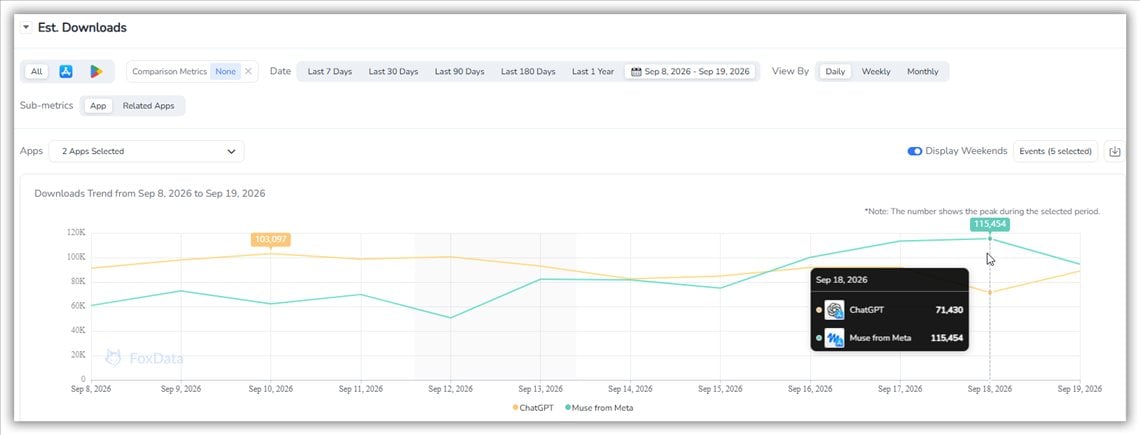
Source: FoxData's Download Trend
The difference is less about which app recorded the highest single-day figure and more about how their download patterns developed. Established products such as ChatGPT tend to generate demand across an ongoing user base, while a newly launched app can experience sharper changes as users respond to product announcements, media coverage, and early adoption.
For app marketers, this is where download data becomes more useful when viewed alongside market context. Muse's early performance should be considered in relation to its launch date, available markets, and the timing of external events, rather than compared with ChatGPT or other established apps through daily download figures alone. Looking at cumulative downloads, average daily performance, and changes over time can provide a more complete picture of how an app is gaining traction.
These are contributing factors, not a ranked list of causes — the available data doesn't isolate which mattered most, or when.
Chatbot: ask a question, get an answer, done. The dominant model from late 2022 through most of 2024.
Copilot: the AI works alongside an ongoing task — drafting, suggesting edits, proposing next steps — while the person stays in the driver's seat. This became common through 2024–2025 as AI tools embedded into everyday software.
Agent: the person sets a goal; the AI executes a sequence of actions toward it, checking in at defined approval points. This is the category Muse is built for.
This is an analytical frame, not an industry-standard taxonomy — but it explains why agentic products might acquire users differently than chatbots do. Someone who finds a chatbot useful uses it often. Someone who finds an agent useful tells a different kind of story about it, because the value is a completed outcome, not an answer.
For app marketers, that shifts the positioning question from what can this tell me to what can this do for me — and the keyword strategy that follows from it.
"AI that books flights" and "AI chatbot" are different search intents. Apps positioned around task completion may start capturing queries that chatbot-branded apps don't. Pulling keyword-footprint data with FoxData's keyword tracking is the fastest way to see whether that shift is showing up in your own category yet.
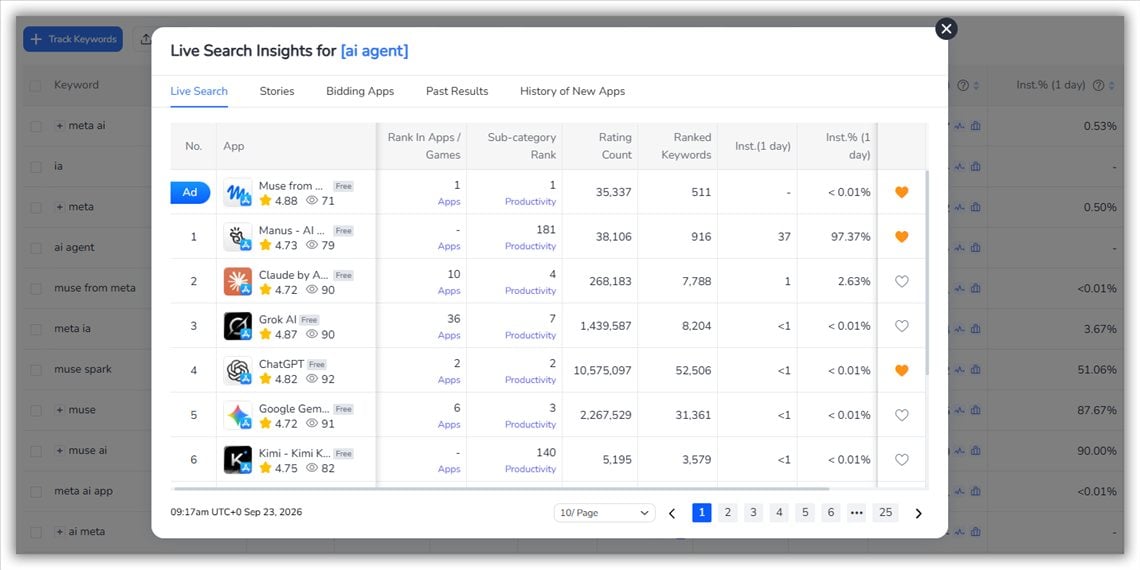
Muse's App Store subtitle is "Your personal AI agent." ChatGPT's is "Your everyday AI assistant." One word — agent vs. assistant — signals a different job-to-be-done, and it's the kind of detail that's easy to A/B test against conversion rate once you're tracking it.
Millions of curious downloads don't behave like downloads earned through demonstrated utility. If you're watching a competitor's breakout, the ranking chart alone won't tell you which kind you're looking at — you need day-7/day-30 retention or, short of that, a proxy like review-sentiment trend over the same window.
Muse's $20/$100 tiers suggest Meta is betting people will pay more for task execution than they typically pay for information access. If that holds, it changes the acquisition-cost math for anyone building an agentic product.
Whether Muse is pulling share from ChatGPT, Claude or Gemini — or whether the whole AI-app category is just expanding — requires reading ranking, keyword, download and review data together across markets, not any one of them alone.
Seeing Muse at No. 1 tells you what happened. It doesn't tell you why, whether it holds, or what it means for your own app. Reading a breakout properly means pulling several data types together:

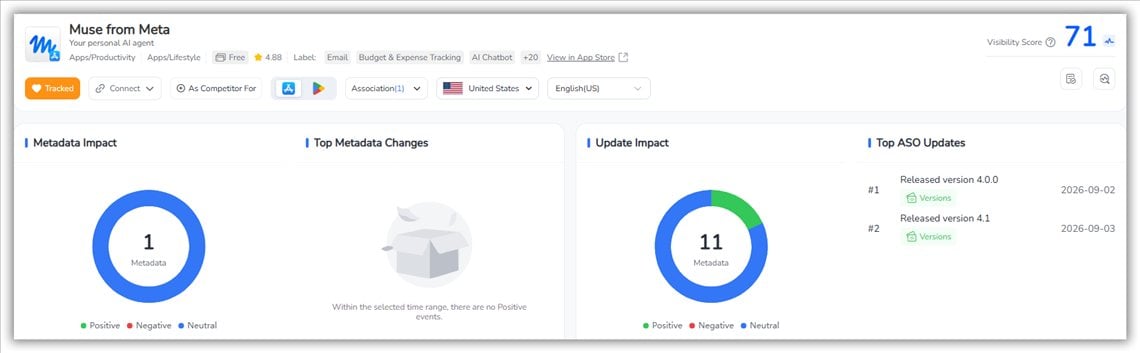
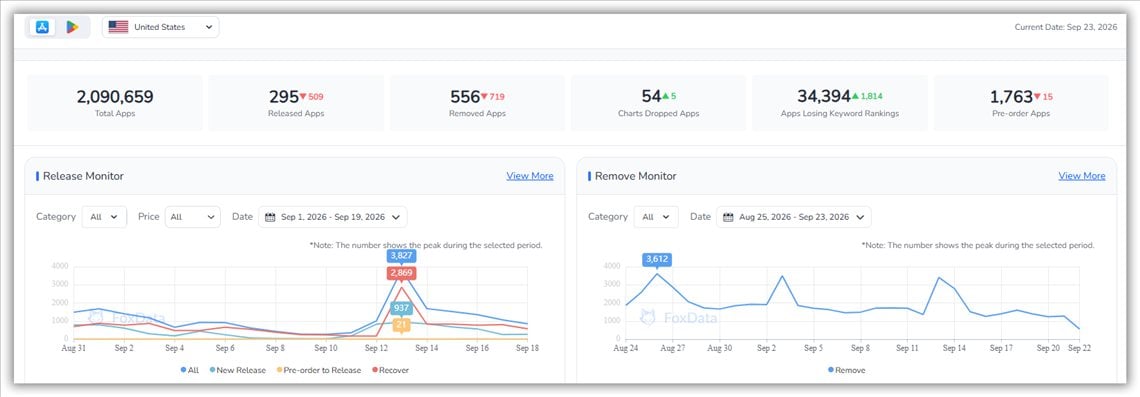
At the scale of tracking this across dozens of competitors and markets on an ongoing basis, this stops being a manual, dashboard-by-dashboard exercise.
None of these resolve from a single data point — they need ongoing tracking, which is the same workflow this piece has been describing throughout.
Muse's climb to No. 1 matters less as a ranking event than as an early signal of where consumer AI is heading — from answering questions, to assisting with tasks, to executing goals. That shift could reshape how apps are discovered, positioned, and monetized, and we're still in the early stages.
The more useful question isn't who's at No. 1 today, but what explains the movement and whether it lasts. A ranking snapshot shows download velocity. Keyword trends, competitor movements, review sentiment, and ASO changes help reveal what's driving that momentum and whether it has the potential to continue.
For app marketers, the takeaway is simple: don't just track who's moving up. Understand why.
See how your app and competitors are performing → Start your free FoxData analysis
Not ready to dig in yet? Subscribe for sharp, data-backed insights into top apps and market trends.
A: Muse is Meta's personal AI agent, launched September 8, 2026. Unlike a chatbot that answers questions, it executes tasks — sending emails, booking travel, managing calendars, comparing prices, and making purchases with approval. Available on iOS, Android, WhatsApp and the web in the U.S. and Canada.
A: September 8, 2026, on iOS, Android, WhatsApp and the web. The Mac app followed September 17–18; Canada was added September 18.
A: Meta's existing user base for cross-promotion, a task-execution pitch rather than a chatbot pitch, an AI-assistant category that was already familiar to consumers, heavy media coverage, and a free tier that lowered the barrier to trying it.
A: An agent. It opens browsers, fills forms, books reservations, sends emails, tracks expenses and buys things — the user sets goals and approves actions; Muse handles execution.
A: Manage email and calendars, book travel and dining, track spending and audit subscriptions, compare prices and shop, negotiate bills, build fitness and meal plans, and keep working on multi-step tasks in the background after you close the app.
A: Yes, it launched simultaneously on iOS and Android and reached No. 1 on both the U.S. App Store and Google Play by September 22.
A: Free tier with usage limits, Power Plan at $20/month, Maximum Plan at $100/month (limited rollout, not yet available everywhere).
A: Two things worth acting on now: reassess your own keyword set for task-oriented, not just conversational, search intent, and add Muse (plus whichever AI apps compete in your category) to your competitor-tracking list before the next breakout, not after.
💡 Want to set that watch list up in minutes instead of building it by hand? [See how FoxData tracks competitors like this →]
📣 Don't Miss These:
© 2020-2026 FoxData. All Rights Reserved.