






Explore More Possibilities for Your Business
Full-cycle scenario construction to meet your needs from App research, development, and release to operation.
Ready for your soaring growth
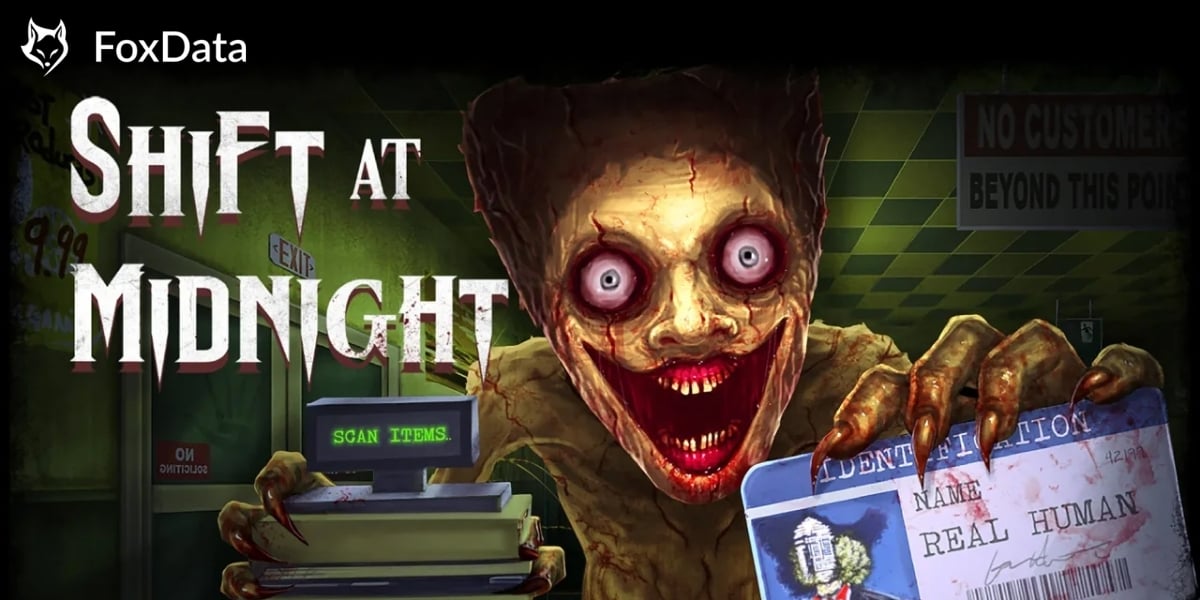
If you have been watching Steam's best-seller charts recently, you have probably seen Shift At Midnight climbing fast.
Shift At Midnight, officially released on July 22, quickly secured a spot on several core top-seller lists. Developed entirely by a solo creator, this three-player co-op horror game broke into the global top 10 best-sellers during its launch week. Beyond its global success, the game also secured high rankings in the Chinese market, highlighting the massive cross-regional potential for multiplayer horror titles.
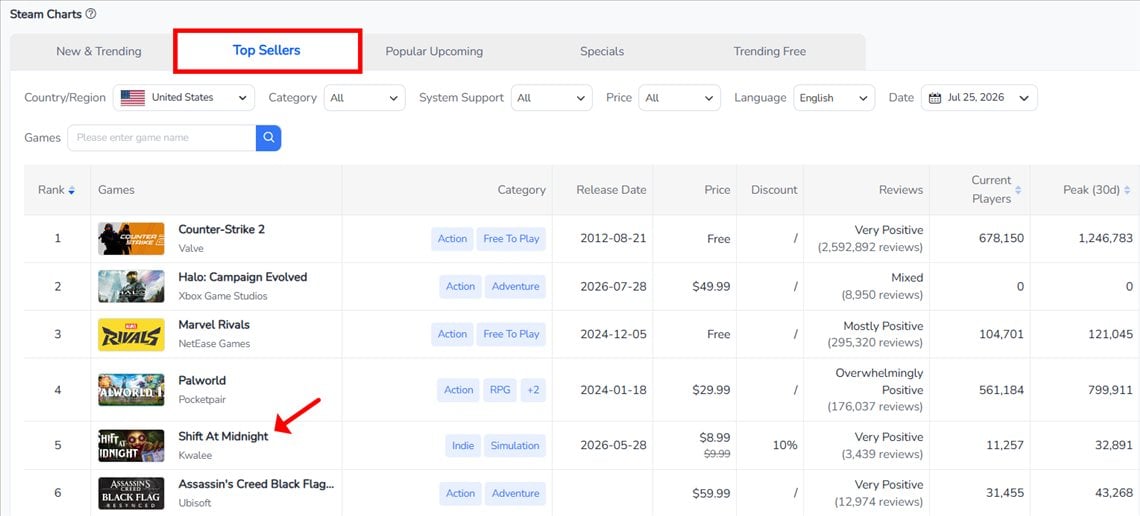
Source: FoxData Steam Charts
At FoxData, we tracked the complete lifecycle of Shift At Midnight—from its initial demo to its highly successful launch. By combining our market data with the developer's public post-mortems, it becomes clear that this breakout hit was not a stroke of luck.
Behind this success is Bun Muen, a young Australian developer who spent three years building mobile games before pivoting to the PC indie space. In under a year, he managed to push a small-scale indie title to the top of the Steam charts.
So, what exactly did he do right?
For those unfamiliar with the title, the premise sounds deceptively simple.
You play as a night-shift clerk at a remote gas station. Your routine tasks involve stocking shelves, ringing up customers, cleaning up, and refueling cars. It sounds like a standard management simulator, but the core mechanic is entirely different: any customer walking through the door could be a "doppelganger" (an anomaly).
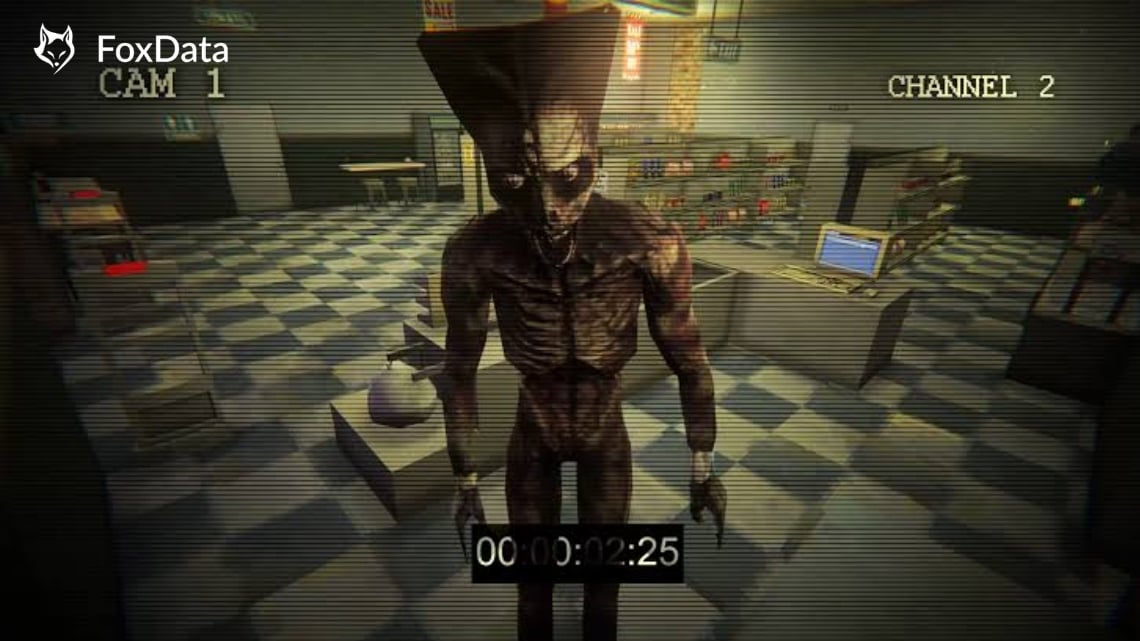
Your real job is to verify their identities while serving them. You must check their IDs for inconsistencies and watch for abnormal behavior. If you make a mistake and let an anomaly leave, they return later that night as a monster to hunt you down.
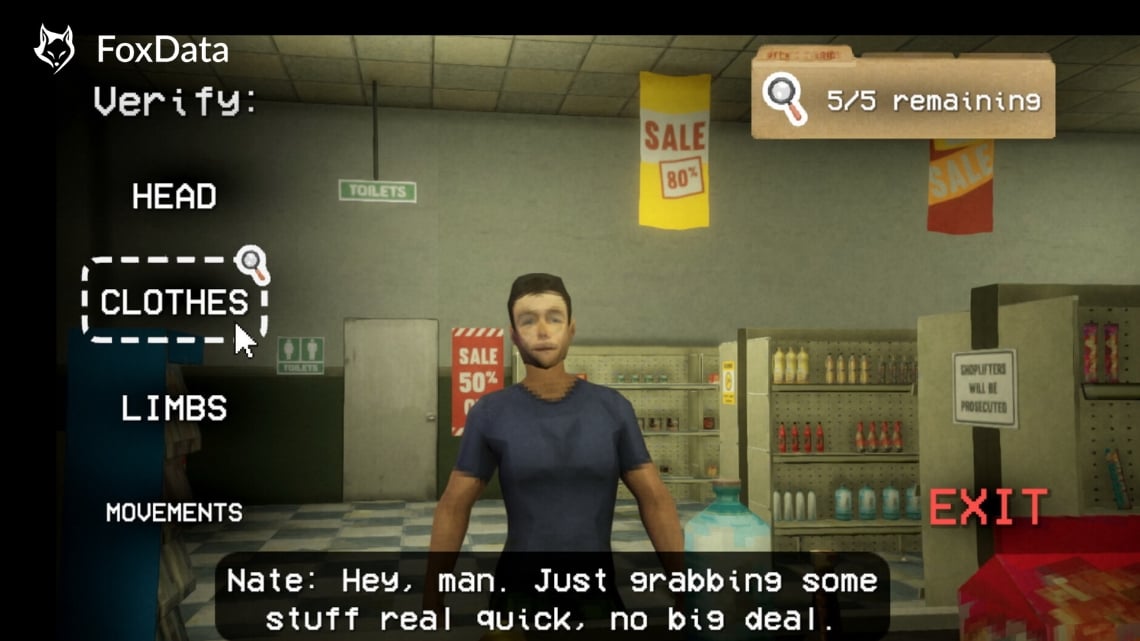
This design tightly intertwines two contrasting experiences. The first half is a chaotic management sim; the second half violently shifts into survival horror. Players must juggle tasks under extreme pressure. Furthermore, the game features randomly generated shifts, ensuring high replayability through variable stacking rather than static narrative consumption.
The game supports up to three players and includes proximity voice chat. Three-player co-op is a deliberate choice. A smaller lobby lowers the barrier to forming a team, while proximity chat turns "communication" into a gameplay mechanic—and a potential source of danger. You can never be entirely sure if the voice in your ear belongs to your real teammate.
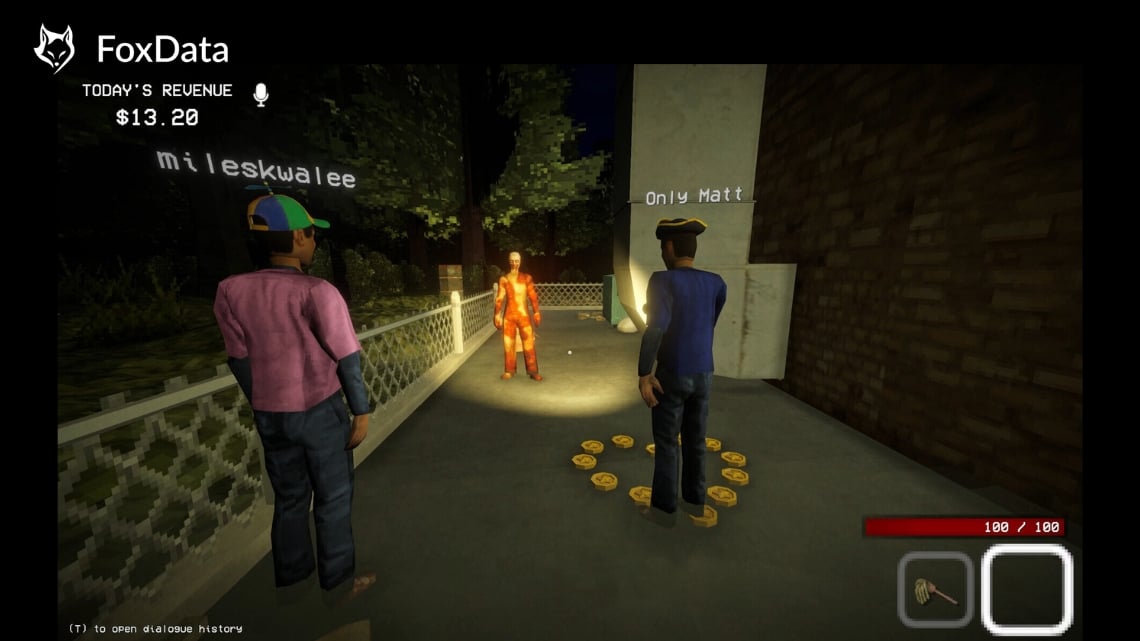
Before Shift At Midnight, developer accounts indicate Bun Muen spent roughly three years developing a 2D pixel-art RPG for mobile devices. The project struggled to find an audience, which led him to rethink his approach.
He later described the experience as a turning point that pushed him away from microtransaction-driven design and toward building something players genuinely wanted to play.
At the time, early reports suggest he started with limited resources and initially relied on free indie portals to distribute prototypes and gather feedback at zero cost. He quickly realized the core loop—working a retail job while spotting doppelgangers—had serious traction. The pacing and feedback loops were tighter than expected. Early playtesting not only helped him squash bugs but also validated his biggest hypothesis: multiplayer co-op was the true growth engine for this concept.
Bun Muen's promotional strategy was methodical, not accidental. He identified top-tier horror content creators and made sure they had access to material worth broadcasting.
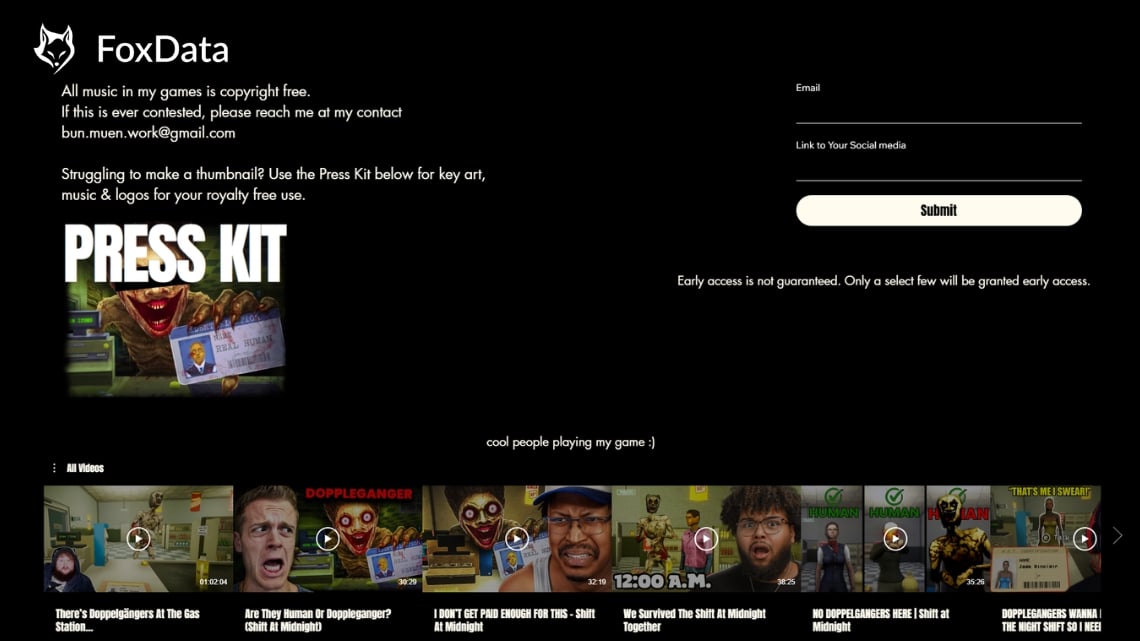
CaseOh played the demo on its first available day. His expressive reactions to handwritten ID checks and system prompts like "This person is already dead" were clipped immediately. Those clips traveled across TikTok, YouTube Shorts, and Instagram Reels, accumulating tens of millions of views.
Content will be displayed after page load
🎬
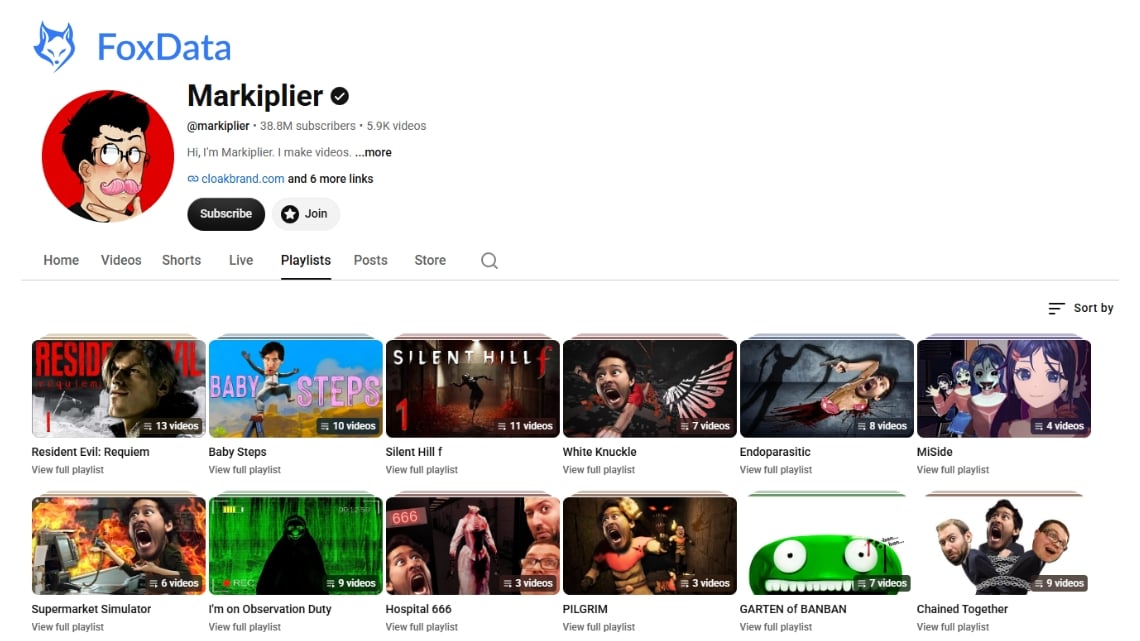
Markiplier followed, pushing visibility into a broader audience segment. By the time the full game launched, awareness was already saturated among core horror-game consumers.
The critical insight here is timing. Bun Muen did not wait until the game was finished to send keys. He let creators test the viral potential of the demo early, then used that signal to justify accelerating multiplayer polish before launch.
By March 2026, the multiplayer demo had drawn hundreds of thousands of players. That pool represented a qualified audience ready to convert on release day.
💡 Growth Insight: Knowing which market segments to target and tracking competitor momentum is half the battle. Studios that monitor category trends, analyze competitor performance, and refine go-to-market strategies using live data consistently outperform those relying on intuition alone.
If you are planning a Steam launch, start by understanding what similar titles did in the weeks before and after their release.
👉 Explore FoxData's Steam Charts to track concurrent player trends, pricing history, and category movement in real time.

Shift At Midnight officially launched across Steam and Xbox Series X|S (with day-one Xbox Game Pass availability) on July 22. Within days, it broke into Steam's global top-seller tier.
According to FoxData's Steam Charts, the game did not follow the typical "day-one spike followed by a steep crash" trajectory. Instead, it maintained a steady upward curve. Data shows the game reached its all-time peak concurrent users (CCU) on July 26, hitting nearly 37K players. For a co-op horror title priced under $20, this scale of player retention is exceptional.

The Steam store page maintains a Very Positive rating, with thousands of English-language reviews and an approval rate exceeding 90%. That level of sustained satisfaction indicates the core loop delivers on its promise.
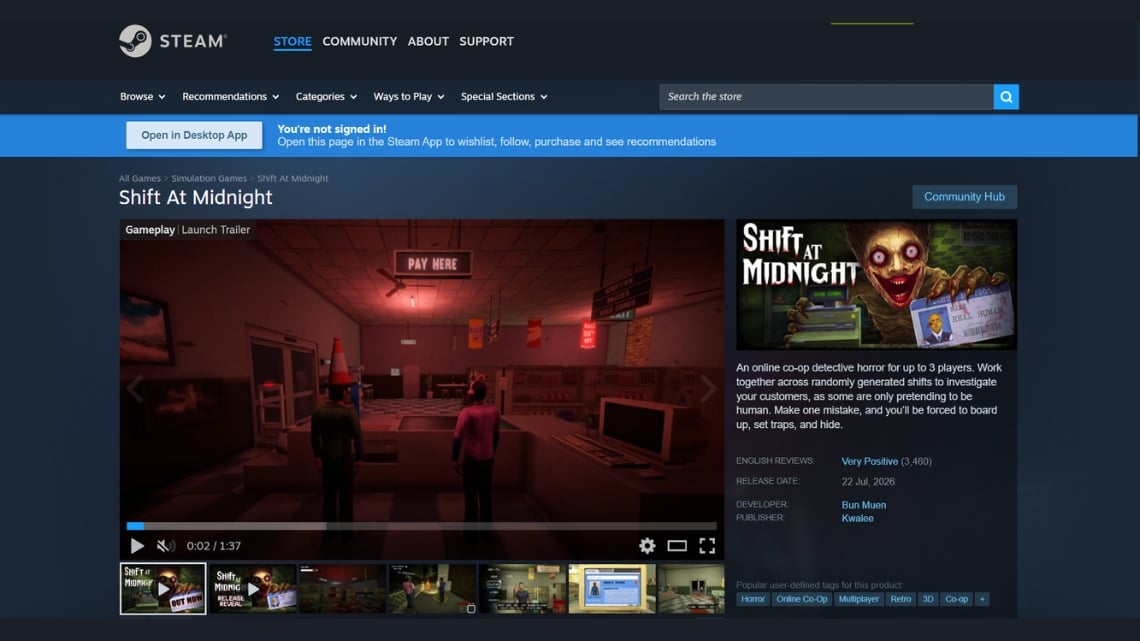
Players do not need a tutorial to understand the stakes. A gas station night shift is instantly recognizable. The game leverages that familiarity, then introduces tension through identity verification rather than complex lore.
Identifying a doppelganger requires observation, debate, and often failure. Wrong guesses produce dramatic, funny, or terrifying outcomes. That loop of observation → discussion → consequence is ideal for live streaming and short-form video. Streamers provide the entertainment; viewers share the clips; the game becomes the vehicle.
At roughly 8.99–9.99, the game promises 10–15 hours of multiplayer chaos and delivers exactly that. There is no AAA feature creep, no battle pass, no microtransaction layer. The price point lowers the barrier to entry and reduces refund risk.
Three-player co-op is a deliberate choice. It is easier to assemble than a four-stack, harder to carry than duos, and proximity chat adds genuine social tension. The smaller lobby size also broadens the potential audience—not everyone has a regular four-person squad.
Releasing a free demo is the lowest-risk way to test a core loop. The goal is not perfection—it is discovering the exact interaction that keeps players talking. Bun Muen used the demo to confirm that multiplayer co-op, not solo play, was the real growth engine. That insight redirected production focus before money was sunk into the wrong mode.
Do not wait for a finished build. Give selected creators access to vertical slices or demos that highlight the most clip-worthy moments. Their reactions become your market research. If top-tier talent does not bite, that is valuable signal too.
Understanding where you sit in the market requires actual numbers, not guesswork. Monitoring platform charts, competitor CCU curves, pricing experiments, and genre saturation levels lets you position your release for maximum impact.
This is where continuous intelligence pays off. Platforms like FoxData let you track exactly how competing titles perform after launch—where they peak, how fast they decay, and what pricing or update cadence correlates with retention.
Ready to map your competition? Start analyzing competitor Steam performance with FoxData and see how your target genre behaves in real time.
Shift At Midnight is a 3-player online co-op detective-horror game developed by Bun Muen and published by Kwalee. Players work the night shift at a rural gas station, serving customers while identifying supernatural doppelgangers before they return as monsters. It launched July 22, 2026, on PC via Steam and Xbox Series X|S with Xbox Game Pass support.
The game was created by Bun Muen, an Australian solo indie developer. It is published by Kwalee, a UK-based publisher known for supporting indie titles across PC and console platforms.
The developer released a free, highly replayable demo and deliberately targeted top-tier horror streamers. Viral clips of streamers reacting to in-game failures spread across TikTok, YouTube Shorts, and Instagram Reels, driving massive wishlist growth and pre-launch awareness.
Success in a crowded market requires moving beyond guesswork. Studios should:
Tools like FoxData provide Steam Charts, competitor tracking, and app intelligence to help teams spot gaps before committing production resources.
FoxData offers dedicated Steam Charts and PlayStation Charts to monitor concurrent player trends, rankings, and category shifts. For mobile-first studios, FoxData also tracks global mobile game rankings and provides solutions tailored to game developers and publishers.
You can explore the full capabilities of our Mobile Game Analytics Solutions here.
FoxData significantly lowers the cost of trial and error. By clearly mapping out what genres are trending and which marketing channels are driving real conversions, developers can optimize their go-to-market strategies and scale their user base efficiently.
Shift At Midnight proves that a disciplined launch strategy beats a massive budget. Cheap validation, smart creator outreach, and tight scoping turned a solo-developed concept into one of the biggest co-op horror launches of 2026.
But the teams that benefit most are not the ones reading case studies after the fact. They are the ones monitoring live data while the trend is still forming.
With FoxData, you can:
Stop guessing what your competitors are doing.
👉 Start your 7-day free trial and explore the same market-intelligence tools used by leading publishers and growth teams. Track competitor rankings, analyze pricing trends, and identify the exact signals that drive user acquisition—before your next sprint starts.
📣 Don't Miss These:
© 2020-2026 FoxData. All Rights Reserved.