





Explore More Possibilities for Your Business
Full-cycle scenario construction to meet your needs from App research, development, and release to operation.
Ready for your soaring growth
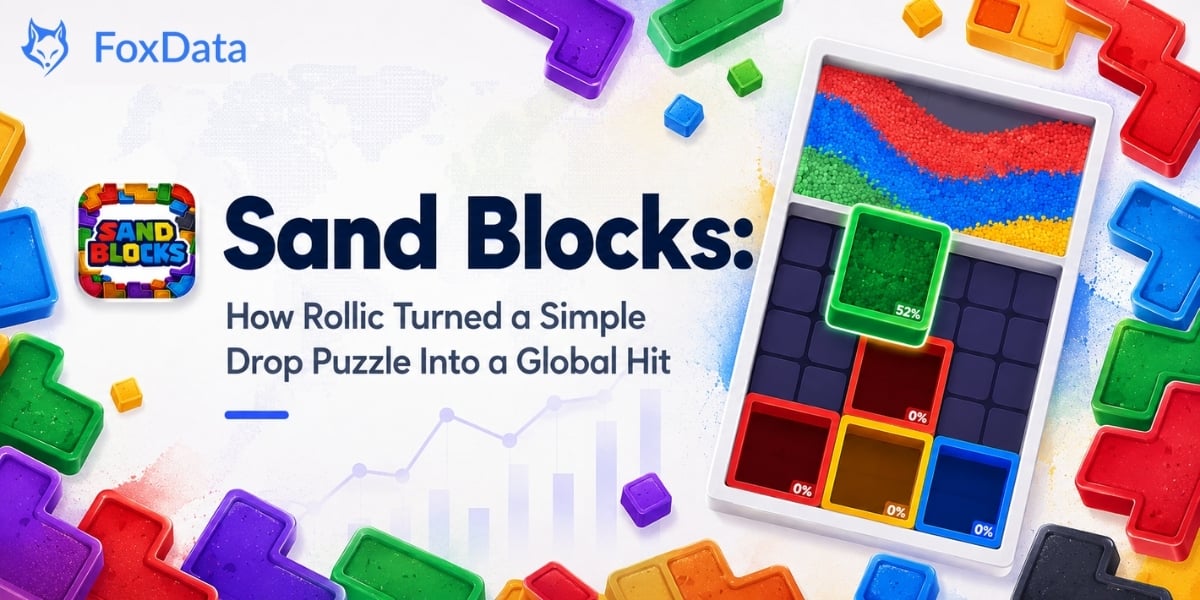
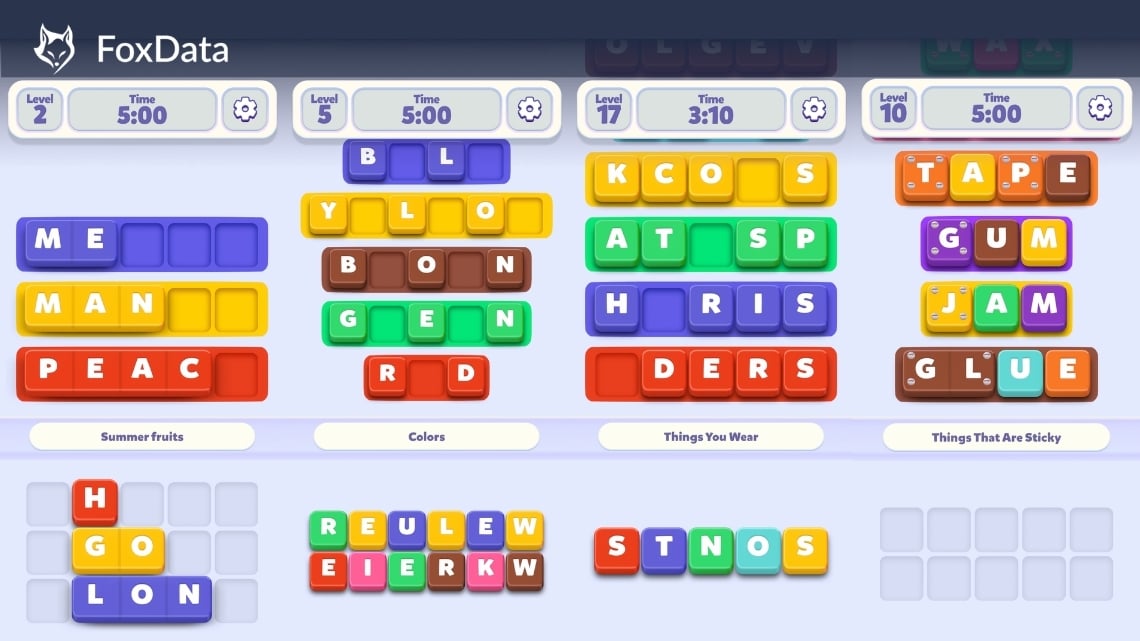
Sand Blocks: Drop Puzzle, published by Rollic Games, launched in February 2026 as a word-sorting game before pivoting to a sand physics puzzle. By August 31, it had risen to #24 on the US App Store Puzzle Free chart (up 39 places), #12 in Japan (up 9 places), and #9 in Australia (up 10 places) — all within roughly two weeks. The game now carries a 4.6-star rating on the US App Store with over 80% five-star reviews. Its trajectory illustrates how a deceptively simple visual hook, combined with rapid iteration and low-language gameplay, can cut through a block-puzzle market crowded with over 2,000 competing titles.
|
Metric |
Sand Blocks: Drop Puzzle |
|
Developer |
Rollic Games |
|
Genre |
Puzzle / Hybrid Casual |
|
Original concept |
Word-sorting puzzle (Letter Sort, v0.1.1) |
|
Current concept |
Sand physics puzzle (Sand Blocks) |
|
Platform |
iOS (App Store); Android via Google Play |
|
Core mechanic |
Pull colored sand toward matching pits using gravity-based physics; clear the board before time runs out |
|
Key markets |
United States, Japan, Australia |
|
US Puzzle Free (Aug 31, 2026) |
#24 |
|
Japan Puzzle Free (Aug 31, 2026) |
#12 |
|
Australia Puzzle Free (Aug 31, 2026) |
#9 |
|
US App Store rating |
4.6 / 5.0 (1,032 ratings; ~830 five-star) |
|
Bundle ID |
com.uncosoft.wordpuzzle (retained from original word-puzzle build) |
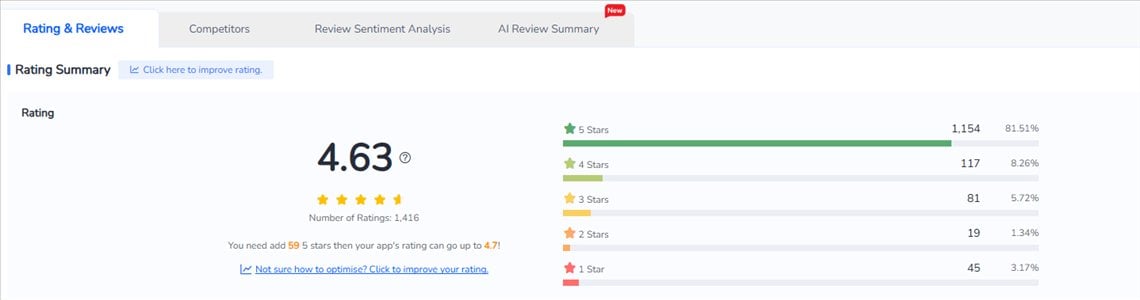
Source: FoxData's Rating & Reviews
Why it matters: A game that can communicate its core mechanic without relying heavily on language has a structural advantage when testing multiple international markets simultaneously.
At its simplest, Sand Blocks: Drop Puzzle asks players to do three things: pull the sand, fill the pits, and clear the board.
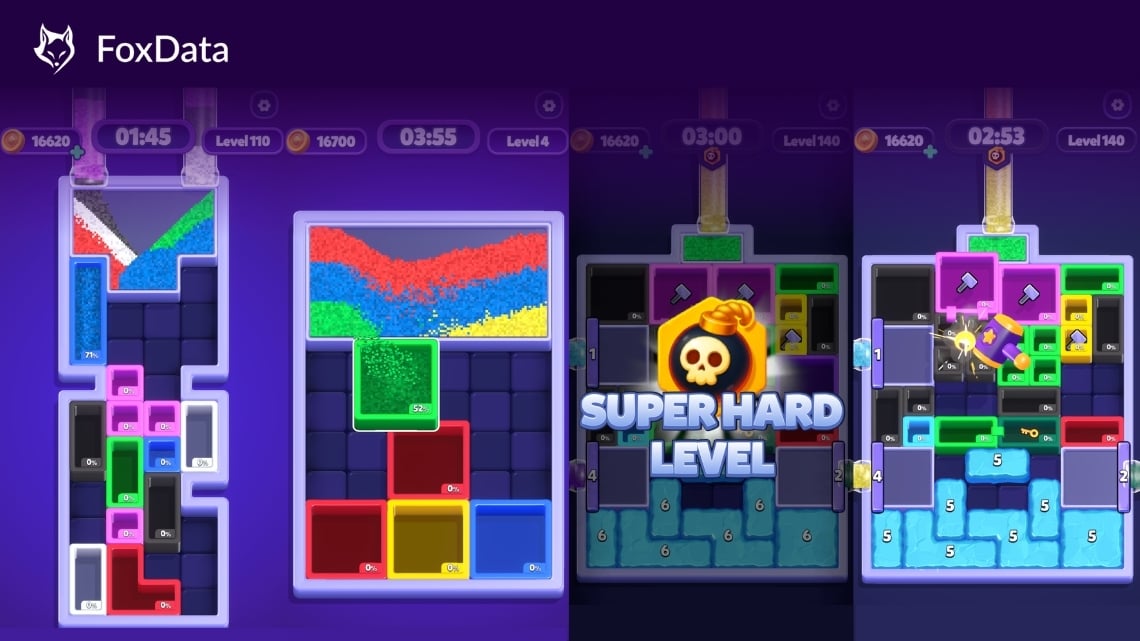
The playfield is a grid populated by colored sand blocks and Tetris-shaped empty pits. Players swipe to drag matching-colored sand toward its corresponding pit. Gravity does the rest — sand cascades, settles, and eventually fills the shape perfectly. When a pit is full, the board clears and the level advances.
The official store description frames it as a "relaxing yet strategic" experience, and that tension is deliberate. Early levels are forgiving: the player learns the pull-and-fill loop without penalty. Later levels introduce tighter time limits, more complex layouts, and multi-step sequencing where order of operations matters. The result is a puzzle that looks approachable but scales into genuine spatial reasoning.
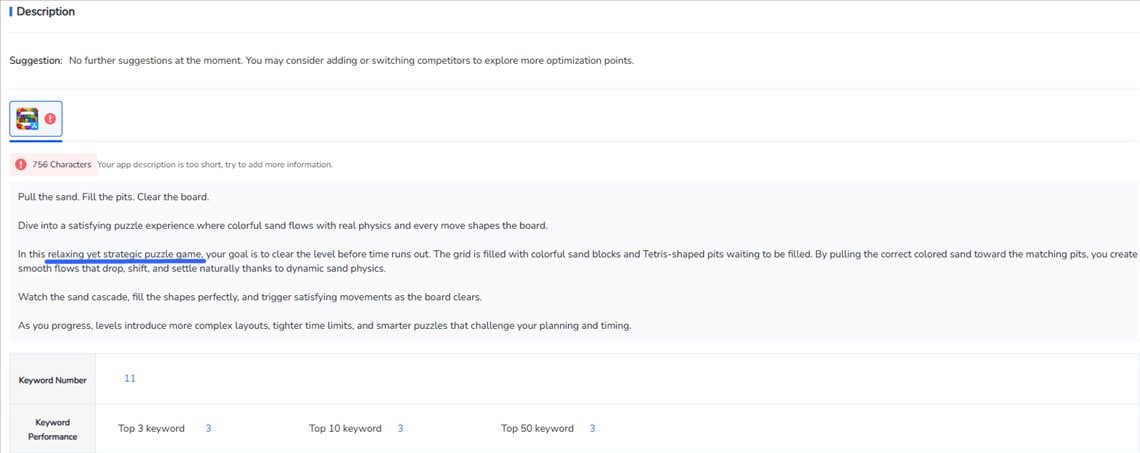
Source: FoxData - ASO Report
What makes the mechanic commercially interesting is not complexity; it is clarity. A three-second video clip of colored sand flowing into a shaped container communicates the entire premise. No tutorial text is required. No voice-over. No cultural reference. The feedback is visual, physical, and immediate.
That clarity matters because it collapses the distance between "ad impression" and "understood mechanic." In user-acquisition terms, it lowers creative fatigue and raises click-to-install conversion — provided the backend monetization and retention systems can support the influx.
Sand Blocks does not invent a new genre. Color-matching, grid-clearing, and physics-based movement are well-established puzzle conventions. What the game adds is a visual signature: flowing sand.
The player understands the objective before finishing the first level because the outcome is visible. Colored sand moves like a liquid. It piles, spills, and settles. When the final grain drops and the board wipes clean, the payoff is tactile even on a flat screen.
This gives Sand Blocks a strong creative hook precisely because the outcome is visually obvious even before the player understands the full puzzle system. A viewer scrolling through a social feed sees sand moving, a shape filling, and a satisfying clearance animation. The loop sells itself.
Hybrid-casual games live or die by their ability to convert installs into sessions, and sessions into revenue. The genre borrows from hyper-casual's low-friction onboarding and mid-core's depth of progression. Sand Blocks sits at this intersection.
The input → reaction → reward loop is tight:
1. Input: Swipe to pull sand.
Each step produces visible, audible, and haptic feedback. The mechanic gives the game a strong creative hook because the outcome is visually obvious even before the player understands the full puzzle system. That immediacy helps with both organic shareability and paid creative performance.
Whether this satisfaction layer directly caused August's ranking surge is harder to prove. But it is fair to say that without a demonstrable hook, a game in a 2,000-title subcategory would struggle to generate the install velocity needed to reach #29 in the US, #21 in Japan, or #17 in Australia.

August 2026 was the inflection month. According to FoxData, Sand Blocks began climbing in all three markets within days of one another. The simultaneity is notable: this was not a staged regional rollout. It looked more like a global pulse triggered by a single event — likely a coordinated marketing push, creative test win, or algorithmic feature moment.
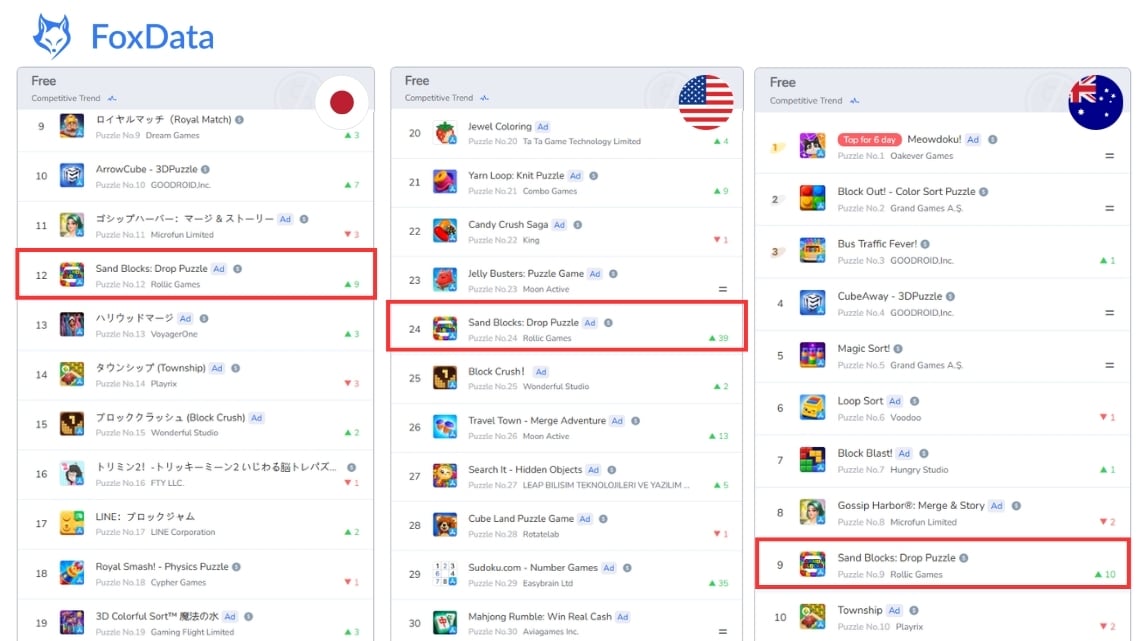
Source: FoxData Top Charts, Puzzle Games Category | August 31, 2026
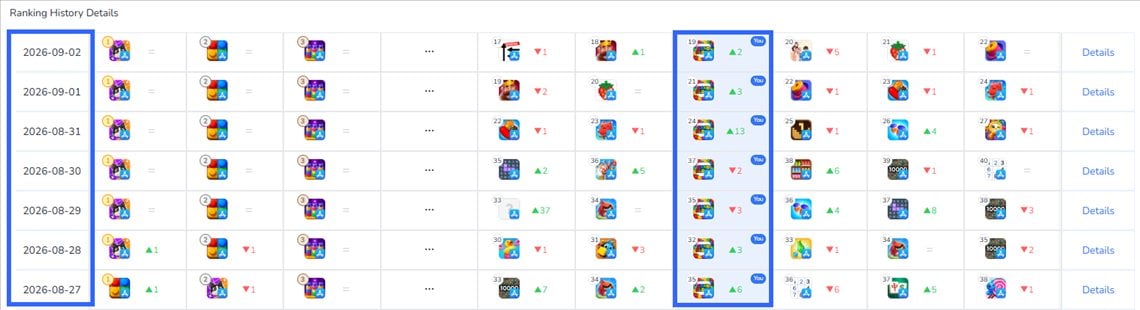
On August 3, Sand Blocks entered the US App Store Puzzle Free chart at #104. By August 27, it had reached #29, and by August 31 it stood at #24 — a climb of 80 positions in under four weeks.
The US is the world's largest mobile gaming market by revenue, and its puzzle category is among the most competitive. Breaking into the top 30 there signals mainstream appeal, not niche success. For a six-month-old title that started life as a word game, the trajectory suggests either strong paid acquisition, favorable organic discovery, or both working in tandem.
What the ranking also reveals is scalability. A game that can sustain top-30 placement in the US puzzle chart is typically pulling enough daily installs to justify continued UA spend. The fact that Rollic kept pushing updates through August (three versions in one month) implies the team saw enough retention or monetization signal to double down.
Japan's trajectory was even steeper. On August 1, Sand Blocks sat at #221 on the Japanese App Store Puzzle Free chart. Within roughly two weeks, it had touched #21, and by August 31 it held #12 — a climb of more than 200 positions.
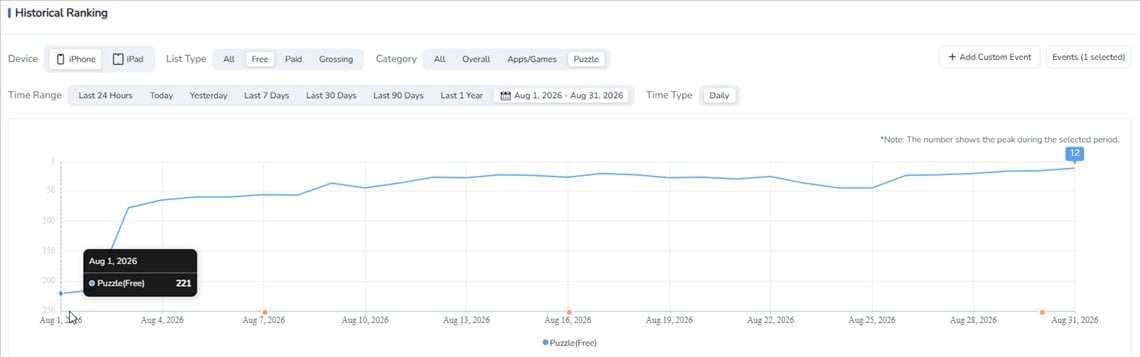
Source: FoxData's Historical Ranking
Japan's mobile puzzle market is dense with domestic and international competition. Success there usually requires either deep localization or mechanics that transcend language entirely. Sand Blocks falls into the second camp. The core action — pull sand, fill shape — requires no reading comprehension. Store metadata and tutorials can remain minimal.
The speed of the climb also hints at efficient creative performance. In Japan, where CPIs can run high for Western titles, a rapid ascent often means the game's video ads are resonating. Again, the visual demonstrability of sand flow plays to this advantage.
Australia is a smaller market by volume, but it serves a strategic role: early Western-market validation. On August 27, Sand Blocks peaked at #17 on Australia's Puzzle Free chart, and by August 31 it had reached #9.
Australia shares demographic and behavioral overlap with the US, UK, and Canada, yet it is less saturated with blockbuster UA budgets. A strong showing there can function as a leading indicator of broader English-market traction before the cost of scaling to the US escalates.
In Sand Blocks' case, the Australian peak coincided closely with the US and Japanese surges. This suggests the August push was global rather than region-specific, and that Australia may have served as a lower-cost proving ground that validated the campaign before larger bets were placed.
Why it matters: A game can look average globally while showing strong early signals in individual countries. Publishers who monitor only aggregate download numbers risk missing breakout momentum until it is already expensive to buy.
Four factors explain why this particular sand puzzle gained traction when hundreds of similar-looking titles did not.
Players grasp the goal in one screenshot. There is no lore, no control scheme to memorize, and no meta-layer to decode first. This reduces drop-off in the first minute — the most expensive minute in mobile gaming.
The sand itself is the reward. Every successful move produces motion, color contrast, and a clearing animation. The brain processes it as a micro-completion before the level is even finished. That dopamine pacing keeps session lengths up and retry rates high.
Rollic structured the difficulty curve so that the first ten levels teach through play, not text. Only after the player is comfortable does the game introduce timers, limited moves, and multi-pit coordination. This "light front door, deeper house" design is a hallmark of successful hybrid-casual products.
Sand Blocks did not emerge in isolation. Rollic's portfolio includes Screw Jam, Color Block Jam (60 million players, 3 million DAU), Knit Out, and Crowd Express. The studio occupied four slots in Q3 2025's hybrid-casual top-ten rankings.
That track record matters. Other developers can clone a sand mechanic; they cannot clone Rollic's speed of iteration, its data infrastructure, or its relationship with platform algorithms built over dozens of previous launches. Sand Blocks benefits from being the latest output of a repeatable hybrid-casual production system, not a lucky one-off.
Sand Blocks is one example of a broader direction in 2026 mobile development: familiar mechanics packaged in unfamiliar visuals.
The underlying puzzle logic — match color, fill space, clear board — has existed for years. The sand wrapper makes it feel novel without adding cognitive load. This matters because:
For publishers, this suggests that innovation in 2026 does not always mean inventing new rules. Sometimes it means finding a new way to show old rules.
The case reflects a broader direction in which hybrid-casual games increasingly rely on strong meta or retention layers to differentiate. The front-end mechanic gets the install; the back-end progression, events, and economy get the revenue. Sand Blocks' August update cadence — three releases in four weeks — shows Rollic treating depth as a live priority, not a post-launch luxury.
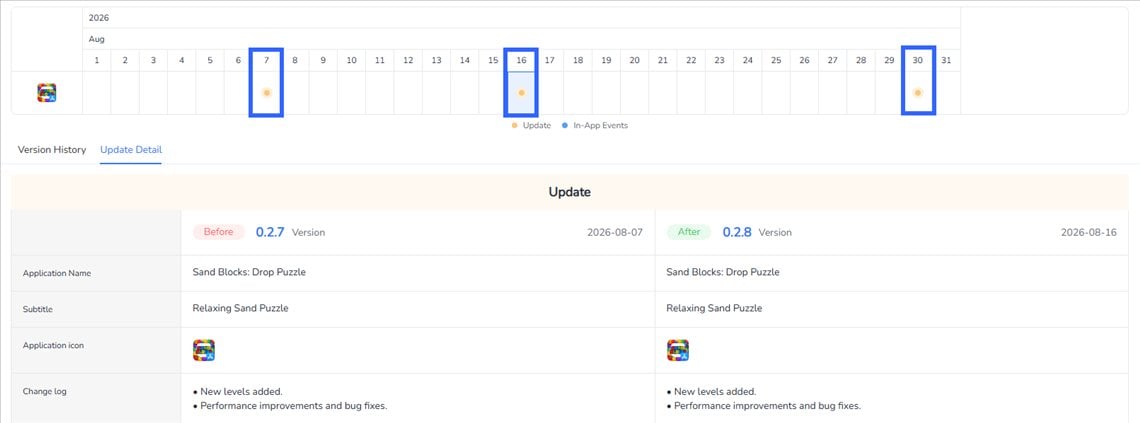
Source: FoxData's App Version Analysis
Rollic's original build was a word puzzle. When retention or conversion did not meet thresholds, the team swapped the core mechanic rather than abandoning the product shell. The bundle ID (com.uncosoft.wordpuzzle) still whispers that history. Publishers should validate:
...before committing to a global UA budget.
If your core loop cannot be understood in a three-second silent video, you are paying a creative tax every time you run ads. Sand Blocks passes this test effortlessly. Publishers should ask during prototyping: "Would a viewer scrolling Instagram understand what to do without sound?"
A game can look average globally while showing strong early signals in individual countries. Sand Blocks' simultaneous rise in the US, Japan, and Australia was only visible if you were tracking each market separately. Aggregate dashboards hide these patterns. Publishers should monitor:
Breakout hits are obvious in hindsight. The real alpha is identifying them before they break out. That means systematically monitoring:
This is where continuous market intelligence becomes a competitive weapon rather than a reporting chore.
Spotting a game like Sand Blocks early requires more than occasional manual checks. Publishers need systematic visibility into download momentum, ranking velocity, and competitive whitespace.
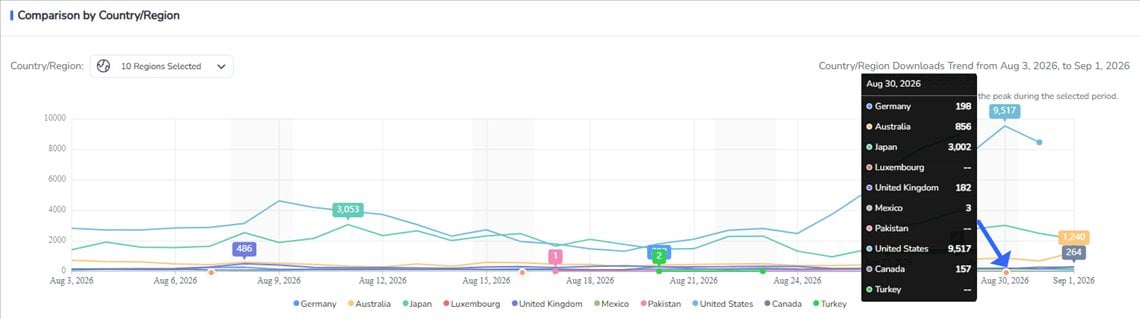
FoxData provides estimated downloads and revenue histories for individual apps, allowing teams to spot inflection points before they become industry news. A sudden spike in daily downloads — especially when paired with a rating surge — often precedes chart movement by days or weeks.
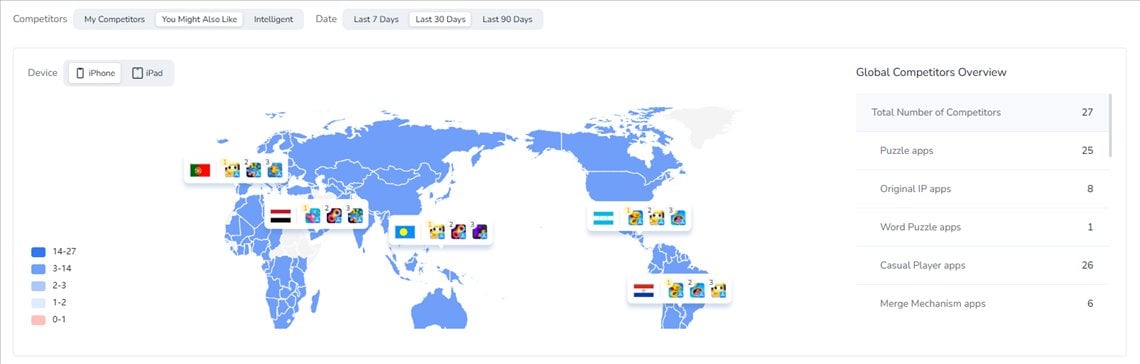
With over 2,000 active titles in the block-puzzle space alone, knowing who is rising and who is fading is essential. FoxData competitor analysis lets publishers compare direct rivals side-by-side across downloads, revenue, rankings, and keyword coverage.
Category rankings and country-level positions update continuously. FoxData's Category Ranking tracks these movements over time, making it possible to correlate version releases, marketing pushes, or algorithm changes with chart performance.
Market-level data surfaces rising games, growing categories, and promising countries that might otherwise go unnoticed. A publisher studying Japan's puzzle category in early August, for instance, could have spotted Sand Blocks at #221 and tracked its climb to #8 — gaining actionable intelligence while competitors were still looking at global averages.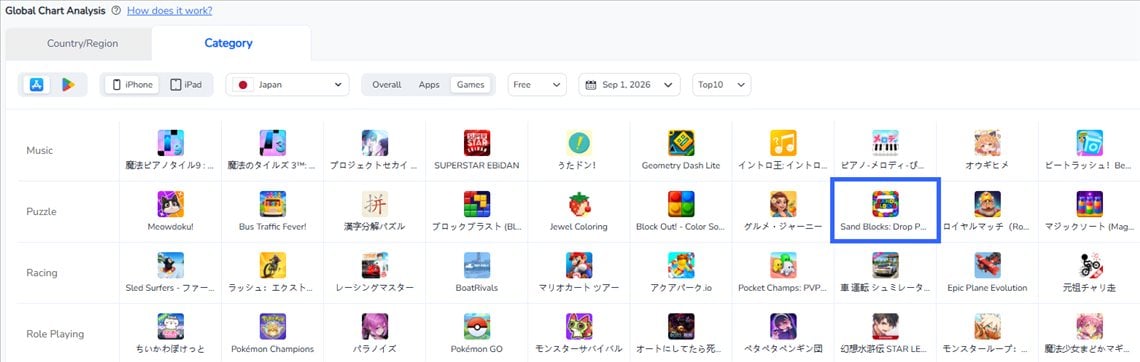
🎮 Want to see which mobile games are gaining traction in different markets? Explore FoxData's Mobile Game Analytics.
For one game, checking rankings manually is manageable. For hundreds of titles across dozens of markets, it quickly becomes a data-engineering problem.
FoxData App Data API provides programmatic access to app and game intelligence, including:
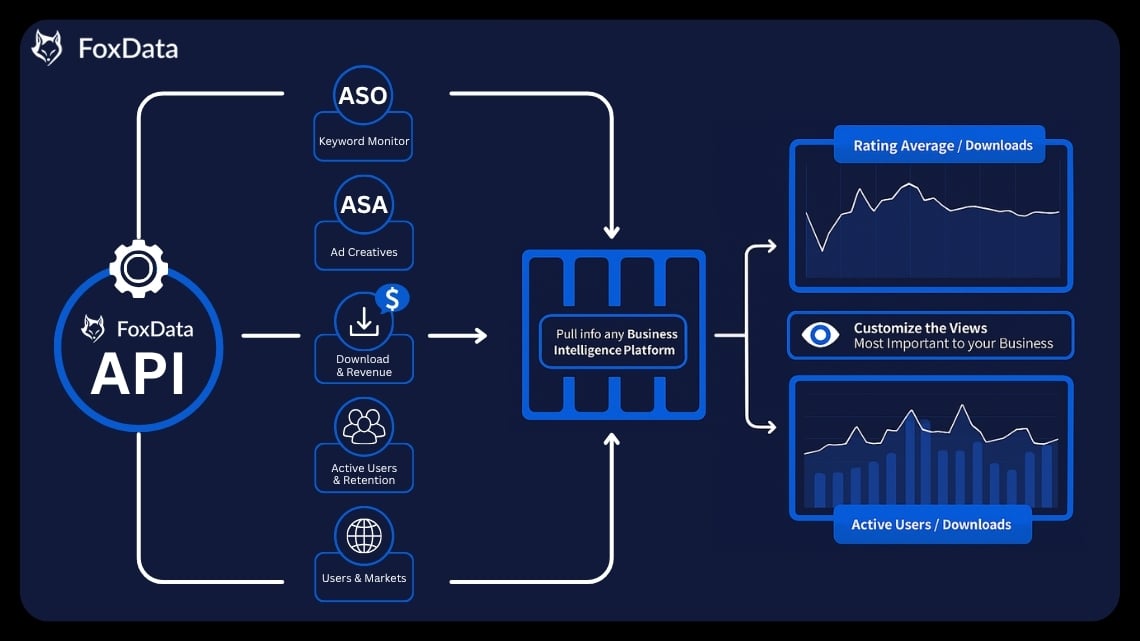
The API supports integration with BI systems, CRM platforms, analytics stacks, and data warehouses. Customizable calls and scalable extraction mean teams can automate the workflows described above rather than running them manually.
|
Team |
Use Case |
|
Game Publishers |
Build internal market-intelligence dashboards that feed into greenlight and kill decisions. |
|
UA Teams |
Automate competitor and market monitoring; trigger spend adjustments when rival games rise or fall. |
|
Data / BI Teams |
Pull app data directly into internal data warehouses for custom modeling and forecasting. |
|
Investment / Research |
Monitor game performance across countries and categories to identify M&A or publishing targets. |
|
App Intelligence Platforms |
Power third-party analytics products with structured, normalized mobile app data. |
Discover → Validate → Monitor → Automate → Scale
1. Discover a fast-rising puzzle game via market scan.
🔍 Need mobile game data at scale? Explore FoxData App Data API and build app intelligence directly into your BI, analytics, or data warehouse.
Sand Blocks is a useful reminder that breakout games do not always start with complicated mechanics. Sometimes the winning combination is a familiar loop, a distinctive visual hook, and the right market signal at the right time.
The more interesting signal is how Rollic got there. The company did not bet everything on a word-puzzle concept and hope. It launched, measured, pivoted, iterated, and then scaled — all within six months. The bundle ID still says wordpuzzle, but the product underneath is something else entirely. That willingness to rebuild rather than patch is what separates studios that occasionally hit from studios that systematically hit.
For the wider industry, Sand Blocks' trajectory illustrates that hybrid-casual success in 2026 is increasingly about the intersection of product, creative, and data:
The challenge for publishers is spotting that signal early. The ones who do will find themselves ahead of the curve. The ones who do not will read about it later.
Ready to turn mobile game market signals into your next growth decision?
👉 Start your free trial with FoxData.
Sand Blocks: Drop Puzzle is a mobile puzzle game published by Rollic Games. Players swipe to pull colored sand toward matching-shaped pits, using physics-based movement to fill containers and clear the board. It is available on iOS and Android.
The game was developed and published by Rollic Games, a Turkish mobile studio known for hybrid-casual hits including Screw Jam, Color Block Jam, and Knit Out.
Several factors contributed: a visually distinctive sand-physics mechanic that is instantly understandable; strong creative performance in video ads; rapid post-launch iteration (three updates in August 2026); and Rollic's established hybrid-casual production expertise. The game also benefited from launching in a period where language-minimal puzzles could scale globally with limited localization.
According to FoxData Category Ranking, as of August 31, 2026, the game reached #24 on the US App Store Puzzle Free chart, #12 in Japan, and #9 in Australia. All three peaks occurred within roughly two weeks, suggesting a coordinated global push rather than a staggered regional rollout.
Key lessons include: validate mechanics with real users before scaling; design for silent, three-second creative comprehension; monitor country-level rankings rather than just global totals; treat ASO and UA as a unified system; and build repeatable production pipelines rather than betting on single titles.
FoxData provides estimated downloads, historical rankings, and competitor benchmarks for individual apps across multiple countries and stores. Teams can use the web dashboard for spot research or the FoxData API for automated, large-scale monitoring.
Yes. FoxData App Data API offers programmatic access to app metadata, ranking history, download and revenue estimates, keyword intelligence, and release monitoring. It supports integration with BI tools, CRM systems, and data warehouses. A free tier with 10,000 API calls per month is available. Learn more at Enterprise Data Solutions - App Store Data API.
📣 Don't Miss These:
© 2020-2026 FoxData. All Rights Reserved.