




Explore More Possibilities for Your Business
Full-cycle scenario construction to meet your needs from App research, development, and release to operation.
Ready for your soaring growth
Short answer: Cyber Week on the App Store follows five patterns you can check in your own data today. Deal-intent demand is concentrated in a few head terms ("black friday" scores 56 popularity in the US, "black friday deals" only 25). Category charts tend to peak before Black Friday, not on it. Cyber Monday (November 30 this year) is a real second wave. The lift reaches every category, not just shopping. And the week after Cyber Monday (Dec 1–7) decides who keeps the gains. Today is Black Friday, so there is still time to act on weekend and Cyber Monday checks.
Written during Cyber Week 2026 (updated November 27). Everything below comes from FoxData's live keyword data and last year's archived chart moves, so you can compare it with your own app this week. The deal is on our side too: the FoxData Black Friday offer runs until December 7, and there's a short section on it near the end.
Most Cyber Week content tells you what to do before Black Friday. This one is written during the week itself, about what to watch while the window is open. Five patterns; each has what the data shows and one action you can still take.
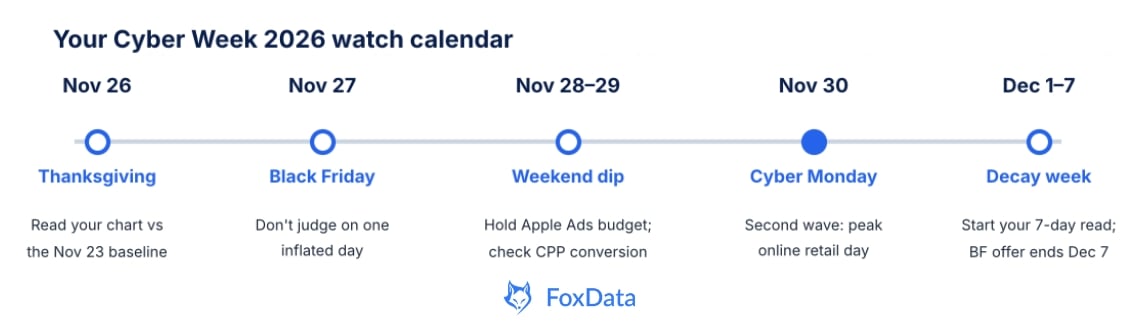
Cyber Week 2026 watch calendar: Thanksgiving Nov 26, Black Friday Nov 27, weekend Nov 28–29, Cyber Monday Nov 30, decay week Dec 1–7
The web instinct is to chase "black friday deals," "holiday deals" and a dozen modifier phrases. The App Store index doesn't spread demand that way. Here's the live snapshot from FoxData's Keyword Trends (US App Store, iPhone, November 20–26, 2026):
|
Keyword |
Popularity (Nov 20–26, 2026) |
Read |
|
black friday |
56 |
The head term carries the demand |
|
christmas |
54–55 |
Already climbing — holiday wave overlapping |
|
black friday deals |
25 |
The web's favorite phrase is thin in app search |
|
holiday deals |
5 |
Negligible |
|
cyber monday |
5 |
Pre-event — see Pattern 3 |
|
photo editor (baseline) |
69–70 |
Non-seasonal reference |
|
meditation (baseline) |
53 |
Non-seasonal reference |
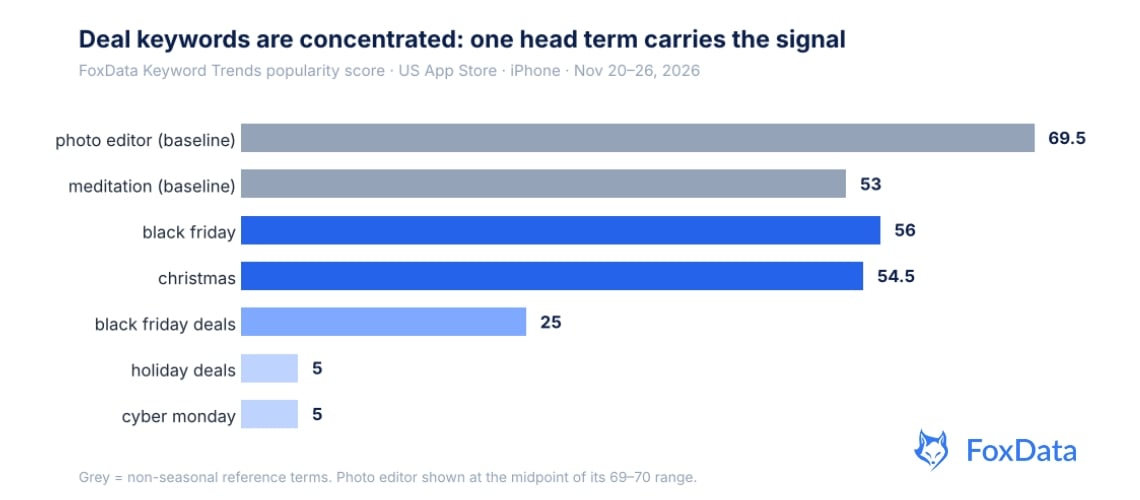
Bar chart of US App Store keyword popularity: black friday 56, christmas 54-55, black friday deals 25, holiday deals 5, cyber monday 5
Two conclusions follow. First, deal-season demand is concentrated: the singular head term holds more than double the popularity of its "deals" long-tail, and phrases like "holiday deals" are barely searchable. Second, even the head seasonal terms score below strong evergreen terms in your category ("photo editor" sits at 69–70 year-round). So don't rebuild your metadata around one seasonal term. Keep the proven head keywords and add one deal-adjacent modifier only where it genuinely fits.
A note on reading this number. Popularity in FoxData is an index that reflects how heavily advertisers are bidding on a keyword in Apple Ads, so treat it as a strong demand signal and not as a raw search count. For a sanity check on real volume, open the same keyword in Keyword Explore and compare Search Volume and Max. Reach side by side.
This week's action: before spending any character count on deal terms, check popularity per storefront in Keyword Trends. In most categories, "black friday" belongs in your Promotional Text, an In-App Event and Apple Ads keyword tests, not in the 100-character keyword field. Promotional Text can be changed without shipping a new version, which is what a three-day window needs.
🖤 Check your category's deal keywords in under five minutes
Open Keyword Trends and Keyword Explore, compare "black friday" with your evergreen head terms, and see which storefronts are actually moving. Start with a free account, then begin the 7-day free trial: payment details are entered when the trial starts, nothing is charged until the trial ends, and you can cancel anytime.
Here is what the Cyber Week window looked like on a major shopping app. Amazon Shopping (id 297606951), US App Store, archived daily ranks from FoxData's Top Charts:
|
Date (2025) |
Shopping, Free rank |
All apps, Free rank |
Note |
|
Nov 15 |
#28 |
#33 |
Baseline week |
|
Nov 24 (Mon) |
#12 |
#16 |
Best rank of the window — four days before Black Friday (Nov 28) |
|
Nov 27 (Thanksgiving) |
#21 |
#28 |
Rank loosened on Thanksgiving Day |
|
Nov 30 (Sun) |
#16 |
#22 |
Weekend wave |
|
Dec 1 (Cyber Monday) |
#14 |
#18 |
Cyber Monday re-climb |
|
Dec 5 |
#25 |
#30 |
Post-sale decay |
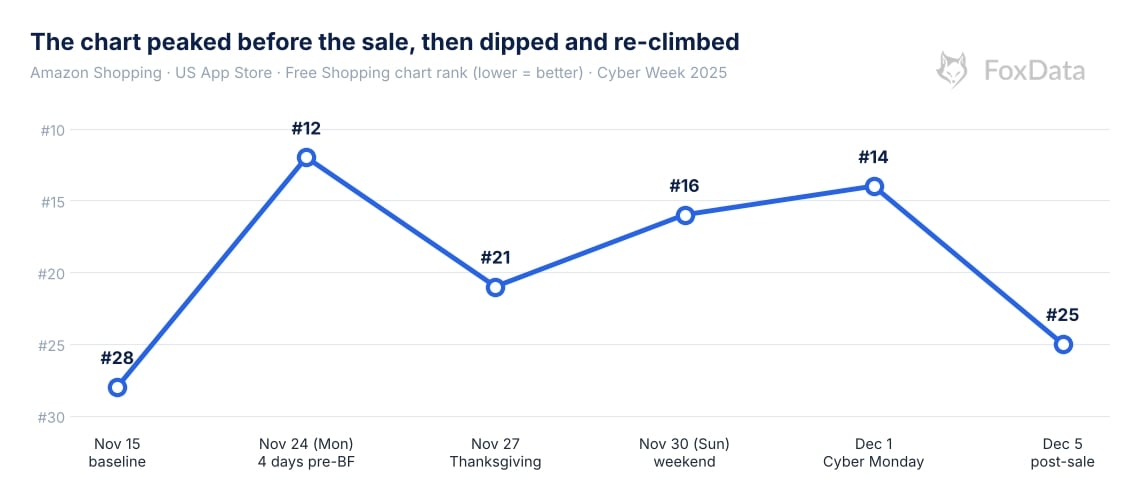
Line chart of Amazon Shopping US Shopping chart rank during Cyber Week 2025: #28, #12, #21, #16, #14, #25
The pattern repeats across categories every year: the strongest chart position of Cyber Week often lands in the days before Black Friday, as early-deal traffic ramps. Amazon's Shopping-chart best of #12 arrived on Monday, November 24, 2025, four days before the sale, and by Thanksgiving Day it sat nine positions lower, at #21. The 2026 equivalent of that Monday was November 23.
Why might this happen? One plausible reading: early-deal traffic arrives first, and once the sale opens, rivals push installs too, so the same volume buys a worse position. Treat that as a hypothesis, not a rule. This is a single app in a single category, and yours may peak on a different day.
This week's action: open your category's free chart now and compare today's rank with Monday's. If you climbed into Wednesday, your promotion is landing and the job is to hold it through the weekend. If you were flat, a Friday-only push won't fix it, but a Cyber Monday re-push might (next pattern). FoxData's Top Charts let you set the category and storefront and read the movement daily.
Two data points frame this. On the retail side, US online spending on Cyber Monday 2025 reached $14.25 billion, ahead of Black Friday's $11.8 billion. For 2026, forecasts put Cyber Monday (November 30) above $15 billion again, with Black Friday growing faster (about 9% vs 6%). On the advertising side, shopping-category ad spend on Cyber Monday edged past Black Friday for the first time in 2024, by a very thin margin. The takeaway isn't that Cyber Monday "wins"; it's that the two days now behave like one event with two peaks.
App Store data agrees. On November 20–26, "cyber monday" scored just 5 popularity, because the wave hasn't broken yet. Amazon's chart tells the same story from the rank side: after easing to #21 on Thanksgiving Day, it re-climbed to #14 on Cyber Monday (Dec 1, 2025). The demand arrives twice.
This week's action: do not shut down Apple Ads budgets on November 28. Hold budget through Cyber Monday (Nov 30) and Tuesday, then compare cost per tap and cost per install with your Nov 23 baseline before setting December pacing. Teams that pause at Friday's close leave the second peak to whoever stays in the auction. Use ASA Data Analytics to see which competitors are still bidding on your keywords over the weekend.
🖤 Keep your Apple Ads budget working through Cyber Monday
See which apps are bidding on your keywords, what changed over the weekend, and where a Cyber Monday push is cheapest. Pro includes ASA Keywords and the CPP Explorer; the Black Friday offer takes 35% off your first paid period until December 7. See the plans and the Black Friday price →
It's tempting to read Cyber Week as a shopping-chart story. It isn't. Apple Ads states that 70% of App Store visitors use search to discover apps, and during Cyber Week the search intent running through the store is "deal," in every category: games run holiday events, subscription apps push annual-plan promos, utilities ride gifting traffic.
The handoff is already visible in the keyword data: while "black friday" holds the Cyber Week window, "christmas" was already at 54–55 popularity on November 20–26. For a subscription or utility app, that means your November promo and your December season are two different campaigns sharing one listing.
This week's action: keep prices and discount wording out of your app name, subtitle, screenshots and preview videos. Apple's App Review Guidelines (2.3.7) say metadata like these should not include prices or terms that aren't specific to that metadata type, and reviewers treat "free" or "discounted" as price references. Put the deal in the places built for it: Promotional Text, In-App Events and in-app offers. Use Custom Product Pages for the theme (gifting, new-year plans, a feature people want over the holidays) and not the price. Then chain the plan: Cyber Week messaging through Dec 1, holiday messaging from Dec 2, each tied to its own keywords.
Look at the last rows of the Amazon table again: #12 on November 24 → #25 on December 5. That's eleven days. The post-sale decay is real, fast and unsentimental. Install velocity drops, rank follows within days, and every position ceded in early December becomes a January re-acquisition problem.
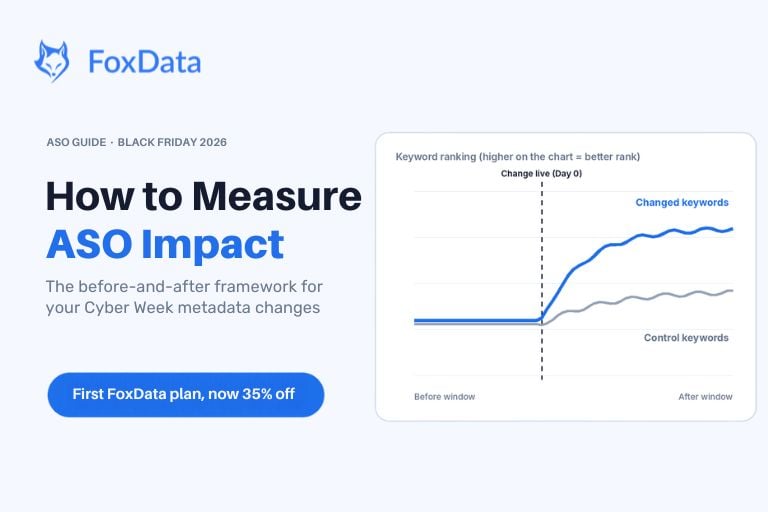
This is where measurement turns into money. Mark the change dates now (promo metadata, screenshot swaps, CPP launches) and read them at 7, 28 and 90 days. For Cyber Week specifically, one read matters most: how much of your sale-week rank survived the first quiet week of December? What survives is your new baseline; what decayed was seasonal rent. The full method is in How to Measure ASO Impact.
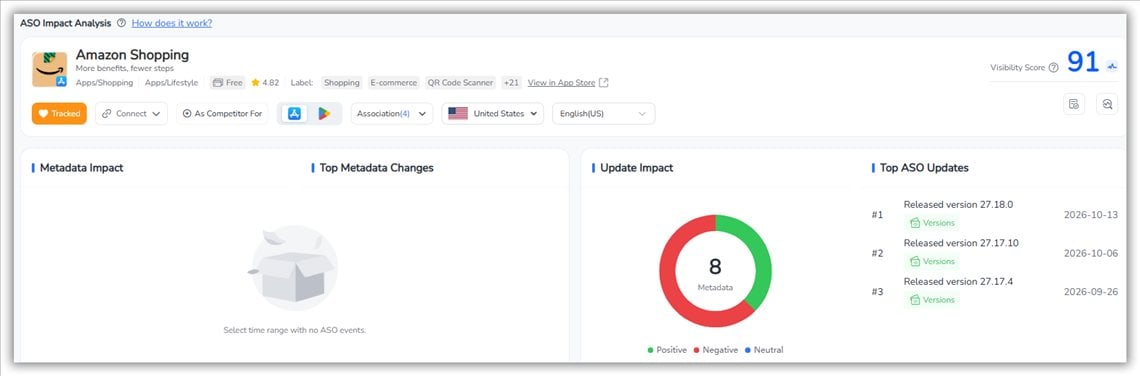
This week's action: in FoxData, mark your Cyber Week change dates in ASO Impact Analysis today, before the numbers arrive, so your December report shows cause and effect. For changes made November 27–30, your Day-7 read lands December 4–7 and your Day-28 read December 25–28.
|
Date |
What to watch |
Action |
|
Nov 24–25 |
Category free charts: the pre-sale climb (already passed) |
Compare today's rank with your Nov 23 baseline |
|
Nov 26 (Thanksgiving) |
Rank on the deal-opening day |
Hold what you climbed; no rebuilds today |
|
Nov 27 (BF) |
Deal-day competitiveness; watch Apple Ads CPC swings |
Don't judge the campaign on one inflated day |
|
Nov 28–29 |
The dip between waves |
Hold Apple Ads budgets; check CPP conversion while traffic is high |
|
Nov 30 (CM) |
Second-wave demand; re-climbing ranks |
The biggest online shopping day of the week; stay in the auction |
|
Dec 1–7 |
Decay curve begins |
Mark event dates; start the 7-day read of your changes |
|
Dec 25–28 |
Day-28 read |
The December report: what held, what was seasonal rent |
The Amazon chart is one app in one category in one year, so use it to know what to look for, not as a forecast. Popularity is an index that reflects Apple Ads bidding activity, and it moves day to day. We'll update this page when December's data is in. If your category behaves differently, that is useful information too, and it's exactly what the charts above are for.
If you're reading this to decide whether to act on it: the FoxData Black Friday offer is live until December 7 at 07:00 UTC. New subscribers get 35% off their first paid period on Standard, Growth and Pro, on monthly, quarterly or yearly billing. Starter is excluded and keeps its everyday pricing. Returning subscribers get 25% off one annual Growth or Pro purchase. The offer applies to the first paid period only, and renewals follow the regular price.
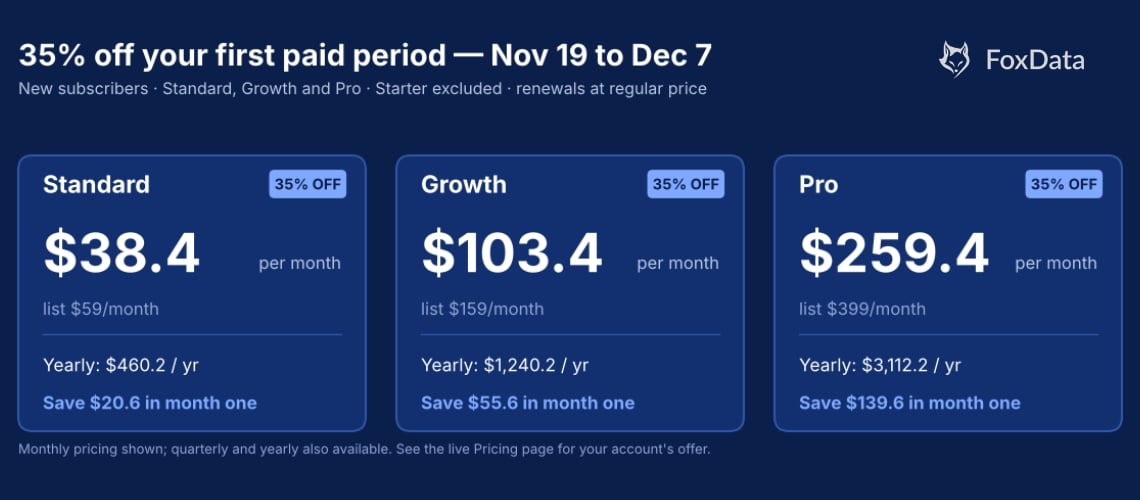
FoxData Black Friday 2026 savings: Standard $38.4, Growth $103.4, Pro $259.4 per month for the first paid period
The safe order: create a free account, start the 7-day free trial (payment details are entered when the trial starts; nothing is charged until the trial ends, and you can cancel anytime), run the five checks above on your own app, then pick the plan while the offer is still open. A trial started by November 29 finishes before the offer closes on December 7. Offer details and eligibility are in the Black Friday offer guide and the plan comparison.
🖤 Start the free trial now, choose your plan before December 7
Run this article's five checks on your own app first. If the data is useful, the Black Friday price is still there when your trial ends.
Start the 7-day free trial → · See the Black Friday prices →
Cyber Monday 2026 is Monday, November 30, three days after Black Friday (November 27). Hold Apple Ads budgets through that Monday and re-read costs on Tuesday.
Only where search demand actually exists. "Black friday" carried 56 popularity in the US App Store, but "black friday deals" scored 25 and "holiday deals" 5. Test the head term in Promotional Text, In-App Events and Apple Ads, and keep most long-tail deal phrases out of the keyword field.
In last year's Amazon Shopping example, the best free-chart rank of the window (#12) landed on Monday, November 24, four days before Black Friday, with a second climb on Cyber Monday. Watch the chart Monday through Wednesday of Thanksgiving week, not just on the sale day.
No. Cyber Monday is still the biggest online shopping day of the week, and the two days now work like one event with two peaks. Hold budgets through Cyber Monday, then re-read costs against your pre-sale baseline.
It's risky. Apple's guideline 2.3.7 says metadata such as screenshots and previews should not include prices or terms not specific to that item, and discounted-price wording has been flagged in review. Use Promotional Text and In-App Events for deal messaging.
Fast. Amazon Shopping went from #12 (Nov 24) to #25 (Dec 5) in the US Shopping chart as deal-week traffic unwound. Defend what you gain with install velocity: updated creatives, retention offers and a clear holiday follow-up.
Mark the change dates before results arrive, compare changed keywords against untouched control keywords, and read at 7, 28 and 90 days. ASO Impact Analysis in FoxData logs each change against rank and install movement.
New subscribers get 35% off the first paid period on Standard, Growth and Pro until December 7 (07:00 UTC). Starter is excluded. Returning subscribers get 25% off one annual Growth or Pro purchase. It can't be combined with other codes.
© 2020-2026 FoxData. All Rights Reserved.