




Explore More Possibilities for Your Business
Full-cycle scenario construction to meet your needs from App research, development, and release to operation.
Ready for your soaring growth
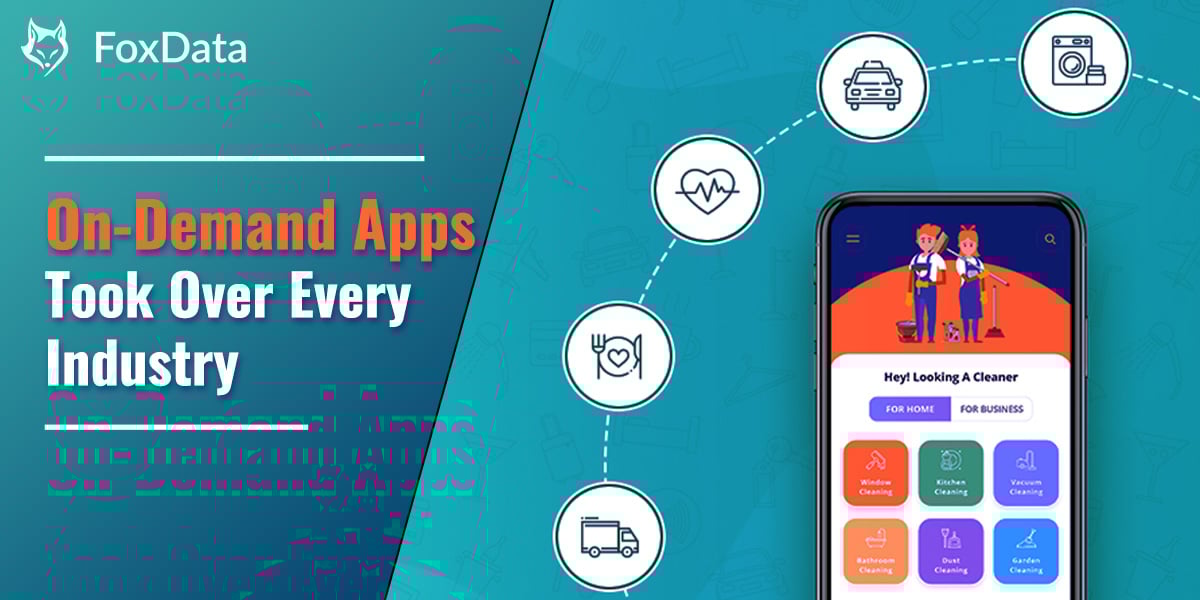
A few years ago, waiting 30 minutes for food delivery or a taxi felt normal.
Now, five minutes feels too long.
That shift — from “okay to wait” to “need it now” — defines today’s global on-demand economy. Behind the convenience users love, developers are under mounting pressure: how to keep apps fast, scalable, and profitable when user patience keeps shrinking.
Building an app isn’t the challenge anymore.
Building one that stays relevant and profitable is.
That’s where FoxData comes in — helping developers, founders, and product teams see market shifts in real time, uncover what users expect next, and make data-driven decisions that directly improve growth metrics.
Technology has hardwired users for instant gratification. As a result, on-demand platforms have redefined how people eat, move, shop, and connect.
“Instant” is no longer a feature — it’s the default. And as expectations grow, more verticals — from fitness to finance — are joining the on-demand wave.
For developers, this evolution is a double-edged sword: more opportunity, but also more pressure to meet rising demand faster than competitors — while staying profitable.
With FoxData, you can see that pressure quantified: which markets are surging, where competitors are slipping, and what features actually drive engagement.
An on-demand app connects customers and service providers in real time, removing friction from traditional offline experiences. Think Uber, Zomato, or Airbnb — they’ve made “now” the new normal.
But beneath every smooth order or instant booking lies a complex network of decisions: logistics, pricing, and personalization.
When one of these cracks, retention drops — and developers often realize too late.
That’s why leading teams use FoxData to constantly monitor user retention, competitor updates, and feature-level performance — long before the numbers start slipping.
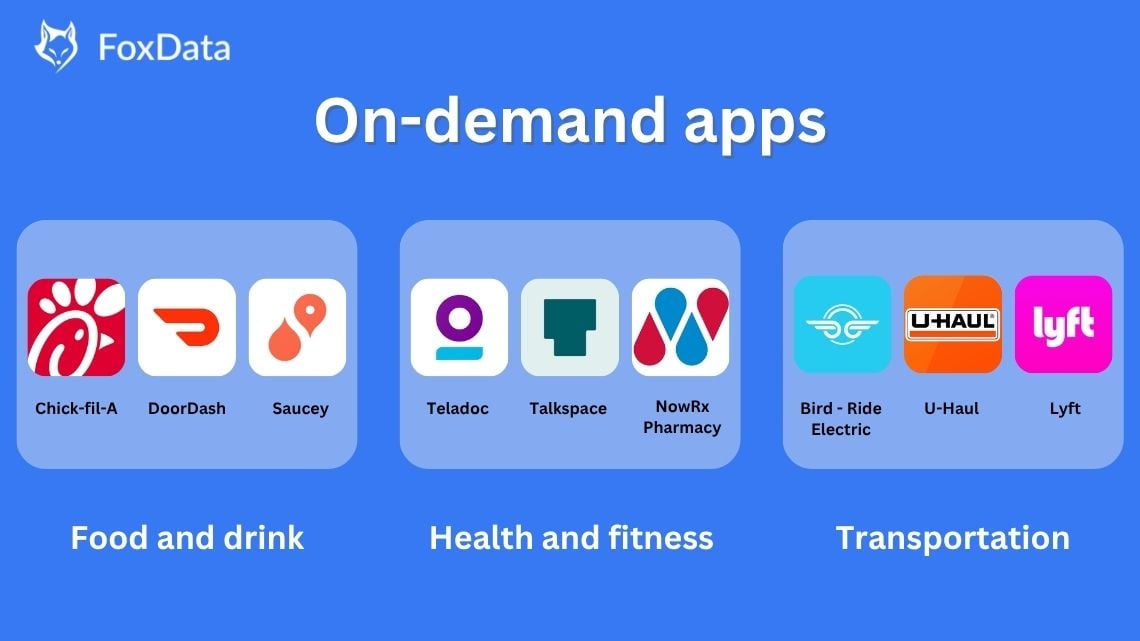
While every on-demand app has its unique model, the foundation is similar — a cycle of request, match, deliver, and refine.
Here’s how most successful apps operate:
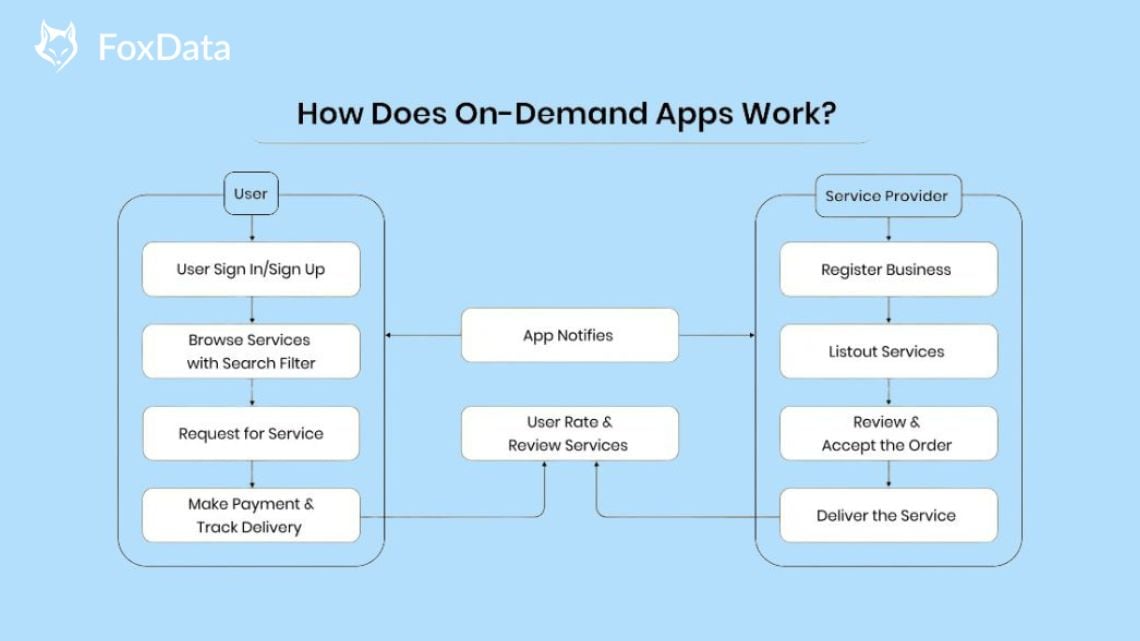
This loop fuels the global on-demand economy — one driven by data, responsiveness, and user experience. And through analyzing this data, FoxData reveals how leading teams sustain growth under intense competition.
When engagement drops — installs, sessions, or purchases — teams usually start guessing.
Marketing blames ads. Product blames the UI. Operations blames the latest patch.
By the time the root cause is found, revenue is already hit.
A food delivery startup wakes up to find daily active users down by 20%. Marketing blames reduced ads. Product blames app speed. Operations blames the new dispatch algorithm. Everyone’s guessing — and decisions stall.
FoxData’s Impact Analysis lets teams visualize exactly how and when specific events — version updates, UI changes, or pricing adjustments — influence downloads, retention, and engagement. By combining Event Timeline, Estimated Downloads, and App Data Details, teams can pinpoint the exact version or update where user behavior shifts — and take action before it affects revenue.
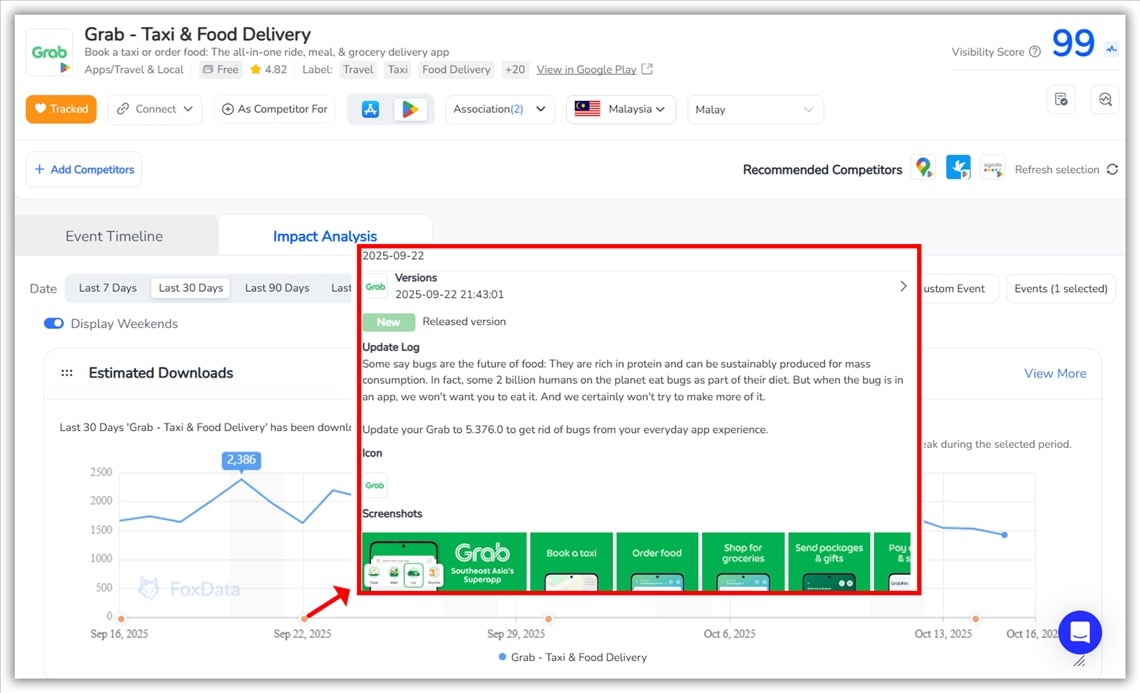
As shown in the chart above, Grab – Taxi & Food Delivery released version 5.376.0 on September 22, 2025. After peaking at around 2,386 downloads, the app’s numbers began to decline — until the 5.376.0 update log was released, when downloads started to rise again. This suggests that the new release helped restore user engagement by addressing earlier issues.
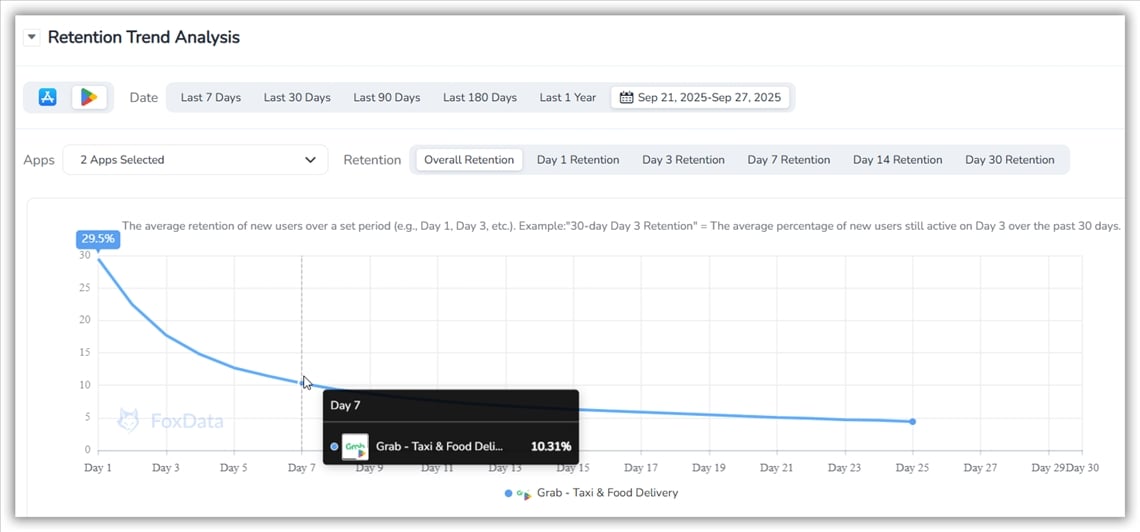
👉 User Retention Analysis Tool shows that:
This stability indicates that the update didn’t negatively affect short-term engagement.
Even better, Day 1 retention later rose to 31.8%, suggesting that the bug-fix update and performance optimizations improved user confidence and in-app experience.
👉 Learn More: The Rise of Super Apps in 2025: Inside Grab's Strategy
With FoxData, product teams can easily correlate user engagement changes with specific app versions. By cross-analyzing version logs, retention curves, and update timelines, teams can quickly confirm whether an issue has been resolved — turning guesswork into data-backed decisions.
The beauty of on-demand apps is flexibility — users can request anything, anywhere, anytime. The nightmare for developers? Managing that chaos when growth takes off.
Your app runs perfectly in one city. Then downloads double — and suddenly, everything cracks. Orders go unassigned, driver response times spike, and Play Store reviews start turning red. You’re left wondering: which market should we stabilize first, and where exactly is the system breaking down?
FoxData App Intelligence helps delivery platforms pinpoint where scale turns into strain. By tracking installs, retention, and category benchmarks across markets, teams can identify whether operational slowdowns come from demand surges or resource gaps.
Take Rappi as an example — recent data shows 44% of downloads in Mexico, 20% in Colombia and 9% in Peru. That means nearly three-quarters of its user growth is concentrated in just three markets. For any on-demand platform, that kind of imbalance can stretch couriers, customer service, and logistics infrastructure to their limits.
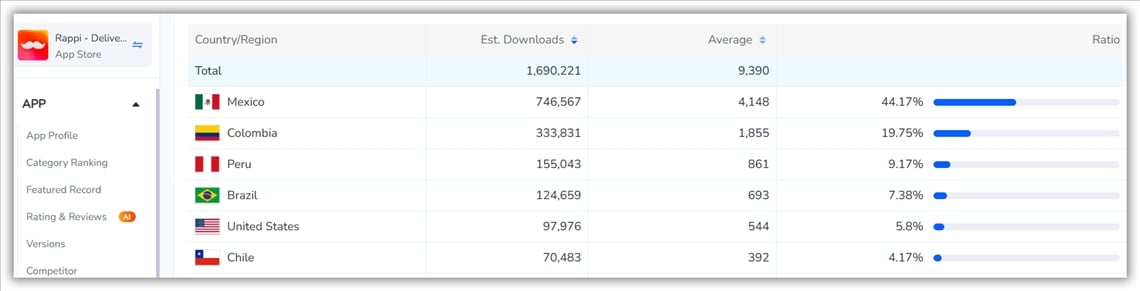
With FoxData, you can spot these shifts before they snowball — forecast when a region will outgrow its current capacity, reallocate operations smartly, and scale without compromising user satisfaction.
In short: grow fast, but stay in control.

Discover how FoxData enhances data protection and security standards to keep your analytics safe and reliable.
Downloads are easy. Retention is the true test.
When your app feels slow or generic, users switch without hesitation.
You spend thousands on user acquisition, but most users never return. You know something’s missing — but not what.
FoxData’s review analysis and sentiment tracker uncover what users love or dislike across competing apps. You can identify emotional triggers, recurring complaints, and hidden opportunities to refine your product roadmap.
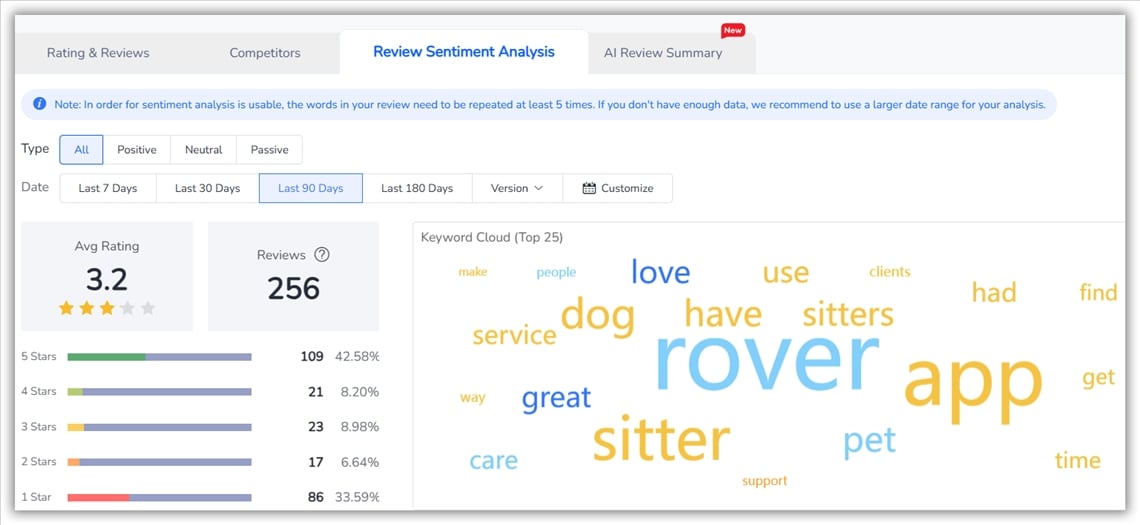
A pet-sitting app (like Rover) showed that while users praised the app’s convenience and reliable sitters, many complained about high fees, slow support, and chat bugs.
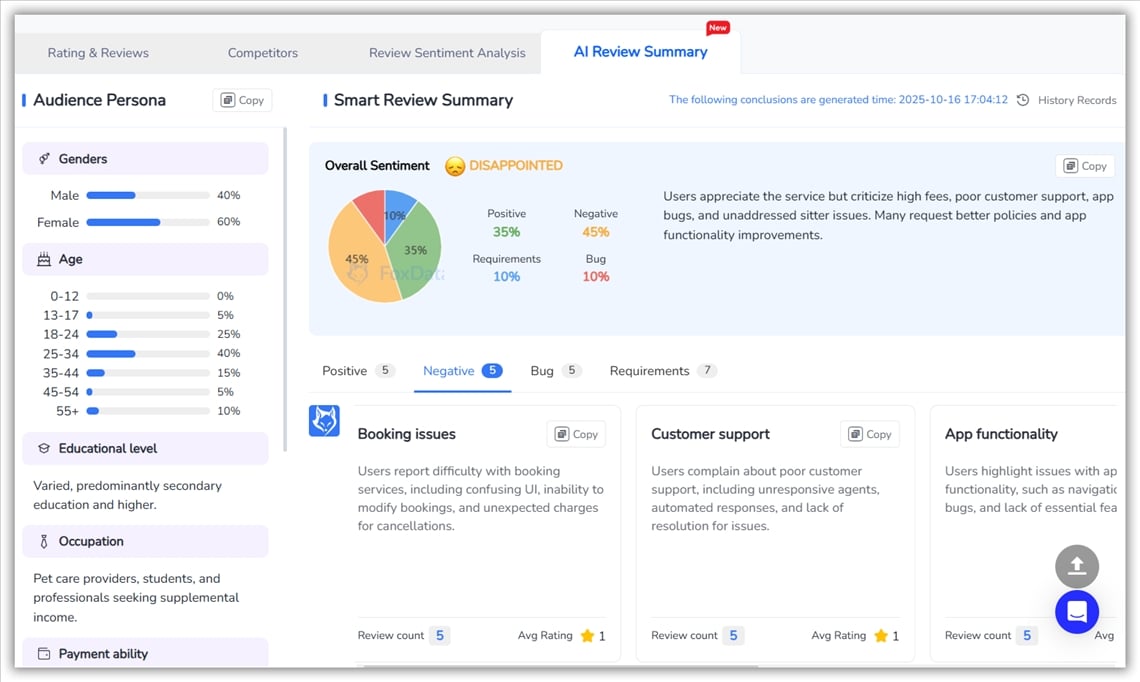
Over the past 90 days, the app received 256 reviews with an average rating of 3.2 stars — 42.6% were 5-star, but 33.6% were 1-star, showing a polarized experience. Positive keywords like “love,” “great,” and “care” reflected appreciation for convenience, while complaints about high fees, slow support, and chat bugs revealed frustration with reliability.
By improving in-app messaging, clarifying pricing, and speeding up customer support, the team turned frustration into trust. Within three months, repeat bookings rose by 23% and App Store ratings increased from 3.9 to 4.3, proving that understanding user sentiment can turn one-time customers into loyal fans.
Even the best apps can get buried in crowded app stores. Without visibility, growth stalls.
Your app rating is solid, but installs stagnate. You suspect your App Store Optimization (ASO) isn’t aligned with current search trends.
FoxData's App Data Analysis reveals trending keywords, competitor rankings, and low-competition phrases that actually convert. You can adjust your metadata and climb search results faster.
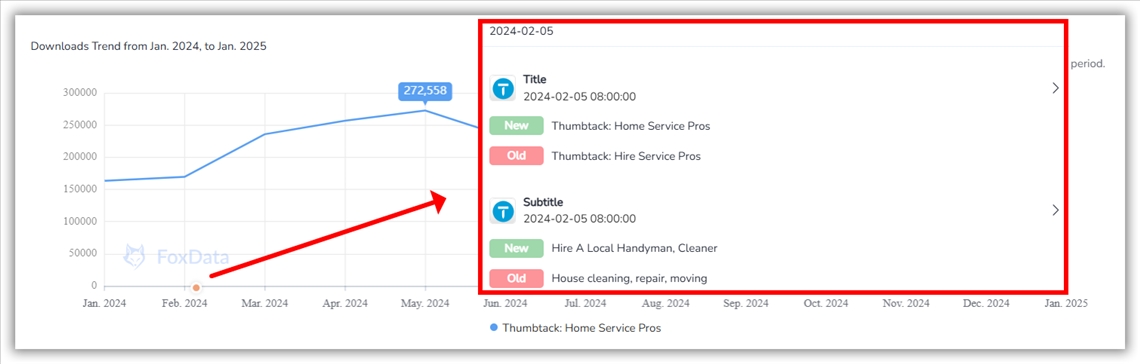
A handyman service app, inspired by tactics used by Thumbtack, spotted the highest ranking #21 on FoxData’s Lifestyle category charts. After optimizing its title and short description, the app’s weekly installs surged 39.1% within a month — without increasing ad spend.
The on-demand model is expanding fast — into healthcare, education, and finance.
For developers, this means more potential markets — and more competitors watching the same opportunity.
What separates those who win from those who fade is who sees the signal first.
FoxData helps you see beyond dashboards — to understand why users behave the way they do, which markets to enter next, and how to optimize before the trend peaks.
On-demand apps are about speed.
But sustainable success — the kind that lasts through competition and market shifts — comes from clarity. Clarity about what users want, what competitors are doing, and where the next opportunity lies.
FoxData gives you that clarity — all in one place.
So you can make confident decisions, scale strategically, and stay ahead while the on-demand world keeps moving at full speed.
You’ve felt the uncertainty — the drop in numbers, the “what happened?” moment.
FoxData helps you turn that frustration into foresight. See your next move clearly.
👉 Get started with FoxData today.
📣 Don't miss these:
© 2020-2026 FoxData. All Rights Reserved.