



Explore More Possibilities for Your Business
Full-cycle scenario construction to meet your needs from App research, development, and release to operation.
Ready for your soaring growth
If you're the one who tracks competitor launches, explains chart swings to leadership, or decides where next quarter's UA budget goes — this one's written with you in the room.
Picture the Monday morning version of this: a competitor's new game takes the #1 spot on three different App Store charts, in three different countries, on the same day. Nobody warned you. You find out from a screenshot someone dropped in a group chat, followed by "did you see this?"
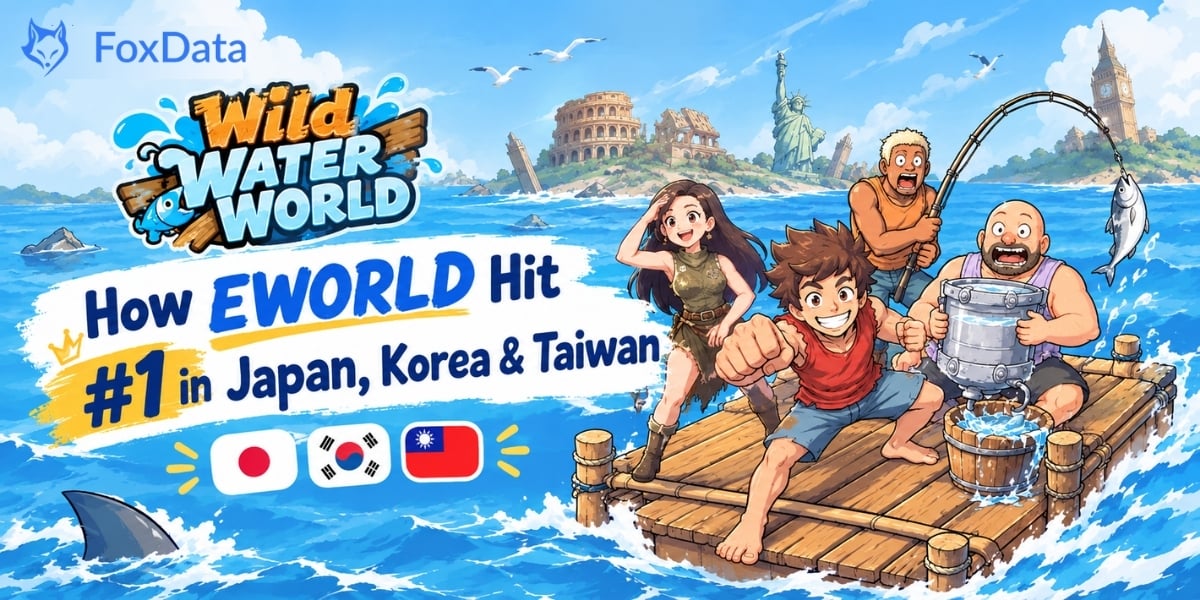
That's roughly how most of the industry heard about Wild Water World.
“Just pick the seawater filter at the start. Trust me.”

If you've scrolled through short-form video in the last few months, that line has probably already lodged itself somewhere in your head, uninvited. It started as a throwaway in-game item in China's mini-game scene, wrapped in a wave of loud, cheap-looking, AI-generated ads. Somehow it crossed over — into a meme people repeat even if they've never opened the game.
The meme isn't the interesting part, though. What happened when EWORLD took it overseas is.
On September 1, the international version launched across Japan, South Korea, and the Chinese-speaking markets of Taiwan, Hong Kong, and Macau. It's now live in 152 countries and regions, with over 500K pre-registrations already banked before day one. Real-time App Store ranking data puts it at #1 on the free charts in Taiwan, South Korea, and Japan — simultaneously, on launch day.
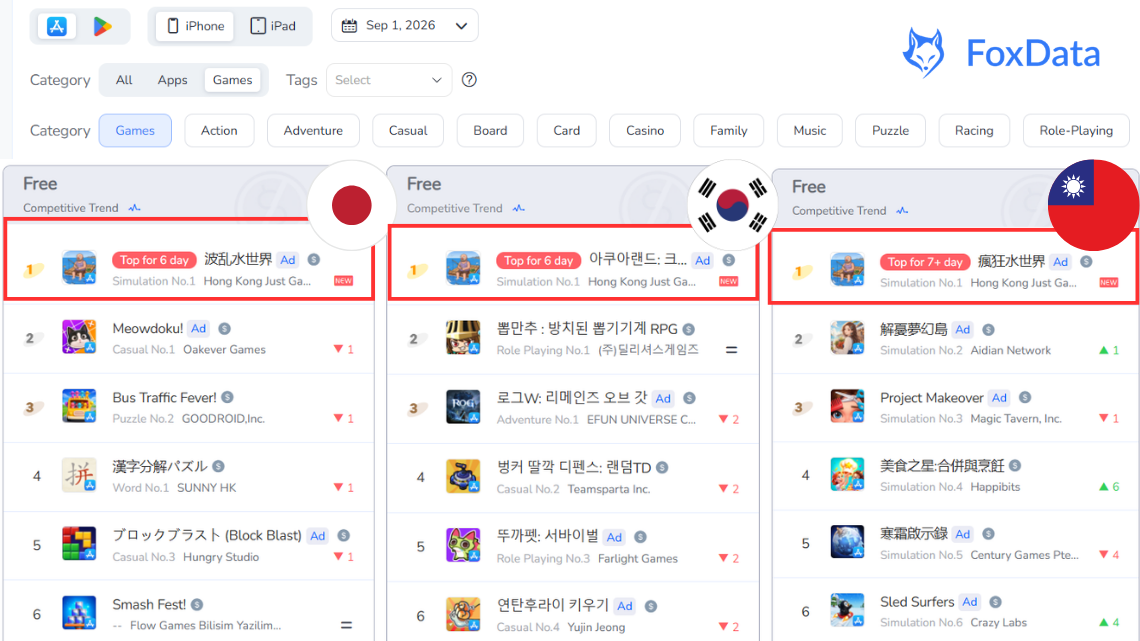
Source: FoxData—Top Charts
→ This is the same live ranking view the numbers above came from — pull it up and watch a launch happen in real time
EWORLD isn't a new name if you've been in mobile gaming for a while. The Guangzhou studio built its early reputation on simulation-management titles like Coin Billionaire and Business Tycoon. Its Japanese release, Please, President!, held a spot in Japan's iOS top-grossing top 20 for eighteen straight months — long enough that it stopped being a launch story and started being infrastructure.
Then in March 2025, EWORLD released Lands of Jail, a prison-themed mashup of simulation management and SLG mechanics. It cleared $10M in its first month overseas, grew more than 3x month-over-month in month two, and finished the year at nearly $118M off a $17M opening month.
That's the number that should stop you for a second. Not because it's large — plenty of launches post a big month one — but because of what it validated: a specific sequencing. Let the simulation layer do the early work of pulling people in and keeping them around. Then let SLG mechanics — alliances, resource competition, long-term progression — do the harder job of making them stay for months, not days.
Wild Water World is that same sequencing, wearing a different costume. Swap the prison yard for a post-apocalyptic ocean, and the theme gets easier to sell, not harder. "Raft survival" doesn't need explaining — PC titles like Raft and a flood of mobile survival-crafting games already did that work. Players know the loop on sight: scavenge, expand the raft, unlock a facility, go explore. Once there's a base worth defending, the SLG layer — alliances, resource wars — slides in without friction.
A studio that had only run this once might call the second attempt a bet. EWORLD had already seen the receipts.
Here's the uncomfortable part if you're on the other side of a launch like this: EWORLD didn't out-create anyone here. They out-informed them. They knew which sequence worked before they spent a single dollar proving it a second time. The studios that keep winning repeat launches aren't the ones making better guesses — they're the ones who stopped needing to guess.
Lands of Jail went West first. Wild Water World didn't — it opened in Japan, South Korea, and Taiwan, the three markets where EWORLD has spent years building relationships, distribution, and a read on what actually lands with local players, largely through Please, President!'s long run.
A single #1 ranking can happen by accident. Three, at the same time, in three markets with different user behavior, different App Store dynamics, and different creative expectations — that's not an accident. That's a studio that knows exactly which levers move which market, and pulled all three on the same day.
This is the part most competitive write-ups skip past: it's not enough to clock that a studio won three charts. The useful question is which of their earlier moves you could have called in advance — and whether your own roadmap would have made the same bet.
→ Walk into that roadmap meeting with a studio's actual market-entry history, not a hunch about it — pull it from the API here

Here's the part that's actually worth stealing: the chart position isn't the interesting story. The creative system underneath it is.
EWORLD's China playbook — loud, unhinged, AI-generated ads — didn't just get dubbed and shipped overseas. It got rebuilt, market by market, around one idea: take an ordinary object, hammer it until it becomes a symbol, and let that symbol travel even when the actors, language, and jokes around it don't.
Three creative streams carried that weight:
Celebrity work closed the loop — actor Park Ji-hwan in South Korea, cheerleader Lee Joo-bin in Taiwan — pairing AI-scale reach with the kind of local credibility a machine-generated ad can't manufacture on its own. Screen-recorded gameplay handled the last mile: proving the base-building was as satisfying as the ads promised.
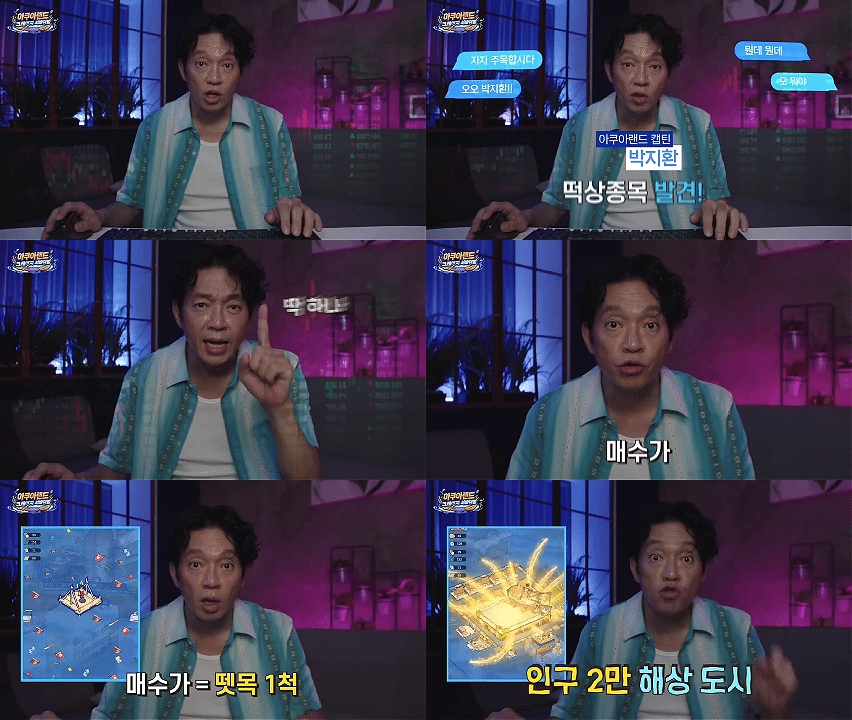
None of this required new ideas for every market. It required one idea, disciplined enough to survive translation.
Domestically, Wild Water World barely looks like a UA campaign at all. It looks like entertainment — AI live-action mini-dramas around a rising "Water City Boss," manhua-style content, jokes that spread through comment sections before anyone downloads anything. A Chinese user might never install the game and still know exactly who "the seawater filter guy" is. The content travels first. The install is optional.

Overseas, the balance flips toward paid UA and localized marketing — AI creative for scaled testing, celebrity content for regional trust, gameplay footage for conversion. Different mechanics, same instinct: don't transplant China's ecosystem wholesale, translate the logic that already worked and let each market's UA channels digest it on their own terms.
That translation instinct, more than any single ad, is the part that's hard to copy.
Here's where it gets less flattering, and more useful. Early Japanese App Store reviews are already split. The good ones say what you'd expect — easy to pick up, a solid time-killer. The bad ones cluster around something much less forgivable: data loss after a version update, including paying players who came back to find their accounts reset.
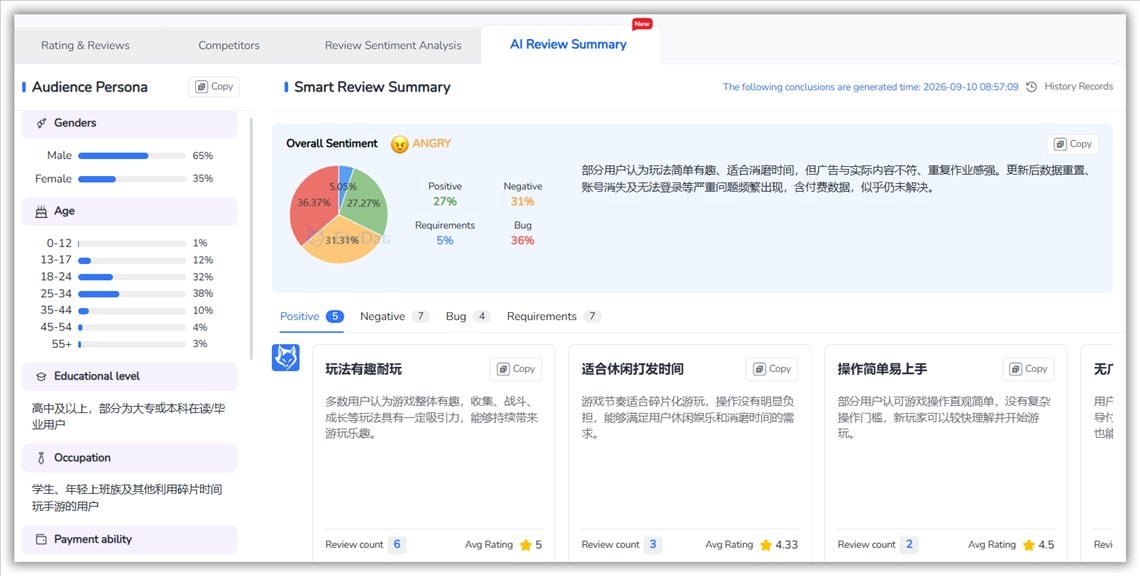
Source: FoxData's AI Review Summary
EWORLD pushed a fix fast. Credit where it's due. But for a week, that complaint sat in the review section next to a #1 chart badge — a reminder that a great launch and a great product are not the same achievement, and only one of them survives past week two.
If this were your launch, would you have caught that pattern in reviews before it became a Reddit thread? Most teams find out the same way the rest of the industry did here — after the fact, from users, in public.
That's the real gap between tracking vanity metrics and tracking the ones that actually move retention. A chart position tells you a launch worked today. Review sentiment tells you whether it's still working next month — and it moves faster than most teams remember to check it.
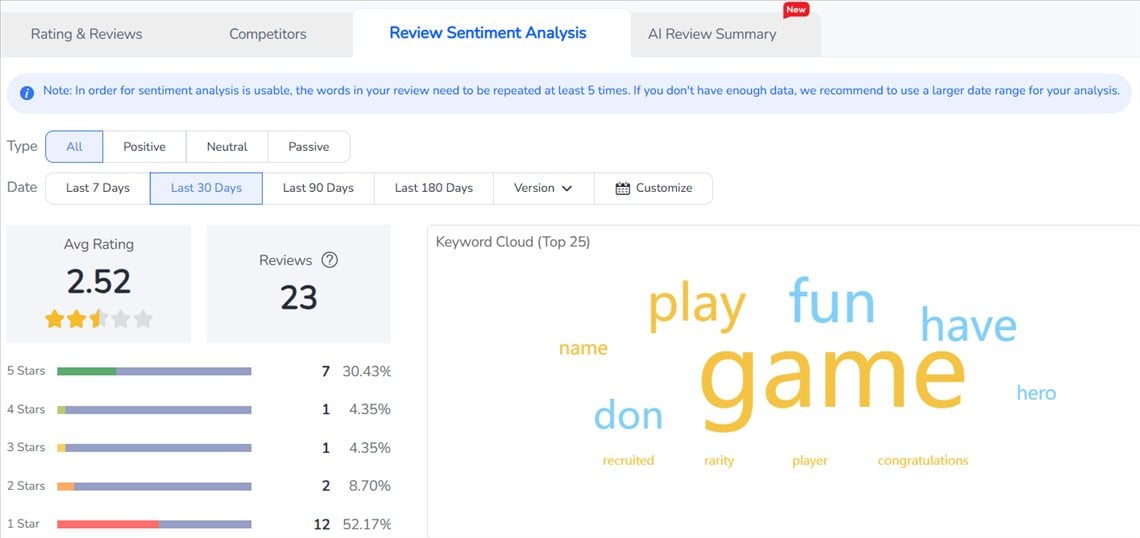
Source: FoxData—Review Sentiment Analysis
(Based on early reviews —23 ratings in the first 30 days — so treat this as a first signal, not the full picture.)
→ Seeing sentiment shift in real time, before it becomes a headline, is the difference between a fast fix and a slow bleed — here's what that actually looks like
Two products in, EWORLD's international formula is no longer a theory: use simulation-management production values as the hook, hand off to SLG systems for retention, and use theme plus localization to open each market on its own terms. With Wild Water World already in 152 countries and regions, the open question is how hard — and how soon — EWORLD pushes UA spend into Western markets, where Lands of Jail already proved the model travels.
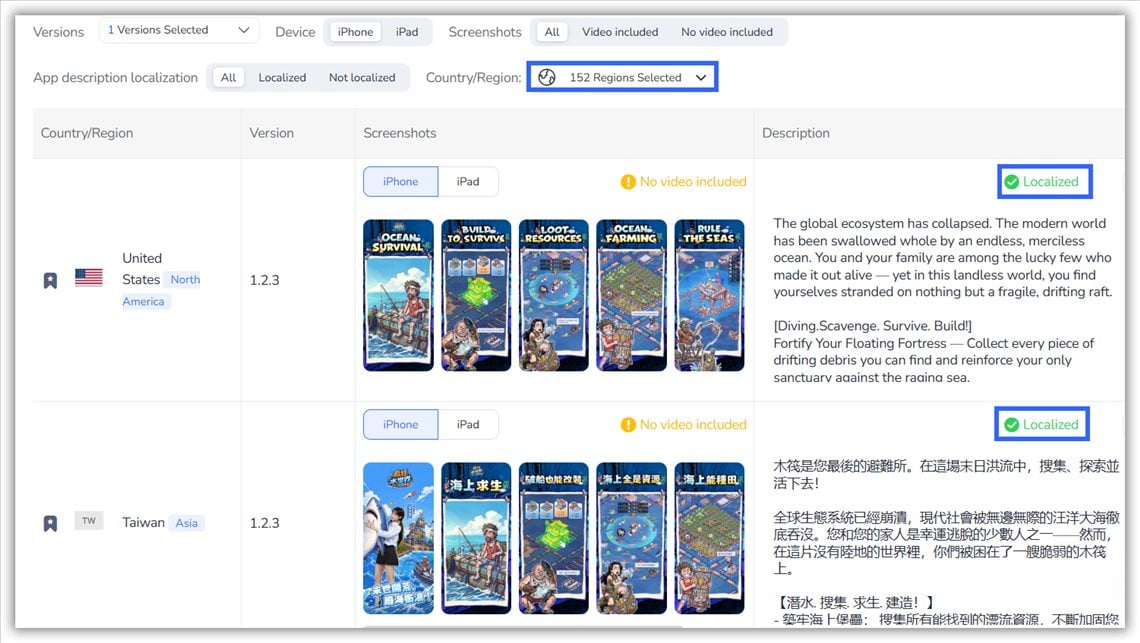
Source: FoxData — ASO Localization Tracker (152 regions)
The bigger risk isn't a rival studio. It's fatigue. AI-generated creative stopped being a novelty the moment every studio got access to the same tools, and that clock is already running. Whether "the seawater filter" stays funny in six months depends entirely on whether EWORLD can manufacture the next hook before this one goes stale.
A #1 ranking is a headline. What a studio does in the next 30 days is the actual story — and it's a story almost nobody outside the studio gets to watch as it happens. Almost.
Knowing that Wild Water World hit #1 in three markets at once is trivia. Knowing why — and having that same visibility on the launches actually competing with yours — is the difference between reacting to a competitor's quarter and planning around it.
If you're in UA, that's catching a creative pattern before your test budget burns through five variants finding it blind. If you're in ASO, that's knowing which keyword and chart movements are real signal versus noise, before you rewrite a listing on a guess. If you're the one presenting next quarter's roadmap, that's walking in with a chart instead of a hunch.
What is Wild Water World?
A raft survival-crafting game layered with SLG mechanics, from Guangzhou studio EWORLD. It launched internationally on September 1 in Japan, South Korea, Taiwan, Hong Kong, and Macau, and is now live in 152 countries and regions.
Why did it rank #1 in three countries at the same time?
Real-time App Store ranking data shows Wild Water World topped the free charts in Japan, South Korea, and Taiwan simultaneously at launch — the result of a coordinated, market-specific creative campaign, EWORLD's existing regional distribution experience, and 500K+ pre-registrations. Track a launch like this as it unfolds.
What's the "seawater filter" meme, actually?
An ordinary in-game item that became a recurring joke in Chinese short-form ads ("just pick the seawater filter at the start"). EWORLD reused it as a consistent creative anchor across every international market, changing the characters and story around it but never the object itself.
How much has EWORLD's simulation-to-SLG model actually earned?
Its prior title, Lands of Jail, made $17M in its first month overseas and nearly $118M over its first full year — the result that gave EWORLD the confidence to run the same structure again, in a new setting, with Wild Water World.
How do teams track launches like this before they blow up?
With real-time App Store and Google Play ranking data, creative tracking, and market-by-market performance visibility — the kind FoxData's mobile game analytics platform provides. Schedule a walkthrough to see it against your own titles or a specific competitor.
Nobody on the outside knew Wild Water World was about to take three charts at once — until it already had. The teams who stop finding out from screenshots are the ones watching the data before the headline gets written, not after.
None of this takes a bigger team or a bigger budget. It takes seeing the signal before everyone else is already reacting to it.
See live App Store and Google Play rankings, by market, for any title you're watching →
Talk to us about setting it up for your team →
Already have an account? Sign in here.
© 2020-2026 FoxData. All Rights Reserved.