



Explore More Possibilities for Your Business
Full-cycle scenario construction to meet your needs from App research, development, and release to operation.
Ready for your soaring growth
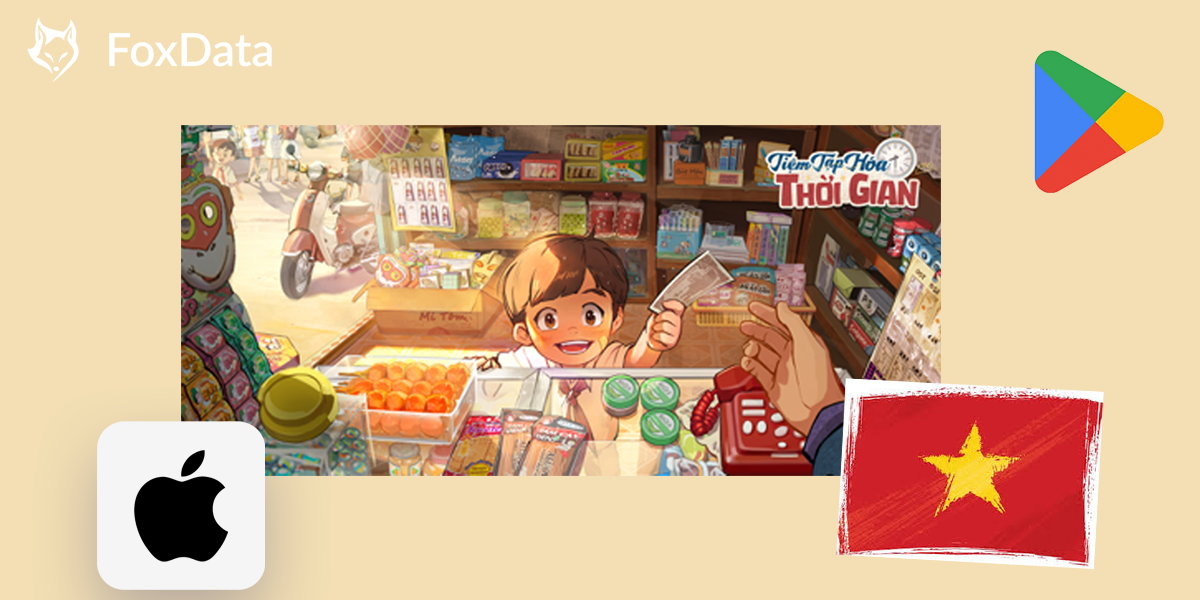
Recently, a simulation and management mobile game built around nostalgic themes climbed rapidly to the top of the charts after its launch in Vietnam. Unlike traditional MMORPGs or the commonly seen Three Kingdoms and wuxia-inspired titles, this game presents a sense of “everyday nostalgia” through familiar settings—such as corner stores, old streets, and cinemas—that deeply resonate with Vietnamese players.
On August 22, Tiệm Tạp Hóa Thời Gian (Time Grocery Store) secured a spot in the Top 3 Grossing iOS Games in Vietnam.
In the past, when people talked about the Vietnamese mobile games market, the common associations were with “mid-to-hardcore gameplay,” “wuxia fantasy,” or “Three Kingdoms” themes. Many of these titles were direct PC-to-mobile adaptations, resulting in heavy homogeneity and short product lifecycles.

In the past two years, however, the situation has been quietly changing:
The market in Vietnam is clearly evolving from a reliance on a few “traditional genres” into a more well-rounded and diverse gaming ecosystem.
The success of such titles is far from accidental.
Localization settings of Tiệm Tạp Hóa Thời Gian (Time Grocery Store)
In short, this is both the result of shared cultural symbols and a reflection of collective psychology shaped by an accelerated social rhythm.
Nostalgic themes can easily trigger emotional resonance, but whether a game can stay on players’ phones for the long run depends on how much effort developers are willing to invest in the details.
TikTok records around 300,000 monthly downloads on iOS in Vietnam.

These factors often determine whether a title becomes a fleeting download champion or establishes itself as a sustainable, long-term success.
The nostalgic-realism genre has undoubtedly injected fresh momentum into the Vietnamese market. Its breakthrough demonstrates that even games not centered on flashy combat can still achieve impressive traction. However, developers should remain cautious:
Vietnam is becoming an increasingly important player on the global mobile gaming map. It is not only a stronghold for mid-to-hardcore genres but also an emerging stage for experimenting with new themes. The success of nostalgic-realism titles reminds the industry that players are not only driven by numbers and competition—they also crave emotional resonance and familiar cultural symbols.
Those who can execute localization with greater authenticity and finesse are far more likely to secure long-term success in the Vietnamese market.
While Vietnam has recently demonstrated the strong potential of nostalgic and life-simulation mobile games, the opportunity is not confined to one market alone. Across Southeast Asia, mobile-first demographics, rising disposable incomes, and the cultural relevance of shared everyday symbols are creating fertile ground for similar genres to thrive. Countries such as Indonesia, Thailand, and the Philippines are also showing an appetite for lighter, emotionally engaging titles alongside their established popularity with mid- and hardcore genres.
For publishers and developers, this suggests that Vietnam may well be the bellwether for a wider regional trend, where players seek both accessibility and cultural resonance in gaming experiences. To better understand these dynamics, readers can refer to our detailed research in the2025 Southeast Asia Mobile Gaming Market Insight Report, which provides data-driven analysis, regional case studies, and actionable strategies tailored for companies exploring growth opportunities across SEA markets.
📌 Whether you are involved in product design, growth experiments, campaign execution, or cross-regional expansion, FoxData offers a comprehensive closed-loop analysis system covering keyword insights, ranking changes, user behavior chains, and creative opportunities, empowering you to make faster, more accurate, and forward-looking growth decisions.
📈 Want to access more app ranking trends and ASO analysis?
👉 Experience FoxData now >
📬Contact us for customized regional data insights or industry solutions to help you win in the market!
🧭 Data-driven growth starts with FoxData.
Follow us to access more data reports and industry insights.
📢 FoxData Official Blog / Twitter/ Facebook / LinkedIn
© 2020-2026 FoxData. All Rights Reserved.