





Explore More Possibilities for Your Business
Full-cycle scenario construction to meet your needs from App research, development, and release to operation.
Ready for your soaring growth
There is a painful irony at the heart of the productivity app market. Apps built to help people do more are among the first to be deleted. Users download them with good intentions. They set up their workspace, add a few tasks, and then disappear. The habit never forms, and the app gets buried under dozens of others.
This is not just a product problem. It is a business-critical crisis. The global mobile app market is projected to grow by $2.63 trillion between 2025 and 2029, according to Yahoo Finance. Competition for user attention has never been more intense. User acquisition costs keep rising. And the tolerance users have for apps that fail to deliver instant value is at an all-time low.
If you are building or marketing a productivity app in 2026, retention is the number that determines whether your growth is real or just cosmetic. This article explains why users leave, what the data says, and exactly what you can do to keep them.
Most developers track installs. Fewer track what happens after the install. That gap is where growth goes to die.
Productivity apps have a Day 1 retention rate of just 17.1%, dropping to 4.1% by Day 30. To put that in context, a widely cited global benchmark shows retention settling around 26% on Day 1, 13% by Day 7, and approximately 7% by Day 30 across all app categories. Productivity apps are falling well below that average at every milestone.
Fintech and digital banking show 11.6% Day 30 retention, reflecting habitual financial management. Finance apps succeed because users return daily out of necessity. Productivity apps must engineer that same sense of necessity through design and messaging. Without it, they bleed users steadily until the revenue model collapses.
Research into worldwide retention rates shows that the average retention rate across 31 mobile app categories was 25.3% on Day 1, before falling to 5.7% by Day 30. Sitting below both figures, productivity apps face a structural disadvantage that no amount of paid acquisition will fix. The solution starts with understanding why users leave and acting on that data fast.
That is precisely why developers who use dedicated productivity app analytics and ASO solutions to track cohort behavior, keyword performance, and competitive positioning are consistently pulling ahead of those who rely on basic dashboards and guesswork.

The first session is your only guaranteed opportunity to prove value. Most productivity apps waste it entirely. They front-load the experience with permission requests, lengthy account setup, and feature tours before users have accomplished anything meaningful. Users arrive with genuine intent and leave before their first real action.
Nearly 30% of annual subscriptions are canceled in the first month, and retention starts on day one. Getting users to understand and experience your app's core value quickly is not a nice-to-have. It is the single most important thing you can do for long-term retention.
The "aha moment" is what makes or breaks early engagement. This is the specific action that makes a new user realize the app is genuinely useful to them.
For a task manager, it might be completing and checking off their first task. For a note-taking app, it might be capturing and retrieving an idea in under ten seconds. Whatever it is, getting users there fast, ideally within the first session, is your highest-leverage retention move.
How To Fix It
Count exactly how many steps a new user needs to complete their first meaningful action. Then cut that number in half. Request only the permissions that are immediately necessary. Push advanced features and settings to later sessions, once the user has already experienced why the app is worth keeping.
Productivity tools only stick if they become part of a daily or weekly routine. Unlike games that trigger reward loops or social apps that create obligation through other people, productivity apps have to earn their way into a user's workflow through demonstrated, repeatable value.
In 2026, the average user juggles messaging apps, fitness trackers, weather widgets, and whatever trend is hot this week. Your app is competing for a slot in a very limited set of daily-use tools. If it does not find a natural home in how a user already works, it gets replaced or simply forgotten.
Retention rates are nearly 3x higher when users receive one or more push notifications in their first 90 days of using the app, compared to those who received zero notifications. More specifically, users of utility and productivity apps who opt in to push notifications are retained 49% longer than opt-out users, the highest retention lift of any vertical studied.
This is significant. It tells you that when productivity users see early value and engage with your messaging, they are highly predisposed to stay. The habit loop is possible. You just have to build the mechanics that make it happen.
Fix it by identifying the single core action you want users to repeat daily or weekly. Build your notification strategy, in-app prompts, and progress indicators around reinforcing that one action. Streaks, progress tracking, and visible outcomes all work. Use at least one of these mechanics actively from day one.
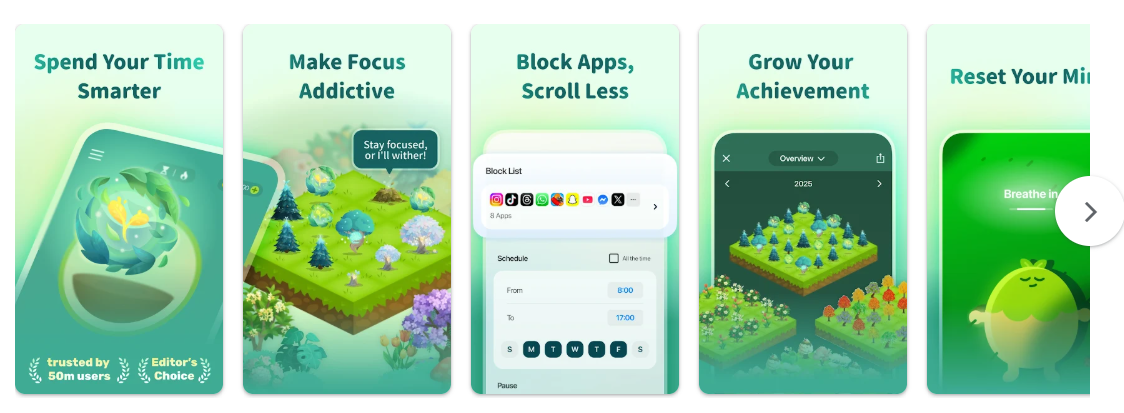
For example, Forest app create a planting reminder for its user to remind them to open the app and plant trees.

Many retention problems begin before the install. If your app store listing is optimized for volume rather than fit, you will attract users who were never going to stick around. They download based on a broad keyword match, realize the app is not what they expected, and churn immediately. This inflates your install numbers while quietly destroying your Day 7 and Day 30 metrics.
Organic installs yield higher retention at 30 days than paid installs, because organic users often come in with stronger intent or product interest. But even organic installs can be low-quality if your keywords and store creative are not speaking to the right audience.
Keyword quality matters as much as keyword volume. A user who finds your app after searching a specific use case, like "project tracker for freelancers" or "shared grocery list app," is far more likely to retain than one who finds you through a generic term like "productivity app." The specificity of the search intent predicts the quality of the install.
Audit which keywords are driving your highest-retention cohorts, not just your highest install volume. Use your screenshots and description to speak directly to your ideal user. Show the outcome, not just the feature set.
Developers who use app store optimization tools built for productivity app growth can connect keyword performance to downstream retention data, making it easier to prioritize the visibility that actually matters.
Productivity apps are especially prone to feature bloat. New capabilities get added to stay competitive. Settings multiply to satisfy power users. The result is a first-run experience that overwhelms new users before they ever locate the core workflow. If users cannot find value quickly, they will not come back to look harder.
The apps with the best retention in this category are rarely the most feature-rich. They are the most focused. A clear, fast path to the first win beats a comprehensive feature tour every single time for early retention.
Run a first-session audit. Hand your app to someone unfamiliar with it and observe where they hesitate, what they ignore, and where their expectations break down. Identify your top two or three friction points and fix those before considering any new feature additions.
Even users who love your app will occasionally fall out of the habit. Work gets busy. Devices change. Routines shift.
The difference between apps with strong long-term retention and those without is often whether a systematic re-engagement strategy exists at all.
78% of users churn in the first week after installation when brands do not have a clear engagement strategy based on regular push notifications. At the same time, 46% of users will opt out of push notifications if they receive two to five messages in a single week.
The challenge is finding the right frequency. Too little and users drift away. Too much and they disable permissions entirely, which removes your ability to reach them at all.
Segment re-engagement by inactivity duration. A user who last opened your app two days ago needs a different message than one who has been gone for three weeks.
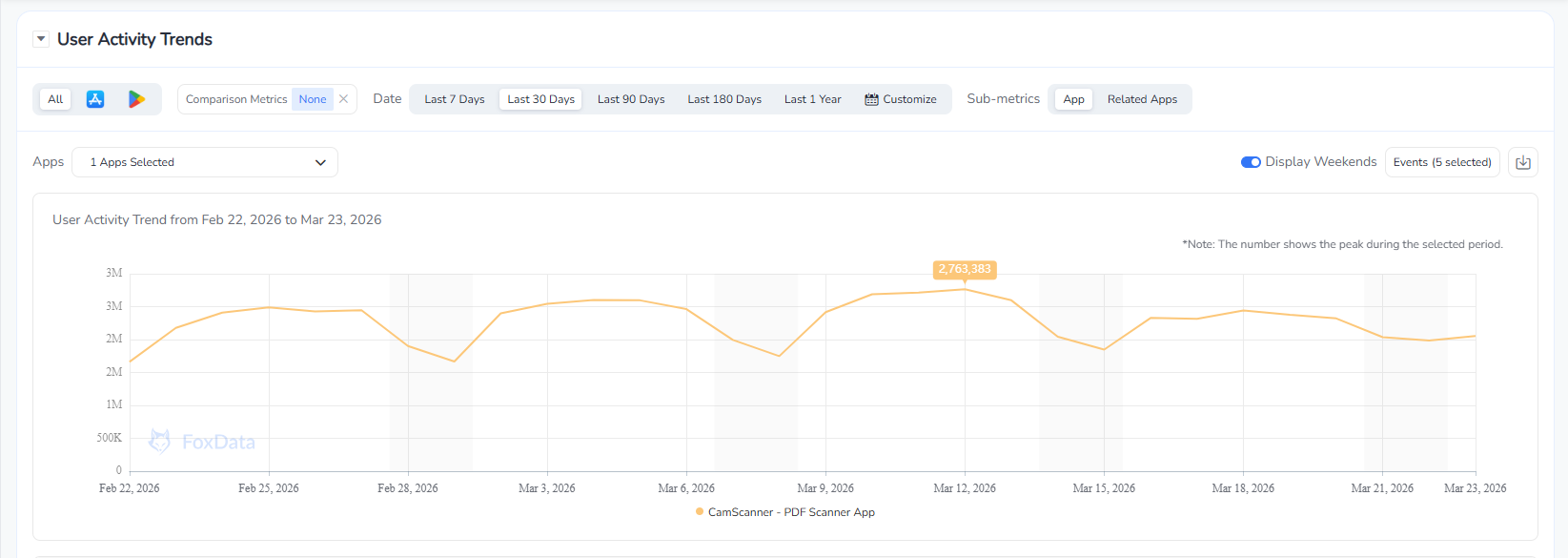
Understanding why users churn is only useful when you can act on it systematically. That requires tools that connect behavioral data, keyword performance, and competitive context in one place.
Cohort analysis is your foundation. Daily Active Users tells you how many people opened your app today. It does not tell you whether the users from three weeks ago are still active, or which first-session actions predicted who would retain. Cohort tracking does. It lets you measure the retention impact of every onboarding update, keyword shift, or product change on real user behavior over time.
Connect ASO performance to retention quality. The keywords you rank for determine who finds your app. But most developers stop measuring at the install. The highest-performing teams identify which keyword cohorts have the best Day 30 retention, then use that to shift their ASO investment toward quality over volume.
This loop, where retention data improves your store strategy, and better store strategy improves retention data, is one of the most powerful growth systems available to a productivity app team.
Use reviews as a real-time churn signal. Recurring themes in negative reviews surface friction points before your internal analytics catch them. A cluster of complaints about sync failures or a confusing setup flow is actionable product intelligence.
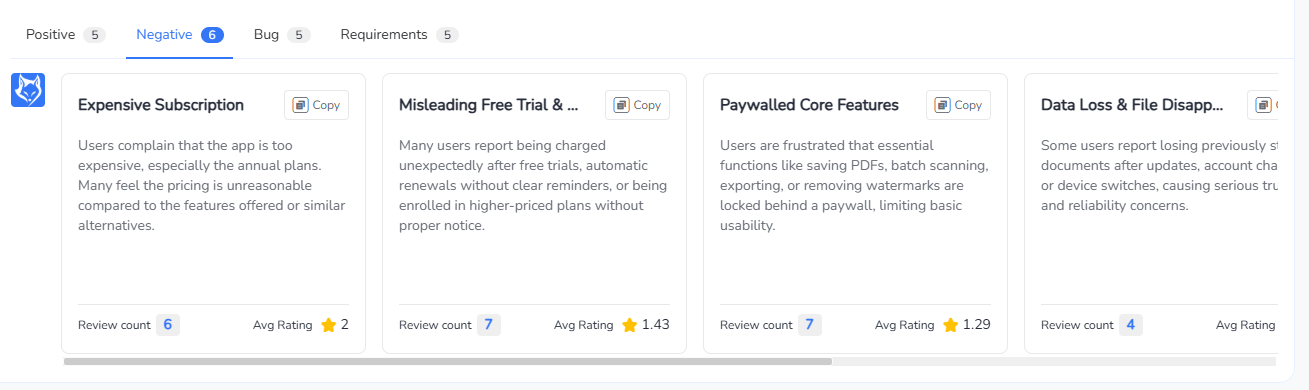
Respond publicly, fix the issue, and follow up. Users who see feedback addressed are significantly more likely to re-engage.
Teams using data-driven analytics and ASO tools for productivity apps can now access cohort tracking, keyword monitoring, review analysis, and competitive benchmarking at a scale that works for independent developers and growth-stage teams, without the complexity or cost of enterprise platforms.
Treating retention as a marketing problem rather than a product problem is the most fundamental error. Marketing can attract better-fit users. But if the app does not deliver clear value quickly, no campaign will move your Day 30 numbers sustainably.
Over-notifying new users is another common mistake that backfires fast. Since productivity app users who opt in to notifications retain 49% longer than those who do not, losing that permission is a major long-term cost. Send fewer, smarter, more contextual notifications, especially in the first 30 days.
Rolling out major UI changes without segment testing is risky. If a redesign removes something that power users depend on, the resulting churn spike is very hard to reverse. Treat every significant product change as an experiment with a control group and measure retention before and after.
Ignoring your app store listing after launch is a slow leak. Keyword rankings decay. Competitor listings improve. Visibility drops quietly, attracting lower-intent installs and higher churn over time. ASO is an ongoing practice, not a launch task.
Using discounts and promotions alone to address churn is a short-term patch. If users are leaving because the app does not deliver value, a temporary offer brings them back only to churn again. Fix the product first. Then use incentives to re-engage users who were genuinely close to converting.
Improving productivity app retention in 2026 is not a single fix. It is an ongoing practice that combines strong onboarding, habit mechanics, accurate ASO, and continuous behavioral analysis.
The developers who retain users longest are not always the ones with the most features or the biggest budgets. They are the ones who know exactly when and why their users leave, and who act on that knowledge before the churn compounds.
Every percentage point you improve at Day 7 or Day 30 compounds into lower acquisition spend, higher lifetime value, and a more defensible product over time. In a market where attention is scarce and acquisition costs are rising, retention is not a secondary metric. It is your most important growth lever.
If you are ready to move from guesswork to data-driven growth, explore FoxData's analytics and ASO solutions built for productivity app teams to track retention trends, optimize keyword strategy, benchmark competitors, and attract the users who actually stick around.
What is a good Day 30 retention rate for a productivity app in 2026?
The category average sits at approximately 4.1%. The global benchmark across all app types is 5% to 7%. A Day 30 rate above 6% is considered above average for this specific category. Reaching 10% or higher is a strong signal of product-market fit and places your app among the top performers in the productivity vertical.
How does ASO directly affect user retention?
ASO determines who discovers and installs your app. Accurate keyword targeting and store creative that reflects your actual product attract users whose expectations match the experience. When expectations are misaligned, users churn immediately.
Improving the fit between your ASO strategy and your ideal user profile is one of the most cost-effective retention levers available.
When is the highest-risk churn window for productivity apps?
The first 72 hours after install. Mobile apps lose approximately 77% of daily active users within the first three days after install. Users who do not reach a meaningful outcome in their first session are very unlikely to return. Everything in your onboarding should be oriented around preventing this drop-off.
How can indie developers improve retention without large budgets?
Focus on one high-impact change at a time. Improving onboarding clarity or realigning your top keywords to higher-intent searches can produce measurable retention lifts faster than broad campaigns.
Analytics platforms built for smaller teams now offer cohort tracking, keyword insights, and competitive benchmarking at accessible price points. Prioritize data over guesswork, and small teams can move as fast as larger ones.
Ready to make your app shine? Optimize your app's visibility with FoxData, the ultimate ASO tool! Maximize downloads and rankings by leveraging our powerful insights today.
App Growth & ASO Tools by FoxData
FoxData supports every stage of app growth with specialized ASO and app analytics tools, helping teams improve keyword visibility, user acquisition, and retention through reliable data.
🔍 Store Keyword Research Tools
Research high-intent keywords, search volume, and competition to strengthen your app store optimization strategy.
📈 App Store Keyword Tools
Analyze keyword rankings and performance across the Apple App Store and Google Play to refine ASO execution.
📊 ASO Monitoring Tools
Monitor keyword ranking changes, visibility trends, and ASO impact over time with continuous performance tracking.
👥 User Activity Monitoring Tools
Understand in-app user behavior, engagement, and retention with real-time user activity analytics.
Together, these tools form FoxData’s ASO analytics and app intelligence ecosystem, designed to help developers, marketers, and growth teams make data-driven decisions and scale sustainably.
Explore it today!
👉 Learn more about FoxData here | 👉 Book a demo with FoxData team today!
© 2020-2026 FoxData. All Rights Reserved.