




Explore More Possibilities for Your Business
Full-cycle scenario construction to meet your needs from App research, development, and release to operation.
Ready for your soaring growth
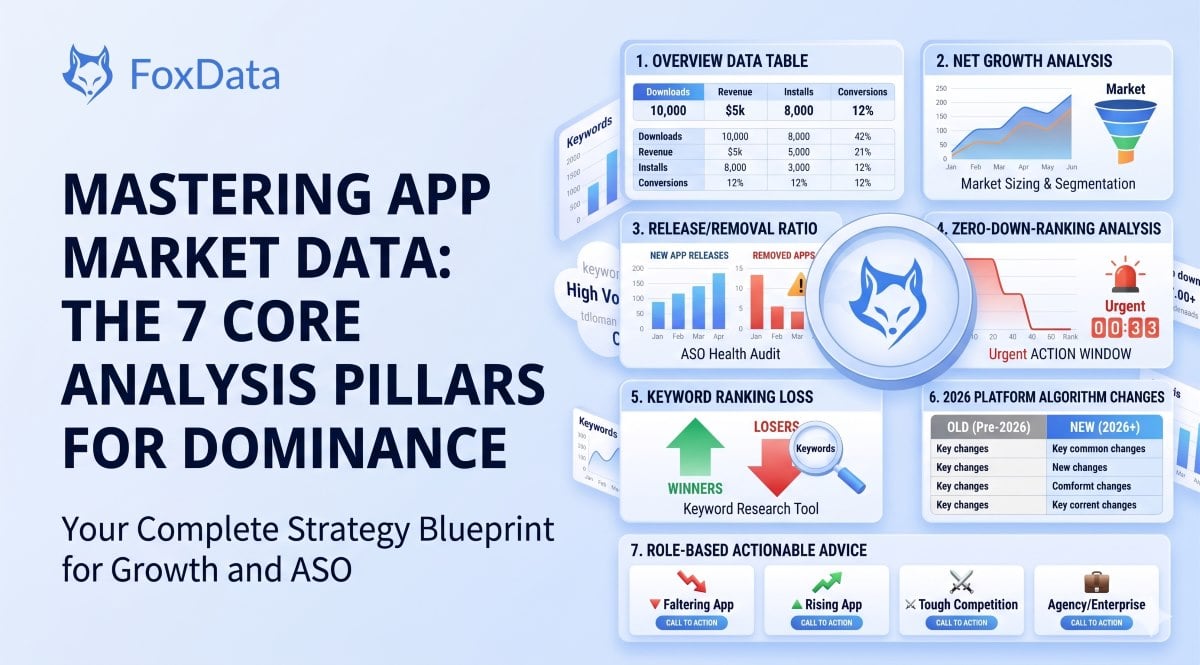
The mobile app economy never sleeps, and neither does competition. Every single day, thousands of apps are born, thousands more are quietly swept away, and keyword rankings shift beneath the feet of developers and marketers who aren't watching. On May 12, 2026, FoxData's Store Monitor captured a revealing snapshot of the US App Store — one that tells a layered story about platform enforcement, organic discoverability, and the relentless pressure to stay visible in a market that now hosts nearly 1.88 million apps.
If you're an app developer, growth marketer, or ASO professional, this data isn't just background noise. It's a competitive signal. Here's how to read it — and what to do with it.
| Metric | Value | Day-over-Day Change |
|---|---|---|
| Total Apps | 1,879,889 | +72 |
| Released Apps | 75 | −1,739 vs. prior period avg |
| Removed Apps | 17 | −212 vs. prior period avg |
| Charts Dropped Apps | 0 | −55,374 vs. prior period avg |
| Apps Losing Keyword Rankings | 2,136 | −13 |
Source: FoxData Store Monitor – US App Store, May 12, 2026
At first glance, these numbers look calm. But context transforms raw figures into strategy.
The US App Store added a net 72 apps on this single day, bringing the total ecosystem to 1,879,889 apps. That's a market that has effectively plateaued at near-saturation levels. Compare this to earlier periods when daily net additions regularly exceeded several hundred: the deceleration is real, structural, and significant.
What does this mean for you?
The days of riding broad category growth are over. With nearly 1.88 million competitors in the store, simply existing in the right category is no longer a growth strategy. The opportunity now lies in vertical niches and underserved intent clusters — segments where user demand has outpaced supply. FoxData's Market Segmentation tools are purpose-built for exactly this kind of opportunity mapping, letting you identify where category gaps exist before rivals do.
| Flow | Count | Interpretation |
|---|---|---|
| New apps released today | 75 | Modest daily entry rate |
| Apps removed today | 17 | Relatively low removal pressure |
| Net change | +58 | Marginal but positive growth |
Today's removal figure (17) is dramatically lower than prior period averages (−212 from baseline), suggesting that the current week sits in an unusually quiet enforcement window. Apple's algorithmic and editorial culling has been intensifying throughout 2025 and into 2026 — over 2.6 million outdated apps were removed in a recent enforcement sweep — but today's data shows the store in a moment of relative stability.
For developers, this is both reassurance and a warning: the low removal rate today does not mean Apple's quality bar has softened. It means the culling has already happened. Apps that survived recent enforcement cycles did so because they maintained updated metadata, strong ratings, and consistent engagement signals. If your app hasn't been through a recent ASO health audit, now is the time — before the next wave.
Perhaps the single most significant data point in today's snapshot: 0 apps dropped from charts. The day-over-day context makes this even more striking — a swing of −55,374 from prior typical levels.
Zero chart churn is extraordinarily rare. It signals a moment of algorithmic stability where the platform's ranking systems have temporarily settled. In practice, this creates two distinct windows of opportunity:
For apps currently on the charts: Consolidate. This is a moment to push for higher positions while volatility is suppressed. Chart positions gained in low-churn windows tend to hold longer because fewer apps are entering and exiting to displace rankings.
For apps trying to break into charts: Act. When chart positions are not being reshuffled by algorithmic swings, the path to a Top Chart entry becomes predictable and data-driven rather than luck-dependent. A focused download velocity push combined with targeted keyword investment is far more likely to succeed in this environment than during high-volatility periods.
Understanding which apps currently hold chart positions — and how long they've held them — requires real-time competitive intelligence. FoxData's App Analytics and ASO Performance tools give you that visibility, including estimated downloads, revenue trends, and ranking trajectories for any competitor in your category.
| Keyword Ranking Signal | Today | Change |
|---|---|---|
| Apps losing keyword rankings | 2,136 | −13 (improving) |
At 2,136, the number of apps experiencing keyword ranking losses is still meaningful — these are real apps losing organic visibility, often without their teams knowing why. But the trend direction matters: the −13 decline from prior periods indicates that keyword volatility is moderating, not accelerating.
This creates a nuanced dual reality in the current US App Store keyword landscape:
The losing side: Over 2,000 apps are bleeding keyword rankings daily. In most cases, the causes are identifiable and addressable: stale metadata that no longer matches evolving user search intent, weak engagement signals from unresponsive or poorly-rated app experiences, or competitor metadata updates that have overtaken previously held positions. The 2026 App Store algorithm increasingly rewards apps that prove real user value through retention and engagement — not just keyword density.
The winning side: For every app losing a keyword position, another app (or a new entrant) is capturing it. With the total keyword ranking loss count declining, fewer positions are becoming available — meaning the window to acquire freshly vacated keyword real estate is narrowing. Speed and precision matter.
This is where FoxData's Keyword Research tools become operationally critical. The platform indexes over 16 million keywords and tracks real search volumes, competition difficulty scores, chance metrics, and correlation data — the full picture you need to identify which vacated keyword positions are worth targeting and which aren't worth the investment.
Today's Store Monitor data doesn't exist in a vacuum. To interpret it correctly, you need to understand the structural shifts that have reshaped how the App Store discovers, ranks, and promotes apps in 2026.
| Platform Change | Impact on Today's Data |
|---|---|
| Apple began indexing screenshot text (June 2025) | Metadata quality now affects visual assets — apps with keyword-aware screenshots may outperform those without |
| Custom Product Pages (CPPs) now appear in organic search | CPPs are no longer just paid UA tools; they're an organic discoverability lever for 70 keyword-linked variants per app |
| Google Play shifted algorithm weight toward retention (2025) | Engagement signals — not just install volume — now determine ranking durability |
| AI-driven "Guided Search" on Google Play | Users increasingly search by intent ("find a meal planner") rather than keyword — apps optimized only for head terms lose ground |
| Long-tail keyword dominance accelerating | High-competition head terms are increasingly unwinnable without massive budgets; intent-specific long-tail phrases convert better and face less resistance |
In this environment, the apps absorbing today's keyword ranking losses are overwhelmingly those that haven't adapted to these structural changes. Their metadata was built for the 2023 App Store, not the 2026 one.
Run an immediate ASO audit. Identify which keywords have slipped, when the slip began, and whether competitor metadata updates or algorithm changes triggered the decline. FoxData's ASO Impact Analysis feature maps your app's update timeline against performance metrics, so you can identify exactly which change — or failure to change — caused the ranking drop.
The zero chart churn window is time-limited. Use FoxData's competitive analysis capabilities to benchmark the download velocity of apps currently at the threshold of the Top Charts, then build a targeted push campaign calibrated to exceed that velocity. Every day of zero chart churn that passes without action is a missed window.
With 1,879,889 apps in the store and net daily growth barely in positive territory, broad category competition is essentially a zero-sum game. The strategic path is segmentation: identify underserved user sub-segments using market data, then build keyword and metadata strategies that speak directly to their intent. This is not a one-time effort — it's an ongoing intelligence loop.
For game developers specifically, competitive intelligence at the feature and monetization level is increasingly important. Understanding not just what a competitor's rankings look like but why they perform — what mechanics drive engagement, how their UA strategy integrates with their ASO metadata — separates sustainable growth from temporary gains. FoxData's complete guide to game competitive analysis outlines the full framework.
If your team manages multiple apps across multiple markets, manual interpretation of Store Monitor data is not scalable. FoxData's App Data API enables you to pipe real-time market intelligence directly into your own dashboards and workflows — covering over 5 million apps, 16 million keywords, and 30 million ad creatives across 200+ countries. This is how top-tier growth teams operationalize data, rather than simply reporting it.
Taken together, today's US App Store data paints a picture of a market in a specific phase: mature, competitive, and increasingly meritocratic. The platforms are doing the heavy lifting of quality enforcement — removing apps that don't meet standards, stabilizing algorithmic ranking to reward genuine quality — while developers who invest in continuous optimization compound their advantages.
The apps that thrive in this environment share common characteristics:
The US App Store in mid-May 2026 is offering a narrow window of relative algorithmic calm. How you use it will determine where your app stands when the next wave of volatility arrives.
Track daily US App Store and Google Play market movements, monitor competitor rankings, and identify keyword opportunities in real time at FoxData.
© 2020-2026 FoxData. All Rights Reserved.