



Explore More Possibilities for Your Business
Full-cycle scenario construction to meet your needs from App research, development, and release to operation.
Ready for your soaring growth
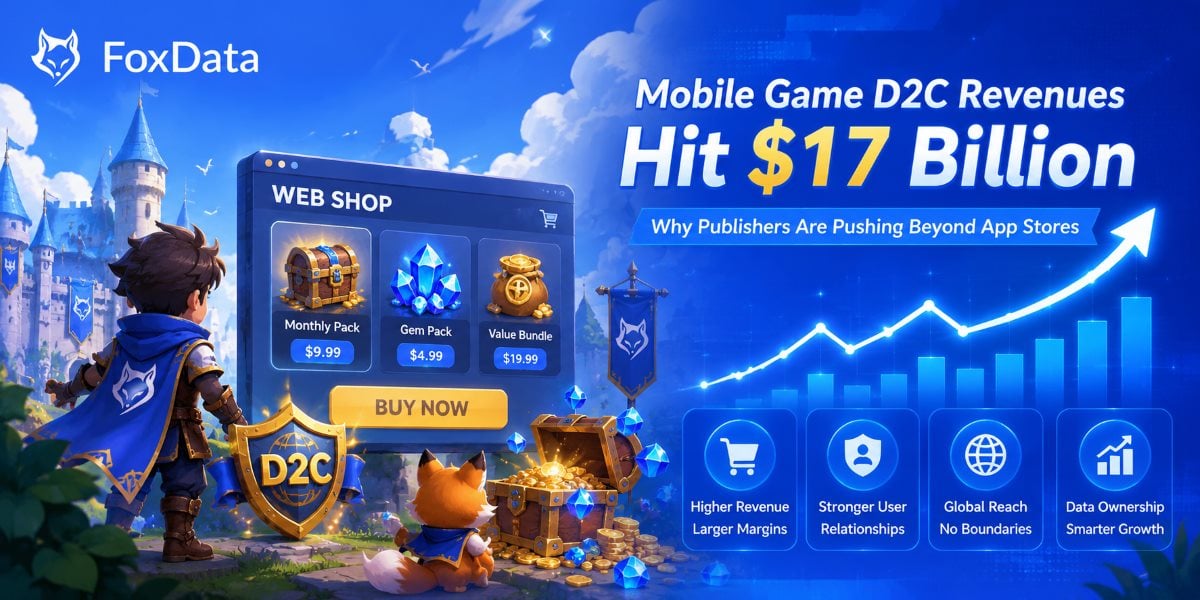
The mobile gaming landscape is undergoing a tectonic shift. According to a newly released joint report by the GDC Festival of Gaming and Appcharge, mobile game Direct-to-Consumer (D2C) revenues have surged to a staggering $17 billion market. This represents approximately 15% of the entire $113.3 billion global mobile In-App Purchase (IAP) economy.
Surveying over 1,200 professional game developers between January and February 2026, the data paints a clear picture: publishers are aggressively moving beyond traditional app store ecosystems. For developers and marketers, this isn't just about avoiding the infamous 30% platform tax anymore - it is a strategic land grab for player data, direct relationships, and long-term retention. This article breaks down the $17 billion D2C milestone, the ongoing fallout from the Epic vs. Apple ruling, and exactly how mobile teams must adapt their monetization pipelines for 2026.

Mobile Game Direct-to-Consumer (D2C) refers to publishers bypassing traditional platform payment gateways (like Apple's App Store and Google Play) by directing players to external web shops to purchase in-game currency, items, or subscriptions. Historically, the 30% platform fee heavily squeezed publisher margins. However, following landmark legal battles like Epic Games vs. Apple and subsequent regulatory crackdowns (like the EU's DMA), the barriers to steering users to third-party payment systems have started to crumble.
What changed in 2026 is the sheer scale and institutionalization of this practice. It is no longer just mega-publishers like Supercell building web shops. Mid-core and casual developers are actively migrating. More importantly, the narrative has evolved. As noted by the Appcharge CEO, the primary driver is no longer just fee avoidance - it is the strategic imperative of owning the player relationship, establishing independent loyalty programs, and safeguarding first-party data in a privacy-first era.
"The real story isn't the fees; it's about publishers directly owning the player relationship, data, and control." - Appcharge CEO
The optimism surrounding D2C monetization is overwhelming. The report reveals that 92% of surveyed publishers expect their D2C revenues to grow this year. Strikingly, 41% of these publishers are projecting double-digit growth. This confidence is fueled by the success of early adopters who have successfully trained their player base to transact outside the app.
The financial incentive goes beyond the platform fee savings. D2C leaders—those who have fully optimized their web shops and loyalty loops - report a median revenue lift of 35%. This significantly outpaces the general industry median revenue increase of 15%. By combining VIP rewards, exclusive bundles, and un-taxed transactions, developers are dramatically increasing player LTV (Lifetime Value).
| Feature | App Store Ecosystem (Apple/Google) | D2C Web Shop | Impact on Publisher |
|---|---|---|---|
| Transaction Fees | 15% - 30% | 2% - 5% (Payment Processor) | +25% margin boost |
| Data Ownership | Platform-owned (Aggregated) | Publisher-owned (First-party) | High precision for targeted UA |
| Player Relationship | Intermediated | Direct Communication (Email/SMS) | Enables cross-platform loyalty |
| ASO Dependency | High (Algorithm reliant) | Low (Brand/Community reliant) | Requires holistic marketing shifts |
While traditional physical products have release dates, D2C is an infrastructure deployment. Setting up a D2C web shop is currently available to almost all global developers, but it comes with tiered complexities. Basic web-store implementation (integrating Xsolla, Coda, or Appcharge) can take a few weeks. However, advanced implementation - requiring deep cross-progression syncing, automated loyalty rewards, and regional pricing localization - is a multi-quarter investment. Given that over half the market hasn't fully reacted to anti-steering policy changes, early movers in late 2026 will still capture significant "blue ocean" advantages.
Marketer's Alert: D2C doesn't replace the App Store - it supplements it. Your highest LTV players will migrate to web shops for better deals, but the App Store remains your primary top-of-funnel acquisition engine.
For players, the D2C shift is a massive win. Because developers are saving upwards of 25% on transaction fees, they are passing those savings directly to the consumer. Players can expect 10-20% bonus in-game currency when purchasing through web shops, access to exclusive cosmetic items not allowed on app stores, and robust loyalty programs that reward long-term play across multiple titles from the same publisher.
A D2C web shop is an external website created by a game developer where players can log in and buy in-game items or currency directly, bypassing the App Store or Google Play billing systems.
Driven by regulatory changes (like Epic vs. Apple and the EU DMA), publishers are now allowed to communicate alternative payment methods to players, creating a massive shift toward higher-margin direct sales.
Yes. Top-tier game publishers use industry-standard, secure payment processors (like PayPal, Stripe, and localized methods) for their web shops, ensuring financial data is heavily encrypted.
While initially adopted by AAA publishers, turnkey D2C solutions are making it easier for indie devs to launch web shops. However, indies must weigh the cost of driving external traffic against the organic discovery of app stores.
Publishers should immediately audit their monetization stack, survey their VIP players' willingness to use web shops, and invest in off-platform community building to drive direct traffic.
The $17 billion D2C market represents a point of no return for the mobile gaming industry. With 83% of leadership teams prioritizing web shops and a proven 35% median revenue lift for early adopters, relying purely on app store billing is rapidly becoming a competitive disadvantage. Owning the player relationship is the new gold standard. FoxData will continue to monitor the intersection of D2C web strategies and ASO performance - bookmark our blog for the latest analytics insights.
© 2020-2026 FoxData. All Rights Reserved.