




Explore More Possibilities for Your Business
Full-cycle scenario construction to meet your needs from App research, development, and release to operation.
Ready for your soaring growth
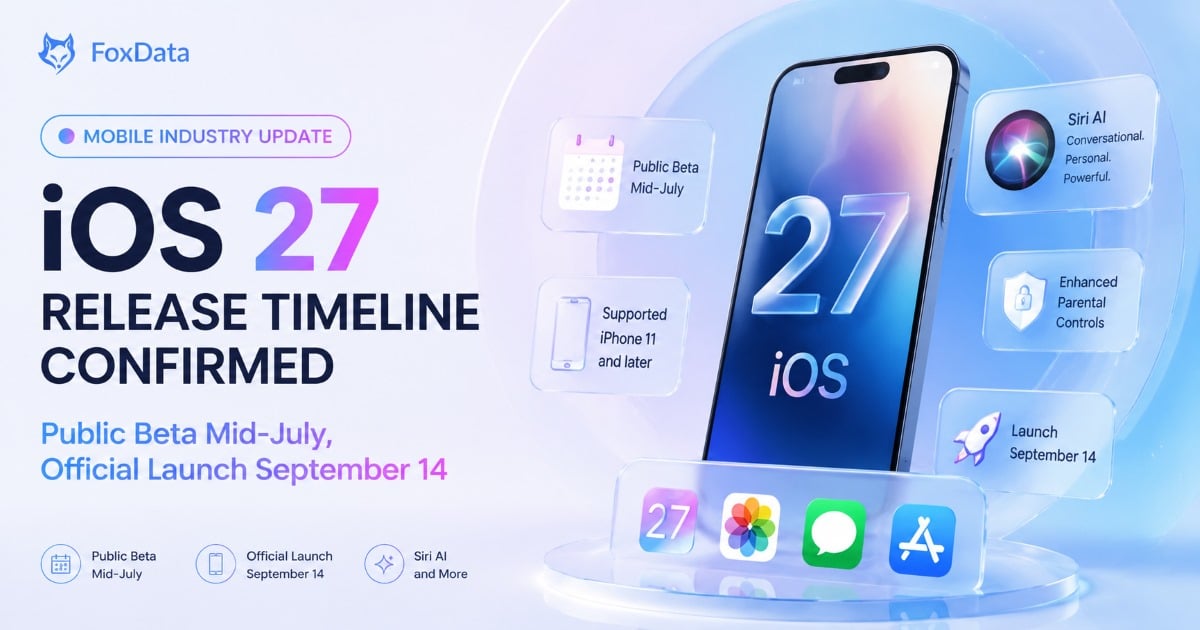
Apple has now locked in the rhythm of its biggest software rollout of the year. Following the WWDC 2026 keynote, developer betas have been shipping steadily since June 8, and Apple has confirmed the iOS 27 public beta will open in mid-July, with the stable release expected alongside new iPhones on September 14.
The headline act is Siri AI, a fully rebuilt, conversational Siri that will roll out gradually through an English-language waitlist rather than arriving for everyone on day one.
For developers, marketers, and everyday iPhone owners, this timeline is more than a calendar curiosity — it defines the exact window in which app icons, store listings, permission prompts, and AI-surfaced content need to be ready.This guide breaks down the confirmed dates, what's changing under the hood, and what each audience should do before September.
iOS 27 is Apple's next major iPhone software update, unveiled at WWDC 2026 on June 8 alongside iPadOS 27, macOS 27, watchOS 27, and tvOS 27 under Apple's now-unified "26/27" versioning scheme. The headline addition is Siri AI, a ground-up rebuild of Siri that blends personal context, on-screen awareness, and web knowledge to hold multi-turn conversations and complete app actions — positioning it much closer to conversational assistants like Claude or ChatGPT than the command-based Siri of the past decade.
Beyond Siri, iOS 27 brings meaningful updates to Photos, Messages, and Shortcuts, tighter and more granular parental controls, and a new per-alarm volume setting. Developer beta 2, released June 22, already introduced user-facing changes such as a "Write with Siri" tool replacing the older Writing Tools, a Wallet Insights view, and improved RCS messaging with inline replies. Every supported iPhone back to the iPhone 11 will be able to install iOS 27 for free, though Apple Intelligence and the new Siri AI experience remain gated to iPhone 15 Pro and later, reflecting the on-device processing these features require.
Siri AI combines three inputs Apple has never fully unified before: personal context pulled from Mail, Messages, Notes, Reminders, and Calendar; on-screen awareness of whatever app is currently open; and general web knowledge for open-ended questions. The result is a Siri that can hold a back-and-forth conversation, carry chat history across devices, and take multi-step actions inside apps rather than just returning a single answer.
Siri AI will not appear for everyone the moment iOS 27 installs. It ships in English first, gated behind a waitlist that Apple opens after the public release, and it will not be available in the European Union — due to Digital Markets Act compliance questions — or in China at launch. That means most of the parental-control, Photos, Messages, and Shortcuts improvements will be universally available on day one, while the marquee AI feature trickles out over the following months.
| Feature | iOS 26 | iOS 27 | Impact |
|---|---|---|---|
| Minimum build SDK | iOS 26 SDK mandatory since April 28, 2026 | iOS 27 SDK expected to become mandatory on a similar annual cycle | Developers must plan a Xcode 27 migration well before next spring's cutoff |
| Siri | Command-based assistant | Siri AI — conversational, on-screen aware, cross-app actions | New App Intents and Siri-surfaced content change how apps get discovered |
| Design language | Liquid Glass introduced | Liquid Glass carried forward and refined | Icons and screenshots need re-testing against translucent system chrome |
| Parental controls | Baseline content and screen-time controls | Deeper, more granular guardian controls | Kids-category and family apps face new compliance review criteria |
| Messaging (RCS) | Initial RCS support | Inline replies, improved delivery | Messaging and social apps should re-test cross-platform threads |
iOS 27 is a free update, as all iOS releases have been. The developer beta has been available since June 8, 2026, with beta 2 shipping June 22. The public beta is confirmed for July, with 9to5Mac and other outlets pointing to mid-July — potentially as early as the week of July 13 — as the likely window, based on the historical gap between the third developer beta and the first public build. A Release Candidate is expected in early September, most likely around September 7–9, tied to Apple's annual iPhone hardware event.
The general release is widely projected for Monday, September 14, 2026, continuing Apple's five-year pattern of mid-September Monday launches, though Apple has not yet confirmed an exact date. iOS 27 will run on any iPhone currently supporting iOS 26, from the iPhone 11 through upcoming iPhone 18 models, while Apple Intelligence features require an iPhone 15 Pro or later.
Most iPhone 11 and later owners will be able to install iOS 27 for free the moment it exits beta, gaining the parental control upgrades, per-alarm volume, and Messages improvements immediately. The headline feature, Siri AI, will feel different: it arrives in English only, requires joining a waitlist, and won't be available at all in the EU or China when the software first ships, so patience is part of the experience for anyone hoping to try the new conversational assistant on day one.
For families, the expanded parental controls are arguably the more immediately useful change, offering finer-grained management of what younger users can see and do without waiting on any waitlist. Anyone curious enough to try the software early can join the public beta in mid-July, though Apple's own guidance — and years of beta-testing history — still favors installing it on a secondary device rather than a daily driver.
The public beta is expected in mid-July 2026, with the stable, general release widely projected for Monday, September 14, 2026, alongside new iPhone hardware. Apple has not officially confirmed the exact date.
iOS 27 is a free software update for all eligible iPhones, consistent with every previous iOS release.
Every iPhone that currently runs iOS 26 will support iOS 27, reaching back to the iPhone 11. Apple Intelligence and the new Siri AI experience are limited to iPhone 15 Pro and later due to on-device processing requirements.
Siri AI is designed to hold multi-turn conversations, use on-screen and personal context, and take in-app actions — positioning it closer to general-purpose AI assistants than the earlier, command-based Siri, though it launches in English only and behind a waitlist.
Confirm your build pipeline already meets the iOS 26 SDK/Xcode 26 requirement enforced since April 28, 2026, test UI against Liquid Glass defaults, and review App Intents so your app is positioned to benefit from Siri AI's on-screen awareness once it rolls out.
iOS 27's timeline is now about as predictable as Apple software gets: a mid-July public beta, an early-September Release Candidate, and a general release tracking to Monday, September 14, 2026. The bigger story isn't the date — it's that Siri AI's staggered, waitlist-based rollout means the "real" iOS 27 experience will keep evolving for months after launch day, while SDK compliance, Liquid Glass continuity, and parental-control changes affect every developer and marketer immediately.
Bookmark this page — we'll update it the moment Apple confirms an exact release date at its September hardware event.
© 2020-2026 FoxData. All Rights Reserved.