



Explore More Possibilities for Your Business
Full-cycle scenario construction to meet your needs from App research, development, and release to operation.
Ready for your soaring growth

There are over 3.5 million apps in the Google Play Store and 1.6 million in the Apple App Store. Within that ocean of apps, VPN and utility tools are among the most saturated categories you can compete in. A search for 'VPN' on the App Store returns hundreds of results, even in the US alone. A search for 'file manager' or 'battery optimizer' looks just as crowded.
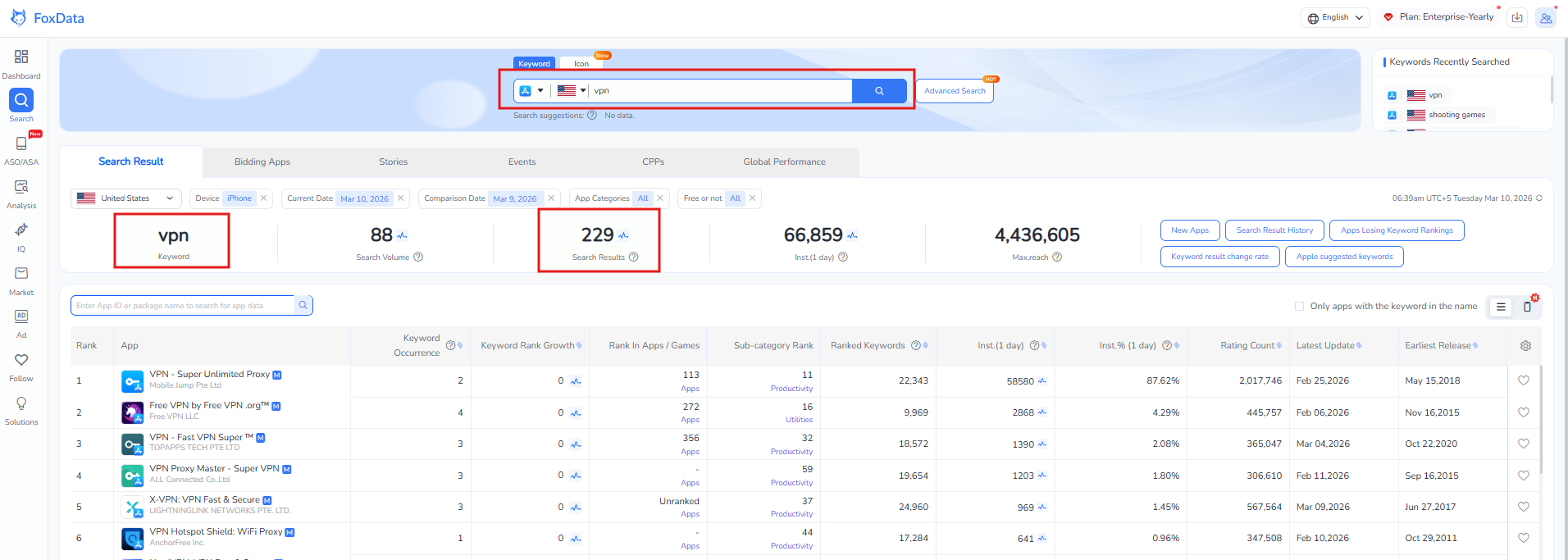 Keyword "VPN" with 88 search volume shows 229 search results in the US App Store alone. | Source: FoxData
For UA managers and app marketers, that saturation is not a reason to give up but it's a signal to get smarter. The apps that cut through the noise are not always the ones with the biggest budgets.
They're the ones built on disciplined keyword research, precise metadata optimization, and a clear understanding of how the algorithm actually works.
This guide breaks down the specific moves you can make to improve your utility app's discoverability, starting today.
Most marketers know they need keywords. Fewer understand how different keyword dynamics are inside the VPN and utility app category.
Unlike gaming or lifestyle apps, utility app users search with intent. They are not browsing but they are looking for a specific solution.
Someone typing 'secure VPN for public WiFi' or 'fast VPN for streaming' has a specific problem in mind. That intent-driven behavior makes long-tail keywords far more valuable in this category than in most others.
The challenge is that the most obvious keywords like 'VPN,' 'free VPN,' 'best VPN', are already claimed by dominant players like NordVPN, ExpressVPN, and Surfshark. Competing head-on for those terms with a mid-size or indie app is a losing proposition.
Effective keyword research for VPN apps means mapping the full intent spectrum of your target user: what are they afraid of, what outcome do they want, and how do they describe their problem in their own words?
That's where the real ranking opportunities live.
According to Windscribe, the global VPN market is projected to continue rising at $75–88 billion by 2027 and $137 billion by 2030 – roughly 15–17% annual growth (CAGR). Meaning that the search volume around VPN-related terms will only grow.
Getting into long-tail positions now, before that growth peak, builds a durable organic base that paid installs alone cannot replicate.
Discover how FoxData enhances data protection and security standards to keep your analytics safe and reliable.
Visibility in the App Store and Google Play is not random. Both stores use ranking algorithms that factor in keyword relevance, conversion rates, ratings, and engagement signals. If you are not deliberately engineering your metadata, you are leaving discoverability to chance.
Your app title is the most heavily weighted metadata field. It should contain your primary keyword naturally. For a VPN app targeting remote workers, something like 'SecurePass VPN: Fast & Private' communicates value while embedding a core search term.
The subtitle (iOS) or short description (Android) is your second most important field. Use it to address a secondary keyword cluster.
Apple gives you 100 characters in the keyword field with no spaces wasted on repetition. Every character should introduce a new concept.
On Android, Google's algorithm indexes your long description, so natural keyword integration across 80 words or more of that description is critical.
Conversion rate is a ranking signal. An app that gets clicked but not downloaded sends a negative signal. Your first two screenshots are visible before a user has to scroll. They need to communicate your core value proposition in under three seconds.
For VPN apps, that typically means showing speed, privacy assurance, and ease of use simultaneously.
The FoxData platform helps UA managers and ASO teams run this kind of structured metadata audit. Its productivity and utility app ASO tools give you keyword rankings, visibility scores, and competitor benchmarking in one place — built specifically for the types of apps where precision matters most.
The most common mistake in utility app keyword strategy is tunnel vision on a single intent.
VPN apps are not just for privacy-conscious users. They are used by travelers, remote workers, gamers looking to reduce ping, streamers accessing geo-blocked content, and parents setting up parental controls.
Each of those use cases maps to a distinct keyword cluster.
Here is a practical framework for building out your keyword universe:
According to data from AppFollow, apps that update their metadata with fresh keyword iterations at least once per month see measurably better ranking stability compared to apps that set metadata once and leave it unchanged. Keyword optimization is an ongoing process that requires monitoring, iteration, and competitive awareness.
In a saturated market, your competitors are your most underused research resource. The apps ranking on page one for your target keywords have already solved the optimization puzzle, at least partially. Your job is to understand what they did and where the gaps still exist.
Specific things to analyze in competitor listings:
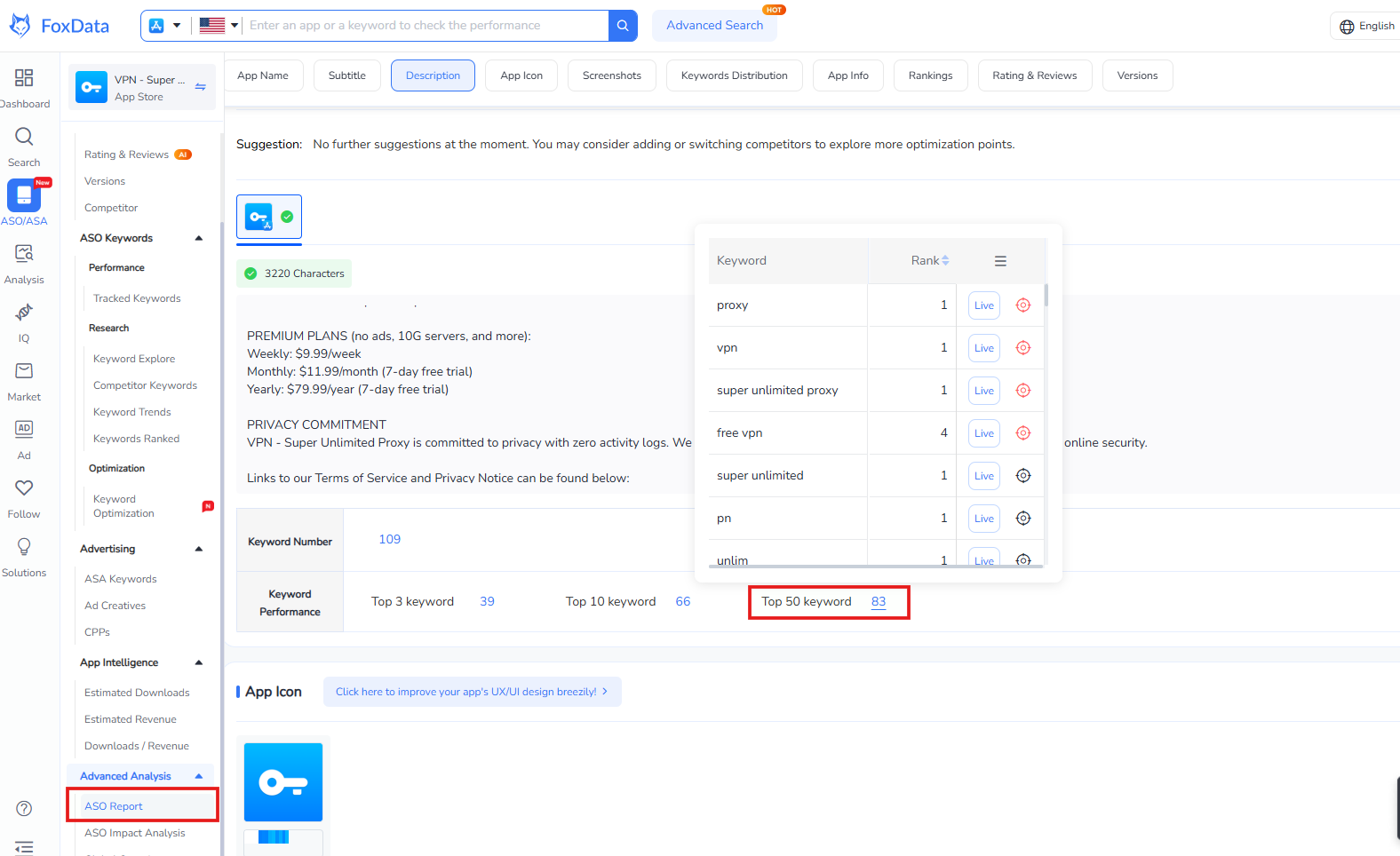 ASO report can help to identify the ASO performance of the mobile app. Keyword performance can help to identify top keywords inside the meta descriptions. | Source: FoxData
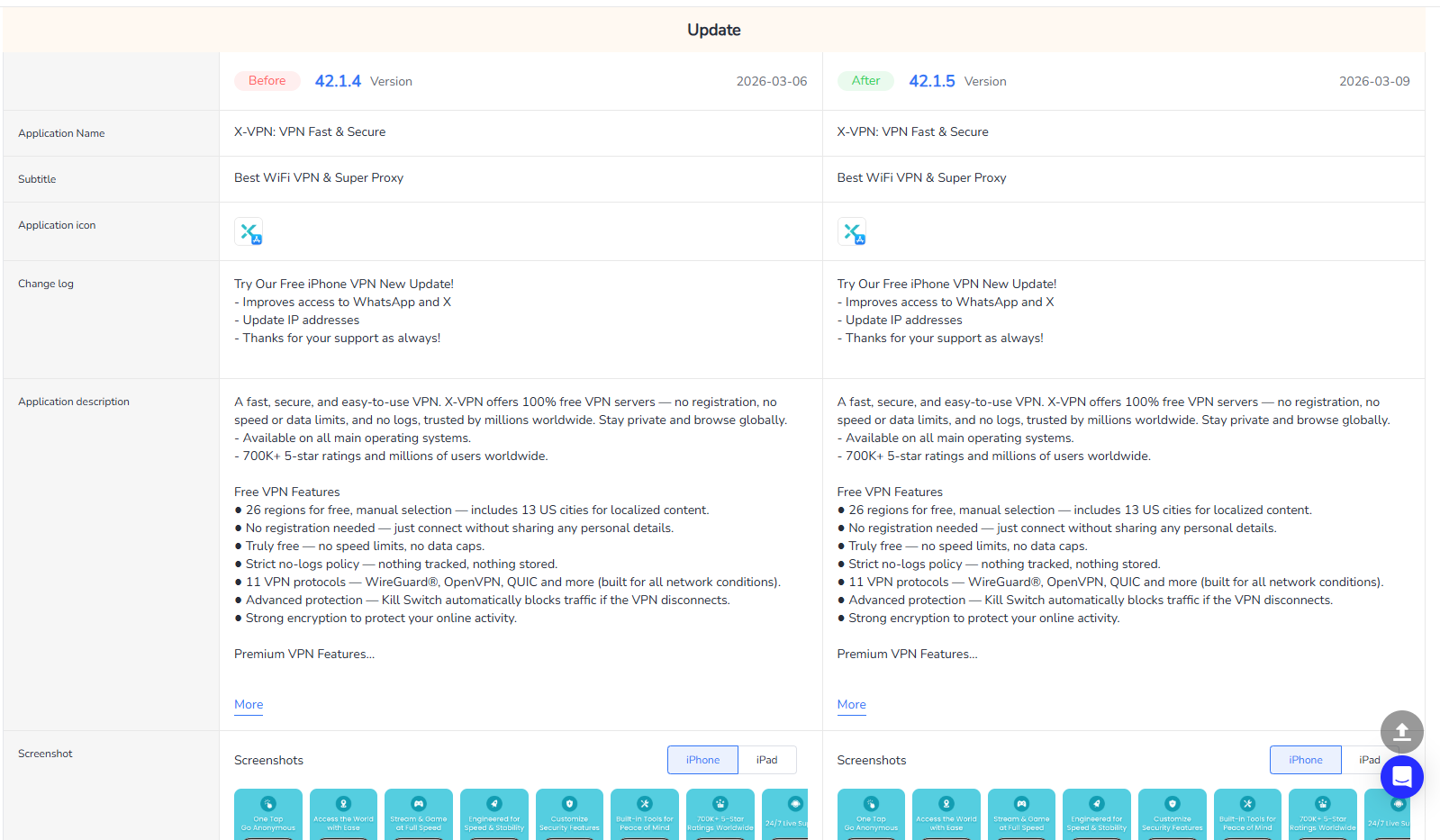 User can see the comparison between the previous update and the current update and find out what changes have been made in the new version update. | Source: FoxData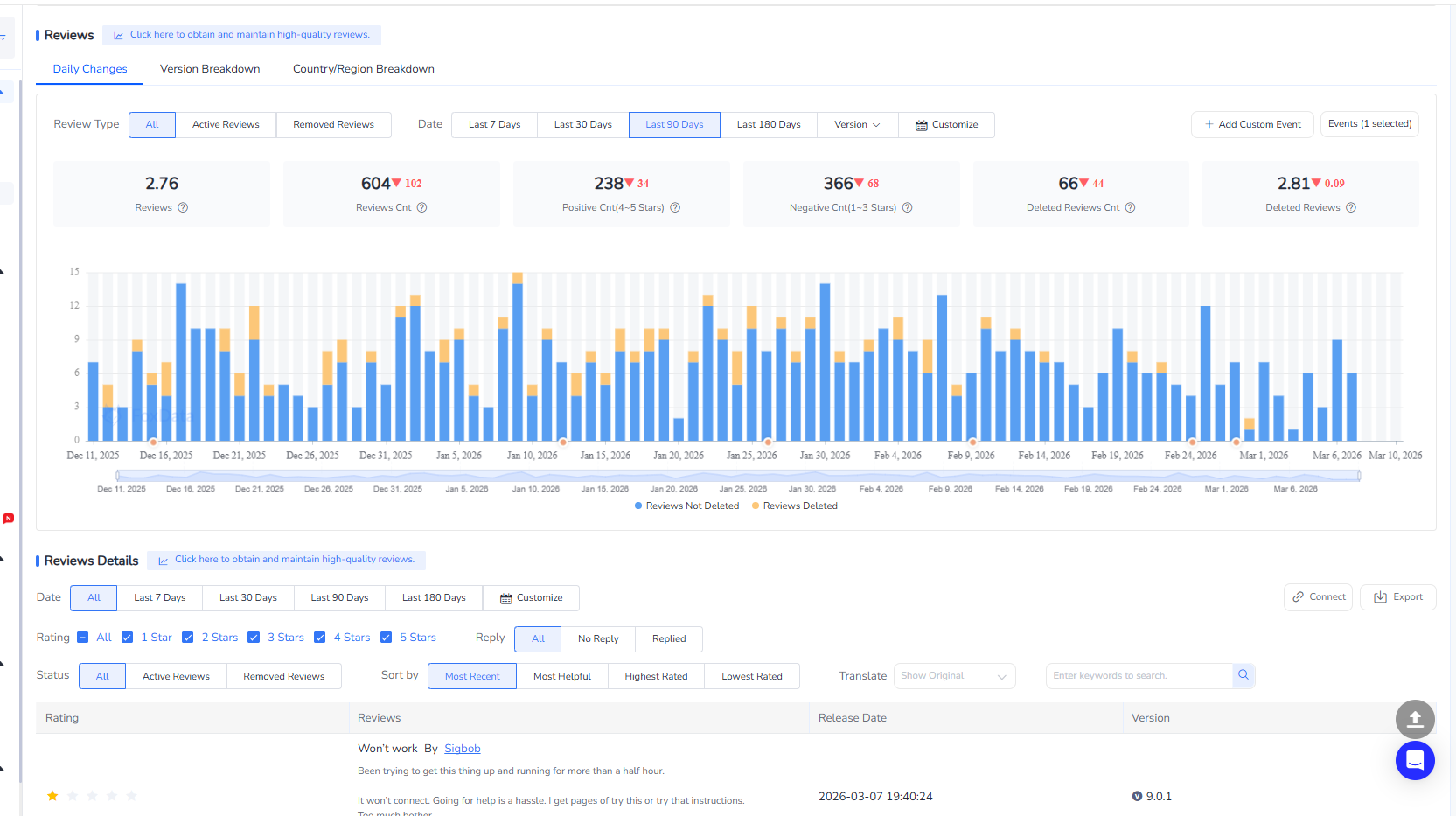
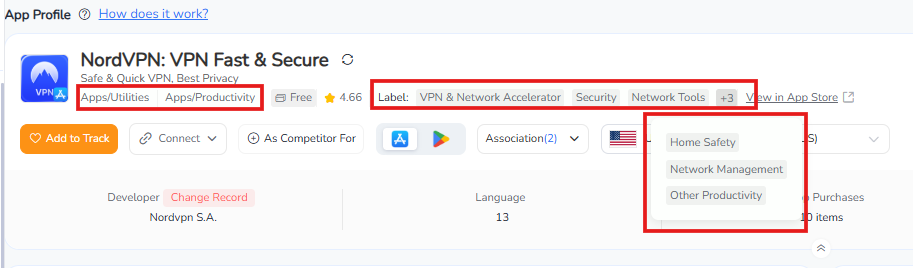 App profile shows the app category and the labels of the mobile app | Source: FoxData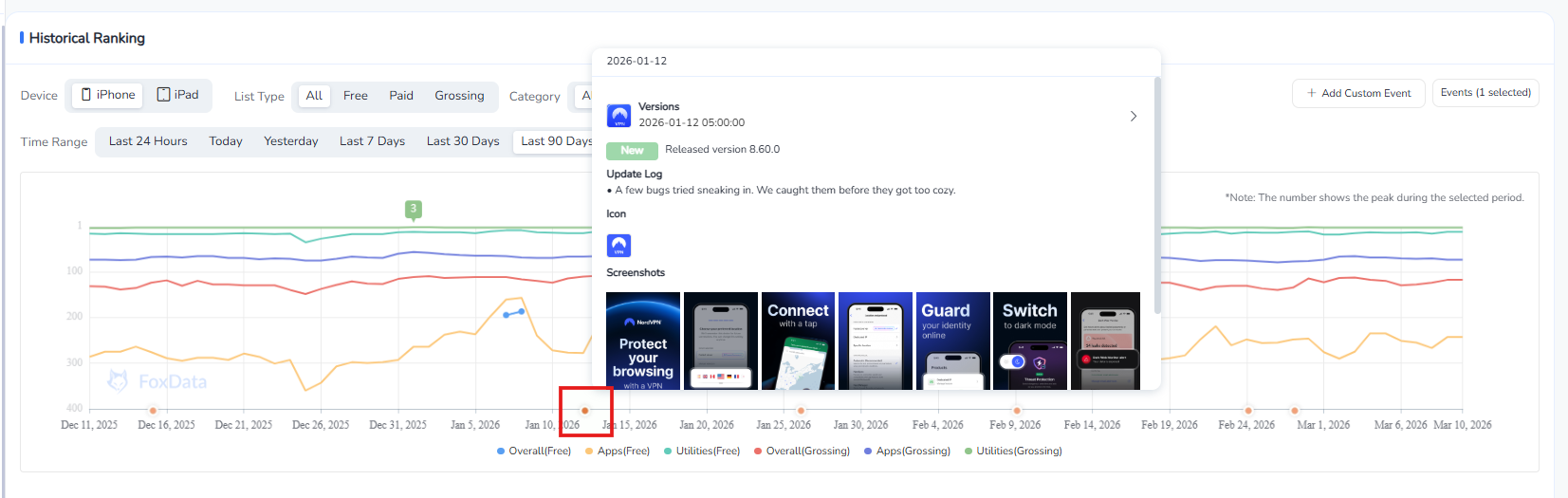
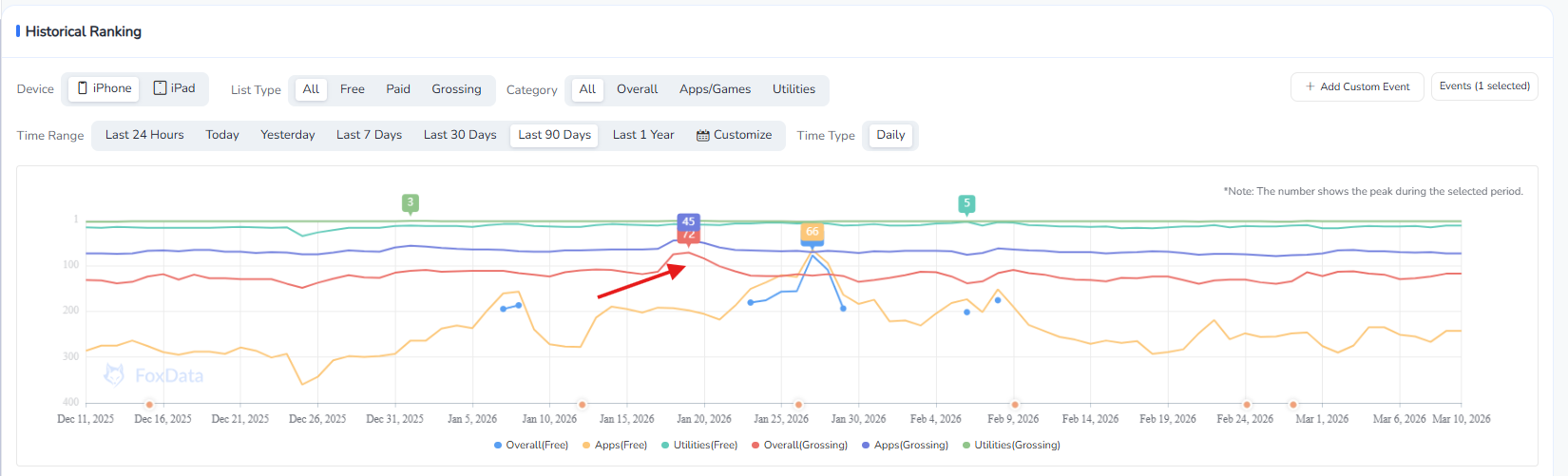 Historical ranking shows the category ranking over a period of time. User can then hover the tiny dot at the bottom of graph to learn more about the app update on that day. | Source: FoxData
The goal is not to copy what competitors are doing but to find what they are missing. If three of the top five VPN apps target 'streaming VPN' but none of them are targeting 'VPN for smart TV', that's an opening. If every competitor uses a dark, technical visual identity in their screenshots, a clean and friendly design might be a conversion rate differentiator.
Platforms built for this kind of competitive intelligence, like FoxData's app analytics and ASO solutions for productivity and utility apps, let you track competitor keyword movements over time so you can spot trend shifts before they become obvious and act on them first.
Keyword optimization does not exist in isolation. Your app's rating and review volume are direct ranking signals. For utility apps, they're especially important because users in this category are outcome-focused. They will leave a two-star review faster for a VPN that drops connections than a casual game player would for a level that's too hard.
A structured ratings strategy means:
A study found that apps with a rating of 4.0 or higher have significantly better conversion rates on their store pages compared to apps below that threshold. In competitive categories like VPN, even a 0.2-point drop in average rating can translate to measurable install volume loss.
Paid search through Apple Search Ads (ASA) is not separate from organic ASO but it feeds it. When you run ASA campaigns, you get real conversion data on keywords: which terms convert at what rate, and which terms get impressions but not installs.
That data is gold for organic keyword optimization. If a keyword converts well in paid search, it deserves a more prominent place in your organic metadata.
If a keyword shows high impression volume but low conversion, it might be driving the wrong intent. Users are might be expecting something your app doesn't deliver.
For VPN and utility apps, this loop is particularly powerful because search intent in this category is high and conversion windows are short. Users who search for 'VPN app' and land on your page have already made most of their decision before they even read your description. The metadata just needs to confirm it.
To manage your Apple Search Ads (ASA) campaign effectively, try FoxData's Intelligent Ad Platform:
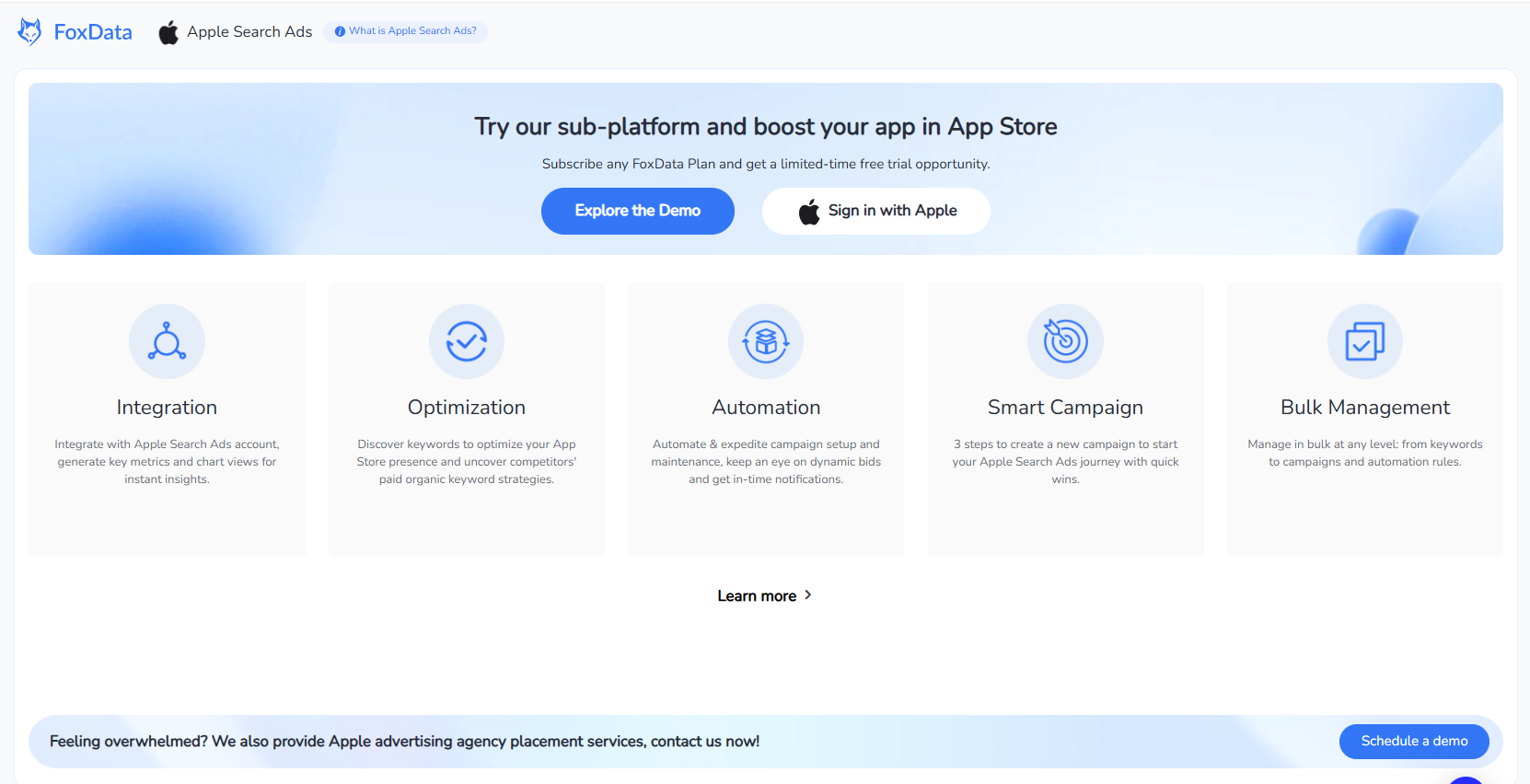 FoxData's Intelligent Ad Platform is an Apple Search Ads (ASA) management platform | Source: FoxData
The VPN and utility app market will not get less crowded. Most competitors are still operating on guesswork of unoptimized metadata, ignored long-tail opportunities, and ASO treated as a one-time launch task rather than an ongoing discipline.
The apps that win treat discoverability as a system. Keyword research feeds metadata. Metadata feeds conversion data. Conversion data feeds the next iteration.
That loop, run consistently, is what separates page one from everyone else.
Start with your keyword architecture. Audit your metadata. Study competitor gaps. Iterate every 30 days. The utility app category rewards precision. Give it exactly that.
There is no fixed number, but a useful launch framework is to target three to five primary keywords with moderate competition and twenty to thirty long-tail keywords across multiple intent clusters. Start with terms where you have a realistic chance of ranking in the top 30, then build authority from there. Targeting high-competition head terms at launch with limited review volume and ratings history rarely works.
For competitive categories like VPN apps, reviewing metadata monthly is a strong baseline. After each App Store Connect update cycle (typically every 30 days on iOS), analyze which keywords gained or lost positions and iterate. On Android, smaller description updates can be pushed more frequently without requiring a full app update submission.
Yes, both Apple and Google factor in app freshness as part of their ranking signals. Apps that are updated regularly are seen as actively maintained, which builds trust with the algorithm and with users. For utility apps specifically, consistent updates also give you regular opportunities to refresh your metadata, test new screenshots, and improve your conversion rate.
ASO (App Store Optimization) is how you optimize your listing to rank naturally and organically in search results without paying per click. ASA is a paid channel where you bid on keywords to appear at the top of search results. The two are complementary: ASA gives you immediate keyword performance data and installs, while ASO builds sustainable organic visibility over time. For utility apps with limited UA budgets, a strong ASO foundation reduces dependence on paid channels.
Ready to make your app shine? Optimize your app's visibility with FoxData! Maximize downloads and rankings by leveraging our powerful insights today.
App Growth & ASO Tools by FoxData
FoxData supports every stage of app growth with specialized ASO and app analytics tools, helping teams improve keyword visibility, user acquisition, and retention through reliable data.
🔍 Store Keyword Research Tools
Research high-intent keywords, search volume, and competition to strengthen your app store optimization strategy.
📈 App Store Keyword Tools
Analyze keyword rankings and performance across the Apple App Store and Google Play to refine ASO execution.
📊 ASO Monitoring Tools
Monitor keyword ranking changes, visibility trends, and ASO impact over time with continuous performance tracking.
👥 User Activity Monitoring Tools
Understand in-app user behavior, engagement, and retention with real-time user activity analytics.
Together, these tools form FoxData’s ASO analytics and app intelligence ecosystem, designed to help developers, marketers, and growth teams make data-driven decisions and scale sustainably.
Explore it today!
👉 Learn more about FoxData here | 👉 Book a demo with FoxData team today!
© 2020-2026 FoxData. All Rights Reserved.