


Explore More Possibilities for Your Business
Full-cycle scenario construction to meet your needs from App research, development, and release to operation.
Ready for your soaring growth
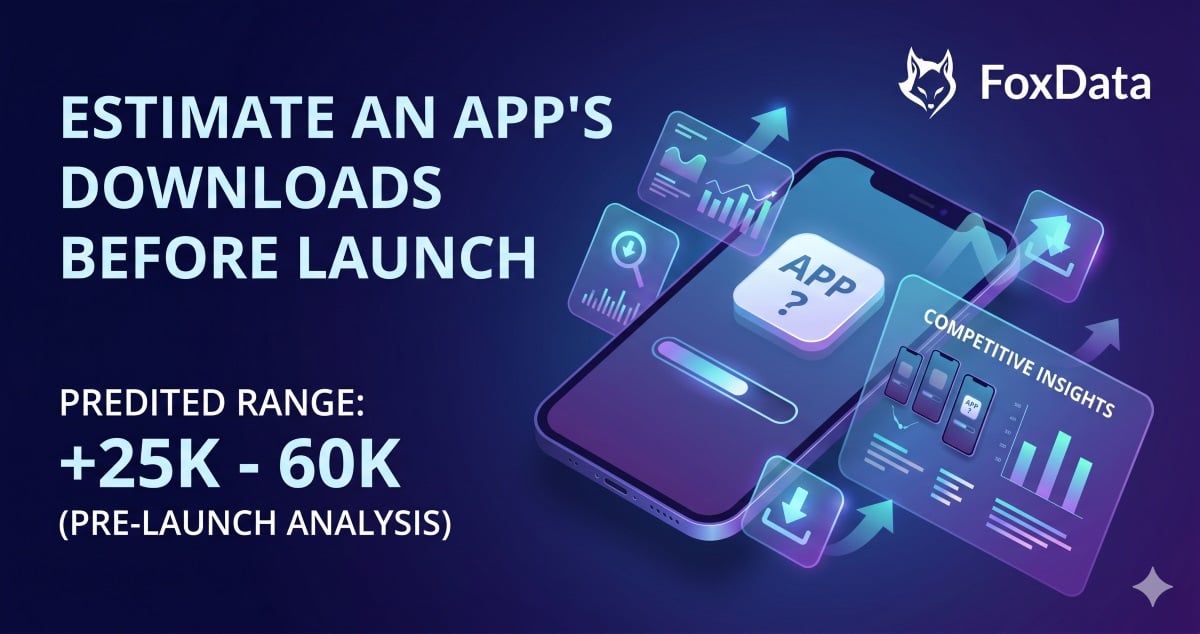
Launching a mobile app without knowing your market is like opening a store without checking foot traffic. The stakes are high in 2026. According to TechCrunch, global downloads across the App Store and Google Play reached approximately 106.9 billion in 2025 — and yet consumer spending climbed to nearly $155.8 billion, a 21.6% increase year over year. More money is moving through fewer downloads. That means every install counts more than ever.
Before you invest in development, creative assets, or paid user acquisition, you need to answer one critical question: how many downloads does an app actually get in your category and market? This article shows you exactly how to find that answer, what data to trust, and how to use an app download estimation tool to make smarter competitive decisions.
You cannot build a revenue forecast, a UA budget, or a competitive positioning strategy without understanding download volume. Here is what estimated app download data tells you:
According to Apple, 65% of all App Store downloads originate from search. If you do not know what keywords are driving downloads for your competitors, you are missing the single largest channel for organic installs.
There is no perfectly exact method for calculating predicted app downloads. However, combining several signals gives you a reliable range. Here are the most practical approaches.
Apps that rank in the top 3 positions for high-volume keywords receive significantly more downloads than lower-ranked apps. Research shows that apps in the top 3 search results get up to 90% more downloads than those ranked below them. If you know an app's keyword ranking and the estimated monthly search volume for that keyword, you can reverse-engineer a download range.
An app download estimation tool like the one inside FoxData's app analytics and ASO performance metrics platform can show you which keywords a competitor ranks for, their estimated search volume, and how that correlates to install trends over time.
App store chart positions in the Top Free, Top Grossing, or category-specific charts are a direct reflection of recent download velocity. A sustained position in the top 20 of a category typically signals consistent daily download volume. Plotting ranking fluctuations over 30, 60, or 90 days gives you a picture of whether a competitor is growing, plateauing, or declining.
You can explore this through FoxData's global mobile app market research tools, which allow you to monitor competitor chart positions across multiple regions and app stores simultaneously.
Apps receive reviews from roughly 1% to 5% of their total user base, depending on the category and platform. If a competitor has accumulated 2,000 new reviews in the past 30 days, you can estimate they have had somewhere between 40,000 and 200,000 downloads in that period. This is an imperfect but directionally useful metric, especially when combined with ranking and keyword data.
This is the most reliable method. Platforms that aggregate app store data, keyword rankings, chart histories, and revenue signals produce download estimates calibrated against real market patterns. Rather than guessing, you get a statistically grounded range.
For game developers and indie publishers specifically, FoxData's ASO tools for indie developers provide access to download trend charts like the one shown at the top of this article: granular, day-by-day visibility into how competitors are performing across each platform.
FoxData is built for mobile teams who need to move from guesswork to data. Here is how to use its platform for download estimation specifically.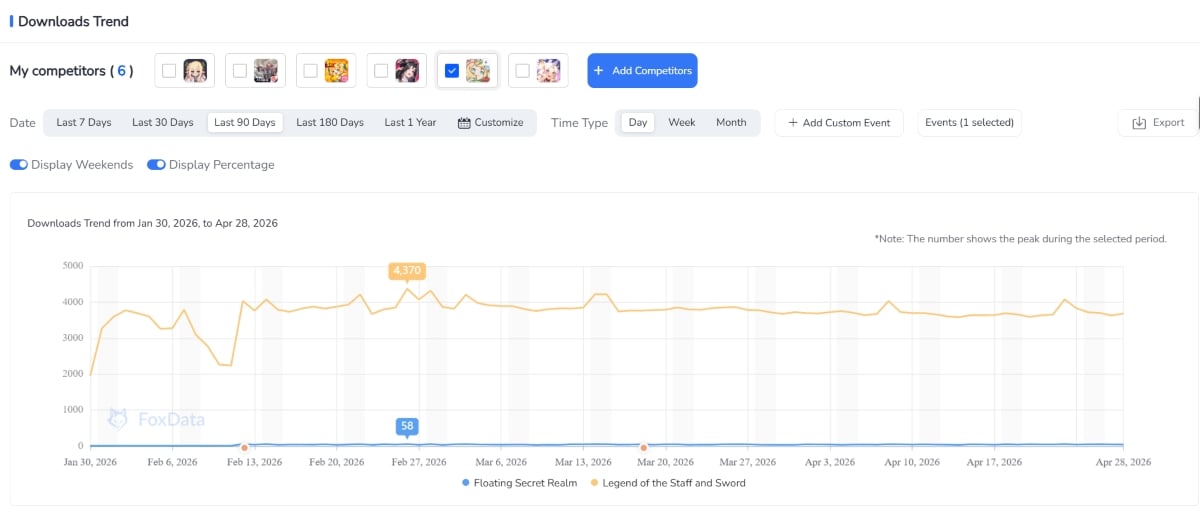
Step 1: Build your competitor set. Inside FoxData's competitor tracking dashboard, add the apps you are competing against or benchmarking. You can track up to 6 competitors simultaneously, as shown in the downloads trend visualization above, and monitor their daily download performance across a custom date range.
Step 2: Set your time window. Use the Last 90 Days view to identify medium-term trends and seasonal patterns. Use Last 7 Days when you want to detect whether a competitor recently ran a campaign or updated their metadata. The date range flexibility matters because a single snapshot of app download data tells you very little. Trends are what drive decisions.
Step 3: Analyze keyword coverage gaps. Use FoxData's keyword research feature to identify which high-volume terms your competitors rank for that you do not. A fitness app that used FoxData's tools increased keyword coverage by 60% and reduced acquisition costs by 28% by identifying exactly this kind of gap. More keyword coverage means more predicted app downloads from organic search.
Step 4: Cross-reference with the ASO impact analysis. Use FoxData's ASO impact analysis tools to see which metadata changes correlate with download spikes. If a competitor updated their title or screenshots and their downloads jumped 20% the following week, that is a competitive signal worth acting on.
Step 5: Export and report. Once you have download trend data, keyword coverage insights, and competitor benchmarks, export them to share with your UA team, publisher, or studio leadership. Decisions made with real app download data are far easier to defend and fund.
For a deeper framework on competitive analysis, FoxData's guide on how to deconstruct a competitor's game walks through the full competitive intelligence process step by step.
Relying on a single data point. One keyword ranking or one chart position does not tell the full story. Download estimation requires triangulating across keyword trends, review velocity, and ranking history together.
Ignoring geographic variation. India led all countries in app downloads in 2025 with approximately 19.1 billion installs, followed by the United States at 12.6 billion. The top 10 countries account for roughly 60% of all global downloads. An estimate built on global averages may be wildly inaccurate for a specific launch market.
Confusing revenue signals with download signals. A high-grossing app is not necessarily a high-download app. The App Store consistently generates more revenue per download than Google Play, even though Google Play accounts for approximately 73.5% of total global downloads. Mixing up monetization data with install data leads to bad projections.
Using stale data. The mobile market moves fast. Download data from 12 months ago may not reflect current category dynamics, especially in gaming. Always work from the most recent 30 to 90 days of app download data.
Treating estimates as guarantees. Download estimates are ranges, not targets. Build your planning models with a base case, upside, and downside scenario rather than anchoring to a single number.
Estimates vary by platform and methodology but are generally directionally accurate within a reasonable margin. They are most reliable when used comparatively, for example, benchmarking your app against 3 to 5 close competitors rather than expecting a precise absolute number.
Yes. That is one of the most valuable use cases. Before launch, analyze your top 5 competitors' download trends over the past 90 days to understand realistic category volume, seasonal patterns, and what level of ASO investment is required to be competitive.
Downloads refer to the number of times an app is tapped to install from the store. Installs can include re-downloads and multi-device installations by the same user. When using app download data for competitive analysis, make sure you understand which metric your tool is measuring to ensure apples-to-apples comparisons.
For active competitors in a fast-moving category, weekly monitoring is recommended. For broader market benchmarking, a monthly review is sufficient. FoxData's platform supports both with configurable date ranges and export options.
The apps winning in 2026 are not the ones with the biggest budgets. They are the ones making better decisions with better data. Whether you are preparing a launch, benchmarking against a competitor, or pitching a publisher, knowing how to estimate app downloads is a foundational skill for any mobile team.
The good news: you do not need to build this capability from scratch. FoxData gives you the download trend data, ASO analytics, and competitor intelligence to answer the question "how many downloads does an app get?" with real numbers, not guesswork.
Ready to stop estimating blind? Explore FoxData's full suite of app analytics and ASO performance tools and start making decisions backed by real app download data today.
© 2020-2026 FoxData. All Rights Reserved.