


Explore More Possibilities for Your Business
Full-cycle scenario construction to meet your needs from App research, development, and release to operation.
Ready for your soaring growth
The mobile app market is no longer a game of guesswork. As of April 2026, there are approximately 2.29 million apps on Google Play and 2.22 million on the Apple App Store, according to 42matters. The teams that win are the ones who make decisions based on real data.
Yet, many developers and marketers still rely on gut instinct. They launch features without validating demand. They copy competitor keywords without understanding context. They miss algorithm changes until their rankings have already dropped.
Market research is not a one-time project. It is an ongoing discipline. And the tools you use to conduct it will either sharpen your edge or slow you down.
This guide walks you through how to use FoxData's free ASO and app analytics tools to build a research system that keeps you informed, competitive, and ready to act.

Discover how FoxData enhances data protection and security standards to keep your analytics safe and reliable.
In 2025, global consumer spending across the App Store and Google Play reached $155.8 billion, a 21.6% increase year over year, according to FoxData's data. Yet total downloads fell for the fifth consecutive year, dropping to 106.9 billion installs. Users are spending more but downloading less. App discovery has never been more competitive, and standing out requires strategic positioning.
The broader mobile app market reached $298.4 billion in 2025 and is projected to grow to nearly $400 billion in 2026, according to Precedence Research. Long-term forecasts put the market above $1 trillion by 2034. That growth attracts new entrants constantly. If you are not tracking the market, someone else is tracking you.
Statista projects combined consumer spending across both major app stores to reach $233 billion by 2026. The opportunity is enormous, but so is the noise. Data-driven market research is how you cut through it.
Research from industry analysts shows that nearly all user acquisition channels, including paid social, influencer campaigns, and web traffic, eventually funnel users to your app store page. If that page is not optimized with the right keywords, visuals, and messaging, every other channel underperforms.
App Store Optimization (ASO) is not just about ranking. It is about understanding what users search for, what competitors say, and how your positioning compares in real time. That understanding starts with structured market research.
Effective market research in mobile has four dimensions. Miss any one of them, and your strategy has blind spots.
You need to know whether your app category is growing or shrinking. You need to spot rising sub-genres before they peak. You need to understand seasonality patterns that affect download behavior.
For mobile game publishers, this means watching which game mechanics are trending. For productivity apps, it means monitoring shifts in user behavior around subscription willingness and feature demand.
Competitor research is not just about knowing who ranks above you. It is about understanding why. What keywords are they ranking for? When did they update their metadata? What changed after their last major version release?
Research shows that top apps on Google Play update their screenshots between two and eight times per year, and those that update more frequently rank higher. Understanding competitor update cadence is a strategic research input.
Keyword research in ASO is distinct from web SEO. App store search intent is specific, action-oriented, and shorter. You need to identify keywords with high relevance, manageable difficulty, and growing search volume before competitors saturate them.
Apple and Google update their store algorithms regularly. Review policy changes, new metadata fields, and ranking signal updates all affect your visibility. If you are not monitoring these shifts proactively, you are always reacting instead of adapting.
FoxData's app analytics and free ASO tools are built specifically for the workflows mobile marketers face daily. Here is how to use them tactically across each research dimension.
Begin every research session with a broad market scan. FoxData's Global Overview and Top Charts modules let you see which apps are trending by country, category, and store.
Filter by your target category and region. Look at the top 50 to 100 apps. Note which ones are rising quickly. A rapid climb in rankings often signals a product or positioning change worth studying.
Pay attention to new entrants. An app that did not exist three months ago and is now in the top 20 deserves a close look. Use FoxData's Estimated Downloads and Estimated Revenue tools to gauge how large a threat or opportunity it represents.
This step should take no more than 15 to 20 minutes. The goal is to identify two or three signals worth investigating further, not to read every data point available.
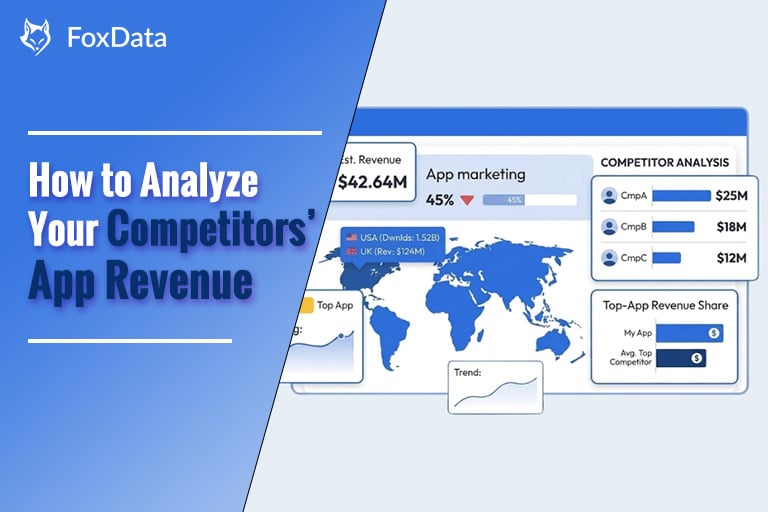
Once you have identified key competitors, go deeper using FoxData's Competitor Analysis and App Data Analysis features. Pull their keyword rankings, review their metadata history, and analyze their download and revenue trend lines.
Look for the inflection points. Where did their downloads spike? Did that coincide with a metadata update, a featured placement, or a paid campaign push? FoxData's ASO Impact Analysis feature maps update timelines against performance metrics, making these connections visible.
This is one of FoxData's most tactically useful capabilities. You are not just seeing what competitors rank for. You are seeing what happened when they changed something, and whether it worked.
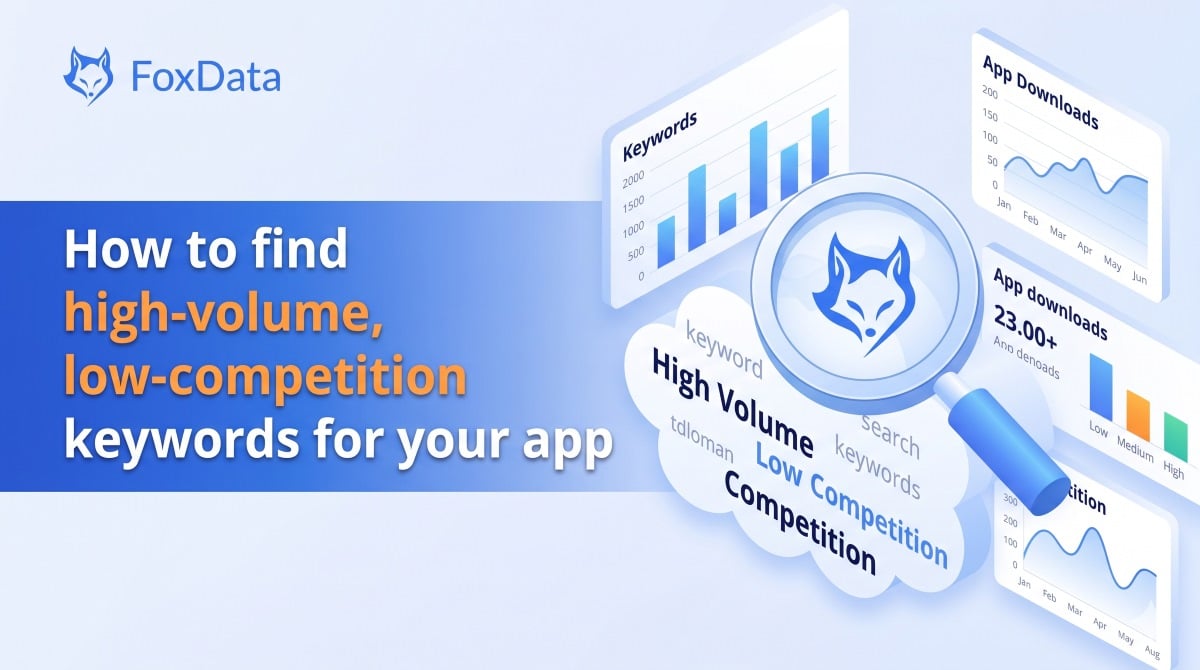
Use FoxData's Keywords Research and Ranked Keywords tools to audit your current keyword portfolio. Identify which terms you rank for and which high-value terms you are missing entirely.
Cross-reference your keyword list against competitor data. If a rival ranks in the top five for a term you are not targeting at all, that is a gap. If you and three competitors all target the same keyword and none of you rank in the top 10, that is a signal the term may be oversaturated or the wrong fit.
Use the Keyword Chance Score and Difficulty metrics to prioritize. Target terms where your app has genuine relevance and where competition leaves room to enter. Then use Metadata Management to push optimized updates and track their impact.
Market research is not a one-time exercise. You need to know when things change.
FoxData's Store Monitor and App Movement IQ features track keyword ranking shifts, new competitor activity, and metadata changes across the stores. Set up alerts for your top competitors and your most important keyword clusters.
When an alert fires, do not just note it. Investigate it. Use FoxData's update history and ASO Impact tools to understand what changed and what the downstream effect was. That context transforms a notification into a learning opportunity.
Download trends and keyword rankings tell you what is happening. Reviews tell you why. FoxData's Reviews Management module aggregates user feedback and surfaces patterns in sentiment.
When you see a competitor's rating drop, check their recent reviews. Is it a bug? A pricing change? A feature removal? This qualitative signal, combined with quantitative download data, gives you a complete picture.
Apply the same analysis to your own app. Negative review clusters often surface problems before they appear in your metric dashboards.
Many teams invest in research before launch and then stop. The market keeps moving after your app is live. Competitor strategies evolve. Algorithm updates happen. User preferences shift. Research must be continuous.
Build a simple weekly or bi-weekly review ritual using tools like the FoxData analytics platform. Even 30 minutes of structured data review per week compounds into a significant strategic advantage over six months.
It is tempting to pull a competitor's top keywords and add them all to your metadata. But keyword relevance matters more than keyword volume. Apple and Google both penalize irrelevant keyword stuffing with lower conversion rates and reduced ranking signals.
Evaluate each keyword for fit with your actual app experience. If users search for a term, land on your page, and do not convert, that negative signal hurts your ranking further down the funnel.
A keyword strategy built entirely on one market misses global opportunity. Research shows that the Asia-Pacific region accounts for more than 52% of the global mobile application market. Markets in Southeast Asia, Japan, and South Korea have distinct search behaviors, different competitive landscapes, and untapped keyword opportunities.
Use FoxData's localization and global research tools to identify which markets offer the best growth potential relative to your current performance.
Downloads alone do not tell you whether your ASO is working. A spike in downloads from a low-quality keyword brings users who churn fast. Track conversion rates, keyword ranking movement, and revenue impact together. FoxData's Estimated Revenue and ASO Impact tools help you measure outcome, not just output.
Before you make any significant change to your app title, subtitle, or description, audit your current reviews. Understand what users already value and what language they use to describe your app. The best metadata updates are informed by how real users talk about real benefits.
A: At minimum, review competitor rankings, keyword performance, and category trends every two weeks. Set up automated monitoring alerts so you are notified of significant changes between scheduled reviews.
A: ASO tools focus on visibility, specifically keyword rankings, metadata optimization, and store conversion. App analytics tools measure performance data like downloads, revenue, and user behavior. FoxData combines both in a single platform, which makes it easier to connect optimization actions to business outcomes.
A: Yes. FoxData offers free ASO tools suited to early-stage teams with limited resources. You do not need a dedicated analyst to run competitor research or keyword audits. The interface is built for practitioners, not just data scientists.
A: Track keyword ranking movement, conversion rate changes, and download trends in the two to four weeks after any metadata update. FoxData's ASO Impact Analysis maps update timelines against performance metrics, so you can see causation rather than just correlation.
The mobile market rewards teams that research continuously, adapt quickly, and make decisions backed by real data. Keyword guesswork, static competitor snapshots, and one-time launch audits are strategies that used to work when the market was less crowded.
That era is over.
With roughly 4.5 million apps across the two major stores and consumer spending hitting $155.8 billion in 2025 despite falling download volumes, the gap between data-driven teams and reactive ones is widening every quarter.
FoxData gives you the infrastructure to close that gap. From market overview and competitor deep-dives to keyword optimization and real-time monitoring, the tools are designed to make continuous research practical, not just possible.
The teams winning in mobile right now are not necessarily the ones with the largest budgets. They are the ones with the clearest picture of their market.
Start building yours today. Explore FoxData's free app analytics and ASO tools and get the market intelligence you need to grow smarter, rank higher, and stay ahead of every change the app stores throw your way.
© 2020-2026 FoxData. All Rights Reserved.