

Explore More Possibilities for Your Business
Full-cycle scenario construction to meet your needs from App research, development, and release to operation.
Ready for your soaring growth
The mobile app market has never been more competitive. With over 5 million apps across the Apple App Store and Google Play combined, getting discovered organically is no longer a matter of luck or basic keyword stuffing. It requires a systematic, intelligence-driven approach and that is exactly where data-driven ASO agencies come in.
For app studios, indie developers, and enterprise publishers alike, working with a skilled ASO agency can be the difference between a breakout hit and a forgotten listing. But for agencies themselves, the challenge is building internal systems that are both repeatable and scalable.
Whether you are starting an ASO practice from scratch or looking to sharpen an existing one, this guide covers the tools, frameworks, and operational disciplines needed to deliver consistent, measurable results for clients, and to grow your agency sustainably.
Intuition and creative instinct still have a role in mobile marketing. But in ASO, data is the foundation that everything else is built on.
Research consistently shows that organic search accounts for roughly 65% to 70% of all app downloads globally. That means that for most apps, the App Store and Google Play search algorithms are the most powerful distribution channel available and those algorithms respond to data signals like keyword relevance, conversion rates, ratings velocity, and more.
Here is why data specifically matters for ASO agencies operating at scale:
Client accountability requires measurement. Agencies that cannot quantify the impact of their work lose clients. Data allows you to tie keyword ranking improvements, conversion rate lifts, and revenue growth directly to the ASO work you are delivering.
App store algorithms change frequently. Apple and Google regularly update how they weight metadata, visuals, and behavioral signals. Agencies that track performance data continuously can detect these shifts early and adapt before clients notice a drop.
Multi-client management demands efficiency. An agency handling five clients can get by with manual tracking. One handling twenty cannot. Structured data workflows allow teams to monitor dozens of apps simultaneously without sacrificing quality.
Competitor intelligence is an ongoing advantage. Understanding what keywords competitors are ranking for, which creatives they are testing, and where they are investing in Apple Search Ads gives your clients a meaningful edge. That intelligence only comes from systematic data collection.
On average, ASO results in a 9–12% boost in app downloads, particularly after optimizing visual assets and keyword strategies. That conversion gap is where ASO agencies earn their value but only if they are working from reliable data.
Before diving into processes, it is worth being clear about what an ASO agency's technology stack should accomplish. At minimum, you need visibility across four domains:
Keyword intelligence. The ability to discover high-volume, low-difficulty keywords relevant to your client's category; track daily ranking changes; and identify gaps between your client and their top competitors.
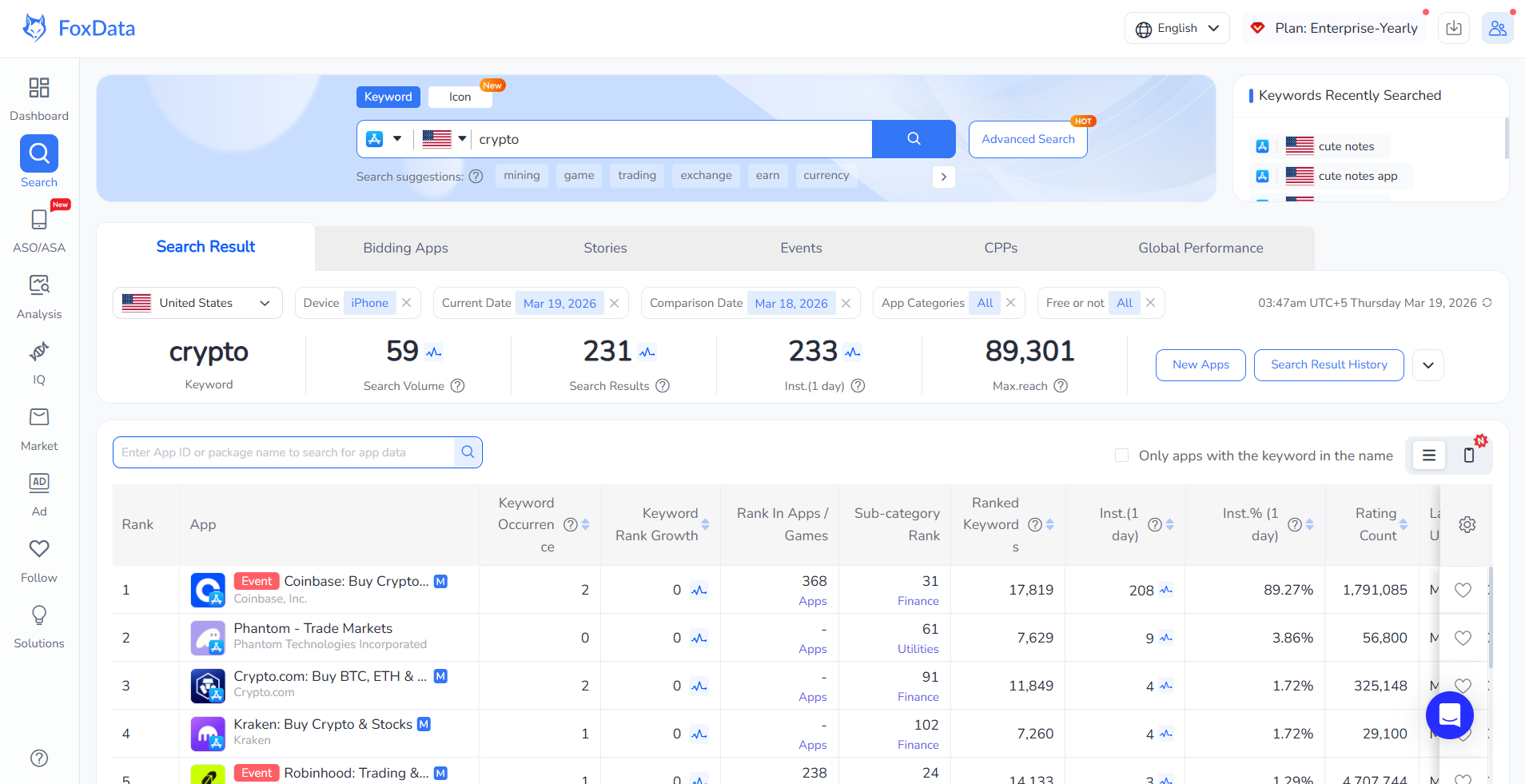
Creative performance analysis. Screenshots, icons, and preview videos are conversion assets. Your stack needs to reveal how creatives are performing relative to competitors and inform A/B testing decisions.
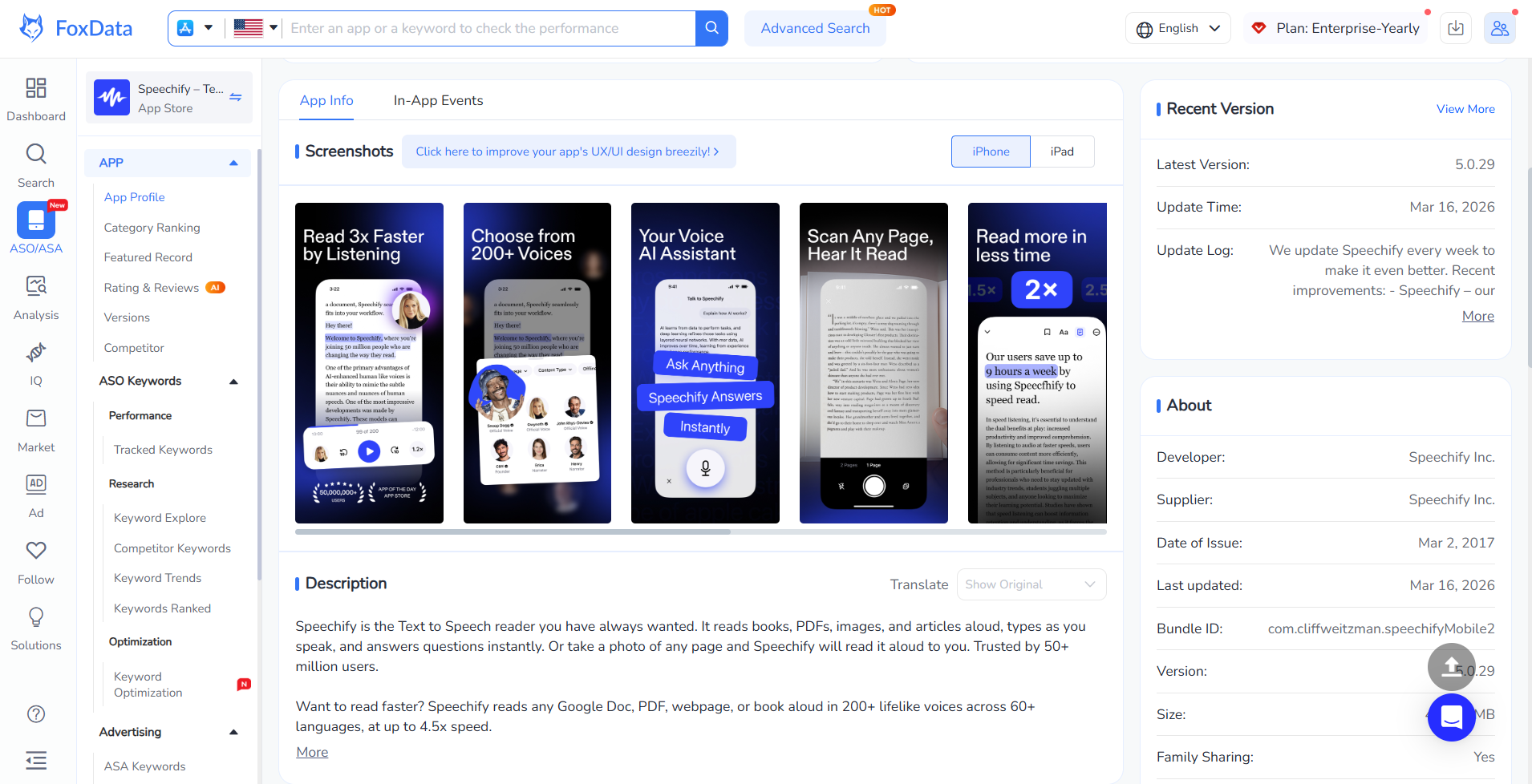
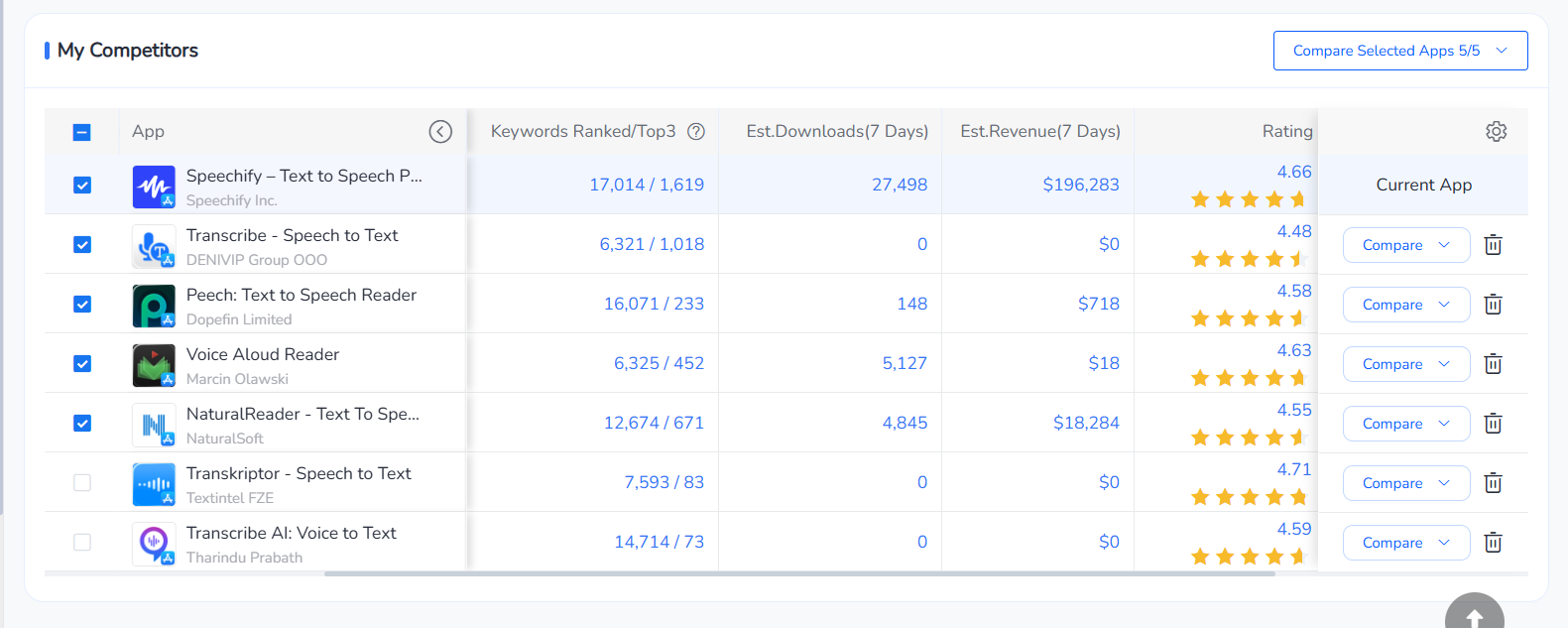
Competitor monitoring. ASO is not played in isolation. Agencies that track competitor metadata changes, rating trends, and keyword movements can help clients respond quickly and strategically.
Apple Search Ads (ASA) data integration. For agencies running paid UA alongside organic ASO, integrating search ads data with organic keyword performance is essential. It allows you to identify which paid campaigns reinforce organic rankings and which keywords are worth investing in organically.
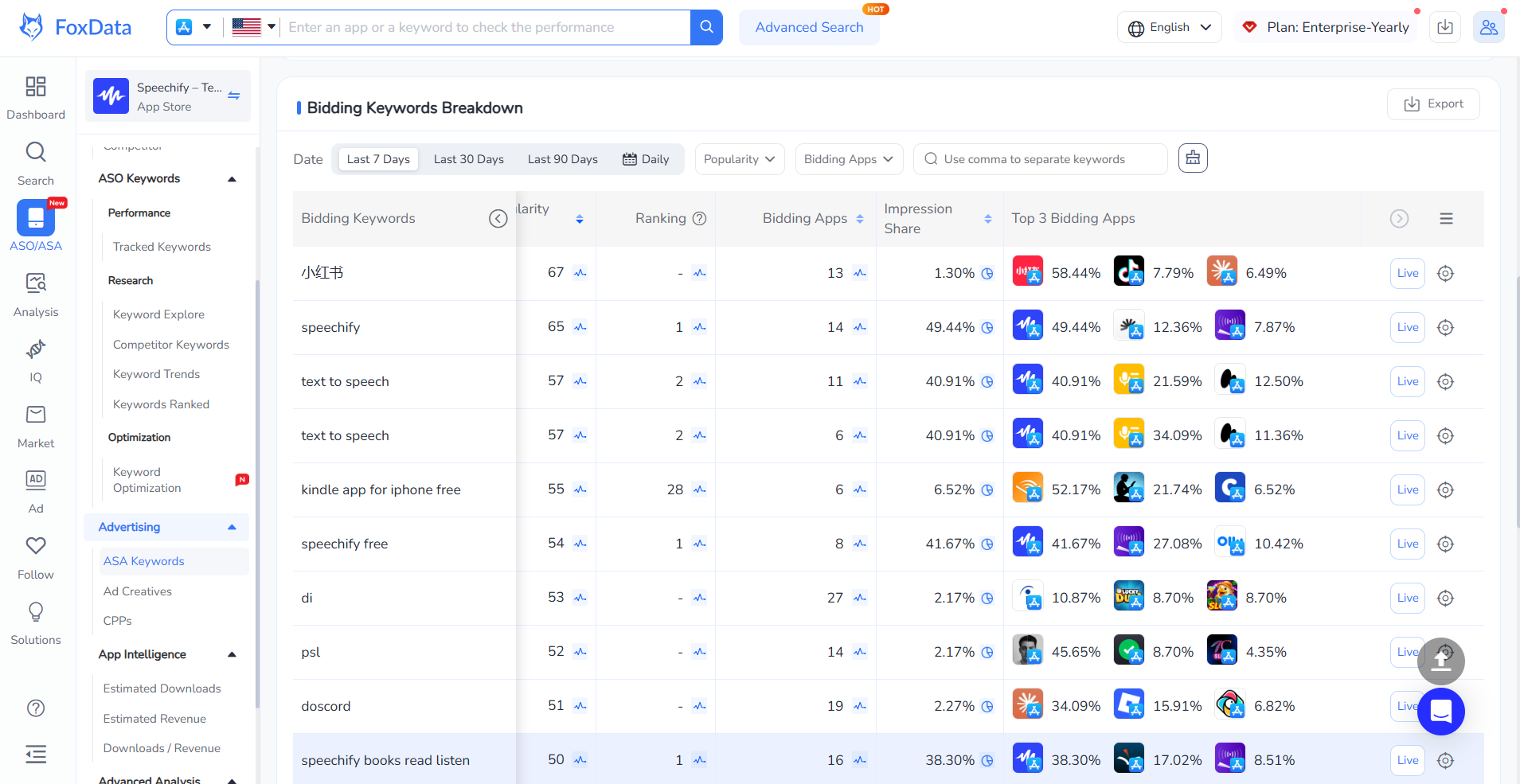
FoxData's ASO and ASA agency data solution is purpose-built to cover all four of these domains in a single platform, making it particularly well-suited for agencies managing multiple app clients simultaneously.
Technology alone does not make an agency great. Process does. Here is a practical, phased framework that data-driven ASO agencies can implement:
Phase 1: Onboarding and Baseline Audit (Week 1–2)
Start every new client engagement with a structured audit. This includes:
This audit becomes your baseline. All future performance is measured against it.
Phase 2: Strategy and Prioritization (Week 2–3)
Not every keyword is worth pursuing. Use data to prioritize:
Translate your keyword strategy into a metadata rewrite plan. Document every change you plan to make and why, so clients understand the rationale.
Phase 3: Implementation and A/B Testing
Roll out metadata changes according to each platform's update cadence. On Google Play, test store listing experiments using Google's native A/B tools. On iOS, use third-party creative testing frameworks to iterate on screenshots and icons.
Track changes methodically. Always change one variable at a time where possible, so you can attribute performance shifts accurately.
Phase 4: Monitoring, Reporting, and Iteration
ASO is not a set-and-forget activity. Establish a weekly monitoring cadence for keyword rankings, competitor movements, and rating trends. Monthly reporting should include:
Agencies that use comprehensive ASO agency platforms with integrated reporting can automate much of this workflow, freeing up analyst time for strategic thinking rather than data wrangling.
One of the most underutilized opportunities in mobile growth is connecting Apple Search Ads data with organic ASO strategy. Most agencies treat them as separate workstreams. The ones that integrate them gain a significant informational edge.
Here is how the connection works in practice:
When you run Apple Search Ads campaigns, you generate keyword-level conversion data at scale. That data tells you which keywords actually drive installs when shown to users and not just which ones have search volume. You can then use that intelligence to prioritize your organic keyword targeting and metadata optimization.
Conversely, strong organic keyword rankings reduce your cost-per-install on branded and exact-match ASA campaigns, because Apple's algorithm rewards relevance.
Agencies that understand this flywheel effect can demonstrate compounding ROI to clients — organic ASO improvements reduce paid acquisition costs, which frees budget for broader campaign expansion.
Platforms that unify both organic ASO analytics and ASA campaign performance data make this integration possible at scale. For agencies looking to offer this as a premium service, having an integrated ASO and ASA data solution for agencies is a competitive requirement.
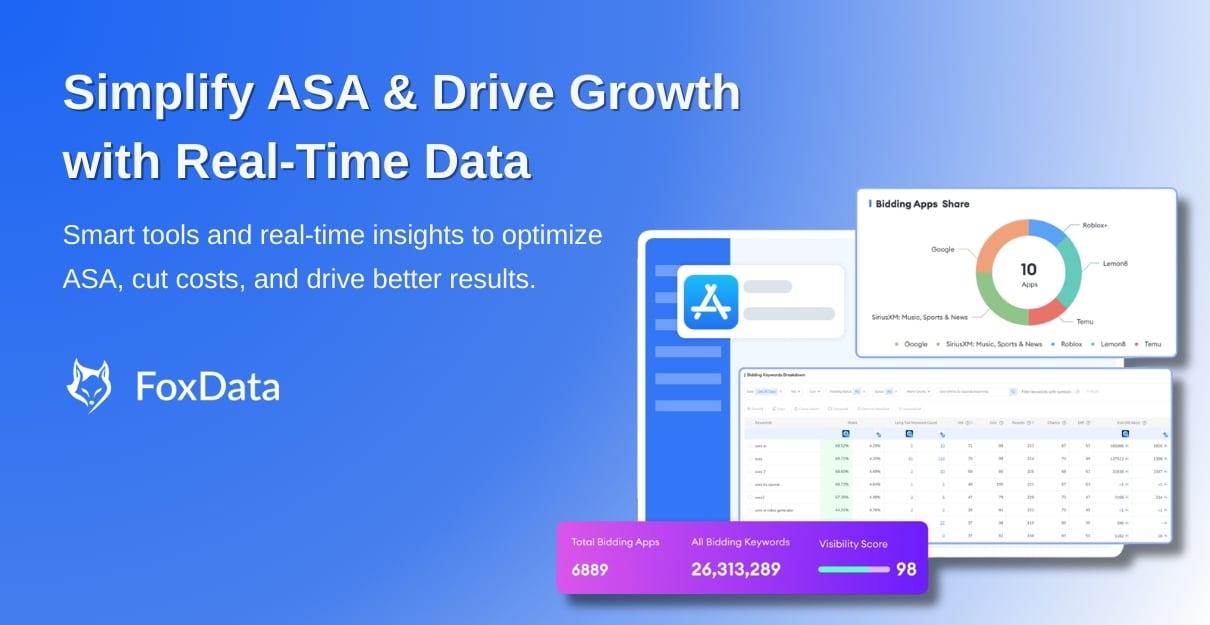
Discover keyword opportunities, monitor competitors, and improve campaign performance using FoxData’s ASA analytics tools.
Let's move from theory to specific use cases. Here are the most common agency problems and how data tools solve them.
1. Client rankings dropped unexpectedly after a metadata update.
Monitor keyword rankings daily with change-detection alerts. Compare ranking trajectories before and after each update, and maintain version history on all metadata changes. If a specific field edit correlates with a ranking drop, you can roll back quickly.
2. Client asks "are we doing better than our competitors?"
Run a competitor share-of-voice analysis. Pull keyword overlap reports showing which top-category terms your client ranks for versus their main competitors, and track how that gap is changing over time.
3. Creative testing results are inconclusive.
Use impression-to-install funnel data broken down by creative variant. Look for statistically significant differences in tap-through rate and first-session retention. If internal data is not sufficient, use category-level benchmarks from your ASO platform to contextualize performance.
4. Scaling from 5 clients to 20 without breaking the team.
Invest in platform features that enable multi-app dashboards, bulk reporting, and automated anomaly detection. The best ASO platforms for agencies offer white-label reporting and role-based access so analysts can work across client accounts without confusion.
The ASO agencies that will lead the next decade of mobile growth are not the ones with the most creative instincts alone. They are the ones that combine creative judgment with structured data workflows, repeatable processes, and tools built specifically for the complexity of managing multiple clients at scale.
The fundamentals are straightforward: build a solid audit process, prioritize based on data not assumptions, integrate organic and paid search strategies, document everything, and report on what actually matters to each client.
What separates good agencies from great ones is the infrastructure behind those fundamentals — the platforms, dashboards, and intelligence layers that make high-quality work reproducible and efficient across every account you manage.
Ready to build or upgrade your agency's data foundation? Explore how FoxData's dedicated ASO and ASA agency data platform gives mobile growth teams the keyword intelligence, competitor monitoring, and integrated search ads analytics they need to deliver measurable results for every client — at scale.
Q: What is the difference between ASO for an indie developer versus an ASO agency?
Individual developers typically manage one or two apps and can rely on manual tracking and basic tools. An ASO agency manages multiple clients simultaneously, each requiring tailored strategies, distinct reporting, and dedicated monitoring.
The scale difference means agencies need professional-grade platforms that support multi-app management, automated reporting, and competitor intelligence across dozens of listings at once.
Q: How long does it take to see results from ASO?
Most ASO changes take two to four weeks to reflect in keyword rankings on iOS, and sometimes longer on Google Play. Significant organic traffic growth typically becomes visible within three to six months of consistent optimization. Conversion rate improvements from creative changes can be measured faster, usually within two to three weeks of running a proper A/B test.
Q: Should an ASO agency also manage Apple Search Ads for clients?
It depends on the agency's capabilities, but offering both organic ASO and Apple Search Ads management as an integrated service is a strong differentiator. The two disciplines are deeply interconnected where keyword data from paid campaigns informs organic strategy, and organic ranking strength improves paid campaign efficiency.
Q: What metrics should an ASO agency track and report monthly?
At minimum, monthly ASO reporting should cover keyword ranking changes (with volume context), conversion rate trends from store page impressions to installs, competitor activity highlights, and ratings and review trends. More advanced reporting can include share-of-voice analysis, creative performance benchmarks, and category-level ranking percentile comparisons.
Ready to make your app shine? Optimize your app's visibility with FoxData, the ultimate ASO tool! Maximize downloads and rankings by leveraging our powerful insights today.
App Growth & ASO Tools by FoxData
FoxData supports every stage of app growth with specialized ASO and app analytics tools, helping teams improve keyword visibility, user acquisition, and retention through reliable data.
🔍 Store Keyword Research Tools
Research high-intent keywords, search volume, and competition to strengthen your app store optimization strategy.
📈 App Store Keyword Tools
Analyze keyword rankings and performance across the Apple App Store and Google Play to refine ASO execution.
📊 ASO Monitoring Tools
Monitor keyword ranking changes, visibility trends, and ASO impact over time with continuous performance tracking.
👥 User Activity Monitoring Tools
Understand in-app user behavior, engagement, and retention with real-time user activity analytics.
Together, these tools form FoxData’s ASO analytics and app intelligence ecosystem, designed to help developers, marketers, and growth teams make data-driven decisions and scale sustainably.
Explore it today!
👉 Learn more about FoxData here | 👉 Book a demo with FoxData team today!
© 2020-2026 FoxData. All Rights Reserved.