


Explore More Possibilities for Your Business
Full-cycle scenario construction to meet your needs from App research, development, and release to operation.
Ready for your soaring growth
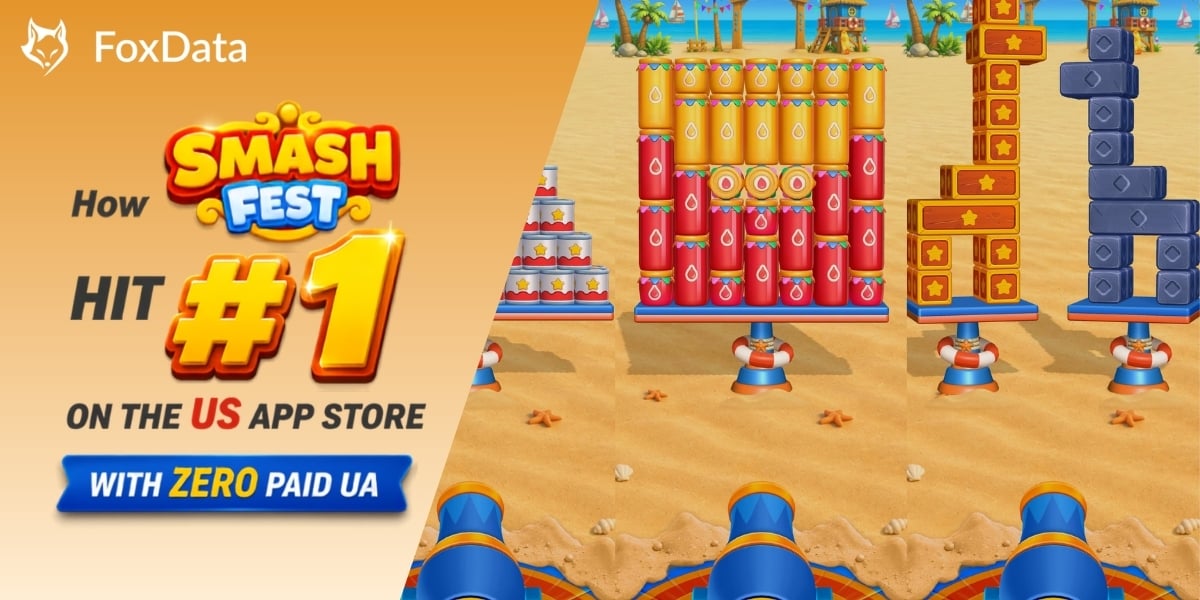
🎮 Track Smash Fest! live data on FoxData →
In June 2026, a name most US publishers had never heard of suddenly dominated the App Store.
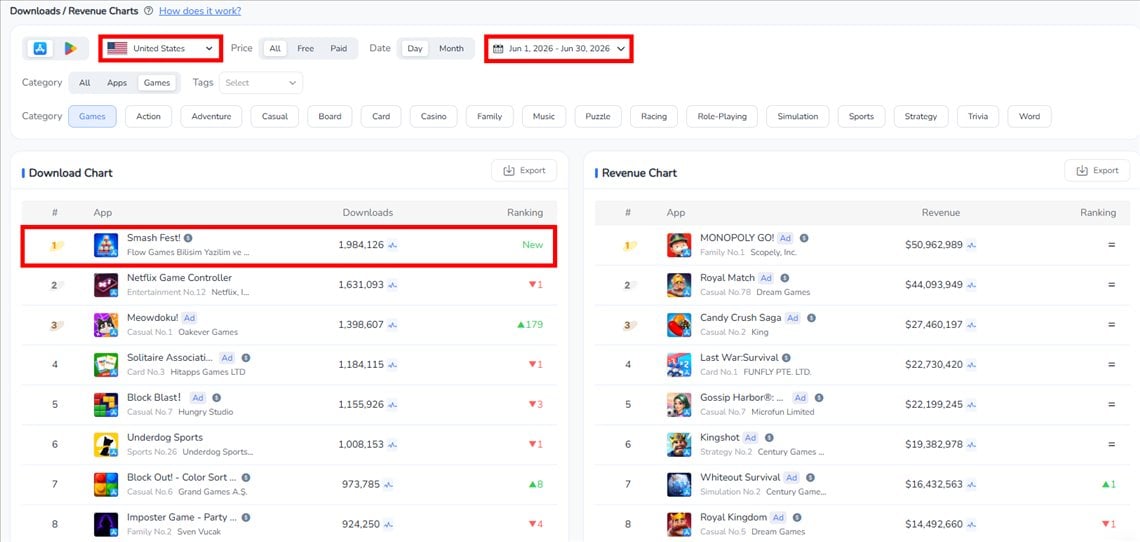
Source: US iOS Game Download & Revenue Charts, June 2026
Smash Fest!, developed by Flow Games, began climbing on June 11. By June 12 it was in the Top 50 across 62 regional markets. On June 15 it locked into the top 3 on the overall US iOS Game Free Chart—and stayed there.
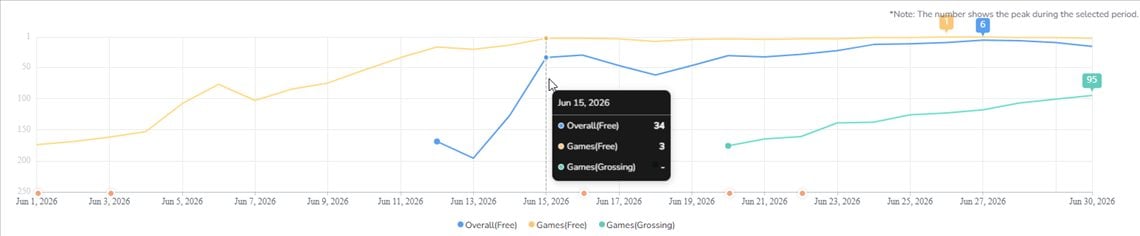
Source: Smash Fest! 30-Day App Store Rankings (US Region)
According to FoxData App Intelligence, the game accumulated approximately 2.9 Million downloads during its first month. The US led with 66.6% of that volume, followed by Japan (6.19%) and Russia (3.98%). Daily downloads peaked at roughly 195,000 and have stabilized above 150,000.
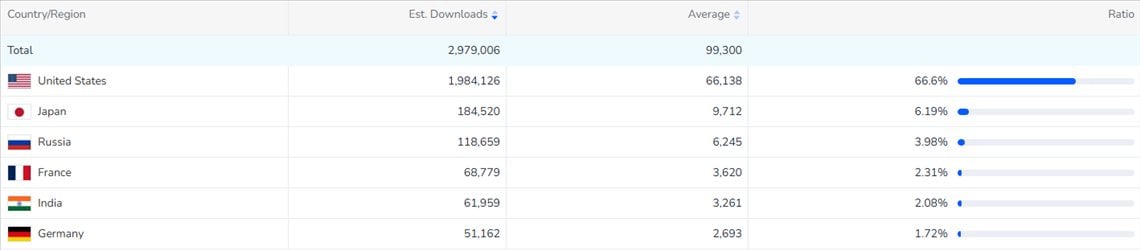
Source: Smash Fest! Global App Store Downloads, June 2026
But here is what makes those numbers interesting: FoxData Ad Intelligence shows that Smash Fest! ran almost no paid iOS campaigns over that same window—and zero paid spend on Android. Its chart run was not bought. It was earned through organic store conversion and word-of-mouth momentum.
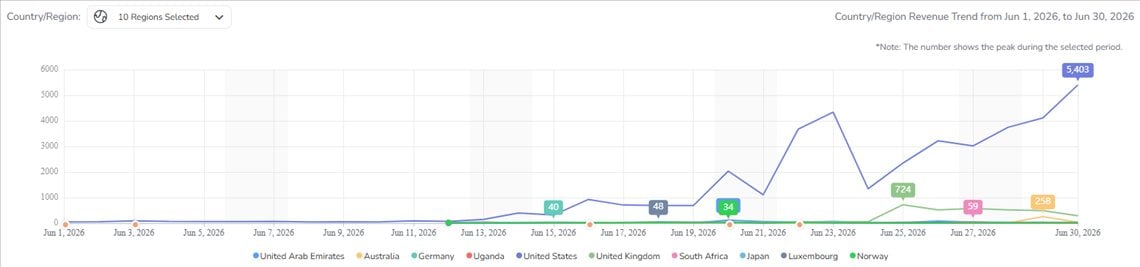
Revenue tells a different story than downloads. FoxData’s Global Overview estimates monthly revenue at just over $60,000, with the US contributing nearly 70%. That is not blockbuster territory by mobile gaming standards. Yet when your customer acquisition cost approaches zero, even modest revenue produces healthy unit economics.
What makes this case study-worthy is not the download count. It is how the game achieved it: with no battle pass, no guild system, no seasonal calendar, no progression meta, and not even an achievement system. Just a cannon, some cans, and a loop so satisfying players could not stop sharing it.
💡See how your game stacks up → Explore FoxData Market Intelligence
To understand why Smash Fest! landed when it did, look back to 2009.
Rovio’s Angry Birds proved that pure physics destruction could carry a global franchise. No daily quests. No cosmetic shop. Just birds, pigs, gravity, and the dopamine hit of watching a structure collapse. The fun was the feature.
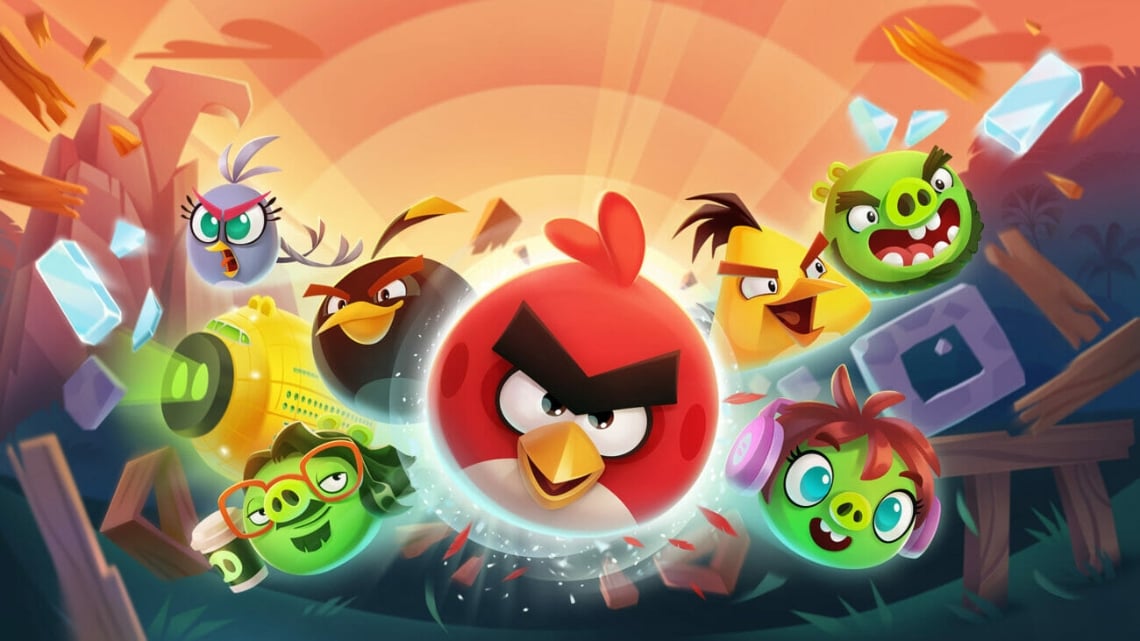
Over the next decade, as acquisition costs climbed and attention spans shrank, the industry responded by adding. RPG stats, card collections, gacha mechanics, battle passes, social leaderboards—each layer designed to give players one more reason to open the app tomorrow. Physics destruction did not disappear; it was demoted to a mini-game inside larger meta sandwiches.
The industry collectively decided that "just breaking things" was no longer enough to sustain a live game.
Smash Fest! proves otherwise. It takes that two-decade-old formula and modernizes it through three upgrades:
The mechanic was never outdated. The industry simply forgot how to make it feel fresh.
Most games sitting at the top of the App Store are engineered to maximize lifetime value through layered retention systems. Smash Fest! does none of that.
It has no battle pass. No guilds. No seasonal events. No achievement framework. No daily login bonuses. What it has is a single interaction loop so immediately gratifying that organic word-of-mouth is doing the marketing.
This runs counter to years of mobile publishing orthodoxy. Studios have optimized for more: more systems, more currencies, more surfaces to monetize, more reasons to return tomorrow. Smash Fest! bets everything on better: better haptics, better audio, better moment-to-moment satisfaction.
Whether that minimalism sustains long-term remains an open question. But the early data confirms something important: building a game purely around fun is not as reckless as conventional wisdom suggests.
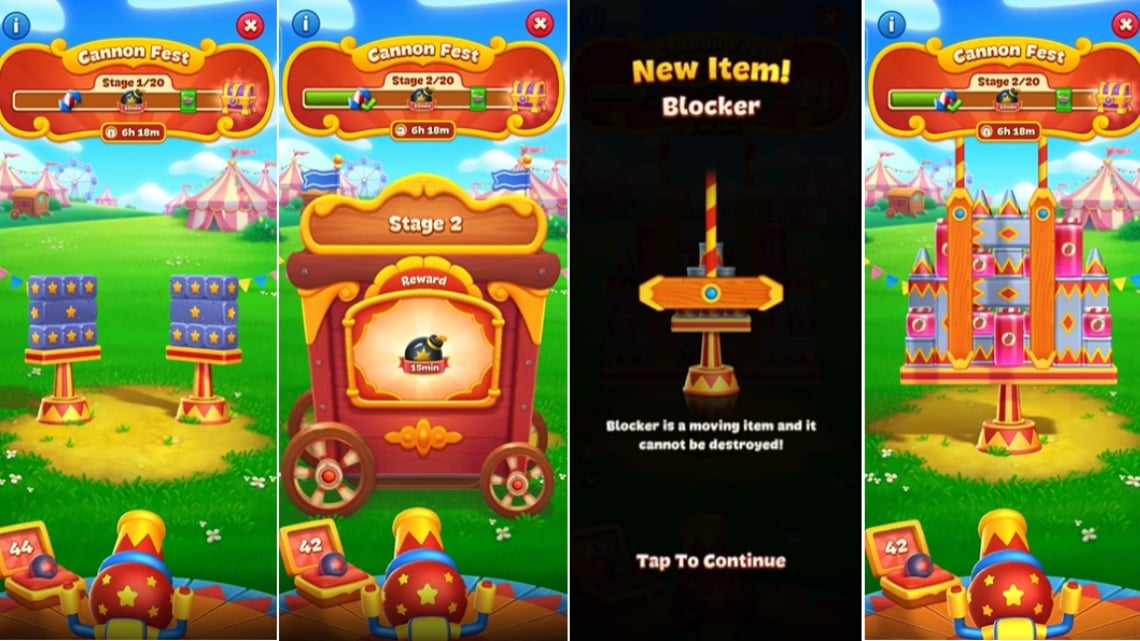

On the surface, Smash Fest! looks like a carnival game ported to mobile. You aim a cannon at stacked objects and fire. Underneath, four specific decisions are doing almost all the heavy lifting.
The targets are not abstract shapes. They are wooden crates, glass jars, aluminum cans, and ice blocks—objects players already understand from daily life. Your brain instinctively knows that hitting the base of a stack sends the top tumbling. No tooltip required.
By leveraging pre-loaded cognition, the game removes the single biggest friction point in casual onboarding: reading. If a player needs text to understand your core loop, you have already lost them.
🎯 Takeaway: Design for intuition first. Text tutorials should be a last resort, not a default.
Audio in Smash Fest! is not background atmosphere. It is structural engineering.
Aluminum cans pop sharp and bright. Wood thuds dull and heavy. Glass shatters with a satisfying crack followed by liquid splatter. Ice fractures into crystalline pieces that decay into silence. Played together, these sounds create an ASMR-like experience that keeps sessions running longer than visual feedback alone ever could.
In 2026, "relaxation" competes directly with "entertainment" as a reason to open an app. Players commuting or scrolling before bed often want decompression, not domination. Smash Fest! meets them there.
🎯 Takeaway: Sound design is not post-production. It is a measurable retention tool.
Here is a detail most competitive analyses miss entirely: vibration timing.
On impact, Smash Fest! fires a short, crisp haptic burst. During chain reactions, those bursts pattern into rhythmic sequences. Neuroscience research on multisensory encoding suggests that simultaneous visual-tactile stimulation strengthens memory consolidation beyond what either channel achieves alone.
Players do not just see the collapse. They feel it in their palm. That dual-channel imprint makes the experience harder to forget and easier to return to hours later.
🎯 Takeaway: Treat haptics as subconscious loyalty triggers, not accessibility afterthoughts.
Every level gives you limited ammunition. You cannot spray randomly; you must read structures, identify weak points, and commit. But the psychological masterstroke is what happens when you fail.
Most failed levels end with one or two objects teetering on the edge—almost falling, but not quite. Behavioral economists call this the near-miss effect. When individuals perceive themselves as almost succeeding, retry motivation spikes higher than after outright failure. Smash Fest! engineers this sensation into nearly every level.
You are not blocked by artificial difficulty walls. You are hooked by your own judgment whispering, "One shot lower and I had it."
🎯 Takeaway: Hook players with close calls, not brutal walls. Near-misses drive retries better than pure failure.
Combined, these four elements create a self-sustaining loop:
1. Instant Understanding → Gets players in instantly.
Notice what is absent. No daily quests. No loot boxes. No battle passes. Smash Fest! demonstrates that if your core loop is genuinely compelling, extrinsic scheduling systems become optional rather than mandatory.
That is a big "if." Most games cannot pull it off. This one does.
🔍 Compare competitor features in your category → Use FoxData's app comparison tools
Flow Games is not a lucky group of beginners. Founded in May 2025 with roughly $5,300 in registered capital, the studio is staffed by alumni from Turkey’s most successful casual operations:
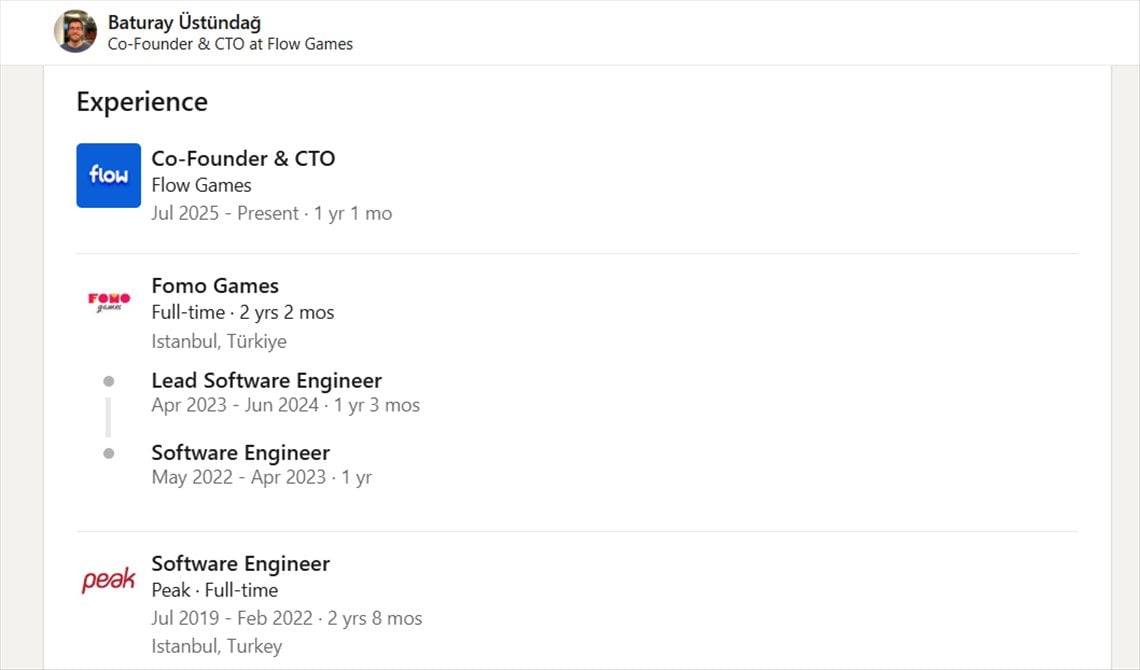
This reflects Turkey’s mature mobile ecosystem, which operates on three pillars:
Conventional development says build first, market second. Smash Fest! suggests the opposite. If your core interaction cannot be communicated in a 15-second silent clip, it will struggle to convert on a store page.
Firing a cannon into stacked objects requires zero narration. Viewers instantly grasp the objective, physics, and payoff. That "single-glance comprehension" is product-market fit expressed visually.
Before greenlighting your next prototype, apply the Mute Scroll Test: if someone scrolling Instagram cannot understand your hook without audio or captions, your core loop is too complex.
Many pitch decks dedicate twenty slides to world-building and monetization layers but only two bullet points to core gameplay. In today’s hyper-casual and hybrid-casual markets, that inversion is expensive.
Comprehension cost—the cognitive effort required to learn your game—is the highest-friction barrier in your acquisition funnel. Smash Fest! eliminates it entirely: zero text, no forced tutorials, no UI hand-holding. Players operate on intuition alone.
Audit your onboarding using the 5-Second Rule: count the seconds until a new player performs their first meaningful, unassisted action. Exceed five, and you are leaking installs.
Smash Fest! launched without standard retention infrastructure—no battle pass, no friend invites, no leaderboard, no loot boxes. What it shipped was a single cannon interaction refined across hundreds of level geometries.
Constraint breeds clarity. Without bloated systems to hide behind, developers must prove their primary loop is intrinsically fun. That singular focus demonstrates higher craftsmanship than many titles ten times its scope.
Run the Feature Stripping Exercise: reduce your game to its single most basic interaction. If that core loop is not compelling enough to stand alone, layering complex meta-systems on top will not save retention.
For all its launch momentum, Smash Fest! faces familiar sophomore hurdles. Long-term retention systems remain largely undeveloped. IAP depth currently centers on coin packs and a single pre-round power-up. Android scaling, which began later than iOS, will test whether organic momentum holds once iOS saturation plateaus.
Yet the precedent matters regardless of longevity. Smash Fest! joins Magic Sort!, Color Block Jam, and others as proof that Istanbul’s ecosystem has operationalized a repeatable playbook:
1. Extract validated micro-interactions from existing hits.
Whether that model scales to $100M+ annual revenue is still debated. Whether it reliably produces profitable, low-risk launches looks increasingly settled.
🔔 Monitor competitor movements →
The mobile industry has spent years optimizing for more. More meta-systems. More dual currencies. More engineered reasons to return. More surfaces to monetize.
Smash Fest! optimizes for better—better feel, better feedback, better comprehension, better moment-to-moment satisfaction. And in doing so, it poses a question worth hanging in every product review: If you stripped away every system except your core action, would anyone still care?
Flow Games answered yes. With a cannon, some cans, and nothing else. Sometimes the bravest product decision is not what you add. It is what you refuse to.
A: Hybrid casual, specifically within the physics-destruction subgenre. It blends hyper-casual accessibility (one-tap mechanics) with light puzzle-strategy progression.
A: Flow Games, an Istanbul-based studio founded in May 2025. Despite minimal initial capital (~$5,300 USD), its talent pool includes veterans from Good Job Games, Peak Games, Dream Games, and Grand Games.
A: Yes. However, the Android (Google Play) version launched later than its iOS counterpart and initially ran with zero paid user acquisition (UA) spend. The iOS version drove the vast majority of the game's early chart traction and organic momentum.
A: The game stands out from competitors through three modern design layers: material-specific audio and visual feedback, haptic patterning synchronized to chain reactions, and ammo scarcity engineered to produce near-miss tension.
A: Use FoxData App Intelligence for real-time download estimates, revenue tracking, and competitive benchmarking across 150+ markets
A: Yes. The platform tracks all ranked application on the App Store and Google Play, including breakout hits like Meowdoku!, Color Block Jam, and other emerging entrants in the physics-puzzle and hybrid-casual ecosystems.
The best mobile teams do not guess—they measure. Join thousands of publishers, developers, and investors who rely on FoxData’s market intelligence to spot trends before they break.
📬 Subscribe to the FoxData Blog and secure your first-mover edge in the global mobile games market.
Or dive straight into the platform:
📣 Don't Miss These:
© 2020-2026 FoxData. All Rights Reserved.