



Explore More Possibilities for Your Business
Full-cycle scenario construction to meet your needs from App research, development, and release to operation.
Ready for your soaring growth
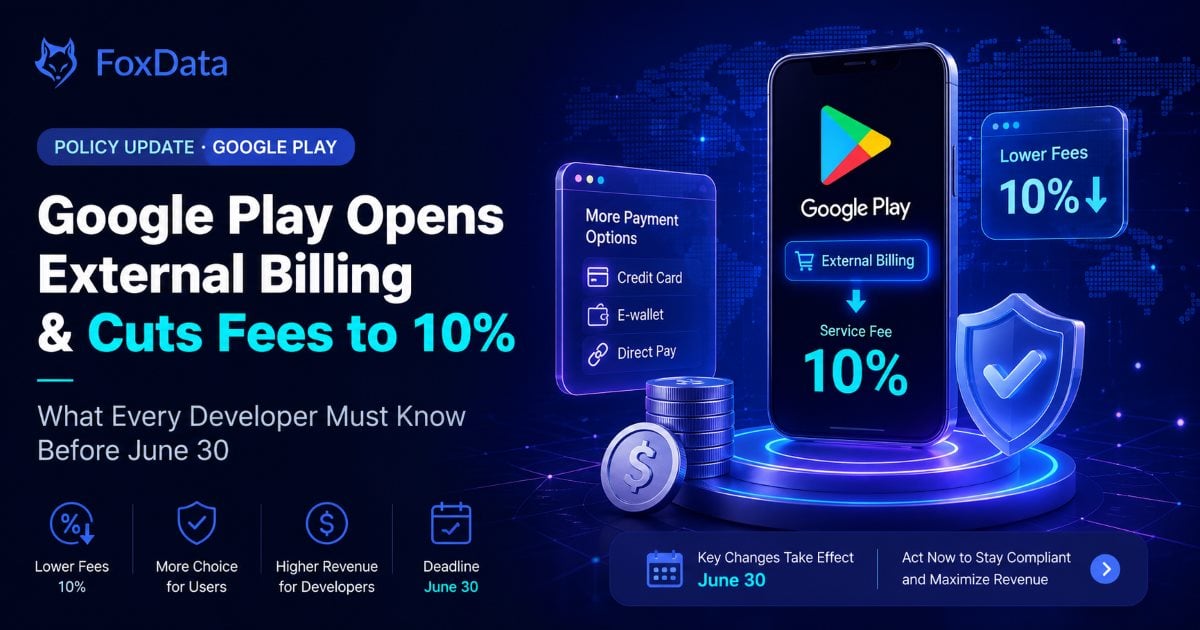
Today marks the day Android's 30% tax officially comes apart. As confirmed by 9to5Google and Google's own Android Developers Blog, Google Play has opened external billing and dropped its base service fee to 10% in the United States, United Kingdom, and European Economic Area — the practical conclusion of the multi-year Epic Games antitrust dispute. For mobile game studios, subscription apps, and ASO teams that have spent a decade budgeting around a 30% platform cut, this is the kind of structural shift that changes monetization math overnight. Below, we break down exactly what changed, who it affects first, and what to do about it this week.
What: Google Play separates its service fee from billing fee and opens external/alternative billing
When: Effective today, June 30, 2026
Where: United States, United Kingdom, and the European Economic Area (other regions follow on a staggered schedule)
Key Spec: Base service fee drops to 10% on the first $1M in annual earnings, regardless of billing method
Why it matters: It's the clearest sign yet that the era of the flat 30% app store commission is ending on Android
For most of its history, Google Play charged a single bundled commission — historically 30%, later reduced to 15% for a developer's first $1 million in annual revenue — regardless of how a purchase was processed. Starting today, Google is unbundling that commission into two separate components: a service fee (for access to Google Play's distribution, discovery, and platform tools) and a billing fee (for using Google's own payment processing). Developers can now choose to keep using Google Play Billing, adopt an alternate billing system inside their app, or link users out to an external website entirely — and the service fee applies no matter which path they pick.
This isn't a regional experiment. It's the direct outcome of Google's settlement following the Epic Games ruling, and it lands the same week the wider games industry is already rethinking platform dependence — a recent GDC and Appcharge survey found that direct-to-consumer mobile game revenue had already reached roughly $17 billion, or about 15% of the global in-app purchase market, even before today's fee cut made store billing meaningfully cheaper.
Why this is bigger than a fee cut: Platform commission has been the single largest line item in mobile monetization for over a decade. A move from 30% to a 10–20% blended rate doesn't just improve margins — it changes what pricing, promotions, and player acquisition spend can look like on Android, especially for studios that were previously priced out of aggressive live-ops offers.
Under the new model, every transaction carries a service fee, and only transactions processed through Google Play's own checkout carry an additional billing fee:
Service fee: 10% on a developer's first $1M in annual earnings, applied to all auto-renewing subscriptions and to other transactions up to that threshold — regardless of whether the purchase runs through Google Play Billing, an alternative in-app billing system, or an external web link.
Billing fee: An additional 5% that applies only when a transaction uses Google Play's own billing system. Developers who route purchases through alternative billing or external links skip this fee entirely.
Above the $1M threshold, fees for non-subscription transactions depend on whether the purchasing user counts as a "new install" or an "existing install" relative to the date the new policy launched in their region — new installs after June 30 are billed at the updated, generally lower rates, while users who installed the app before today's cutover continue under a separate rate tier until they re-qualify as new. Developers should treat this distinction as a data problem to solve immediately, since it directly affects revenue reporting and forecasting going forward.
Base commission cut: The flat 30% standard rate that defined Android monetization since the Play Store launched is now functionally retired for the first $1M in annual earnings.
Decoupled billing: Developers are no longer forced to use Google's checkout to remain in good standing — billing and distribution are now priced separately.
External link-outs allowed: Apps can now direct EEA, UK, and US users to a website to complete a purchase, something that was either banned or heavily restricted for most app categories until today.
Incentive layer coming in September: Google's revamped Games Level Up and new Apps Experience programs will unlock further reduced rate cards for apps meeting quality benchmarks — but those don't activate until September 30, 2026.
Staggered global rollout: Australia gets the new structure by the end of 2026, Japan and South Korea follow by December 31, and the rest of the world is scheduled for September 2027.
|
Feature |
Previous Standard |
New Google Play (June 30, 2026) |
Apple App Store (Current) |
|---|---|---|---|
|
Base commission |
30% (15% under $1M) |
10% service fee under $1M |
30% standard / 15% small-business tier |
|
In-app billing required |
Yes, in most cases |
No — alternative and external billing allowed |
Limited external links allowed under court order |
|
External purchase fee |
Not generally permitted |
10% service fee, no billing fee |
Currently $0 in the US pending district court ruling on a "reasonable" commission |
|
Subscriptions |
30% / 15% after year one |
10% service fee, regardless of billing method |
30% / 15% after year one |
|
Rollout scope |
Global |
US, UK, EEA first; staggered globally through 2027 |
US link-outs in flux; EU under a separate 5% Core Technology Commission model |
The most striking line in that table is Apple's: because of an unresolved contempt ruling in the Epic Games case, Apple is currently collecting no commission at all on US external link purchases while a federal court works out what a "reasonable" fee would look like — a temporary state that could change as the case heads toward the Supreme Court. Google, by contrast, has now locked in a permanent, publicly documented rate card. For now, that gives Android a clearer, more predictable cost basis than iOS, even though Apple's current zero-fee window is technically more generous where it applies.
Audit your install base today. Because new-install and existing-install rates differ, pull your Play Console data now to understand what share of your active users will fall into each bucket as the policy rolls out in your market.
Model both billing paths before committing. Run the math on Google Play Billing's 10%+5% combined rate against the operational cost of standing up your own checkout or external link flow — the savings are real, but so is the engineering and compliance overhead.
Revisit pricing and promotions. A meaningfully lower cost basis creates room for sharper player offers, deeper subscription discounts, or improved unit economics on previously thin-margin titles — particularly relevant for studios using mobile game analytics solutions to track how monetization changes affect retention and LTV.
Watch the September incentive programs. Games Level Up and Apps Experience rate cards aren't live yet, but the eligibility criteria are public now — start aligning your quality metrics (crash rates, form-factor support) ahead of the September 30 activation date.
Get your reporting infrastructure ready. Teams pulling Play Store performance data programmatically should confirm their pipelines can handle the new fee and install-classification fields — this is exactly the kind of structural change where an app store data API saves weeks of manual reconciliation.
Reassess UA budgets per region. Because the new fee structure launches first in the US, UK, and EEA, paid UA cost-per-install targets in those markets may need recalculating against improved net revenue per install — tools built for app market segmentation make it easier to compare regional performance as the rollout proceeds.
Benchmark competitor monetization shifts. As rivals adjust pricing or run more aggressive promotions on freed-up margin, ongoing ASO impact analysis can help isolate whether ranking or conversion movements are tied to creative changes or to broader pricing shifts across your category.
Brief agency and client teams now. ASO and ASA agencies managing multiple developer accounts will need a consistent way to track which clients fall under new-install versus existing-install rates — a use case well suited to ASO/ASA agency data solutions built for managing performance across a portfolio.
Don't ignore the consumer-facing side of pricing changes. Lower platform fees often translate into promotional pricing tests; tracking how those tests move downloads and revenue across app analytics and ASO performance metrics will help separate genuine demand shifts from short-term promo spikes.
For solo developers and small studios, today's change is arguably the single biggest monetization update of the year. Most indie teams earn well under the $1M annual threshold, meaning the new 10% service fee — down from a 15% or 30% baseline depending on prior program enrollment — applies to effectively all of their Play Store revenue. That's a meaningful margin improvement without requiring any code changes, assuming a developer simply continues using Google Play Billing as before.
For indie teams weighing whether to build external billing: the 5% billing-fee savings from skipping Google's checkout only pays off once payment processing, fraud handling, tax compliance, and refund support are accounted for. Smaller teams without dedicated finance or engineering resources may find that staying on Google Play Billing at the new 10% rate is the more economical choice, at least for now. Teams evaluating this trade-off can start with free ASO tools to baseline current performance before testing any billing or pricing change.
For everyday consumers, the practical effect will likely show up gradually rather than overnight: lower platform costs give developers room to lower prices, run better promotions, or invest more in app quality, but those benefits depend on whether individual companies choose to pass savings on. Users in the US, UK, and EEA may also start seeing more apps offering a choice between in-app purchase and an external website checkout — a pattern that's already common on iOS following its own external-link changes.
It launched today, June 30, 2026, in the United States, United Kingdom, and European Economic Area. Australia follows by the end of 2026, Japan and South Korea by December 31, 2026, and the rest of the world by September 30, 2027.
The service fee starts at 10% on a developer's first $1 million in annual earnings, regardless of billing method. Developers who use Google Play's own billing system pay an additional 5% billing fee on top; those using alternative or external billing do not.
Any developer earning revenue from users in the US, UK, or EEA is affected starting today. Subscription apps see the clearest immediate benefit since the 10% rate applies to all auto-renewing subscriptions regardless of annual revenue tier.
Google's 10% base rate is now permanent and documented, while Apple is currently charging $0 on US external link purchases only because of an unresolved court contempt ruling — a temporary situation that could change once a district court sets a "reasonable" commission, with Apple separately pursuing Supreme Court review.
Pull install-base data now to understand the new-versus-existing install split, model the combined cost of Google Play Billing against an external billing build-out, and start tracking the Games Level Up and Apps Experience eligibility criteria ahead of their September 30 activation.
Google Play's shift to a 10% base service fee and open external billing closes the book on the flat 30% Android commission that shaped app store economics for over a decade. Combined with Apple's own ongoing fee turmoil in the US, the two dominant app stores are now running fundamentally different — and both shrinking — commission models for the first time. Whether developers see real margin gains will come down to execution: how they classify users, which billing path they choose, and how quickly they adapt pricing strategy to the new math. FoxData will continue tracking how this rollout affects download, revenue, and retention trends across regions as the September and 2027 phases land — bookmark this page for updates.
© 2020-2026 FoxData. All Rights Reserved.