

Explore More Possibilities for Your Business
Full-cycle scenario construction to meet your needs from App research, development, and release to operation.
Ready for your soaring growth
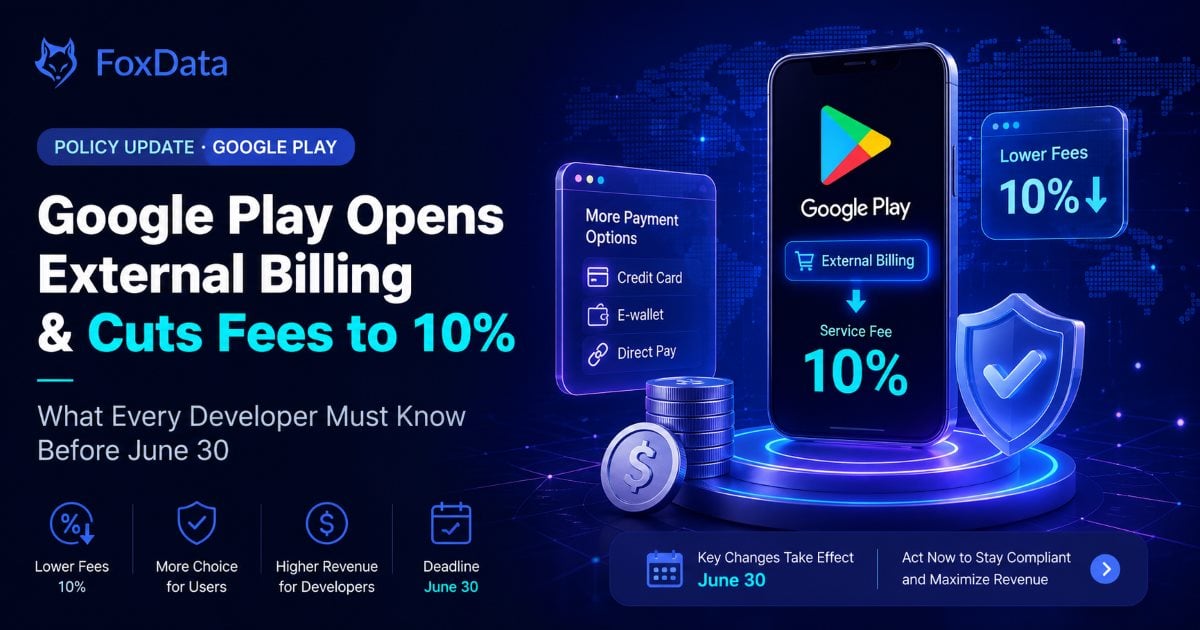
In one of the most consequential shifts to the Android ecosystem since the Play Store launched, Google has officially announced that it will open external billing options and cut its base service fee to just 10% for the first $1 million in annual revenue — effective June 30, 2026, in the US, UK, and European Economic Area.
The announcement, posted on the Android Developers Blog, follows the resolution of Google's multi-year antitrust dispute with Epic Games and signals a fundamental restructuring of how revenue flows between developers, platforms, and users. For app developers, ASO teams, and growth marketers, the window to act is narrow: days away. This article breaks down every layer of the new fee structure, the phased global rollout, the new Games Level Up and Apps Experience programs — and exactly what they mean for your monetization and store optimization strategy right now.
⚡ Quick Facts
What Google Play opens alternative billing & cuts base service fee to 10% on first $1M revenue
When June 30, 2026 (US, UK, EEA) — phased to September 30, 2027 globally
Where Google Play Store — US, UK, European Economic Area first
Key Spec Service fee: 10% (≤$1M/yr) · +5% billing fee if using Google Play Billing · No billing fee for external links
Why It Matters Developers can save up to 20 percentage points vs. the former 30% commission and own the customer payment relationship directly
Google Play's new Billing Choice Program is the formal framework that allows Android developers to offer payment options beyond Google's own in-app billing system. Historically, Google Play Billing was essentially mandatory for digital in-app purchases, and Google charged a flat 30% commission on every transaction — a structure that attracted antitrust scrutiny in the EU, South Korea, the US, and beyond.
The program restructures that model in two critical ways. First, it separates the service fee from the billing fee: the service fee covers the cost of distributing and listing your app on Play; the billing fee is an additional charge that applies only when you process payments through Google's own infrastructure. Second, it opens the door to alternatives — developers can now integrate third-party payment processors directly inside their apps, or redirect users to an external web page to complete purchases.
This isn't a minor tweak. For developers earning under $1 million per year, the base service fee drops from 15% to 10% — and you retain that rate regardless of whether you use Google Billing or not. For large publishers, the savings opportunity across millions of in-app purchases is substantial. Combined with the two new incentive programs launching in September 2026, the overall economics of distributing on Android have fundamentally changed.
Google has decoupled what used to be a single, opaque commission into two transparent components. Understanding both is essential before making any implementation decision.
| Revenue Tier / Scenario | Previous Fee | New Service Fee | + Billing Fee (GPB) | Total (GPB) |
|---|---|---|---|---|
| First $1M/yr (all devs) | 15–30% | 10% | +5% | 15% |
| Above $1M — New Installs | 30% | 20% | +5% | 25% |
| Above $1M — Existing Installs | 30% | 15–20% | +5% | 20–25% |
| External billing / web links | Not permitted | 10–20% | No billing fee | 10–20% |
| Games Level Up / Apps Experience (from Sep 30) | N/A | Further reduced | Program-specific | Lower overall |
💡 Key insight: Developers who route transactions through external web links avoid the 5% billing fee entirely. For a title generating $5M in annual IAP, that 5% difference equals $250,000 in savings — before accounting for any lower rates from the Games Level Up or Apps Experience programs. Use FoxData's mobile game analytics to accurately model your revenue tiers and project which billing path maximizes net margin.
Games Level Up Program: Open to all games meeting performance and UX thresholds. First milestone date is July 2026. Qualified games receive a reduced overall rate card available from September 30, 2026, in EEA, UK, US, and Australia simultaneously.
Apps Experience Program: Designed for non-game apps. Also launching September 30, 2026, with its own reduced rate structure for qualifying applications that meet user experience and content quality criteria.
Eligibility: Both programs reward apps with strong user experience metrics, low crash rates, and policy compliance — meaning ASO hygiene and app quality directly influence your effective fee rate. Tracking your ASO impact metrics now is critical to qualifying by the July milestone date.
Google's rollout is intentionally phased to align with antitrust regulations and regional legal requirements. The markets going first are precisely those where Google faces the strongest regulatory scrutiny following its settlement with Epic Games.
| Date | Markets & Changes |
|---|---|
| June 30, 2026 | US, UK, European Economic Area — External billing + lower fees + Billing Choice Program launches |
| Sep 30, 2026 | Australia — Billing choice + fee changes; Games Level Up & Apps Experience programs also available in EEA / UK / US / AU |
| Dec 31, 2026 | Japan, South Korea — Billing updates + Experience programs rollout |
| Sep 30, 2027 | Rest of World — Global completion of expanded billing choice and fee restructuring |
The Billing Choice Program goes live on June 30, 2026 for developers with users in the US, UK, and EEA. There is no application or enrollment cost to participate — developers simply implement the technical integration and comply with Google's UX guidelines for choice screens.
The additional 5% billing fee applies only when using Google Play's own billing system. Developers using third-party processors or external web links pay only the service fee, though they also pay whatever processing rates their chosen payment provider charges (typically 2–3% for card transactions). For most mid-to-large developers, the net economics of switching to a third-party processor are favorable once engineering costs are amortized.
The Games Level Up and Apps Experience programs — with their additional rate reductions — launch September 30, 2026. Google has indicated that the first milestone date for Games Level Up qualification is July 2026, giving developers approximately one month to prepare.
The window between now and June 30 is short. Here are the highest-impact actions to prioritize immediately.
1. Audit your revenue tier before choosing a billing path.
If you earn under $1M annually, the difference between GPB and external billing is 5% — real, but modest. Above $1M, the calculus shifts significantly. Use FoxData's mobile game analytics solutions to pull accurate revenue estimates and project which billing path maximizes your net margin across your user base.
2. Begin technical evaluation of third-party payment integrations.
Integrating an alternative billing provider takes engineering time. Start scoping now. Review Google's UX guidelines for choice screens to ensure compliance before launch.
3. Map your install cohorts.
The fee structure differentiates between "new installs" (users whose first install is on or after June 30 in their market) and "existing installs." Your analytics setup needs to flag this cleanly, since the two cohorts carry different fee rates above $1M.
4. Check Games Level Up eligibility criteria early.
The July 2026 milestone date for program qualification is approaching. Review your crash rate, engagement metrics, and policy compliance now. FoxData's ASO Impact Analysis tools can help you benchmark performance signals quickly before the September 30 deadline.
5. Design your monetization A/B test now.
You can split-test a Google Billing flow vs. an external web-shop flow before full deployment. Starting early gives you conversion data before committing to one architecture at scale.
For Android users in the US, UK, and EEA, the most visible change starting June 30 will be the appearance of payment choice screens inside apps that have adopted the new billing options. Instead of being taken straight to a Google Pay checkout, you may be offered a choice between Google Play Billing, a developer's own payment system, or a link to complete the purchase on the developer's website. This choice is yours — apps cannot force you away from Google Billing if you prefer it.
The practical implication is that prices for in-app purchases and subscriptions may begin to vary depending on which payment method you choose. Developers who save on fees via external billing have the option — though not the obligation — to pass those savings to users. Expect to see subscription services experiment with "web price" discounts, similar to what players of some mobile games have experienced through web shops over the past couple of years.
⚠️ Consumer protection note: Refunds for purchases made through third-party billing systems will be handled by the developer or their payment processor, not by Google. Before completing a purchase outside of Google Play Billing, check the developer's refund policy carefully. Google's own refund guarantees apply only to transactions processed through its native billing system.
When does Google Play's new billing policy launch?
The Billing Choice Program goes live on June 30, 2026 in the US, UK, and European Economic Area. Australia follows on September 30, 2026; Japan and South Korea on December 31, 2026; and the rest of the world by September 30, 2027. Developers should consult the Android Developers Blog for the official rate cards before implementation.
What will Google Play fees be after June 30?
The base service fee drops to 10% on the first $1 million in annual revenue, regardless of billing method. If you use Google Play Billing, an additional 5% billing fee applies, bringing your total to 15%. External billing or web links avoid that additional 5%. Above $1M, service fees rise to 20–25% depending on install cohort and whether you qualify for the Games Level Up or Apps Experience programs launching September 30.
Which markets are included in the June 30 launch?
The United States, United Kingdom, and all countries in the European Economic Area are included in the initial June 30 rollout — the three jurisdictions where Google faces the strongest antitrust scrutiny following its settlement with Epic Games. Other major markets including Australia, Japan, and South Korea follow in phased waves through 2026 and 2027.
How does this compare to Apple's App Store fees?
The two platforms have diverged sharply in 2026. Google's new base fee is 10% on the first $1M (+ optional 5% billing fee), while Apple is currently charging $0 on purchases made via US web links under a court order during its Supreme Court appeal. For developers, the implication is that iOS and Android now require distinct monetization strategies for the first time.
What should developers do to prepare?
Start by auditing your annual revenue tier to model which billing path is most economical. Then scope the engineering work for any third-party billing integration. Review Google's UX guidelines for choice screens, map your install cohorts, and begin your Games Level Up eligibility review. FoxData's analytics and research tools can accelerate the data gathering needed for each of these decisions.
What are the Games Level Up and Apps Experience programs?
Both are new developer programs launching September 30, 2026, that offer further reduced rate cards for qualifying apps and games. Games Level Up is open to all games, with a qualification milestone in July 2026. Apps Experience is the equivalent for non-game apps. Eligibility is tied to performance metrics, UX quality, and policy compliance — making app quality a direct financial lever under the new structure.
Google Play's Billing Choice Program, launching June 30, 2026, represents the most significant structural change to Android's in-app purchase economics since the platform's inception. The combination of a 10% base service fee, the removal of the mandatory Google Play Billing requirement, and the introduction of the Games Level Up and Apps Experience programs creates a genuinely new monetization landscape — one where your billing architecture, app quality metrics, and ASO strategy are more tightly coupled than ever before.
Developers in the US, UK, and EEA have days, not weeks, to begin implementation planning. ASO teams need to adapt keyword and metadata strategies to a world where price transparency and payment choice are new competitive levers. FoxData will publish follow-up coverage breaking down the Games Level Up rate cards in detail when they go live on September 30 — bookmark this page to stay ahead of the curve.
Stay Ahead of Every Play Store Policy Shift
FoxData gives ASO teams, indie developers, and enterprise publishers the data intelligence to act fast when the rules change — from keyword tracking to revenue estimation and competitor analysis.
© 2020-2026 FoxData. All Rights Reserved.