




Explore More Possibilities for Your Business
Full-cycle scenario construction to meet your needs from App research, development, and release to operation.
Ready for your soaring growth
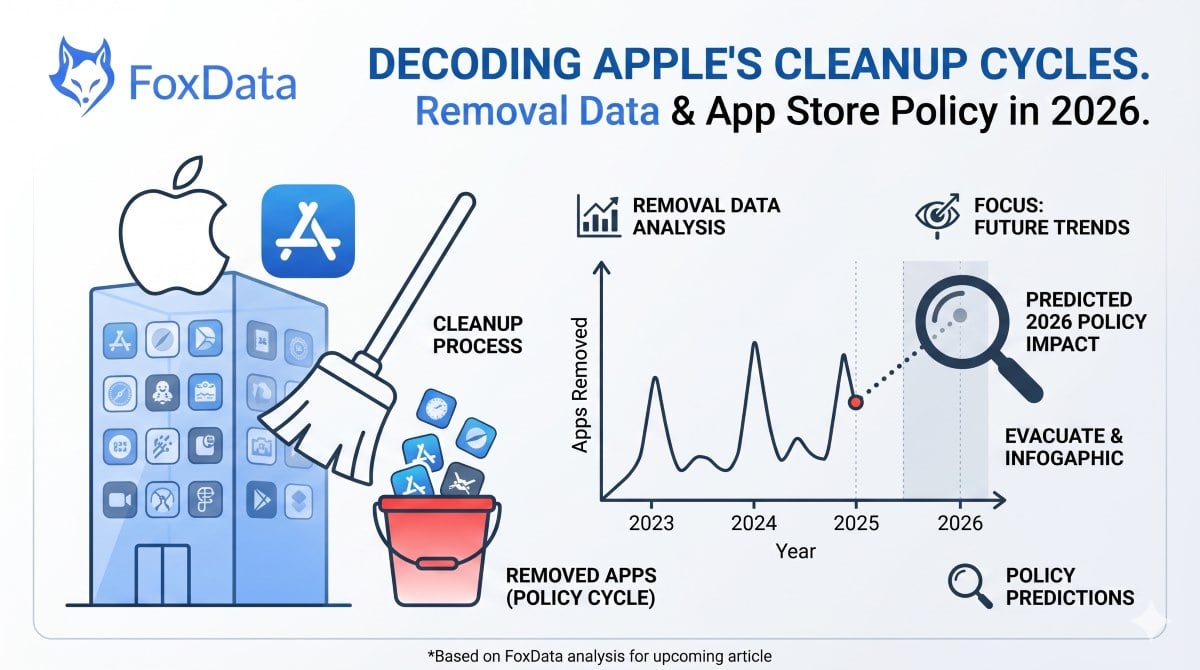
For most App Store users, April 29 was an ordinary Tuesday. For app publishers, it was anything but. On that single day, Apple removed 6,467 applications from the U.S. App Store - roughly four to five times the typical daily removal rate.
No press release. No developer advisory. No public explanation. Just thousands of apps, gone.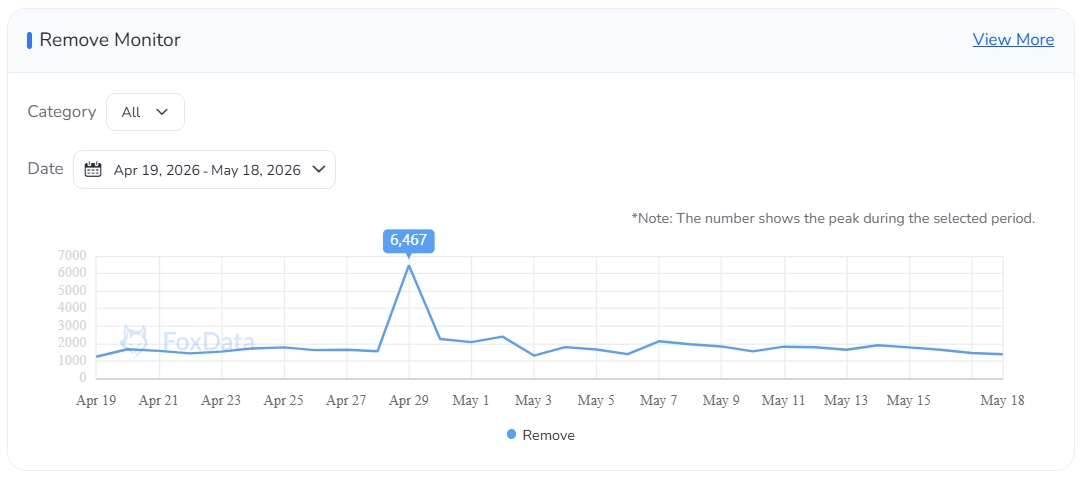
FoxData's Remove Monitor captured the April 29 removal spike in real time. The event resolved within 24 hours, with daily removals returning to the 1,200-1,500 baseline by May 1.
This wasn't the first time Apple has conducted a large-scale cleanup, and it won't be the last. But for the first time, tools like FoxData make it possible to detect, quantify, and analyze these events as they happen - rather than discovering weeks later that your category landscape shifted beneath your feet.
By cross-referencing FoxData's Remove Monitor with category-level data, a clearer picture emerges of what Apple targets during enforcement sweeps:
Based on historical patterns and the April 29 event:
Abandoned apps - Apps without updates for 2+ years that fail to meet minimum compatibility requirements
Policy violators - Apps using deprecated APIs, containing undisclosed tracking, or violating updated App Store Review Guidelines
Low-quality duplicates - Template-based apps with minimal differentiation (Apple's longstanding battle against "app spam")
Metadata manipulators - Apps with keyword-stuffed titles, misleading descriptions, or fake screenshots
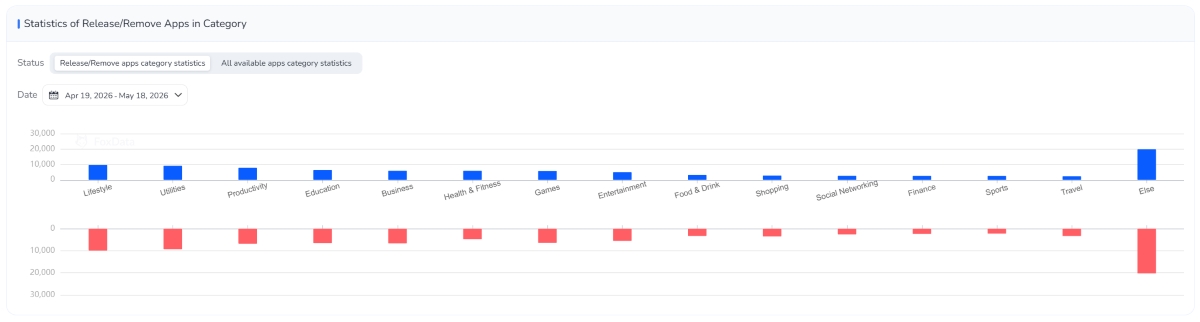
The "Else" catch-all category shows disproportionately high removals relative to releases - suggesting that niche, miscategorized, or poorly maintained apps bear the brunt of enforcement. Lifestyle, Utilities, and Productivity show balanced churn.
The data suggests Apple's cleanup primarily targets:
Apps in ambiguous categories (the "Else" bucket)
Categories with historically high template-app density
Verticals where user safety concerns have increased (Health, Finance)

FoxData's data shows that major removal events are sometimes preceded by subtle signals:
A slight uptick in daily removal baseline (1,200 → 1,400 → 1,600) over 3–5 days
Increased keyword clearing events (suggesting metadata policy enforcement beginning)
Apple developer communication updates (guideline revisions posted without fanfare)
The spike itself is typically concentrated in 24-48 hours. The April 29 event peaked at 6,467 and normalized by May 1. During this window:
Keyword rankings become volatile (positions vacated by removed apps redistribute)
Category charts shift (removed apps free up chart positions)
User search behavior may change (users of removed apps seek alternatives)
The post-sweep period (first 7-14 days) represents a strategic opportunity window:
Keyword positions recently held by removed apps are now available
Users displaced from removed apps are actively searching for alternatives
Category chart positions have opened up
Teams that detect sweeps in real time can execute an ASO impact analysis within 24 hours and reposition their metadata to capture newly available positions.
The best response to removal waves is to never be caught in one. Here's how FoxData's monitoring data informs a compliance-first strategy:
If removals in your category are trending upward (even slightly), Apple may be increasing scrutiny in your vertical. Use this as a trigger to:
Audit your own app against current App Store Review Guidelines
Ensure all third-party SDKs are updated and privacy-compliant
Verify your metadata accuracy (screenshots match current functionality, descriptions are non-misleading)
If direct competitors are being removed, analyze why:
Were they using deprecated APIs you also depend on?
Did they have metadata patterns similar to yours?
Were they in a sub-category Apple is actively cleaning?
Their removal is both an opportunity and a warning. Capture their users, but learn from their mistakes.
After a sweep, the Release Monitor shows "Recovered" apps - previously removed apps that have been resubmitted and re-approved. Tracking this tells you:
How long recovery takes (typically 2-4 weeks)
Whether Apple is accepting resubmissions in your category
What changes removed apps made to get reinstated (compare before/after metadata)
Zoom out from individual events and the 30-day trend tells a broader story:
|
Metric |
Trend |
Implication |
|---|---|---|
|
Daily removals |
Stable at 1,200-1,500 (with periodic spikes) |
Continuous quality enforcement, not one-time cleanup |
|
Daily releases |
Declining (2,600 → 841 over the period) |
Higher submission barriers or developer caution |
|
Net store growth |
+598/day |
Market is growing, but barely |
|
Pre-orders |
Stable ~2,100 |
Developer investment continues despite tighter standards |
The pattern is clear: Apple is systematically raising quality standards. The App Store of 2026 is not a "publish and forget" platform. Active maintenance, regular updates, and strict compliance are table stakes for survival.
For developers who meet these standards, the reward is a less crowded competitive landscape. For those who don't, it's a matter of time.
The most sophisticated app publishers don't just comply with Apple's policies - they use enforcement patterns as strategic signals. When Apple removes 6,467 apps in a day:
Marketing teams immediately scan for keyword opportunities in the cleared landscape
Product teams check whether removed competitors had features worth incorporating
ASO teams run competitor revenue analysis to estimate the revenue pool that just became available
Paid acquisition teams adjust ASA bids on keywords where competition just decreased
None of this is possible without real-time removal monitoring.
Apple will continue cleaning the App Store. The pace and intensity may vary, but the direction is clear: higher standards, fewer low-quality apps, more opportunity for those who remain.
FoxData's Store Monitor gives you the data to:
Detect enforcement events as they happen
Assess whether your category is being targeted
Identify the strategic opportunities each cleanup creates
Track your own compliance risk relative to removal patterns
Monitor removal trends, understand the patterns, and position yourself on the right side of Apple's quality curve. Explore FoxData's app analytics tools to get started.
© 2020-2026 FoxData. All Rights Reserved.