


Explore More Possibilities for Your Business
Full-cycle scenario construction to meet your needs from App research, development, and release to operation.
Ready for your soaring growth
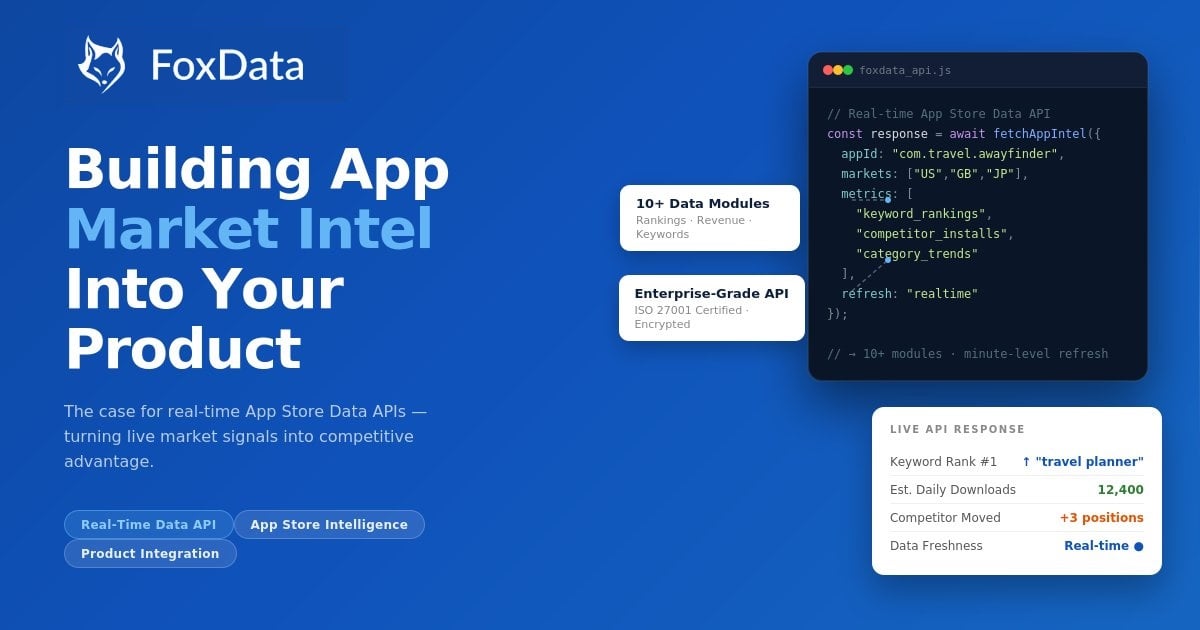
Dashboards are useful. But for teams running automated workflows - portfolio monitoring at scale, algorithmic trading of app install campaigns, or building internal tools for client reporting - logging into a dashboard doesn't scale.
The U.S. App Store processes roughly 800-2,600 new releases per day, 1,200-1,500 removals, and continuous keyword ranking fluctuations affecting tens of thousands of apps. For organizations that need to act on this data programmatically, the question isn't whether to monitor - it's how to integrate monitoring into existing systems.
Consider the operational workflows that benefit from real-time App Store data feeds:
When 66,083 apps lose keyword rankings in a single day (as occurred on May 9, 2026), Apple Search Ads dynamics shift immediately. Automated bidding systems that detect this signal can:
Reduce ASA spend during the disruption (avoiding inflated CPAs on unstable rankings)
Increase spend 48 hours later (capturing positions vacated by apps that reactively changed metadata)
Reallocate budget toward keywords where competitors just lost organic visibility
This response needs to happen within hours, not days. Dashboard monitoring can't drive this - API integration can.
Agencies managing 50+ app clients can't manually check each client's competitive landscape daily. But an API feed that flags:
New pre-order apps entering a client's category
Removal spikes affecting a client's competitor set
Keyword ranking drops exceeding normal variance
...can trigger automated alerts and pre-populate weekly client reports with relevant market context.
Firms evaluating app-based businesses need to understand whether an acquisition target's growth is occurring in an expanding or contracting category. An API that delivers daily release/removal ratios by category provides this context automatically as part of due diligence pipelines.
FoxData's App Data API exposes the same data that powers the Store Monitor dashboard - but in structured, programmatic format designed for integration:
|
Endpoint Category |
Data Points |
Update Frequency |
|---|---|---|
|
Store Statistics |
Total apps, daily releases, daily removals |
Daily |
|
Release Monitor |
New releases, pre-order conversions, recoveries by category |
Daily |
|
Removal Monitor |
Removal counts, spike detection, category breakdown |
Daily |
|
Keyword Monitor |
Clearing list events, ranking change volumes |
Daily/Hourly |
|
Pre-order Pipeline |
Active pre-orders by category, pricing, publisher |
Daily |
|
Category Analytics |
Release/removal ratios, app density by vertical |
Daily |
Teams typically integrate FoxData's data in one of three patterns:
Poll the API daily. When metrics exceed configurable thresholds (e.g., removal spike >3x average, keyword clearing >20,000 apps), trigger webhooks to Slack, PagerDuty, or internal alert systems.
Best for: ASO teams, growth marketers, portfolio managers
Ingest daily snapshots into your data warehouse (Snowflake, BigQuery, Redshift). Join with internal performance data to build correlation models between market events and your own KPIs.
Best for: Data science teams, investment analysts, large publishers
Feed API outputs directly into marketing automation platforms. When a competitor is removed from the store, automatically adjust ASA bids on shared keywords. When a new pre-order appears in your category, auto-create a competitive analysis task.
Best for: Performance marketing teams, agencies with ASO/ASA operational needs
The math depends on your scale, but consider these reference points:
For an agency managing 30 clients:
Manual competitive monitoring: ~2 hours/client/week = 60 hours/week = 1.5 FTEs
API-driven automated monitoring: setup cost + maintenance = ~0.1 FTE equivalent
Net savings: 1.4 FTEs redeployed to strategic work
For a publisher with 10+ apps:
Missed market events (keyword drops, competitor entries) cost an estimated 5-15% of organic install volume during response delay
Real-time detection reduces response time from days to hours
Even a 3% improvement in organic installs across a portfolio of 10 apps compounds significantly
For performance marketing:
ASA campaigns running during keyword disruption events waste budget on unstable positions
Automated pause/resume based on clearing list data can reduce wasted spend by 10-20% during volatility events
For teams evaluating whether API integration makes sense, FoxData offers a progression path:
Start with the dashboard - use FoxData's free tools to validate that the data points align with your operational needs
Prototype with the API - build a proof-of-concept integration against a single workflow (e.g., competitor removal alerts)
Scale to production - expand API integration across your full workflow suite once value is validated
The App Data API documentation provides endpoint specifications, authentication details, and rate limit information for technical evaluation.
The App Store generates signals continuously. 841 releases, 1,365 removals, thousands of keyword ranking shifts - every single day. Organizations that capture these signals programmatically don't just react faster; they begin to predict market movements based on pattern recognition across historical data.
The dashboard shows you what happened today. The API lets you build systems that anticipate what happens tomorrow.
Explore FoxData's App Data API and start building market intelligence into your product stack.
For technical teams evaluating integration options, FoxData's API supports RESTful endpoints with JSON responses, standard OAuth authentication, and configurable rate limits suitable for both real-time alerting and batch processing workflows.
© 2020-2026 FoxData. All Rights Reserved.