

Explore More Possibilities for Your Business
Full-cycle scenario construction to meet your needs from App research, development, and release to operation.
Ready for your soaring growth
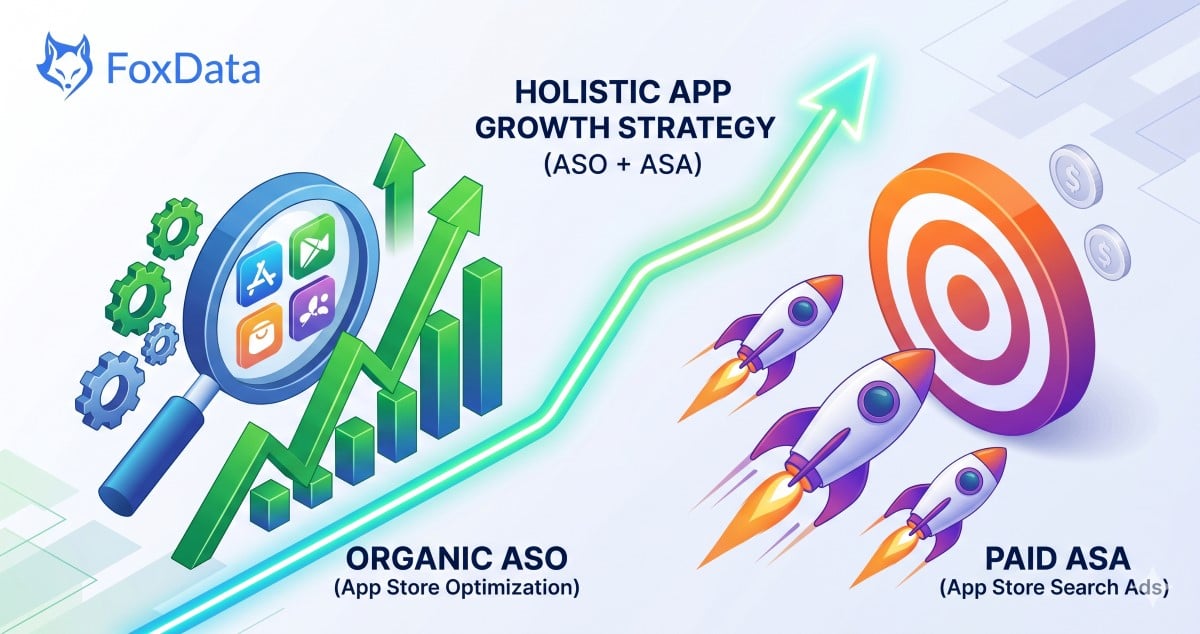
You want more downloads. That is the goal.
Two powerful levers exist to help you get there. The first is App Store Optimization (ASO). The second is Apple Search Ads (ASA). They sound similar, but they work very differently.
Many developers treat them as two separate worlds. That is a costly mistake. Understanding how each works — and how they work together — is what separates average growth from scalable, sustainable results.
This guide breaks down both strategies clearly. It also shows you how a unified platform makes managing both far more effective.
The app stores are brutally competitive. As of 2024, Apple reported more than 1.9 million apps available on the App Store, according to Apple's own data. Standing out requires more than a good product.
Apple has long maintained that 65% of App Store downloads come directly from search. That means most users find apps by typing something into the search bar. Whether you rely on organic visibility or paid placement, keywords are the foundation of both strategies.
Here is why data matters so much. Without accurate keyword data, you are guessing. You might optimize for terms that get no traffic. You might bid on ASA keywords that cost too much and convert too little. Data tells you where demand actually lives.
An analysis of the top 1,000 apps in the U.S. market found that apps improving their rating from 3.6 to 4.2 saw nearly 60% higher conversion rates. That lift comes before a single dollar is spent on paid ads.
When you understand search behavior through real data, every decision — organic or paid — becomes smarter and more efficient.
ASO is the process of improving your app's organic visibility. It covers your title, subtitle, keyword fields, description, screenshots, icon, and ratings. Done well, ASO brings consistent, free traffic over time.
Think of ASO like SEO for your app store listing. You are not paying per click. You are earning visibility through relevance and quality signals.
Key ASO levers include:
ASO is a long-term investment. Results compound over time. An app with strong organic rankings can drive downloads indefinitely at zero cost per install.
Apple Search Ads is Apple's own paid advertising platform. It lets you bid to appear at the top of App Store search results for specific keywords. You pay per tap, not per download.
Apple's own platform data shows that Search Ads deliver more than a 60% average conversion rate for ads appearing at the top of search results. That makes it especially powerful for new apps, seasonal campaigns, and competitive markets.
Key ASA levers include:
ASA is a paid channel. Stop spending, and the traffic stops. But used well, it delivers measurable, scalable installs with strong intent.
ASO builds organic foundations. ASA accelerates paid visibility. They share the same battlefield — app store search — but operate with different mechanics and timelines.
The biggest mistake marketers make? Running them in isolation.
Here is where strategy gets interesting. ASO and ASA are not competitors. They are multipliers.
When your ASO is strong, your ASA performance improves. Apple's algorithm considers relevance when determining ad rank. An app with a well-optimized metadata structure often achieves better Quality Scores in Search Ads, leading to lower CPTs and stronger placements.
The data flows both ways. ASA keyword data is a goldmine for ASO. When you run Search Ads campaigns, you can see exactly which keywords drive taps and conversions. That real conversion data is far more reliable than estimated search volumes. You can then prioritize those high-converting terms in your organic metadata.
Consider this workflow:
This loop compounds. Your organic footprint grows. Your paid spend becomes more efficient. Your cost per install trends down over time.
According to Apple's own Ads documentation, whether a search results ad displays over competitors is determined by a combination of your app's relevance to the search query and the amount of your keyword bid. That means the work you do in ASO directly influences your ASA results. The two strategies are deeply intertwined.
Understanding the strategy is step one. Executing it requires the right platform.
This is where FoxData's advanced ASO tools come in. FoxData is built specifically for mobile app marketers who need both ASO and ASA data in one place.
Here is what that looks like in practice.
For ASO keyword research: FoxData provides keyword traffic scores, difficulty ratings, and ranking history. You can benchmark your keyword coverage against competitors. You can identify gaps where high-traffic terms are underserved in your metadata.
For ASA campaign intelligence: FoxData surfaces keyword-level performance data to help you identify which terms deliver strong conversion at acceptable cost. You can see where competitors are bidding and model your own strategy accordingly.
For creative analysis: FoxData tracks competitor icon and screenshot changes over time. You can spot creative trends in your category before they become standard.
For market intelligence: FoxData provides country-level data, so you can prioritize localization efforts where opportunity is highest.
Teams using a platform like FoxData for keyword optimization and ASO management eliminate the need to stitch together multiple tools. Everything lives in one dashboard. That saves time and reduces the risk of acting on inconsistent data from different sources.
Whether you are a solo indie developer or a UA manager at a major publisher, the workflow is the same. Discover keywords. Validate with paid data. Optimize organic metadata. Track rankings. Refine.
Even experienced marketers make these errors. Avoiding them protects your budget and your rankings.
ASO is not a checkbox. Search trends shift. Competitors update their metadata. The algorithm evolves. Apps that set their metadata once and forget it lose rankings steadily over time. Schedule monthly ASO audits minimum.
Apple Search Ads shows you the actual terms users searched before tapping your ad. Many marketers ignore this report. It is one of the most valuable data sources available. Irrelevant search terms drain your budget fast.
If you are not bidding on your own brand name, competitors might be. Branded keyword campaigns in ASA are typically low-cost and high-converting. They are also an important defensive layer for any established app.
A keyword gets users to your listing. Your creative gets them to download. High-traffic keywords paired with weak screenshots result in poor conversion. Always test both dimensions together.
Different markets search differently. Direct translations of English keywords rarely perform well in Japanese, Korean, or German markets. Localized keyword research and localized ad creative can dramatically improve performance in non-English markets.
Industry benchmark data shows that localized store listings consistently outperform non-localized ones in non-English speaking markets. This applies equally to your ASA keyword lists.
Yes, but it is not ideal. ASA without ASO means you are paying for traffic going to an under-optimized listing. Your conversion rate will suffer. The smartest approach is to reach a baseline level of ASO quality before scaling paid spend. Even basic metadata and strong screenshots will improve your return on ASA investment.
Most apps see meaningful ranking movement within 4 to 8 weeks of metadata updates, according to industry benchmarks tracked by major app intelligence platforms. Highly competitive categories take longer. Niche categories can show faster movement. Consistency matters more than speed.
Apple has not confirmed a direct relationship. However, paid installs do increase download velocity, which is a positive ranking signal. There is indirect evidence that apps with strong ASA campaigns also see organic ranking lifts, particularly in search results where ASA and organic listings both appear.
Not necessarily. A unified platform that handles both reduces data silos and workflow friction. FoxData covers both ASO research and ASA analytics, so teams can make connected decisions rather than working from fragmented data sources.
ASO and ASA are not competing strategies. They are complementary engines.
ASO builds your long-term organic foundation. ASA accelerates growth and generates the keyword intelligence that makes your ASO smarter. Used together, they create a self-reinforcing growth loop that consistently lowers your cost per install over time.
The apps that win in saturated markets are not the ones with the biggest budgets. They are the ones that make the smartest decisions with their data.
That starts with having the right tools.
Ready to bring your ASO and ASA strategy under one roof? Explore FoxData's advanced ASO and ASA analytics platform and start making data-driven decisions that grow your app, both organically and through paid search.
© 2020-2026 FoxData. All Rights Reserved.