Key Takeaways
- Campaign structure matters: A clean, goal-driven campaign structure sets the foundation for scalable growth and easier optimization.
- Keyword match types are critical: Use a mix of exact, broad, and Search Match with regular negative keyword refinement.
- Custom product pages boost CVR: Tailored landing pages can raise conversion rates by nearly 6%.
- AI-powered bidding is the new standard: Automation rules and Apple's Maximize Conversions feature streamline bid management at scale.
- ASO + Apple Ads synergy: Aligning paid and organic strategies creates a performance loop that lowers blended acquisition costs.
- Track the right KPIs: Focus on TTR, CPT, CPI, and ROAS to guide smarter budget allocation.
- Localization drives global ROI: Tailored campaigns for each storefront can unlock significant growth in new markets.
What Are Apple Ads?
Apple Ads (formerly Apple Search Ads) is Apple's proprietary advertising platform for promoting apps directly within the App Store. It enables marketers to drive visibility and installs by placing targeted ads across four key App Store placements:
👉 Promote Your App with Apple Search Ads 2026: Today Tab, Search Tab, Search Results & Product Pages
With over 65% of App Store downloads originating from search, Apple Ads provides access to high-intent users at the moment they are actively looking for solutions.
The platform operates on a second-price auction model, offering two tiers:
- Apple Ads Basic: Automated setup with CPI pricing and limited controls. Good for beginners with budgets up to $10,000/month per app.
- Apple Ads Advanced: Full manual control over keywords, bids, creatives, and audience targeting with CPT pricing. Recommended for serious growth marketers.
For teams aiming to scale efficiently, Apple Ads Advanced combined with a data platform like FoxData's ASA Analytics Tools provides the level of insight needed to compete.
Apple Ads Best Practices to Maximize ROI in 2026
1. Build a Strong Campaign Structure from Day One
A well-structured campaign setup is what separates scalable Apple Ads strategies from inconsistent results.
When campaigns are aligned with user intent and funnel stages, optimization becomes faster, reporting becomes clearer, and budget allocation becomes more effective.
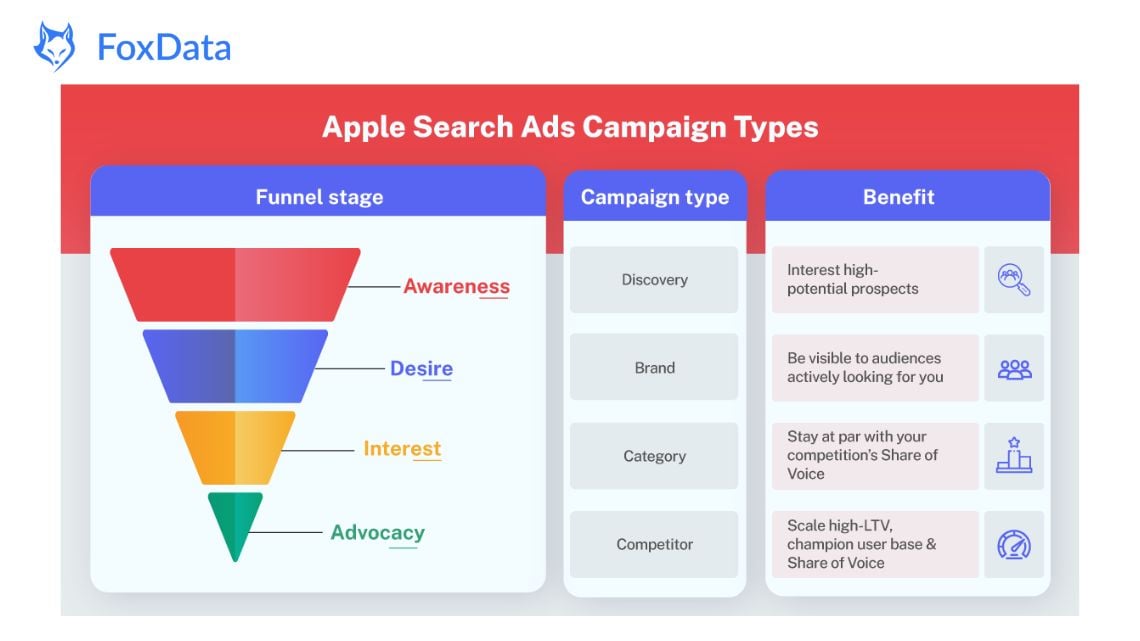
Recommended campaign structure:
- Brand campaign: Target your own brand name and variations using exact match keywords. These typically yield the highest conversion rates.
- Category/ Generic campaign: Target category-level keywords (e.g., "fitness tracker app", "budget planner") to capture users with broad intent.
- Competitor campaign: Bid on competitor brand terms to capture users exploring alternatives.
- Discovery campaign: Use broad match and Search Match to uncover new keyword opportunities.
Best practices for campaign structure:
- Separate brand, generic, and competitor keywords into distinct campaigns for clearer reporting and budget control.
- Align ad groups with specific keyword themes and creative sets to ensure relevance.
- Allocate budget proportionally based on campaign goals and expected return.
- For multi-geo targeting, create country or storefront-specific campaigns to account for differences in language, seasonality, and user behavior.
Pro Tip: Start with ~80% of budget on performance campaigns and ~20% on discovery. Reallocate based on actual conversion data—not assumptions.
2. Master Keyword Strategy with Match Types and Negatives
Selecting the right keywords is one of the most impactful decisions in your Apple Ads strategy. High-intent keywords closely related to your app's core functionalities drive better tap-through and conversion rates.
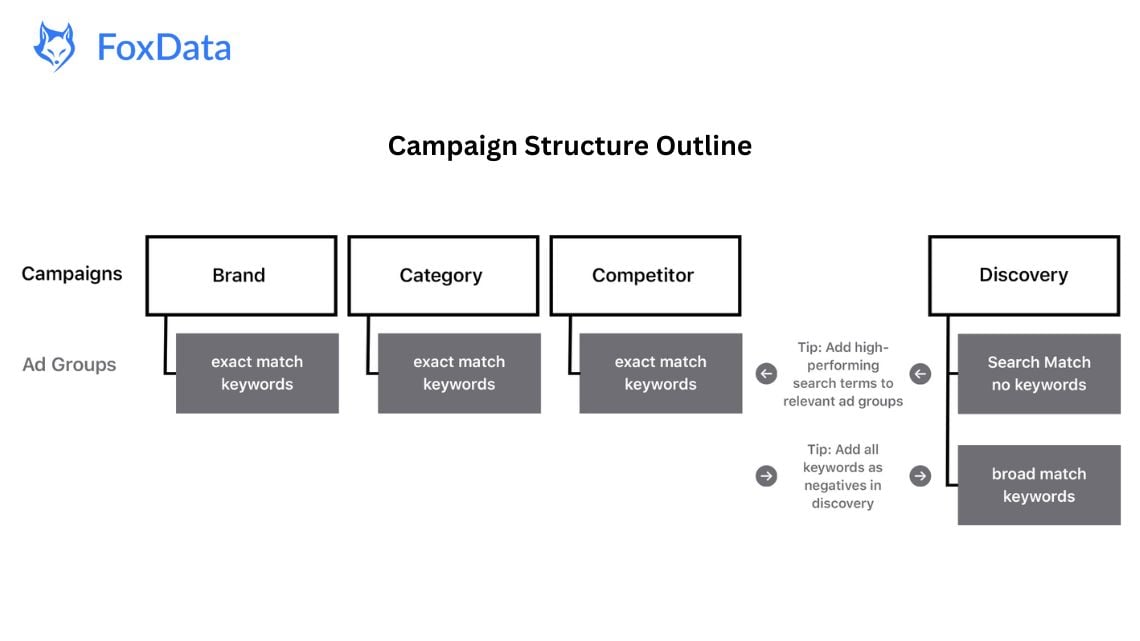
Match type strategy:
- Exact Match: Use for your most valuable, high-intent keywords. Provides maximum control over when your ad appears.
- Broad Match: Use to explore new keyword opportunities and capture related search queries.
- Search Match: Enable in discovery campaigns to let Apple automatically match your ad to relevant queries.
Negative keyword best practices:
- Add high-performing keywords from core campaigns as exact match negatives in discovery campaigns to prevent overlap.
- Exclude irrelevant queries based on actual search term reports.
- Continuously refine your negative keyword list as your campaigns scale and new patterns emerge.
3. Leverage Custom Product Pages (CPPs) for Higher Conversions
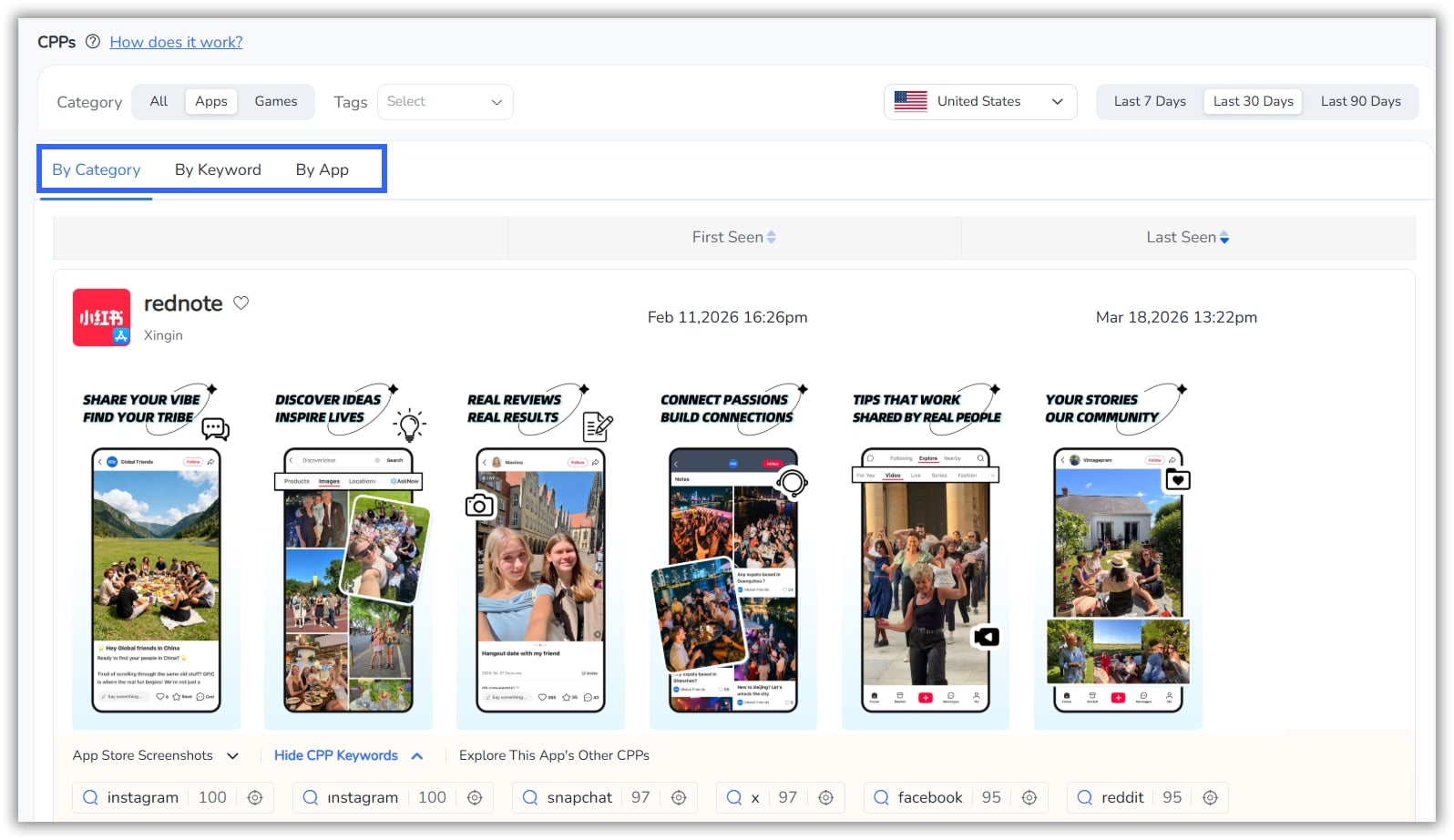
Apple allows you to create up to 70 custom product pages tailored to different user intents. When linked to specific ad groups in Apple Ads, CPPs create a seamless experience from ad to landing page that significantly boosts conversion rates.
Industry data shows that ad variations using CPPs raise conversion rates by nearly 6% on average compared to default product pages.
CPP best practices:
1. Align each CPP with user intent: Match screenshots, messaging, and app preview videos to the keyword theme of the associated ad group.
2. Maintain consistency between ad and landing page: Your CPP should be a natural follow-through of the ad, not a disconnect.
3. Use ASO data to build user personas: Leverage keyword trends and competitor analysis to inform CPP creative direction.
4. Monitor performance metrics: Track tap-through rate and conversion rate for each CPP variation to optimize continuously.
5. Get inspiration from competitors: Analyze competitor CPPs to identify gaps and opportunities in your own creative strategy.
Following the 2025 update, CPPs can now also be discovered for organic keywords, extending their reach beyond paid campaigns. Explore CPP analytics with FoxData's CPP.
4. Optimize Your Bidding Strategy for Efficient Ad Spend
A strategic bidding approach is essential to maximize return from your Apple Ads investment. Rather than applying flat CPT bids across all keywords, tailor bids based on user intent, keyword performance, and regional opportunities.
Segment bids by intent:
- Brand keywords: Higher bids justified by strong user intent and high conversion rates.
- Category keywords: Moderate bids, adjusted based on conversion efficiency.
- Competitor keywords: Conservative bids until proven effective, as conversion rates are typically lower.
- Discovery keywords: Start low and scale based on search term report data.
Bid adjustment rules:
- Only increase or decrease keyword bids by about 20% at a time to accurately assess impact.
- Raise bids on high-performing keywords to improve impression share and volume.
- Lower bids or pause spend on keywords with low conversion efficiency.
- Adapt bids for different regions based on country-level performance indicators.

Your Data, Secured: FoxData Achieves ISO 27001
Discover how FoxData enhances data protection and security standards to keep your analytics safe and reliable.
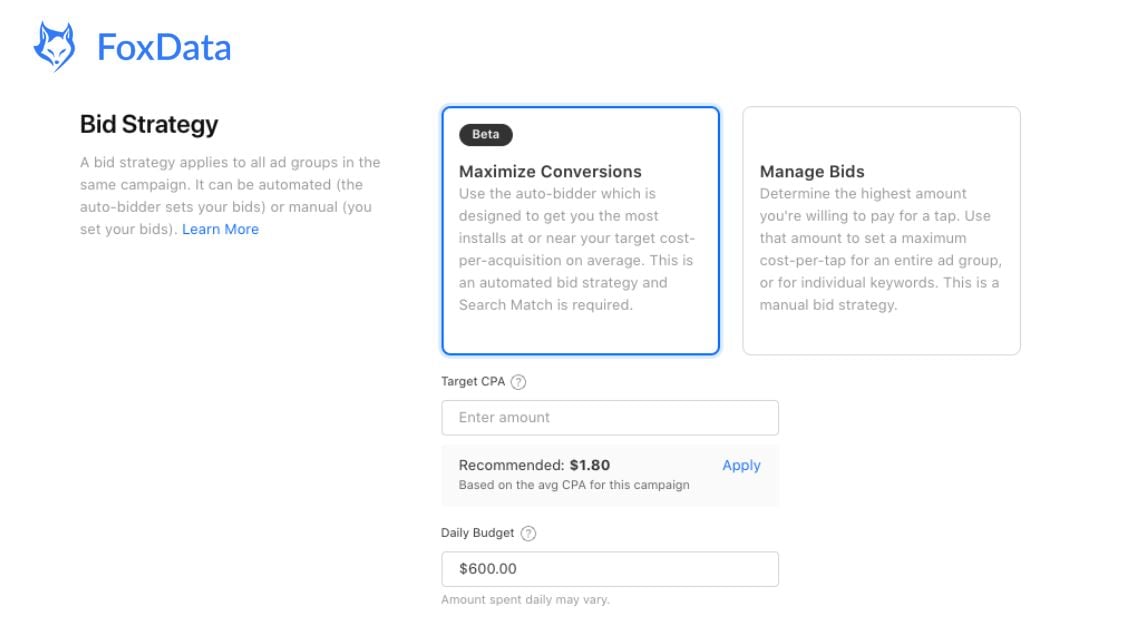
5. Use Apple's New Maximize Conversions Feature
Apple’s Maximize Conversions feature reflects the shift toward AI-driven campaign optimization in 2026. It automatically adjusts bids to generate the highest number of installs within your budget.
Best used when:
- Campaigns with sufficient historical data for the algorithm to learn from.
- When scaling campaigns where manual bid management becomes impractical.
- In combination with well-structured campaigns and clean keyword segmentation.
When to stick with manual bidding:
- New campaigns without enough conversion data.
- Highly competitive keyword categories where you need granular control.
- When optimizing for post-install events (ROAS) rather than pure install volume.
6. Track the Right KPIs to Guide Optimization
Successful Apple Ads campaigns are built on data-driven decisions. Focus on both campaign-level and keyword-level metrics to understand performance and optimize results.
Key performance indicators include:
- Tap-Through Rate (TTR): Indicates how engaging your ad is in search results. Benchmark: 5-10% for search results ads.
- Conversion Rate (CR): Measures how well your ad and landing page convert users post-tap. Global average: ~55% for search results.
- Cost Per Tap (CPT): Shows how much you pay for each user interaction.
- Cost Per Install (CPI): Reveals how efficiently you are acquiring users.
- Return on Ad Spend (ROAS): Assesses campaign profitability. Pair with MMP attribution data for full-funnel visibility.
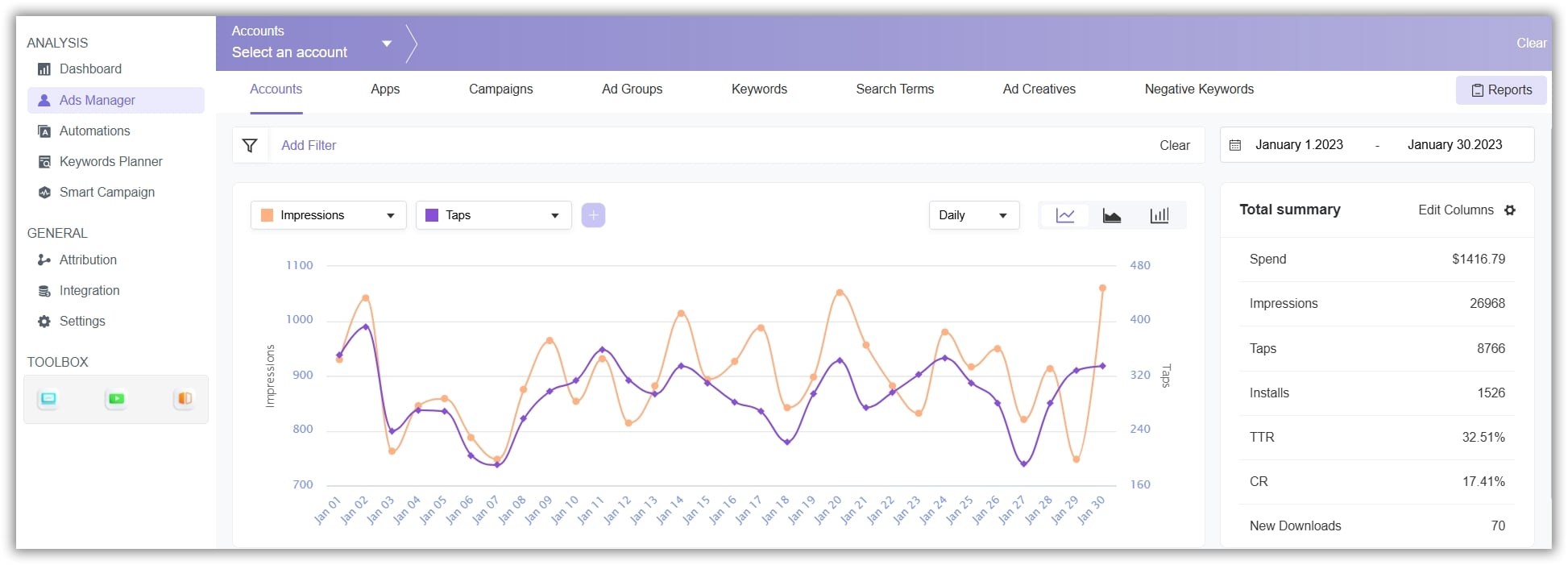
With FoxData's Campaign Manager, you can monitor all of these metrics at the campaign, ad group, and keyword level. The platform also supports MMP integration, letting you track post-install events and true ROAS in a unified dashboard.
Ready to Optimize Your Apple Ads Campaigns?
FoxData's ASA Analytics Tools provides automated campaign management, real-time competitor bid monitoring, and comprehensive keyword intelligence.
Explore FoxData ASA Tools →
Avoid These Common Apple Ads Mistakes
Even experienced marketers fall into common traps that waste budget and reduce campaign effectiveness. Here are the most critical mistakes to avoid:
Mistake 1: Overlapping keywords across campaigns
Letting the same keywords appear in multiple campaigns divides spend and makes performance analysis difficult. Move proven keywords out of discovery campaigns into core campaigns, and add them as exact match negatives in discovery.
Mistake 2: Over-investing in discovery campaigns
Discovery campaigns are for finding new keywords, not driving volume. Limit discovery spend to around 20% of your total Apple Ads budget.
Mistake 3: Making large bid adjustments at once
Changing bids by more than 20% at a time makes it impossible to isolate the impact. Use incremental adjustments and monitor results over several days.
Mistake 4: Confusing ROI with ROAS
ROI accounts for all marketing costs (staff, tools, creative production). ROAS measures revenue per dollar of ad spend. Use ROAS to evaluate specific channel performance.
Mistake 5: Neglecting negative keywords
Without negative keywords, your ads appear for irrelevant queries, wasting budget and inflating CPT. Maintain a regularly updated negative keyword list based on search term reports.
Mistake 6: Mixing exact and broad match in the same campaign
This creates confusion and makes performance analysis unreliable. Separate match types into distinct campaigns or ad groups.
Combine Apple Ads with ASO for Full-Funnel Growth
Apple Ads and App Store Optimization (ASO) are most effective when used together as part of a unified growth strategy. When aligned, they create a performance loop that improves both paid efficiency and organic visibility.
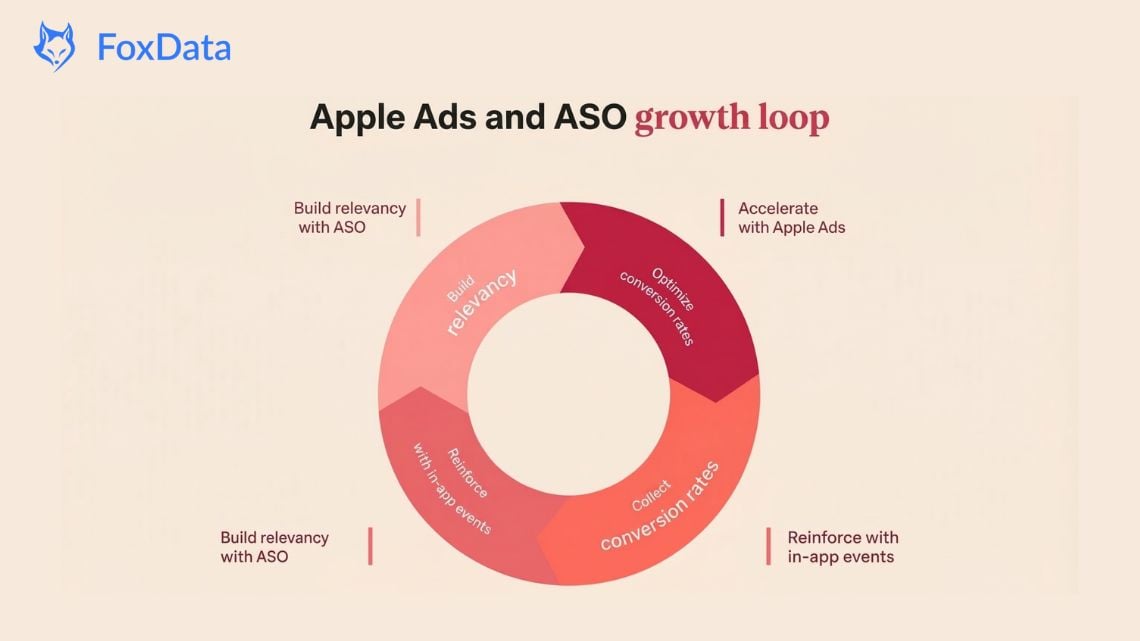
How the growth loop works:
- High-performing keywords from Apple Ads inform updates to your ASO metadata (title, subtitle, keyword field, screenshots).
- Reinforcing these keywords in metadata can improve organic rankings for the same terms.
- Better organic conversion rates help Apple Ads campaigns win more auctions at lower cost.
- As organic visibility grows, your blended acquisition cost decreases.
Key alignment areas:
- Keyword synergy: Use Apple Ads data to discover new high-intent keywords for your ASO strategy, and use ASO keyword research to expand your paid keyword coverage.
- Creative consistency: Align the messaging and visuals across ad creatives, CPPs, and your default product page for a seamless user experience.
- Performance feedback: Regularly compare paid and organic keyword performance to identify gaps and opportunities.
FoxData provides both ASO tools and ASA analytics in a single platform, making it easy to align your paid and organic strategies.
Advanced Apple Ads Strategies for 2026
Leverage AI and Automation for Smarter Campaign Management
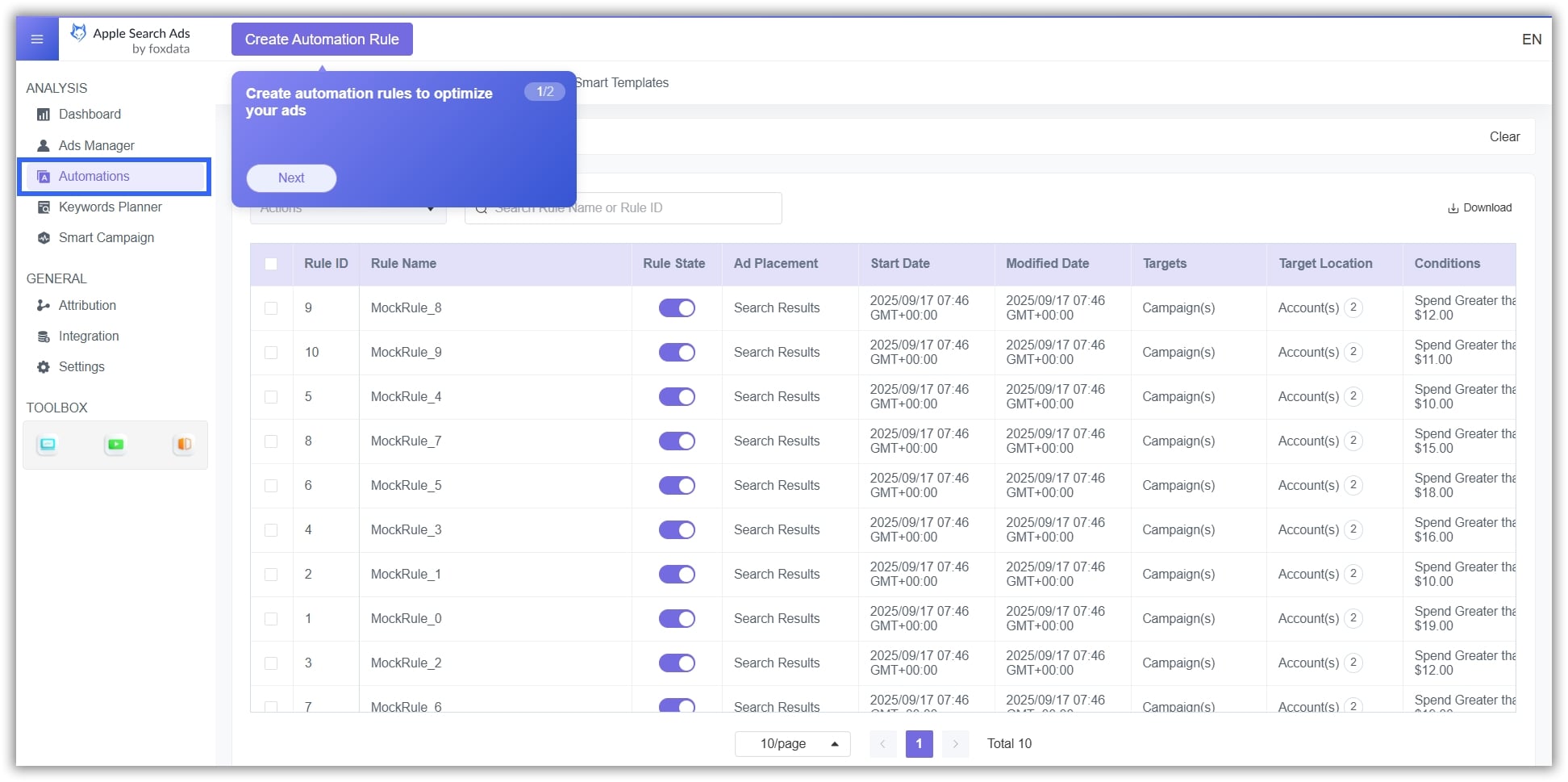
AI and automation are playing an increasingly central role in Apple Ads strategy in 2026. As campaigns scale across storefronts and user segments, the ability to make timely, data-driven decisions becomes essential.
Key automation opportunities:
- Automated bid adjustments: Set rules to automatically increase or decrease bids based on CPI, ROAS, or conversion rate thresholds.
- Budget reallocation: Automatically shift budget from underperforming campaigns to high-ROAS opportunities.
- Keyword management: Auto-pause underperforming keywords and promote high-converting terms from discovery to core campaigns.
- Performance alerts: Get notified when key metrics deviate from expected ranges.
FoxData's Campaign Manager provides automation-driven optimization that transforms manual workflows into systematic execution, reducing operational costs while maintaining desired KPIs.
Retarget Lapsed Users and Localize for Global Reach
Retargeting:
Apple Ads enables re-engagement of users who previously interacted with your app but did not convert, churned, or failed to complete key in-app actions. Use targeted CPPs to tailor re-engagement messaging:
- Users who tapped your ad but did not install can be retargeted with a value-focused CPP.
- Churned users might respond to CPPs highlighting new features or time-sensitive promotions.
- Existing users who have not completed key milestones can be directed to CPPs emphasizing ease of use.
Localization:
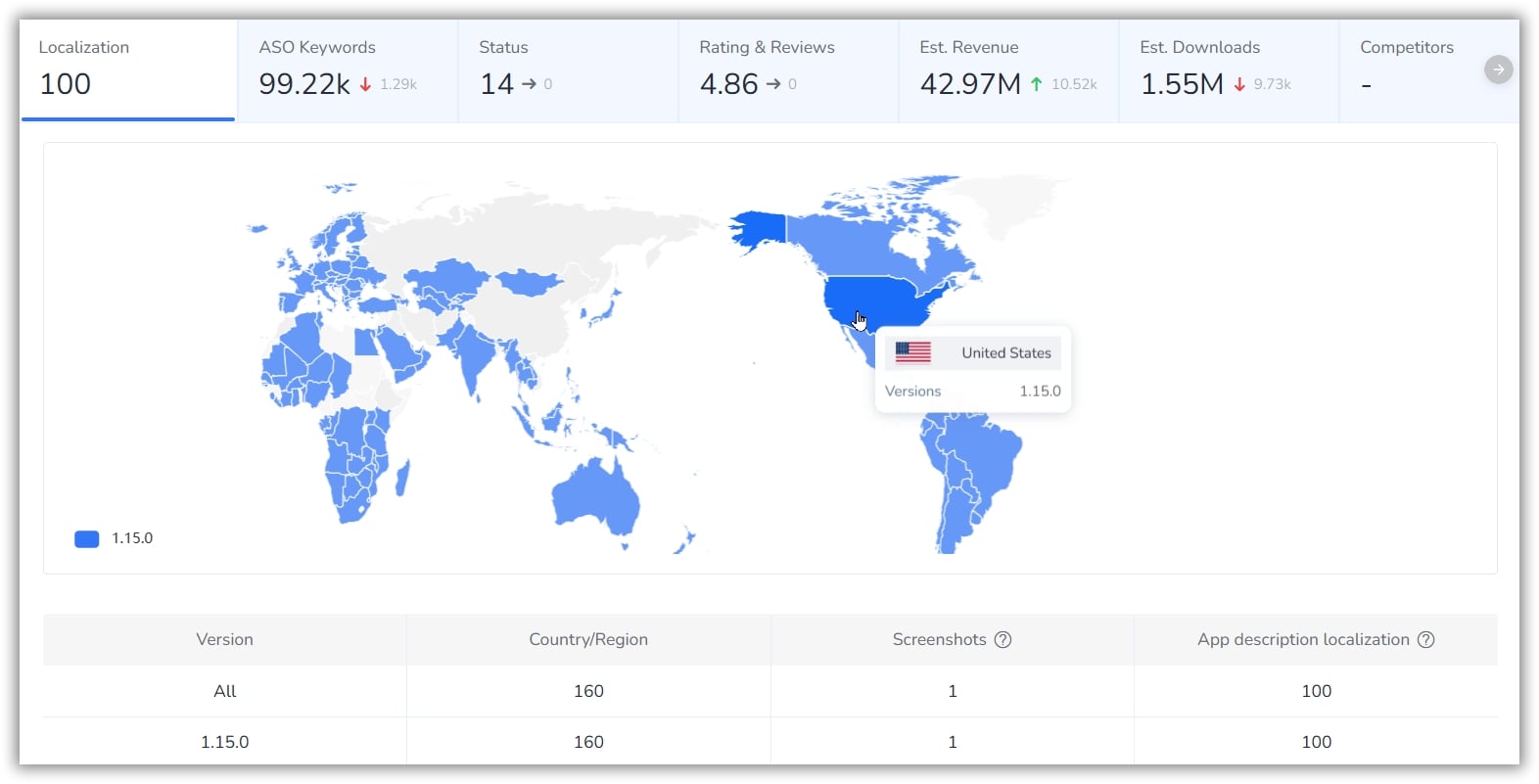
Campaign performance varies significantly across storefronts. Effective localization goes beyond translation. It involves tailoring visuals to regional design trends, referencing culturally relevant events, and adapting bidding strategies based on country-level performance data.
Localization checklist:
- Translate and culturally adapt all CPP creative assets for each target market.
- Conduct multilingual keyword research using native language terms.
- Adjust bids based on regional CPT and CPI benchmarks.
- Plan seasonal campaigns around local holidays and cultural events.
Bonus: Seasonal and Trend-Based Campaigns
High-impact Apple Ads campaigns align with what users are already searching for. Whether it is Black Friday, New Year fitness resolutions, or back-to-school season, timing your campaigns to match demand peaks can significantly boost results.
Seasonal campaign playbook:
- Update metadata, CPPs, and creatives before demand peaks, not during them.
- Increase bids on seasonally relevant keywords 1-2 weeks before peak periods.
- Create seasonal CPPs with event-specific messaging and visuals.
- Use historical data and keyword trend tools to anticipate search volume spikes.
- Automate bid increases and budget shifts using rule-based triggers.
Take Your Apple Ads to the Next Level with FoxData
From automated campaign management to competitive intelligence, FoxData's ASA analytics tools helps you scale smarter. Join leading agencies worldwide who trust FoxData for ASA optimization.
Start Your Free Trial →
Frequently Asked Questions (FAQs)
Q: What are Apple Ads and how do they work?
A: Apple Ads (formerly Apple Search Ads) promote apps across four App Store placements: search results, Today tab, product pages, and the Search tab. Advertisers bid on keywords using a second-price auction.
Q: How do I structure my Apple Ads campaigns for better ROI?
A: Use four campaign types: Brand, Category/Generic, Competitor, and Discovery. Separate match types, group similar keywords, and allocate about 80% budget to performance campaigns and 20% to discovery.
Q: What are the most important Apple Ads KPIs to track?
A: Track Tap-Through Rate (TTR), Conversion Rate (CR), Cost Per Tap (CPT), Cost Per Install (CPI), and ROAS. Typical benchmarks: 5–10% TTR and about 55% CR globally. MMP integration helps measure full-funnel results.
Q: How can FoxData improve Apple Ads performance?
A: FoxData provides automation, competitor bid insights, keyword analysis, CPP creative analytics, and MMP integration—helping teams reduce manual work and optimize campaigns with data. Learn more about FoxData ASA Tools.
Conclusion
Apple Ads success in 2026 depends on building a system that is structured, data-driven, and scalable. From campaign architecture and keyword optimization to AI-powered bidding and ASO integration, every component contributes to long-term performance.
Marketers who monitor seasonal trends, align paid and organic strategies, and use the right analytics tools will have the strongest long-term growth on the App Store.
With FoxData’s ASA Data Analytics Tools and Campaign Manager, teams can move beyond manual optimization and unlock the full potential of Apple Ads.
👉 Get Started with FoxData Today
📚 Recommended Reading: