

Explore More Possibilities for Your Business
Full-cycle scenario construction to meet your needs from App research, development, and release to operation.
Ready for your soaring growth
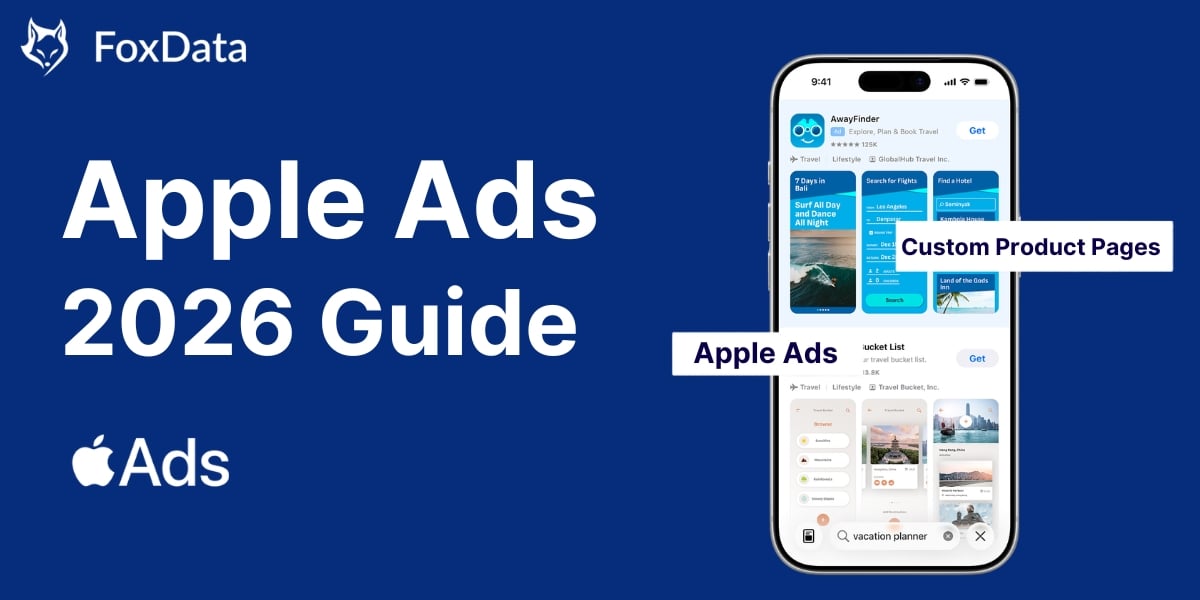
In March 2026, FoxData published seven comprehensive guides covering every dimension of Apple Ads (formerly Apple Search Ads, ASA). From placements and intent-based campaign structures to automation, API scaling, and tool selection — this recap delivers a complete playbook to scale iOS growth efficiently.
Whether you're just starting or optimizing at scale, this guide shows how to execute faster, smarter, and more profitably with FoxData.
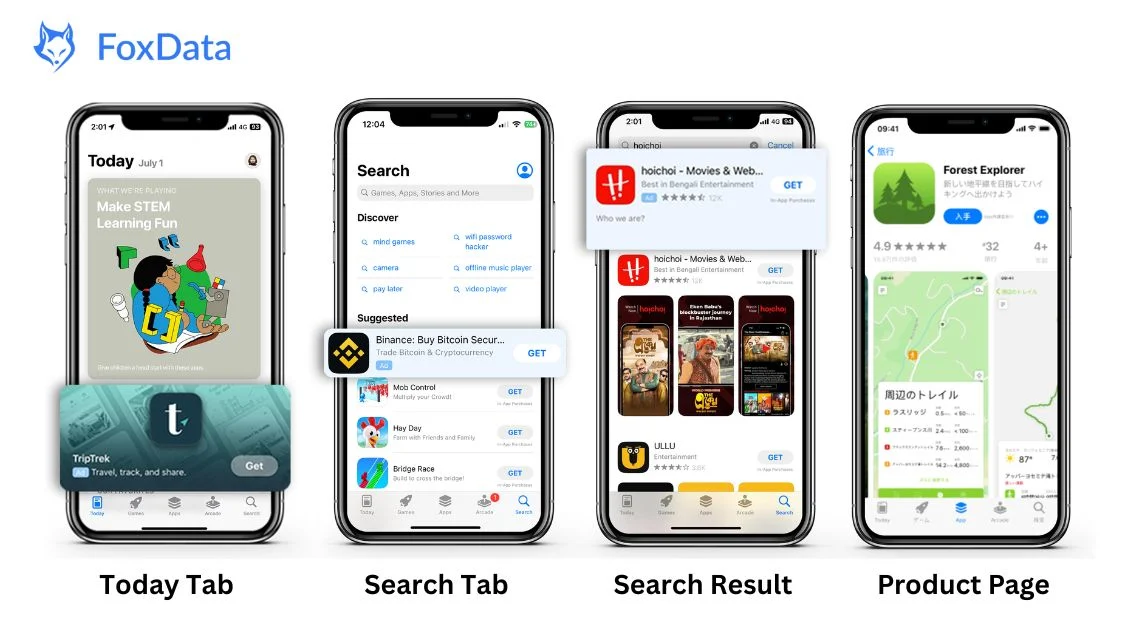
Apple Ads is Apple’s advertising platform that allows developers to promote apps across App Store placements — including search results, Today tab, Search tab, and product pages — capturing high-intent users at the moment of discovery.
With nearly 65% of App Store downloads coming from search, Apple Ads remains the highest-converting user acquisition channel in mobile marketing.
Apple Ads has never been more competitive — and in March 2026, the rules fundamentally changed:
Most teams today lose 20–40% of their Apple Ads budget due to: keyword overlap, poor bid segmentation, lack of automation. To address this, FoxData released a full ASA knowledge series — now consolidated into this actionable guide.
Before diving into lessons, let's address the structural change that makes everything in this recap urgent.
Starting March 3, 2026, Apple began rolling out additional ad placements within App Store search results — first in the UK and Japan, then globally by month's end. For the first time, two ads can appear for a single search query.
"ASO alone is no longer enough: ASA expansion makes organic visibility structurally intertwined with paid campaigns."
The biggest mistake new ASA advertisers make is treating all placements as identical. They're not. Each placement corresponds to a different stage in the user's App Store journey — and therefore requires a different strategy, creative, and success metric.
|
Placement |
Where It Appears |
Funnel Stage |
Intent |
Best For |
|
Today Tab |
App Store homepage |
Awareness |
Low |
Launch & brand exposure |
|
Search Tab |
Before users type a query |
Pre-search |
Medium |
Cateogry discovery |
|
Search Results |
After a specific search |
Intent capture |
High |
Performance & installs |
|
Product Pages |
Bottom of competitor listings |
Comparison |
Medium-High |
Competitor targeting |
💡 Key Takeaway
Don't just "run Apple Ads." Run the right placements for the right objectives. Start with Search Results for performance. Layer in Today Tab and Search Tab for scale once your core campaigns are profitable
👉 Learn how Apple Ads placements work
If Lesson 1 is about where to show your ads, Lesson 2 is about how to organize them. This is the most foundational decision you'll make — and the most commonly done wrong.
The most effective Apple Ads structure in 2026 is built around four intent-based campaign types:
The real power of this structure is the feedback loop:
1. Mine — Discovery campaigns surface new search terms
Want to build this structure faster?
Structure gives you the skeleton. Best practices give you the muscle. Here are the most impactful optimization principles from March's deep-dive guide:
Apple allows you to create up to 70 Custom Product Pages (CPPs) per app, each linkable to specific ad groups. Industry data shows CPPs raise conversion rate by nearly 6% on average compared to default product pages
The formula is simple:
"Even if ASA captures users first, a well-optimized CPP ensures they convert instead of bouncing."
Don't apply flat CPT bids across all keywords. Segment your bids by intent:
Only adjust bids by ~20% at a time to accurately isolate impact
One of the most powerful — and most underutilized — best practices is treating ASO and ASA as a unified system:
1. High-performing ASA keywords → update ASO metadata (title, subtitle, keyword field)FoxData provides both ASO tools and ASA analytics in a single platform, making this loop executable without switching between tools.
❌ Keyword overlap between campaigns (causes internal cannibalization)
❌ Over-investing in discovery campaigns (5–10% max)
❌ Ignoring negative keywords (this will silently drain your budget)
❌ Using the same product page for all ad groups
❌ Mixing exact and broad match in the same campaign
❌ Confusing ROI with ROAS — they measure different things
👉 Master Apple Ads best practices

Discover how FoxData enhances data protection and security standards to keep your analytics safe and reliable.
Once your structure and best practices are in place, the limiting factor becomes operational bandwidth. Managing bids, budgets, and keywords manually across multiple markets is unsustainable. This is where automation becomes essential.
Pre-built templates covering the most common scenarios:
Build your own conditions and actions with full flexibility:
Set a single performance goal (target CPA or ROAS) and let the AI handle bid adjustments in real time. Best applied once campaigns have sufficient historical data
👉 How to Automate Apple Search Ads and Scale Campaigns Faster
Automation handles the repetitive. But efficient human management handles the strategic. Here's how to structure your day-to-day ASA management to avoid the most common time sinks:
Daily (5–10 min)
Weekly (30–60 min)
Monthly (2–3 hours)
Apple's native platform is a starting point — not a scaling solution. As soon as your campaigns grow in complexity, you need a third-party ASA tool. But choosing the wrong one costs you time, money, and competitive advantage.
Given the new multi-slot environment and increasing campaign complexity, your ASA tool in 2026 must deliver:
|
Capability |
Why It Matters in 2026 |
|
Competitor keyword intelligence |
Multi-slot expansion makes competitive visibility critical |
|
Automated bid rules |
Manual bid management doesn't scale across campaigns |
|
CPP analytics |
CPPs are now your primary conversion lever |
|
ASO + ASA unified view |
The growth loop only works if both channels share data |
|
MMP integration |
Post-install event optimization requires attribution data |
|
Real-time keyword tracking |
20-minute update intervals vs. daily = earlier optimization signals |
|
Keyword discovery automation |
Exact Discovery experiments find validated terms faster |
FoxData is built as a full-stack app growth platform — not just an ASA campaign manager. This means your ASA strategy benefits from capabilities that pure ASA tools can't offer:
See competitor keywords, bids, and CPPs in real time → Start Free Trial
Use this checklist to audit your current setup against everything we covered this month:
☐ Have you mapped all ad placements to specific campaign objectives?
☐ Is your campaign structure organized around the four intent types (Brand, Category, Competitor, Discovery)?
☐ Do you have separate ad groups for exact match and broad match within each campaign?
☐ Are you using negative keywords to prevent overlap between campaigns?
☐ Do you have CPPs linked to specific ad groups for each intent type?
☐ Is your CPP creative aligned with the keyword intent of each ad group?
☐ Are you tracking CPP-level conversion rates independently?
☐ Is your ASA metadata aligned with your ASO keyword strategy?
☐ Are your bids segmented by intent tier (not flat across all keywords)?
☐ Do you have automation rules for bid optimization, budget saturation, and CPA monitoring?
☐ Is your brand campaign maintaining ≥90% impression share?
☐ Are you running a keyword graduation workflow from discovery to core campaigns?
☐ Are you tracking TTR, CPA, CPI, and ROAS at the keyword level?
☐ Do you have MMP data connected for post-install event optimization?
☐ Are you using ASA data to inform ASO metadata updates?
☐ Have you re-baselined your KPI benchmarks post-March 2026 dual-slot expansion?
Apple Ads in 2026 is no longer about basic campaign setup — it’s about structured execution, automation, and data integration.
Ready to Scale Your Apple Ads in 2026?
👉 Book a Demo with Our Team — Get a personalized walkthrough of FoxData's ASA module.
A: Apple Ads is Apple’s app advertising platform that promotes apps across App Store placements, targeting high-intent users during search and discovery.
A: Today Tab (brand awareness), Search Tab (pre-search influence), Search Results (high-intent conversions, 60%+ conversion rate), and Product Pages (competitor interception during comparison).
A: Use four intent-based campaign types: Brand (25-30% budget), Category (30-35%), Competitor (20-30%), and Discovery (5-10%). Separate match types into distinct ad groups and use negative keywords to prevent overlap.
A: Daily: Check alerts for budget saturation and CPA spikes. Weekly: Review search term reports, graduate keywords, add negatives, audit overlap. Monthly: Full structure and bidding strategy review with seasonal planning
A: Evaluate campaign management automation, keyword intelligence depth, competitive insights, attribution support, and ASO+ASA integration.FoxData offers all in a unified platform with free trial.
A: Yes. FoxData provides ASA Data Analytics Tools, a Campaign Manager with automation, competitive keyword intelligence, CPP creative analysis, and API access — all in one platform. Start Your Free Trial Now.
© 2020-2026 FoxData. All Rights Reserved.