


Explore More Possibilities for Your Business
Full-cycle scenario construction to meet your needs from App research, development, and release to operation.
Ready for your soaring growth
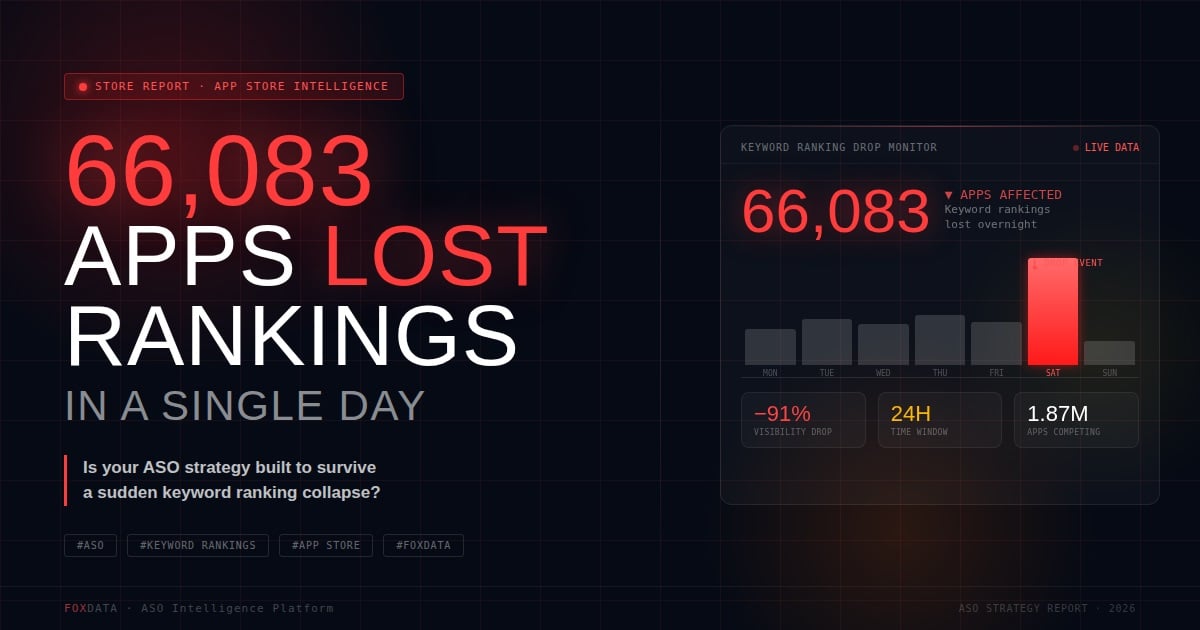
You wake up on a Tuesday morning, check your App Store rankings, and discover your primary keyword position has dropped from #3 to #47. Overnight. No app update. No negative reviews. No obvious explanation.
This isn't hypothetical. On May 9, 2026, FoxData's Clearing List/Word Monitor recorded 66,083 apps losing keyword rankings in the U.S. App Store - in a single day. By May 18, that number had settled to near zero. Something happened. And if you weren't monitoring it in real time, you missed both the event and the recovery window.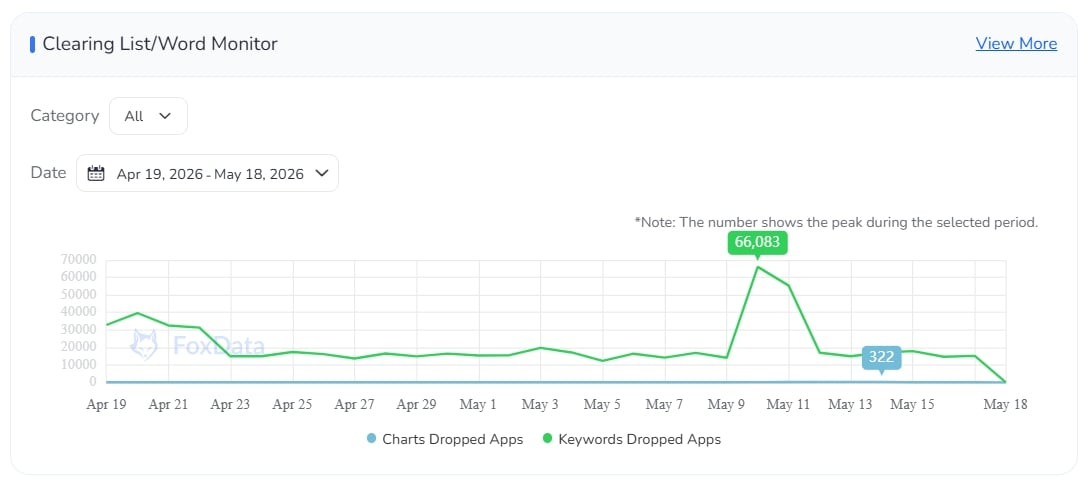
FoxData's Clearing List/Word Monitor showing the dramatic May 9 spike of 66,083 apps losing keyword rankings, followed by rapid normalization. The blue line (Charts Dropped Apps) remained near zero throughout.
There are three primary scenarios behind spikes like this:
1. Apple Search Algorithm Updates
Apple periodically recalibrates its search ranking algorithm. Unlike Google, Apple doesn't announce these changes. The only way to detect them is through large-scale monitoring - when thousands of apps simultaneously lose rankings without individual cause, you're looking at an algorithm shift.
2. Keyword Index Resets
Apple occasionally re-indexes keyword associations, temporarily disrupting rankings before they restabilize. These events typically resolve within 24–72 hours.
3. Metadata Policy Enforcement Waves
When Apple cracks down on keyword stuffing or metadata policy violations at scale, affected apps see simultaneous ranking drops.
In each case, the correct response depends on the cause - and identifying the cause requires data at scale, not just your own app's analytics.
Most ASO tools report keyword rankings on a daily basis. FoxData's Keyword Searching Results Change Rate goes deeper - tracking the Top 10 rate of change on an hourly basis.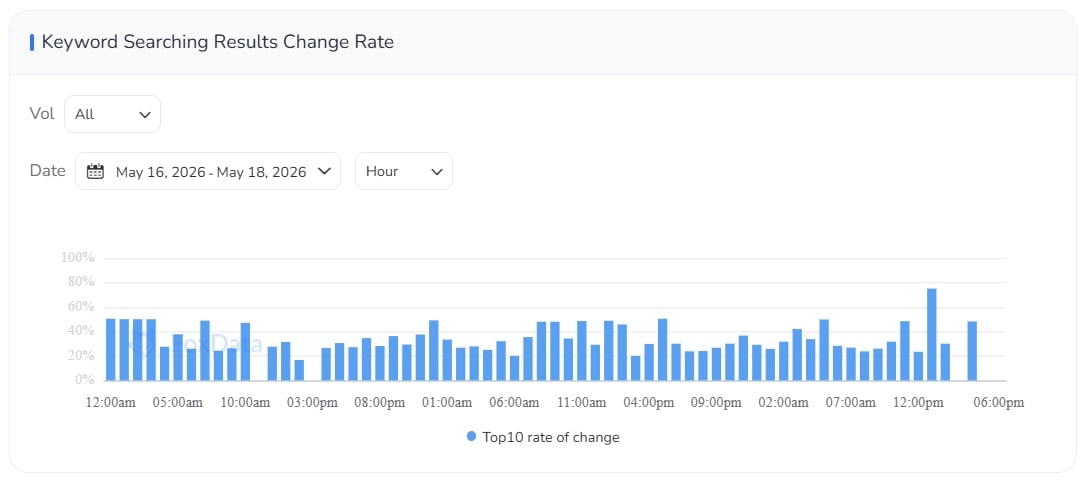
Hourly Top 10 keyword change rate over May 16–18, 2026. Fluctuations between 20–70% indicate continuous ranking volatility, with notable spikes during specific hours.
Why does hourly data matter?
Timing your metadata updates: If you know that keyword rankings are most volatile at certain hours, you can time your app updates to land during stable windows, reducing the risk of being caught in churn.
Distinguishing signal from noise: A ranking drop during a period of 70% churn across the Top 10 is likely systemic - not a response to your specific actions. A drop during a 10% churn period? That's on you.
Competitive intelligence: If your competitor's rankings spike during a high-volatility window, the gain may be temporary. If they rise during stability, they likely made an effective optimization.

Based on FoxData's monitoring data, here's a practical framework:
Use FoxData's ASO tools to document your current keyword positions across all target terms. This becomes your reference point for detecting anomalies.
Monitor the Clearing List/Word Monitor daily. When the "Keywords Dropped Apps" line spikes above 20,000, treat it as a market-wide event rather than a problem with your app specifically. Hold off on reactive changes for 48–72 hours.
Before making ASO adjustments, check the current hourly change rate. If Top 10 volatility exceeds 50%, wait. Optimizing during high-volatility periods produces unreliable results.
Not all categories experience the same keyword volatility. Use FoxData's category filters to understand whether your vertical is experiencing above-average churn - this helps you calibrate expectations and identify ASO impact accurately.
Keyword ranking drops affect both organic (ASO) and paid (ASA) visibility differently. Understanding the interplay between these two channels is critical - apps that maintain ASA spend during organic ranking drops often recover faster. Learn more about the relationship between ASO and ASA to build a resilient strategy.
Let's reconstruct what FoxData's data tells us about the May 9, 2026 keyword event:
|
Date |
Keywords Dropped Apps |
Charts Dropped Apps |
|---|---|---|
|
May 7 |
~15,000 |
~0 |
|
May 8 |
~20,000 |
~0 |
|
May 9 |
66,083 |
~0 |
|
May 11 |
~30,000 |
~322 |
|
May 13 |
~15,000 |
~0 |
|
May 18 |
~5,000 |
~0 |
Key observations:
Charts remained unaffected - this was purely a search/keyword event, not a charts algorithm change
The spike was symmetrical - rapid onset, rapid recovery, consistent with an index refresh rather than permanent algorithm change
Apps that held steady recovered - those who reactively changed metadata during the event likely disrupted their own recovery
The lesson: real-time data prevents panic-driven decisions.
The difference between amateur and professional ASO isn't keyword selection - it's response calibration. Knowing when to act and when to wait is worth more than any keyword list.
FoxData's monitoring suite gives you the context to make that distinction:
Mass keyword drops? Check if it's market-wide before changing anything.
Your rankings fell but competitors held? Time to audit your metadata.
Hourly volatility is spiking? Hold your app update for 24 hours.
For teams managing multiple apps or working with clients, FoxData's app analytics and performance metrics tools provide the dashboard-level view needed to manage portfolios without drowning in noise.
66,083 apps lost keyword rankings on May 9, 2026. Most of those app teams didn't know it was a market-wide event. Many of them panicked. Some changed their keywords, disrupting rankings that would have self-corrected. A few - the ones with real-time monitoring - did nothing, and recovered faster than everyone else.
Which group do you want to be in?
Explore FoxData's keyword monitoring and free ASO tools to turn App Store volatility into a strategic advantage.
Data source: FoxData Store Monitor & Keyword Analytics, U.S. App Store, April–May 2026.
© 2020-2026 FoxData. All Rights Reserved.