

Explore More Possibilities for Your Business
Full-cycle scenario construction to meet your needs from App research, development, and release to operation.
Ready for your soaring growth
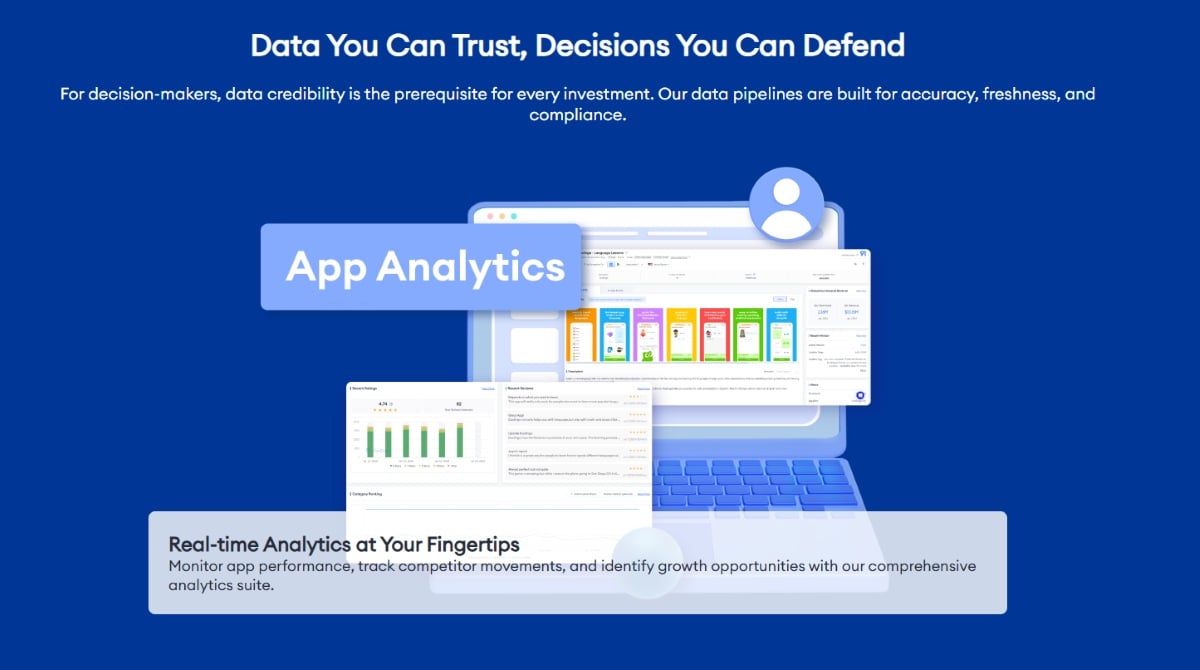
Every growth decision you make starts with data.
Whether you are managing user acquisition, refining your app store listing, or benchmarking competitors, the quality of your data determines the quality of your outcomes.
Yet many mobile teams still operate in silos.
UA managers rely on one dashboard. ASO teams work from another. Product teams pull from a separate system entirely.
The result? Fragmented insights, duplicate effort, and missed opportunities.
Integrating App Marketing Analytics into your enterprise stack changes everything.
When your app store data connects directly to business intelligence tools, you gain a single, coherent view of performance.
You can link keyword rankings to install volume. You can tie metadata changes to revenue shifts. You can measure the ROI of every creative test and ASO experiment in real time.
This is not a luxury reserved for large studios. It is the operational standard for any team serious about growth.

Discover how FoxData enhances data protection and security standards to keep your analytics safe and reliable.
The global app economy is enormous and intensely competitive.
According to 42matters, as of April 2026 there are over 2.2 million apps on the Apple App Store and over 2.3 million on Google Play. Standing out requires more than a good product.
Industry data confirms that 65% of App Store downloads come directly from search, and apps that fall below position three lose up to 90% of their potential download volume. Your search ranking is not optional. It directly drives installs and revenue.
Despite this, many teams invest heavily in paid acquisition while neglecting organic performance.
Research consistently shows that organic users come in with stronger intent than paid users. They are more likely to engage, convert, and stay active long-term. Industry data shows that more than 90% of users churn before the 30-day mark, making user quality at the point of acquisition a critical variable. Organic channels, driven by strong ASO, consistently deliver higher-intent users than broad paid campaigns.
Meanwhile, App Store Performance Metrics such as keyword rankings, conversion rates, and impression-to-install ratios remain underused in most enterprise reporting stacks.
This gap is costly. When app store data is disconnected from business intelligence, teams cannot attribute revenue to specific ASO changes, cannot model the true cost of poor keyword coverage, and cannot forecast the compounding returns of sustainable organic growth.
The ROI case for integration is clear. Teams that embed app store intelligence into their core analytics see faster iteration cycles, more efficient spend, and higher organic share of total installs.
True integration means your App Store Performance Metrics live alongside revenue, retention, and engagement data.
When keyword ranking data feeds into your BI platform, you can answer questions like:
These are strategic questions. Answering them requires app store data to be a first-class citizen in your analytics infrastructure, not an afterthought pulled from a disconnected tool.
ASO Intelligence is not just about ranking higher. It is about understanding the mechanics of visibility and conversion across your entire category.
When your metadata is informed by real search volume and competitor data, every update is an informed experiment.
When you track how your store listing converts across different traffic sources, you can optimize creative assets with precision.
Google's developer documentation highlights that a well-optimized store listing directly improves conversion rates for organic traffic. Even a modest improvement in conversion can deliver outsized returns when applied to high-volume search terms.
For enterprise teams managing multiple apps or markets, the compounding effect is even more significant. Small improvements in keyword coverage and conversion, multiplied across a large catalog, add up to millions in incremental revenue.
Competitor Analysis is one of the most underutilized levers in app marketing.
Most teams occasionally glance at competitor ratings or download estimates. Far fewer systematically track competitor keyword strategies, creative rotations, and metadata changes over time.
This is a significant missed opportunity.
When you monitor how competitors respond to seasonal search trends, you can anticipate market shifts. When you track their keyword gains and losses, you can identify gaps your app can fill. When you analyze their store listing structure, you can benchmark your own conversion funnel.
Data shows that apps which conduct regular competitor keyword analysis capture a measurably larger share of category search traffic over time. Proactive keyword discovery, informed by competitor movements, is consistently more effective than reactive adjustments.
Enterprise teams that build Competitor Analysis into a weekly rhythm, rather than treating it as an occasional audit, consistently outperform peers who do not.
For publishers managing large app portfolios, keyword strategy becomes a significant operational challenge.
Manually tracking hundreds of keywords across dozens of apps and multiple markets is not scalable.
Enterprise-grade App Marketing Analytics platforms solve this by surfacing trends, flagging ranking changes, and prioritizing optimization opportunities automatically.
The result is a leaner workflow with higher impact output. Teams spend less time collecting data and more time acting on it.
Industry research shows the average cost per install in 2025 ranges from $1.50 to $5.00 depending on platform, category, and region, with iOS averaging around $3.60 and Android around $1.20. Improving organic visibility even modestly reduces dependence on paid UA and directly improves your overall blended CPI.
When you integrate app store data into your analytics stack, you make that ROI visible. You can compare the cost of ASO investment against the organic installs it generates and calculate a clear return.
A/B testing in the App Store and Google Play has become an essential tool for conversion optimization.
Apple's Product Page Optimization and Google's store listing experiments allow teams to test icons, screenshots, and videos before committing to a change.
But the data from these tests is most powerful when it connects to downstream metrics.
If a new icon variant drives a 12% lift in conversion but attracts lower-quality users, the experiment is not a win. You only know this if your app store data and user quality data speak to each other.
This is the core value proposition of integrated analytics. Individual signals become strategic intelligence when they are connected.
FoxData's app analytics and ASO performance research tools are built specifically for the workflows described above.
The platform brings together keyword intelligence, competitor tracking, store performance metrics, and market analysis in one place.
Here is how to put it to work immediately.
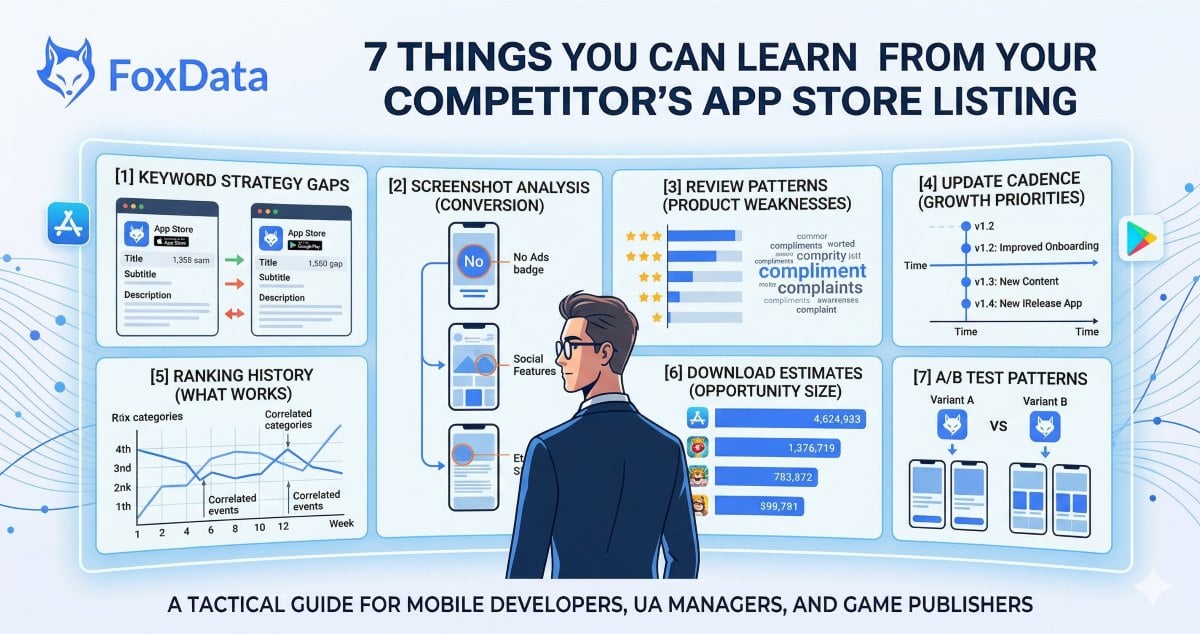
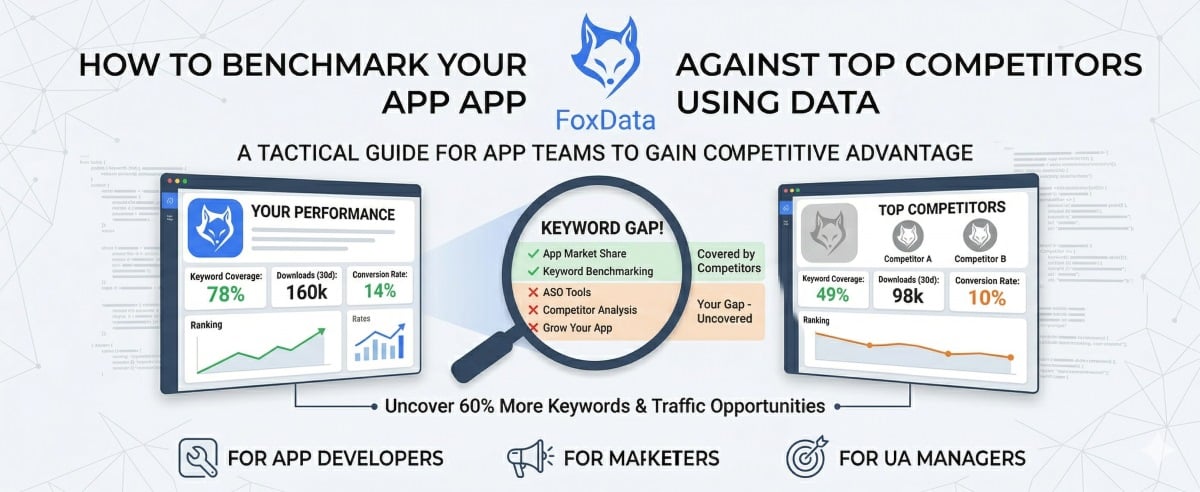
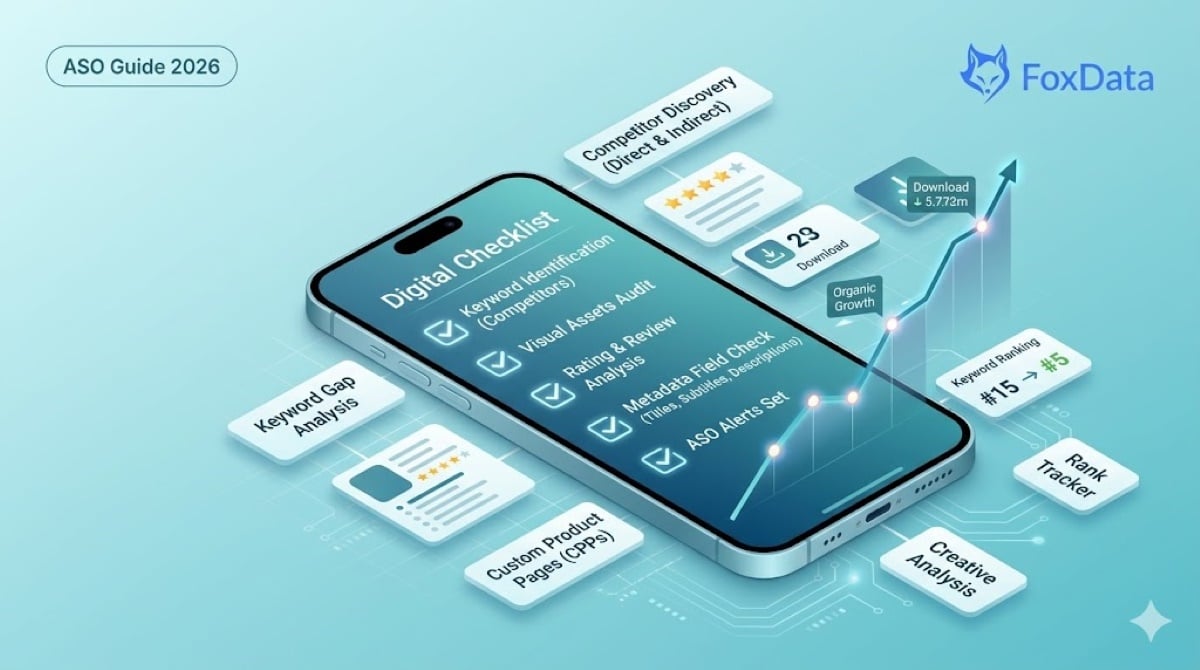
Start with keyword gap analysis. Use FoxData's keyword research tools to identify high-volume terms where competitors rank but your app does not. These are your fastest organic growth opportunities.
Build a competitor tracking cadence. Set up monitoring for your top three to five competitors. Track their metadata changes, keyword movements, and rating trends week over week. Look for patterns that reveal their optimization strategy.
Connect ranking data to install trends. Use FoxData's performance metrics to correlate keyword ranking changes with install volume. This helps you quantify the value of ranking improvements and prioritize your ASO roadmap accordingly.
Audit your conversion funnel regularly. FoxData gives you visibility into impression-to-install rates across traffic sources. Use this to identify where your store listing is losing potential users and test improvements systematically.
Benchmark across markets. For teams operating globally, FoxData's cross-market ASO intelligence features make it possible to identify localization gaps and market-specific keyword opportunities at scale.
The platform is designed for UA managers, ASO specialists, and growth marketers who need actionable data, not just dashboards.
Even well-resourced teams make avoidable errors when managing app store data. Here are the most common ones.
Treating ASO as a one-time project. The App Store and Google Play are dynamic environments. Keyword volumes shift. Competitor strategies evolve. Algorithm updates change ranking signals. ASO requires continuous iteration, not periodic maintenance.
Optimizing for installs instead of quality users. Ranking for high-volume keywords is only valuable if those keywords attract users who convert and retain. Always validate keyword strategy against downstream user quality metrics.
Ignoring localization. Research shows that localizing app store metadata, not just the app itself, significantly improves visibility and conversion in non-English markets. Many teams localize the product but leave the store listing in English only.
Measuring rankings in isolation. A keyword ranking improvement that does not translate to install growth or revenue is a vanity metric. Always connect ranking data to business outcomes.
Skipping competitor analysis during seasonal peaks. Category dynamics shift significantly around major holidays and events. Competitors often adjust their keyword and creative strategy during these windows. Teams that are not monitoring miss these signals entirely.
Underestimating metadata character limits. Both Apple and Google impose strict character limits on titles, subtitles, and keyword fields. Poorly structured metadata wastes valuable indexing space. Use every character strategically.
What is the difference between ASO and paid user acquisition?
ASO (App Store Optimization) focuses on improving organic visibility and conversion within the App Store and Google Play. Paid UA refers to acquiring users through advertising spend on networks like Meta, Google Ads, or Apple Search Ads. Both are complementary. ASO reduces your cost per organic install while paid UA drives immediate volume. The most efficient growth strategies combine both.
How do I measure the ROI of ASO investment?
Calculate the value of organic installs generated by ASO improvements. Estimate the cost to acquire those installs through paid channels. The difference represents the cost saving attributable to ASO. You can also track revenue from organic cohorts to build a full lifetime value model. Platforms like FoxData's performance metrics tools make it easier to attribute install volume to specific keyword and metadata changes.
How often should I update my app store metadata?
There is no universal rule, but a common practice among high-performing teams is to review metadata monthly and update strategically based on keyword performance data and competitor movements. Major updates, such as title changes, should be approached carefully since they can temporarily impact rankings. Smaller optimizations, like keyword field updates on iOS, can be made more frequently.
What app store metrics should be part of my enterprise analytics stack?
At minimum, include keyword ranking trends, impression volume, store listing conversion rate, install velocity, and rating and review sentiment. For more advanced analytics, add competitor keyword overlap, traffic source breakdown, and geographic performance by market. These metrics give you a complete picture of organic acquisition health.
App store data is not a standalone marketing metric.
It is a foundational input that should inform UA strategy, creative decisions, product positioning, and revenue forecasting.
Teams that integrate App Marketing Analytics, ASO Intelligence, and Competitor Analysis into their enterprise reporting stack gain a structural advantage. They iterate faster, spend more efficiently, and build organic acquisition engines that compound over time.
The ROI is real and measurable. The tools to capture it are available today.
Ready to turn your app store data into a strategic growth engine? Explore FoxData's comprehensive app analytics and ASO performance research platform and see how leading app teams use it to make smarter decisions, faster.
© 2020-2026 FoxData. All Rights Reserved.