





Explore More Possibilities for Your Business
Full-cycle scenario construction to meet your needs from App research, development, and release to operation.
Ready for your soaring growth
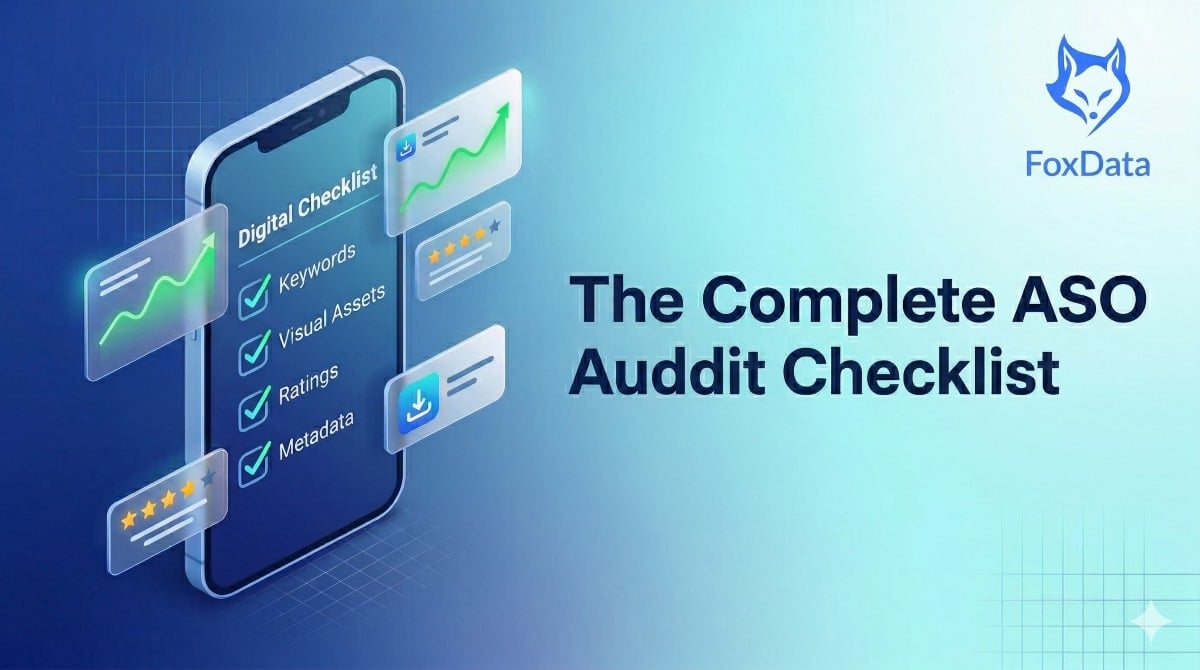
You built a great app. But discoverability is another challenge entirely.
Over 2 million apps compete for attention on the App Store alone. Google Play hosts more than 3 million. Most apps go unnoticed, not because they are low quality, but because their store presence is poorly optimized.
That is exactly where a thorough ASO audit comes in.
An ASO audit is a structured review of every element in your app store listing. It identifies what is hurting your visibility, your conversion rate, and your organic growth. Think of it as a diagnostic checkup for your app's discoverability.
This guide walks you through a complete app store audit checklist. Each section is specific and actionable. Whether you are a developer, UA manager, or publisher, this checklist will help you find what to fix and why it matters.
Good intentions alone do not improve app rankings. Data does.
According to Apple's own App Store documentation, metadata including your app name, subtitle, and keyword field directly influences search indexing. Google's developer guidelines confirm the same for Google Play, where title and short description carry significant weight in their ranking algorithm.
Research in the mobile app industry shows that apps ranking in the top three positions for a given keyword capture over 60% of organic clicks. That makes keyword placement a revenue-level decision, not a cosmetic one.
Conversion rates tell an equally clear story. Studies show that optimizing screenshots and icons can lift install conversion rates by 20% to 35%. That is significant when you are spending budget on paid user acquisition. A higher conversion rate means lower effective CPI across all your channels.
The App Store and Google Play are not static platforms either. Both update their algorithms regularly. A listing that performed well 12 months ago may be losing ground today. An ongoing ASO health check is not optional for serious app publishers. It is baseline hygiene.
Discover how FoxData enhances data protection and security standards to keep your analytics safe and reliable.
Your app title is the single most important metadata field for ASO.
Both Apple and Google confirm that keywords in your title receive higher indexing weight than anywhere else. This means your primary keyword must appear in your app title naturally. It should also describe your app clearly and memorably.
Checklist items:
Avoid keyword stuffing. Apple and Google both penalize listings that use awkward, repetitive keyword strings. Your title should read like a product name, not a search query.
On the App Store, you have 100 characters in the keyword field. Every character is valuable. Wasting that space on duplicated words, spaces, or plurals is a common and costly mistake.
App metadata optimization checklist:
For Google Play, the description field is where keyword optimization happens. Research shows that repeating your primary keyword 3 to 5 times naturally in the full description supports stronger indexing. Anything beyond that diminishes returns.
Tools that give you access to real-time keyword intelligence and app store performance metrics make this phase significantly faster and more accurate.
Visual assets directly drive conversion. A user has already found your listing. Now your visuals must convert that visit into an install.
Checklist for visual ASO health check:
Apple reports that the first impression on a product page takes less than three seconds. If your icon and first screenshot do not immediately communicate value, users scroll past.
Your rating directly influences both ranking and conversion.
App Store data shows apps with ratings below 4.0 stars see measurably lower conversion from search impressions to installs. Google Play similarly weights recent rating trends, not just lifetime averages.
Ratings and review audit checklist:
A negative review left unanswered signals neglect to prospective users. A well-handled negative review can actually build trust.
Localization is one of the highest-ROI actions in ASO and one of the most commonly skipped.
According to Apple, apps that localize their metadata and visual assets for additional regions can see install increases of up to 767% in newly targeted markets. Even basic localization of your title, screenshots, and description makes a measurable difference.
Localization checklist:
Many publishers focus entirely on English-language optimization and miss significant organic growth in markets like Japan, South Korea, Germany, and Brazil.
Small classification errors can quietly suppress your visibility.
Checklist items:
In-app purchase metadata is indexable on the App Store. Many developers leave these fields generic, missing an opportunity to appear in more search results.
An ASO report without competitive context is only half the picture.
You need to know what keywords your competitors rank for, what their conversion rates look like, and where they are growing.
Competitive audit checklist:
Running your competitive benchmarks through a robust ASO performance research and analytics platform gives you strategic insight that manual audits simply cannot match.
Every item in the checklist above can be addressed faster with the right data layer underneath it.
FoxData is a mobile analytics and ASO platform built for developers, marketers, and publishers who need accurate, up-to-date data to make store optimization decisions. Here is how it directly supports your audit workflow.
Keyword Research and Tracking: FoxData gives you keyword difficulty scores, search volume estimates, and real-time ranking positions. You can research the exact terms your target audience is searching for, then track your performance against those terms over time. This eliminates guesswork from your keyword field decisions.
Competitor Analysis: FoxData lets you surface which keywords are driving installs for competing apps. You can monitor how competitors update their metadata, react to ranking shifts, and spot vulnerabilities in their strategies.
App Store Performance Metrics: From download estimates and revenue modeling to category ranking trends and review monitoring, FoxData provides the full picture needed to produce a meaningful ASO report. Rather than assembling data manually from multiple sources, you get it consolidated and actionable in one place.
Conversion Optimization Insights: FoxData tracks page view to install conversion rates, helping you connect your visual asset decisions to actual performance data. You can see what is working and what is not.
If you are serious about building a sustainable organic growth engine, running your audit through a dedicated app analytics and ASO health check tool is the most efficient path forward.
Even experienced ASO practitioners make these errors. Keep them in mind during every audit cycle.
The App Store and Google Play are living environments. Algorithm updates, competitor moves, and seasonal trends all affect your rankings. Build ASO audits into a quarterly cadence at minimum.
Targeting a keyword with 100,000 searches per month is not useful if your app has nothing to do with it. Relevance is what drives quality installs and strong retention.
Many developers focus on the App Store and treat Google Play as secondary. Google Play indexes your full description text, making it a significant keyword opportunity that should not be overlooked.
Running multiple changes simultaneously makes it impossible to know what caused a ranking shift. Test metadata changes in isolated batches and give each change 2 to 4 weeks before drawing conclusions.
Translating text without adapting your screenshots is only partial localization. Users in different markets respond to different visual storytelling cues, color conventions, and design aesthetics.
These fields are indexable on the App Store and are routinely left with generic titles like "Premium Plan" instead of keyword-rich descriptions that could attract additional impressions.
An ASO audit is a structured evaluation of your app store listing across metadata, visuals, ratings, and competitive positioning. It matters because organic discovery through app stores remains one of the most cost-efficient install channels available. An audit identifies what is holding your rankings back.
Quarterly audits are the recommended minimum for active apps. Apps in competitive categories or going through major updates benefit from monthly reviews. Both App Store and Google Play can change ranking factors with little notice, making regular ASO health checks essential.
ASO drives organic installs by improving your visibility and conversion rate in the app store search and browse ecosystem. Paid UA drives installs through purchased media. The two work best together. Strong ASO lowers your overall CPI by converting paid traffic more efficiently once users land on your page.
Yes, and significantly. Localized metadata allows your app to rank for relevant keywords in different language markets. Research shows that apps tailored for specific regions regularly outperform generic English-language listings in those markets, even when the core product is unchanged.
A polished app without strong store visibility is a missed opportunity. The good news is that most apps have significant ASO upside that can be unlocked with a systematic audit.
Use this checklist as your starting point. Work through each section, document your current state, and prioritize fixes by potential impact. Keyword optimization, visual creative testing, and localization alone can meaningfully shift your organic install volume within a few months.
The most successful mobile publishers do not leave their app store presence to chance. They audit regularly, benchmark against competitors, and iterate based on real data.
Ready to run your next ASO audit with accurate, real-time data behind every decision? Explore FoxData's suite of mobile analytics and ASO performance tools and start turning your store presence into a growth engine today.
© 2020-2026 FoxData. All Rights Reserved.