



Explore More Possibilities for Your Business
Full-cycle scenario construction to meet your needs from App research, development, and release to operation.
Ready for your soaring growth
The productivity app category is one of the most competitive on both the App Store and Google Play. With thousands of productivity-related apps competing for the same users on Google Play alone, and the category is projected to reach $14.46 billion in 2026, the stakes for getting your App Store Optimization right have never been higher.
Yet despite this intense competition, a surprising number of productivity app developers are making the same preventable ASO errors repeatedly. They invest months building polished tools, then rely on guesswork when it comes to app store visibility.
The result? Organic downloads that flatline. High cost-per-install from paid channels. Strong products that simply don't get found.
This article breaks down the most damaging ASO mistakes productivity app developers make and explains exactly why they hurt growth.
This is the single most common and costly mistake in the entire category.
Most productivity app teams default to high-volume, obvious keyword targets: "task manager," "to-do list," "productivity app." The problem is that every major competitor is doing the exact same thing. Research shows that roughly 70% of app installs originate from app store searches, and the top 10 results for high-volume productivity keywords capture over 60%to 70% of organic click-throughs. If you're not in that top tier, you're essentially invisible.
The issue isn't just competition. It's misalignment between search intent and what your app actually delivers.
What the wrong keyword strategy looks like in practice:
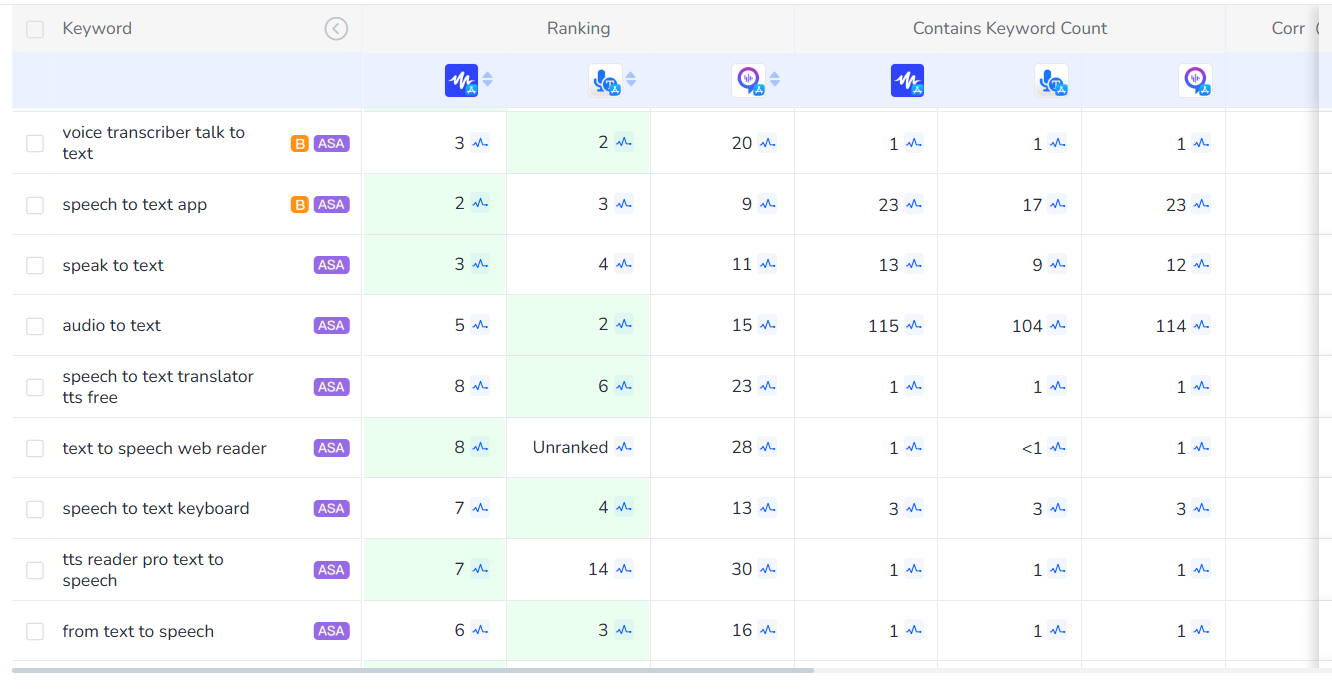
Effective ASO keyword research for productivity apps requires layered thinking.
Start with broad category terms to establish context, then layer in feature-specific keywords that describe what makes your app distinct. A note-taking app, for instance, should be targeting terms like "markdown notes," "offline notes with folders," or "voice to text notes" alongside the generic "notes app."
Keyword research also needs to account for platform differences.
The App Store's 100-character hidden keyword field is completely separate from the indexed title and subtitle. Leaving it underused, or repeating keywords already in your title, wastes one of the most valuable real estate opportunities on iOS. On Google Play, the long description (up to 4,000 characters) is fully indexed, meaning every missed opportunity there is a missed ranking signal.
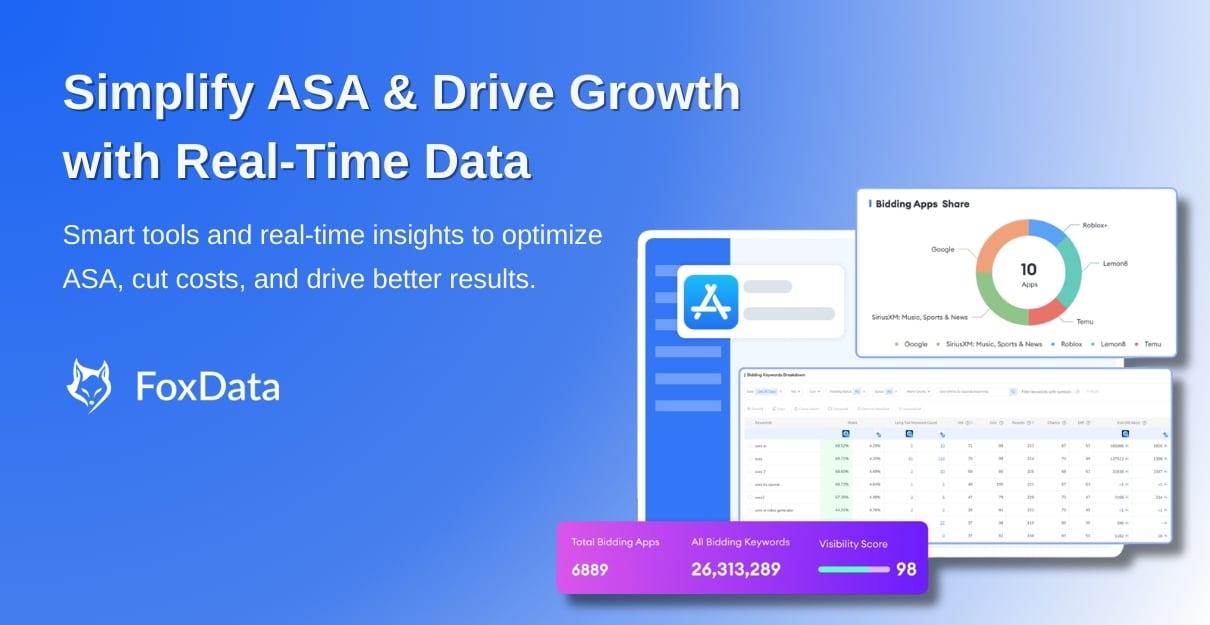
Discover keyword opportunities, monitor competitors, and improve campaign performance using FoxData’s ASA analytics tools.
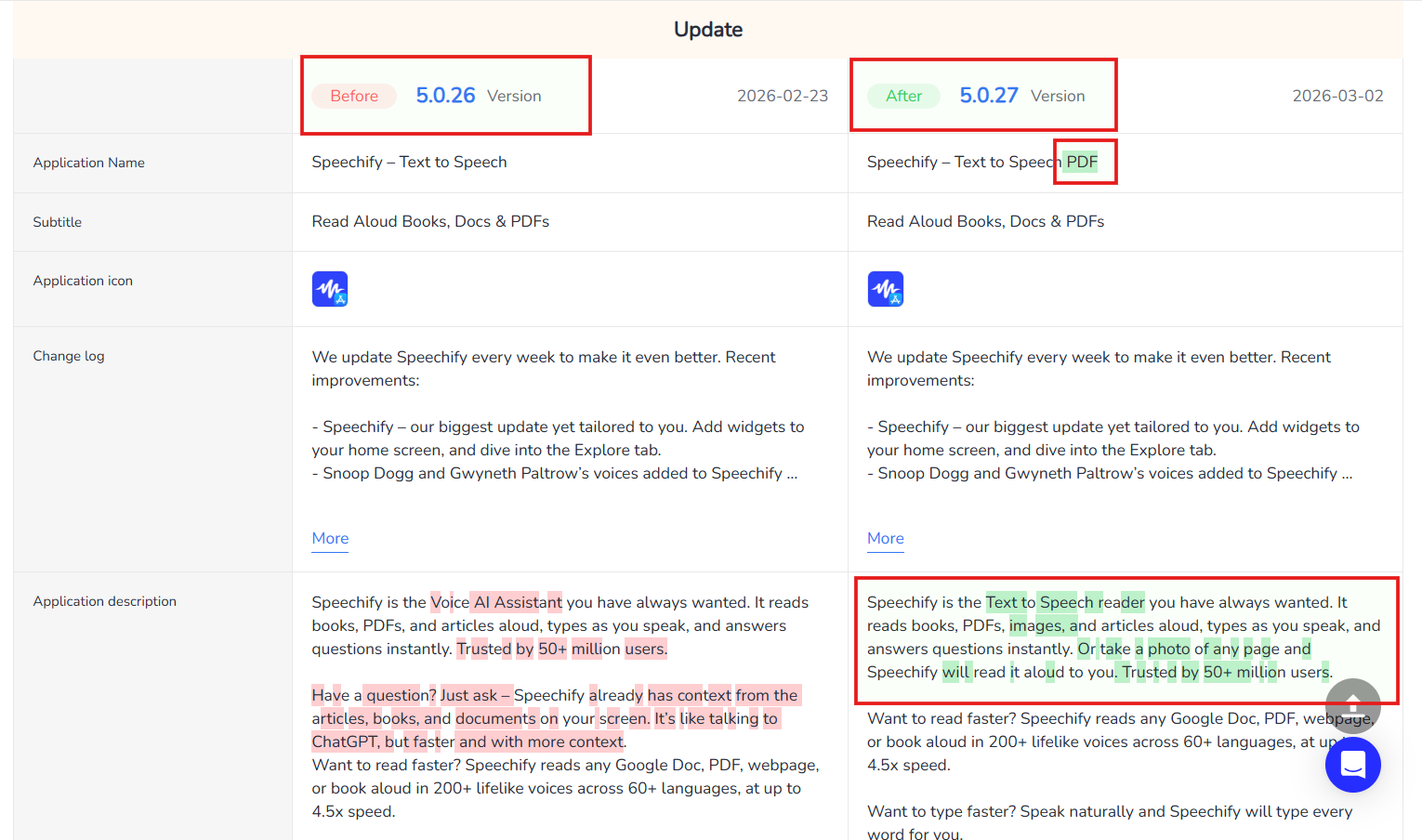
Many productivity app developers do a solid keyword sweep at launch and never touch their metadata again. This is a significant strategic error.
App store algorithms are not static. Both the App Store and Google Play update their ranking signals regularly, user search behavior shifts with trends and seasons, and new competitors enter the category every week. An app listing that was well-optimized 12 months ago may be quietly falling in rankings simply because no one has updated it.
Research on top-ranked apps shows that apps with higher update frequency consistently maintain stronger keyword rankings over time. Lower update frequency correlates directly with lower competitive ranking chances.
For productivity apps specifically, this matters even more because the category is heavily influenced by behavioral trends.
The rise of AI-powered tools, the shift toward async work, and the growing demand for focus and wellness features all create new high-intent keyword opportunities. If your metadata hasn't been refreshed to capture those signals, you're ceding ground to competitors who have.
What a healthy ASO update cadence looks like:
Keyword rankings determine whether users find your app. Visual assets determine whether they download it.
This distinction is where many productivity app developers lose ground they worked hard to gain. A strong keyword strategy drives impressions. But if your screenshots, icon, and preview video don't communicate value instantly and clearly, those impressions don't convert.
Research across app store data shows that apps rated below 3.5 stars rarely rank for competitive keywords, and 90% of featured apps maintain ratings of 4.0 or above. Similarly, apps that actively A/B test their visual assets consistently outperform those that don't. Among top Google Play apps, 57% tested their screenshots at least twice in 2024 alone.
Productivity apps have a specific visual challenge: the core functionality is often abstract. You're selling focus, clarity, efficiency. These are concepts, not objects. The mistake most developers make is designing screenshots that show the app's interface rather than the user's outcome.
High-converting productivity app visuals communicate:
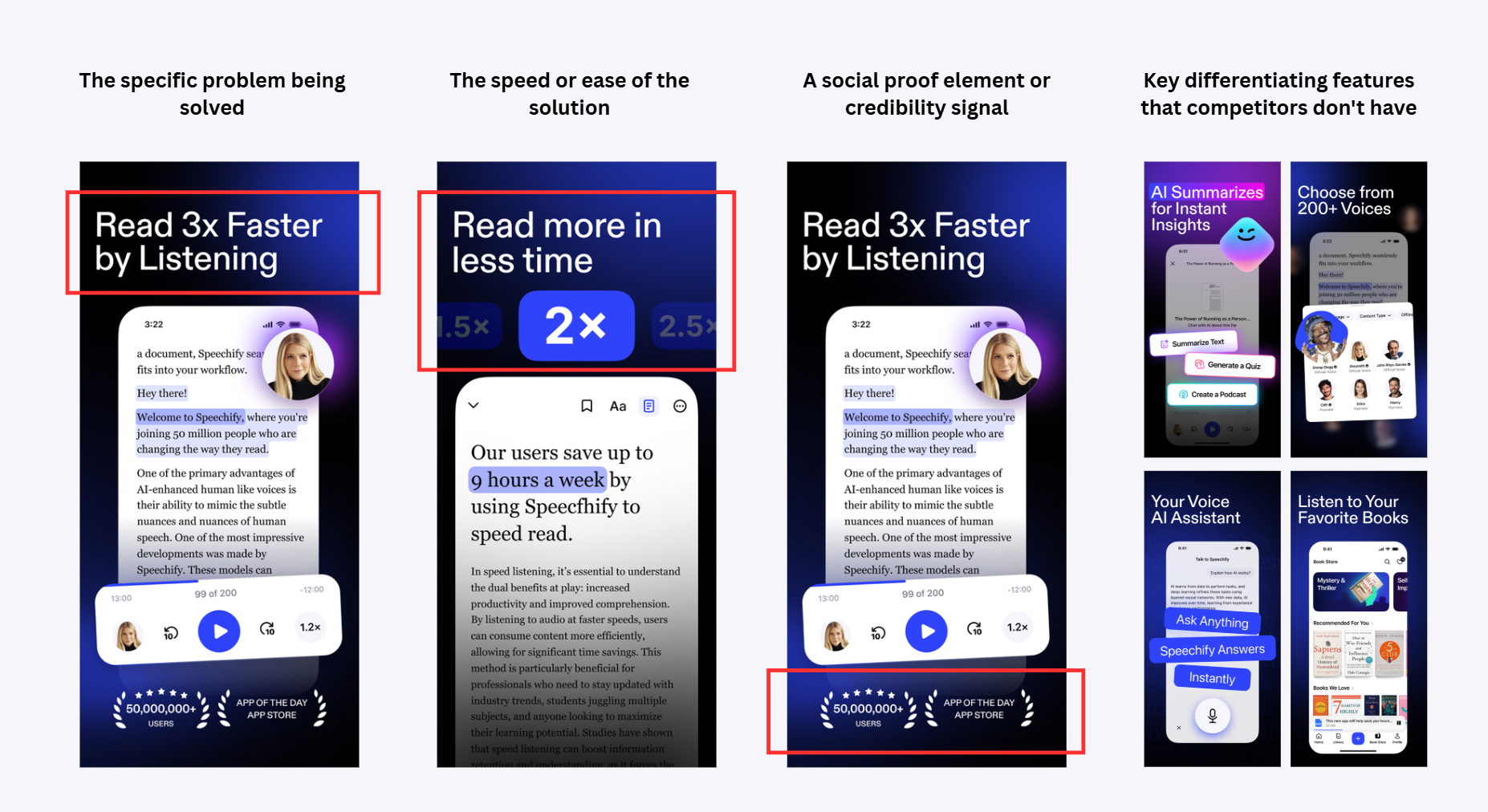
A second visual error is treating the icon as an afterthought. The app icon is the first impression in every search result, and data shows that most top apps on both stores go long periods without updating their icon, despite it being one of the highest-impact elements for click-through rate. Testing icon variants is one of the fastest ways to improve conversion without touching keyword strategy at all.
Ratings and reviews are not a customer service issue. They are a core ASO signal.
Both the App Store and Google Play factor your app's ratings into keyword ranking and featuring algorithms. An app with hundreds of 2-star reviews is not just losing conversions; it is actively losing keyword visibility. The connection between review quality and organic ranking is direct and measurable.
Productivity app developers often deprioritize review management because it feels reactive rather than strategic. But a disciplined approach to soliciting, responding to, and learning from reviews is one of the most effective ASO levers available.
The tactical approach to reviews as an ASO lever:
Localized markets compound this challenge. A productivity app targeting Japan, Germany, or Brazil needs localized reviews to rank in those markets. A global audience doesn't provide those signals automatically.
Many teams run ASO and Apple Search Ads as completely separate workstreams. This is an expensive structural mistake.
Organic ASO and paid ASA are not competing strategies. They are reinforcing ones. Keywords that perform well in paid Apple Search Ads campaigns are strong indicators of high-intent search behavior, and that intelligence should feed directly into your organic metadata decisions.
Conversely, strong organic keyword rankings lower your effective cost-per-tap in ASA campaigns, because Apple's ad relevance scoring takes organic metadata into account. When your metadata, keyword targeting, and paid creative are all aligned, you create an efficiency loop where organic performance strengthens paid ROI and vice versa.
The disconnect usually happens because ASO is owned by the growth or marketing team while ASA is managed by a UA manager, with little systematic sharing of performance data between the two. Bridging that gap is one of the most underutilized growth levers in the productivity category.
The productivity app category is growing, competitive, and rewarding for developers who master the fundamentals. But most productivity apps are not losing because of product quality. They're losing because of fixable ASO mistakes: chasing the wrong keywords, neglecting metadata updates, underinvesting in visual optimization, ignoring reviews, and running paid and organic strategies in silos.
Every one of these mistakes has a clear, data-driven solution. The teams winning in the productivity category are those who treat ASO as an ongoing growth discipline rather than a launch checklist.
If you're ready to fix these gaps and build a systematic ASO strategy backed by real competitive intelligence, start with FoxData's productivity app analytics and ASO solutions to see exactly where your app stands and where the growth opportunities are.
Ready to turn your productivity app's organic visibility into a real competitive advantage? Explore FoxData's dedicated ASO and analytics solutions for productivity apps and start making data-driven decisions that compound over time.
Q: How often should productivity app developers update their ASO metadata?
At minimum, you should review keyword performance monthly and update metadata whenever you launch new features or notice significant ranking drops. For apps in highly competitive categories like productivity, a quarterly deep review of your full keyword strategy is recommended.
The app store algorithms reward active optimization, and research consistently shows that apps with higher update frequency maintain stronger ranking positions over time.
Q: What's the most important ASO element for a productivity app specifically?
Your app title and subtitle carry the highest keyword weight on both the App Store and Google Play. These fields should include your most important, high-intent keywords while still reading naturally to a human user. Beyond metadata, your screenshots are the single highest-impact conversion element.
Q: Does Apple Search Ads performance affect organic ASO rankings?
Indirectly, yes. While Apple doesn't confirm a direct ranking relationship, strong ASA performance increases download velocity, which is a positive signal for organic ranking algorithms.
More directly, ASA keyword performance data provides highly reliable intent signals that should inform your organic keyword strategy. Teams that use both in coordination consistently outperform those that treat them as separate channels.
Q: How do ratings and reviews affect keyword rankings in the App Store and Google Play?
Both platforms factor ratings into their ranking algorithms. Apps below a 3.5-star average face measurable ranking suppression for competitive keywords. Beyond the algorithm, users visually filter search results by rating, so even an app ranking in the top 5 for a keyword will see significantly lower conversion if its rating is below 4.0.
Ready to make your app shine? Optimize your app's visibility with FoxData, the ultimate ASO tool! Maximize downloads and rankings by leveraging our powerful insights today.
App Growth & ASO Tools by FoxData
FoxData supports every stage of app growth with specialized ASO and app analytics tools, helping teams improve keyword visibility, user acquisition, and retention through reliable data.
🔍 Store Keyword Research Tools
Research high-intent keywords, search volume, and competition to strengthen your app store optimization strategy.
📈 App Store Keyword Tools
Analyze keyword rankings and performance across the Apple App Store and Google Play to refine ASO execution.
📊 ASO Monitoring Tools
Monitor keyword ranking changes, visibility trends, and ASO impact over time with continuous performance tracking.
👥 User Activity Monitoring Tools
Understand in-app user behavior, engagement, and retention with real-time user activity analytics.
Together, these tools form FoxData’s ASO analytics and app intelligence ecosystem, designed to help developers, marketers, and growth teams make data-driven decisions and scale sustainably.
Explore it today!
👉 Learn more about FoxData here | 👉 Book a demo with FoxData team today!
© 2020-2026 FoxData. All Rights Reserved.