


Explore More Possibilities for Your Business
Full-cycle scenario construction to meet your needs from App research, development, and release to operation.
Ready for your soaring growth
Most app teams check keyword rankings manually. They log in, pull a screenshot, note a number, and move on. This works when you manage one app. It breaks down fast when you manage five, ten, or twenty.
Scaling your ASO and UA workflows means getting data out of the App Store and into your systems automatically. That means accessing app store ranking data and keyword metrics through an API, not through manual effort.
This guide walks you through how to do exactly that. Whether you are a developer building internal dashboards, a UA manager tracking campaign impact on organic rank, or a publisher managing a portfolio, this is your practical starting point.
The numbers are not subtle. Studies show that over 65% of App Store downloads begin with a user searching the store. If your app is not appearing for the right keywords, you are invisible to the majority of potential users.
The Apple App Store now holds over 2.4 million apps and games. Google Play has leveled off at roughly 2 million after major low-quality app removals. Every day, thousands of new apps compete for the same keyword real estate. Apps that track their rankings daily move faster. Teams that rely on weekly manual checks are always a step behind.
There is another dimension to consider. iOS consumer spending hit $117.6 billion in 2025, a 13.6% year-over-year increase. App Store algorithms are dynamic. Apple's ranking system processes millions of data points daily, including download velocity, retention signals, and metadata relevance. When your rank drops, you need to know immediately, not at your next weekly review.
Pulling this data programmatically means your team can react in hours, not days.
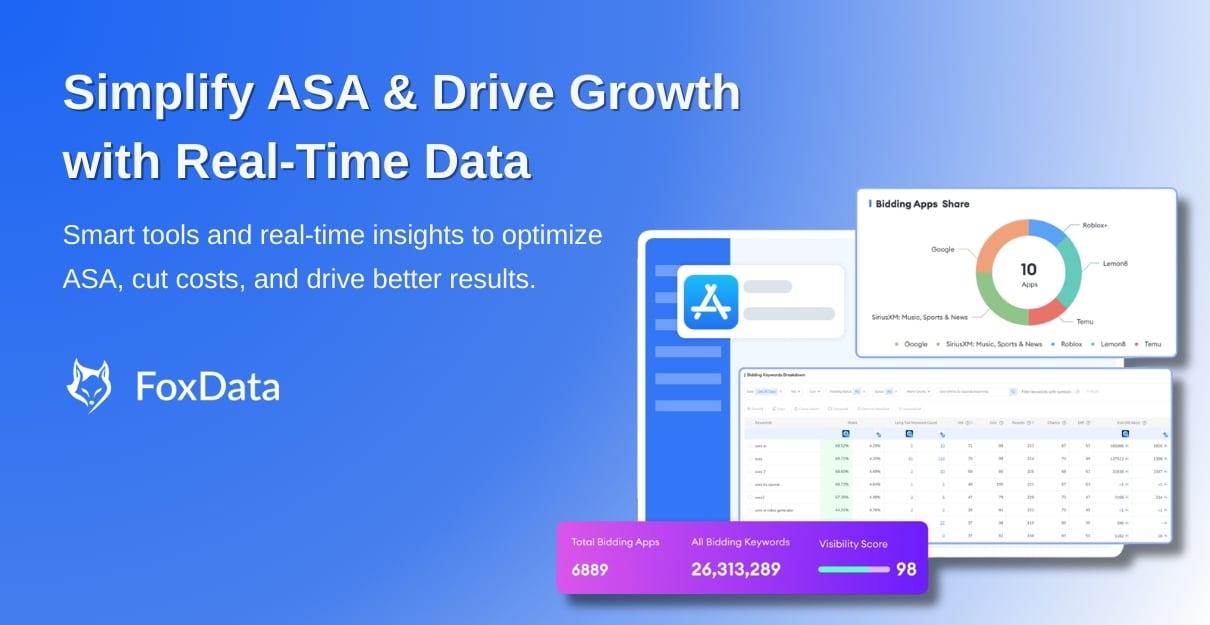
Discover keyword opportunities, monitor competitors, and improve campaign performance using FoxData’s ASA analytics tools.
Before diving into execution, it helps to be specific about what you are accessing.
When you pull App Store ranking and keyword data via an API, you are typically requesting structured data around three core areas.
Keyword rank positions tell you where your app appears in search results for specific terms, across specific countries, on a given date. This is the foundation of any keyword tracking system.
Keyword volume and difficulty scores measure how popular a search term is and how competitive it is to rank for. Apple provides search popularity scores internally through Apple Search Ads, ranging from 5 to 100. Third-party platforms model difficulty scores based on competitor strength, review counts, and related signals.
Category and top-chart rankings show where your app stands within its category on a given day. This data is distinct from keyword rank and often reflects broader momentum metrics like download velocity.
Accessing all three through a reliable app data API turns your reporting from a manual exercise into an automated intelligence pipeline.
Apple does not expose organic ranking data through a public API. That is not a gap, it is just the reality of how the App Store is built. What does exist is a combination of legitimate data sources that, used together, give you highly accurate intelligence.
Apple Search Ads Campaign Management API is one starting point. Apple offers this API to let developers and agencies manage campaigns programmatically. The API also exposes keyword-level performance data from your ASA campaigns. This is real Apple data, pulled directly from the source, and it is especially useful for understanding which keyword bids are converting and at what cost.
Third-party App Store data APIs fill the organic side of the equation. These platforms collect, model, and normalize App Store data across countries and categories. They track where your app ranks for thousands of keywords, how those positions change daily, and what competitors are ranking for. They also model keyword search volume using panel data, first-party signals, and statistical inference.
The most useful APIs return data as structured JSON. A typical keyword ranking response includes the keyword string, country code, device type, your app's current rank, the date of the data point, and historical trend data if requested. Some APIs also return the top-ranking apps for each keyword, which supports competitive analysis.
What to look for in an app ranking API:
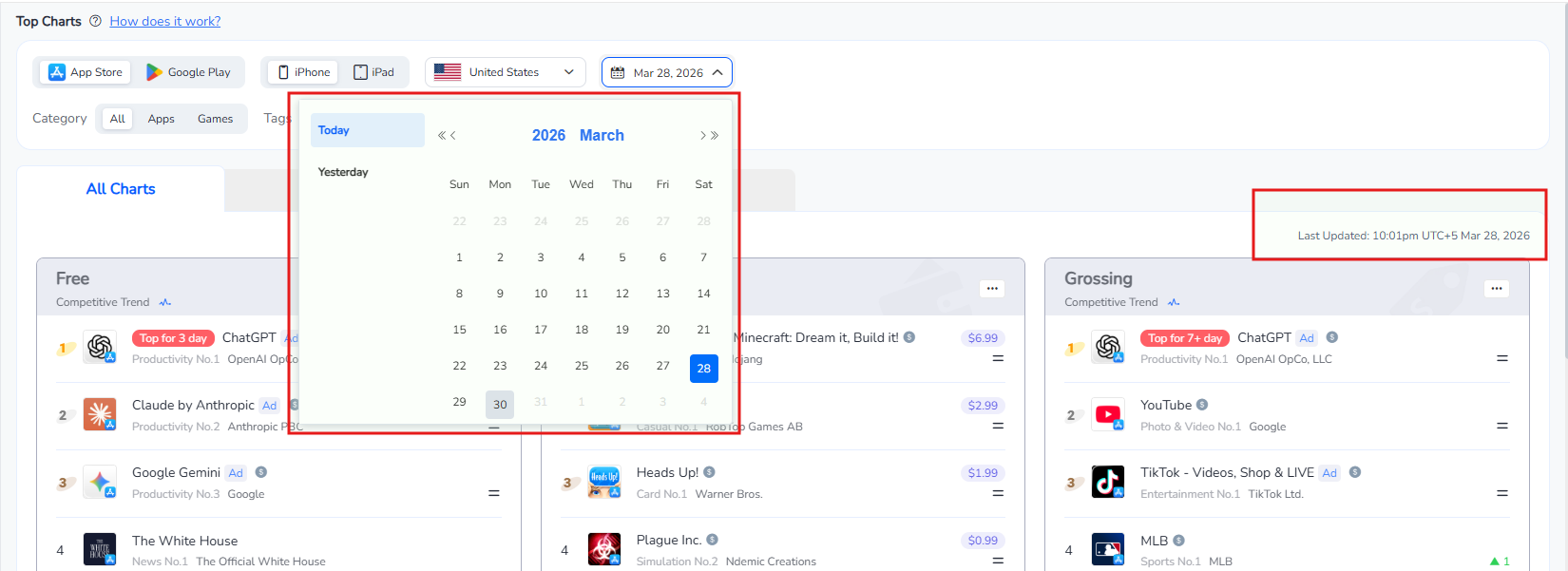
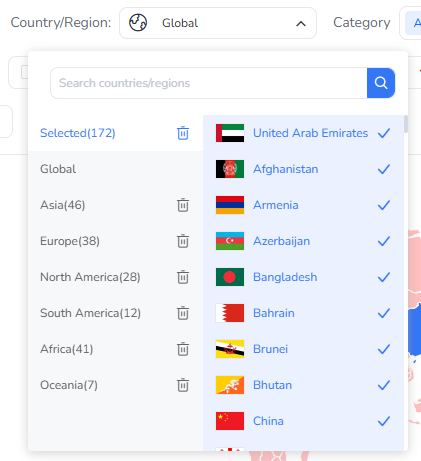
Here is a step-by-step workflow that mobile app teams actually use.
Start with your current metadata keywords, your Apple Search Ads keywords, and any competitor keywords you are targeting. Build a list of 50 to 200 terms depending on your app's scope. Prioritize by relevance and volume.
Use a platform that gives you programmatic access to keyword rankings, top chart positions, and keyword volume data across markets. FoxData's App Data API is built for exactly this use case, giving mobile teams structured access to ranking data, keyword intelligence, and competitive metrics across both the App Store and Google Play.
Authenticate using your API key, pass your app ID and keyword list as parameters, and specify the markets and devices you want to track.
Use a scheduled job, a cron task, or a workflow automation tool to pull ranking data each morning. Store results in a database or data warehouse, indexed by keyword, date, country, and device.
A simple Python loop can pull data for 200 keywords across 10 countries in minutes. Your schema might look like this:
keyword | country | device | rank | date | volume_score | difficulty
Connect your stored data to a visualization layer. Tools like Google Data Studio, Looker, or even a simple internal dashboard can surface the patterns that matter. Focus on rank movement over time, not just point-in-time positions.
The most useful views for app teams are:
Data without action is just storage. Use your programmatic keyword tracking to inform metadata updates, Apple Search Ads bid strategy, and creative testing cycles.
For example, if a keyword is trending up in volume but your rank is slipping, that is a signal to review your metadata relevance and consider increasing your ASA bid. If you are ranked in the top 3 organically, you might reduce paid spend on that term to avoid self-competition.
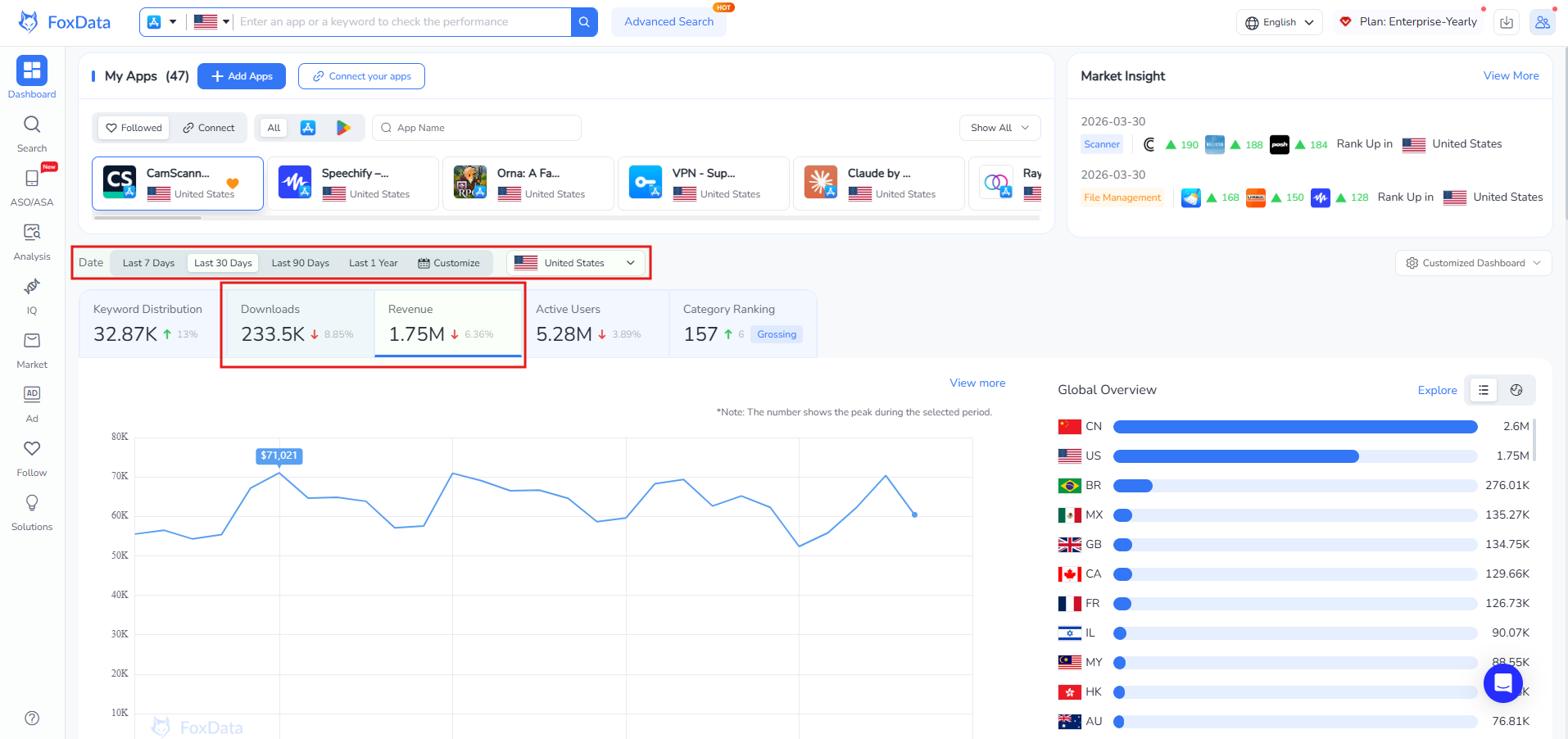
Teams using FoxData's mobile analytics and ASO data tools can layer keyword ranking trends alongside revenue and download data, making it easier to connect ranking changes to actual business outcomes.
Tracking too many keywords with no prioritization. Pulling data on 2,000 keywords might feel comprehensive, but it creates noise without insight. Build a tiered list. Track your top 50 highest-impact terms daily. Run broader pulls weekly or monthly.
Using stale data to make metadata decisions. App Store metadata decisions should be backed by current data. Keyword volume shifts seasonally. A term that was high-volume six months ago may now be saturated or declining. Always work from fresh API data.
Ignoring country-level rank variance. Your app might rank position 3 in the United States and position 47 in Germany for the same keyword. If you only track one market, you are missing a significant portion of the picture. Localization strategy depends on market-specific ranking data.
Conflating paid and organic performance. Apple Search Ads performance data and organic keyword rankings are related but separate signals. UA managers sometimes assume that high ASA conversion on a keyword means strong organic rank. It does not. Track both independently and compare them deliberately.
Failing to version your data pulls. When you update your keyword tracking list, keep a record of the change with a timestamp. Otherwise, you will see sudden changes in your data that look like rank shifts but are actually tracking list edits. Good data hygiene matters in long-running pipelines.
Pulling App Store ranking and keyword data programmatically is not just a technical upgrade. It is a competitive one. Teams that automate their data collection move faster, spot problems earlier, and make better decisions.
The workflow is accessible. You need a reliable API, a clear keyword tracking list, a basic data pipeline, and a dashboard. Once it is running, the data works for you around the clock.
The difference between teams that rank well and teams that do not is often not creativity or budget. It is data discipline. Automated keyword rank tracking is one of the highest-leverage changes an app team can make.
Ready to pull structured App Store and Google Play data into your workflow? Explore FoxData's App Data API to see how mobile teams access keyword rankings, category charts, and competitive intelligence programmatically, across 100 or more markets, at scale.
Q: Can I pull App Store ranking data directly from Apple?
Apple does not offer a public API for organic keyword ranking data. You can access campaign performance data through the Apple Search Ads Campaign Management API, but organic rank tracking requires third-party data platforms. Tools like FoxData's App Data API aggregate and model this data across hundreds of markets.
Q: How accurate is third-party keyword volume data?
Keyword volume scores from reputable platforms are modeled estimates, not raw Apple figures. The most reliable sources derive scores from Apple Search Ads popularity signals, which Apple provides internally. Industry benchmarks show that well-calibrated models can achieve high correlation with actual search behavior. The key is using a platform that updates its models frequently and is transparent about methodology.
Q: How often should I pull ranking data via API?
For active ASO and UA management, daily pulls are standard. For lower-priority apps or broad market research, weekly pulls may be sufficient. Most ranking shifts happen over days and weeks, not hours, so daily frequency gives you enough signal without excessive API usage.
Q: What is the difference between category rank and keyword rank?
Category rank shows your app's position in the top charts for a specific category, based primarily on download velocity and engagement signals. Keyword rank shows your position in search results for a specific search term. Both matter. Category rank reflects momentum. Keyword rank reflects metadata relevance and organic search health.
Ready to make your app shine? Optimize your app's visibility with FoxData, the ultimate mobile app analytics and ASO tool! Maximize downloads and rankings by leveraging our powerful insights today.
App Growth & ASO Tools by FoxData
FoxData supports every stage of app growth with specialized ASO and app analytics tools, helping teams improve keyword visibility, user acquisition, and retention through reliable data.
🔍 Store Keyword Research Tools
Research high-intent keywords, search volume, and competition to strengthen your app store optimization strategy.
📈 App Store Keyword Tools
Analyze keyword rankings and performance across the Apple App Store and Google Play to refine ASO execution.
📊 ASO Monitoring Tools
Monitor keyword ranking changes, visibility trends, and ASO impact over time with continuous performance tracking.
👥 User Activity Monitoring Tools
Understand in-app user behavior, engagement, and retention with real-time user activity analytics.
Together, these tools form FoxData’s ASO analytics and app intelligence ecosystem, designed to help developers, marketers, and growth teams make data-driven decisions and scale sustainably.
Explore it today!
👉 Learn more about FoxData here | 👉 Book a demo with FoxData team today!
© 2020-2026 FoxData. All Rights Reserved.