


Explore More Possibilities for Your Business
Full-cycle scenario construction to meet your needs from App research, development, and release to operation.
Ready for your soaring growth
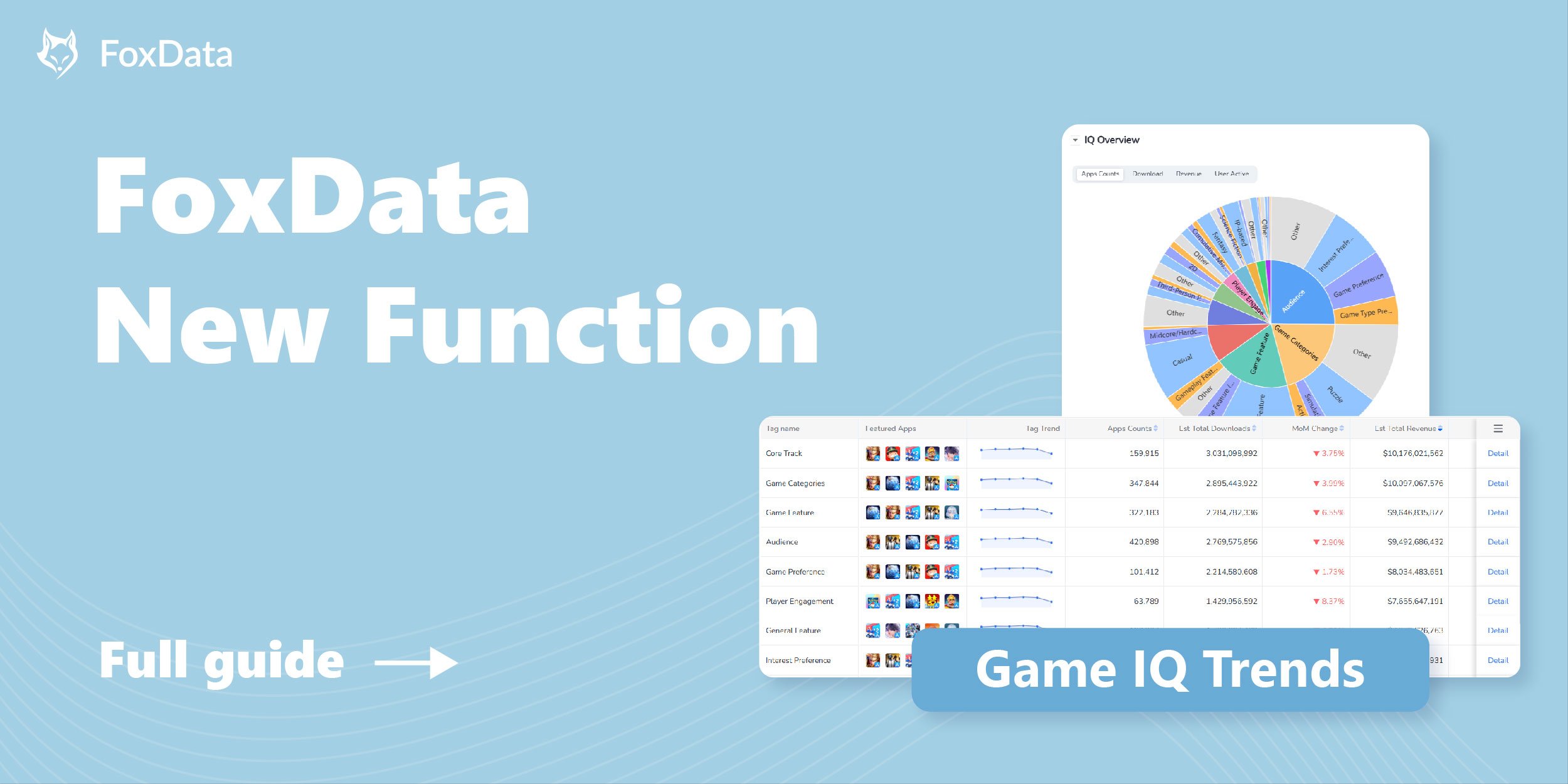
With thousands of new mobile applications and games launched each month, traditional app store categorization labels often fall short. "Social," "Tools," "Puzzle"—these outdated categories fail to reveal your product's true functionality or the nature of your competitors.
Therefore, we are excited to introduce our latest breakthrough:
Developed from scratch by FoxData, this intelligent categorization engine breaks through app store barriers. It provides multi-dimensional, clear insights across the following areas through hundreds of finely segmented, AI-driven categories:
🎮 Game IQ | 📱 App IQ | 🧑💻 Developer IQ | 🌍 Regional IQ
Access Path:
Visit the FoxData official website, then click sequentially on: [User Dashboard] > [IQ] > Select the module (Game IQ / App IQ / Developer IQ / Regional IQ).
Whether you're analyzing competitors or planning your next regional expansion, IQ Trend transforms chaos into strategic clarity.
Whether you're a market analyst curious about category opportunities, a producer needing precise iteration in a fiercely competitive market, or a developer aiming to avoid product misinterpretation, FoxData's new IQ Categorization System enables you to truly understand your product, competitors, and the fundamental shifts in market dynamics.
Starting from the real "categorization anxiety" of thousands of developers, we have created four intelligent and practical categorization modules, helping you see clearly, choose accurately, and act swiftly in a complex market landscape.
IQ has established a standardized system that spans iOS and Android, eliminating concerns like Tinder being categorized as “social” on one platform and “dating” on another. You can clearly identify your own positioning and accurately pinpoint your true competitors, understanding where they are stronger and what strategies they use to succeed.
An app can be “cross-border e-commerce,” “logistics tool,” and “social interaction” simultaneously; a game might be “Chinese-style RPG,” “female-oriented,” “story-driven,” and “cartoon aesthetic.” The IQ classification system supports intelligent multi-tagging, recognizing gameplay mechanics, target audiences, monetization structures, and even worldview backgrounds. This enables external analysis to go beyond just “name” and “icon.”
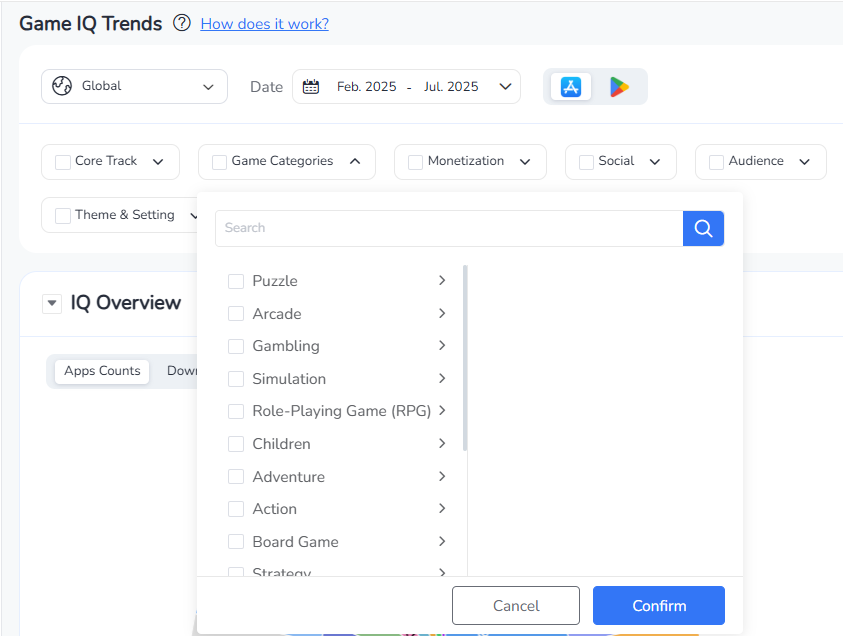
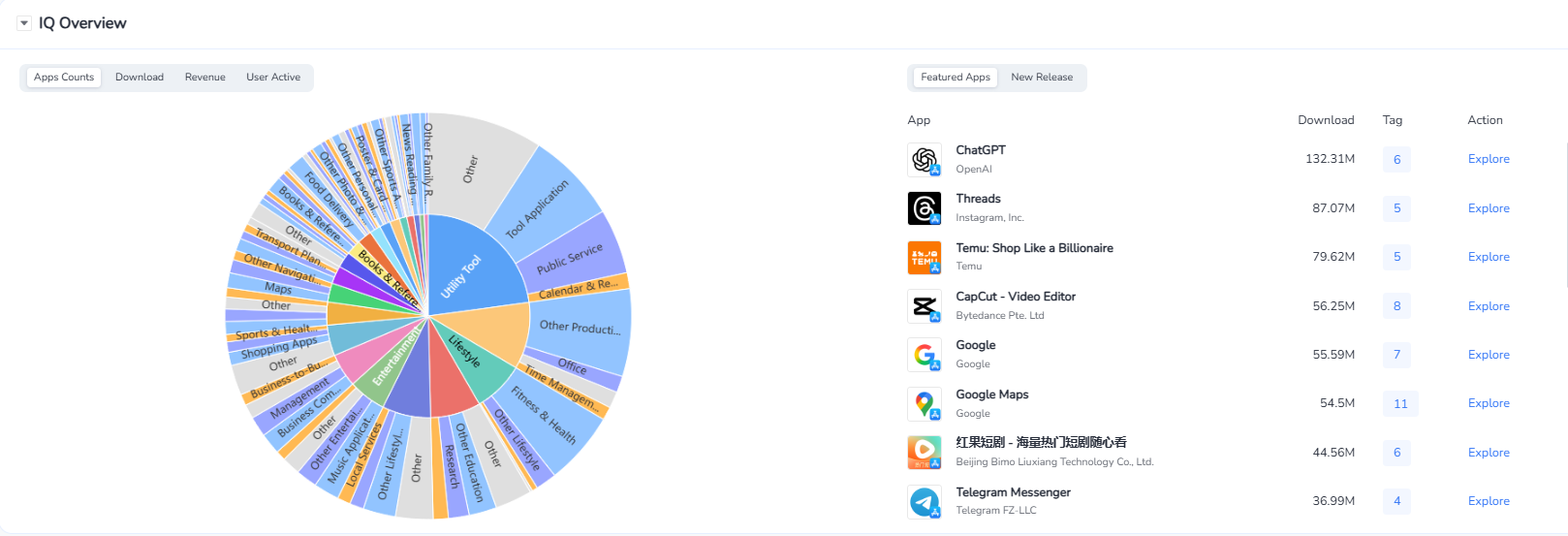
Opening the IQ classification main interface, the first thing that catches the eye is a dual-ring structured visual pie chart. It displays the current category distribution based on "download volume," with support for one-click switching to "number of applications," "revenue," "active users," and other dimensions, allowing you to select the observation perspective aligned with your actual business objectives.
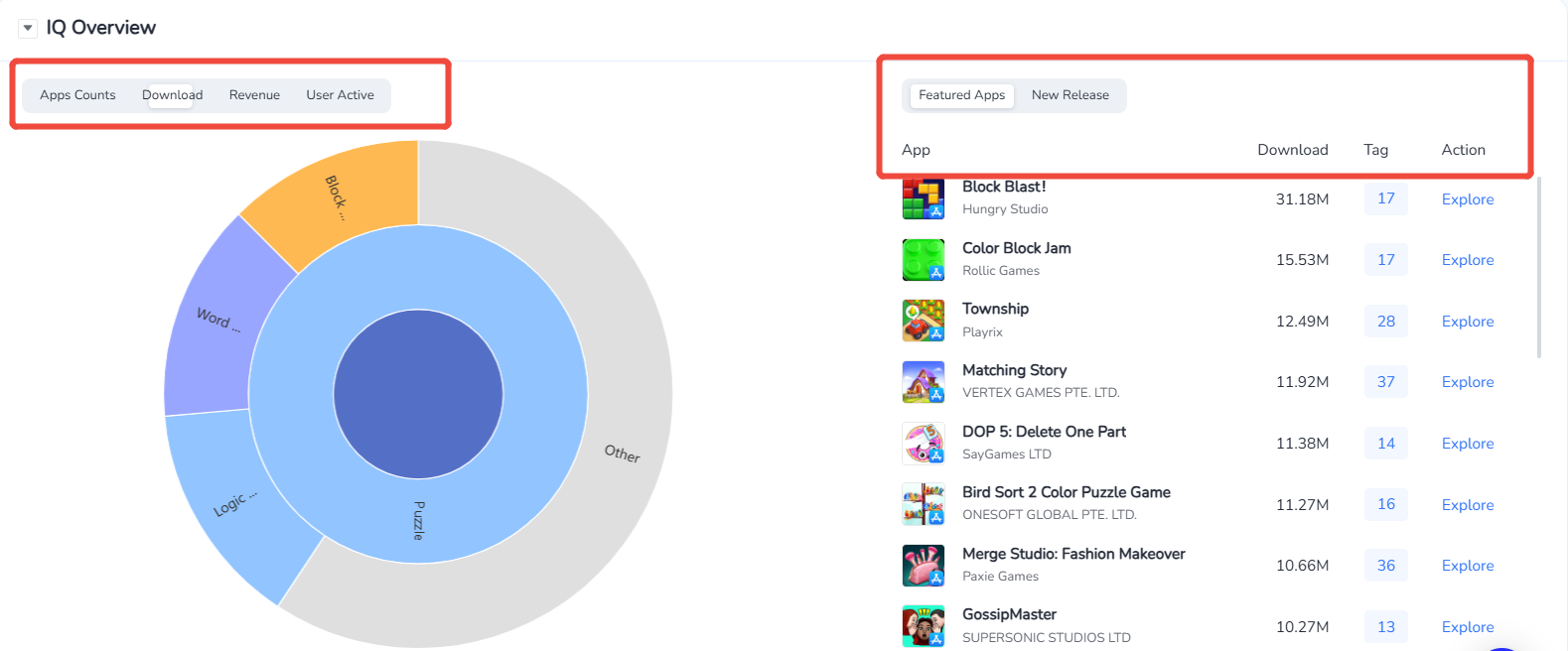
For example, within the current "Download" dimension, it is clearly evident that Puzzle-type games constitute a significant proportion. Among its subcategories, genres such as "Block Puzzles," "Word Games," and "Logic" continue to show strong growth.
Clicking on any sector instantly expands the details of that subcategory, including popular game rankings and performance summaries.
On the right side of the chart, the system automatically generates a list of representative products with high download volumes within that category (e.g., Block Blast!, Color Block Jam, Township), along with the following information:
- Total downloads (e.g., 31.18M)
- Number of associated IQ tags (the richer the product profile, the more tags)
- One-click Explore for in-depth analysis of game features, user demographics, and competitive benchmarks.
The display mode can also be switched freely to view:
- Featured Apps: top-performing flagship products with consistent high performance
- New Releases: innovative products that entered the rankings upon launch this month
🧠 Not only does this provide a comprehensive visualization of category trends, but it also allows you to drill down further to understand the logic behind the listings, helping you answer questions such as:
- What common mechanisms do popular Puzzle products share this week?
- Which puzzle gameplay types have the highest user engagement?
- Are there "potential competitors" with high tag overlap that are experiencing rapid growth?
Through this entire view, IQ helps you connect "category trends" with "product performance," enabling precise support for strategic planning and product iteration from macro to micro levels.
When assessing regional markets, have you encountered these issues:
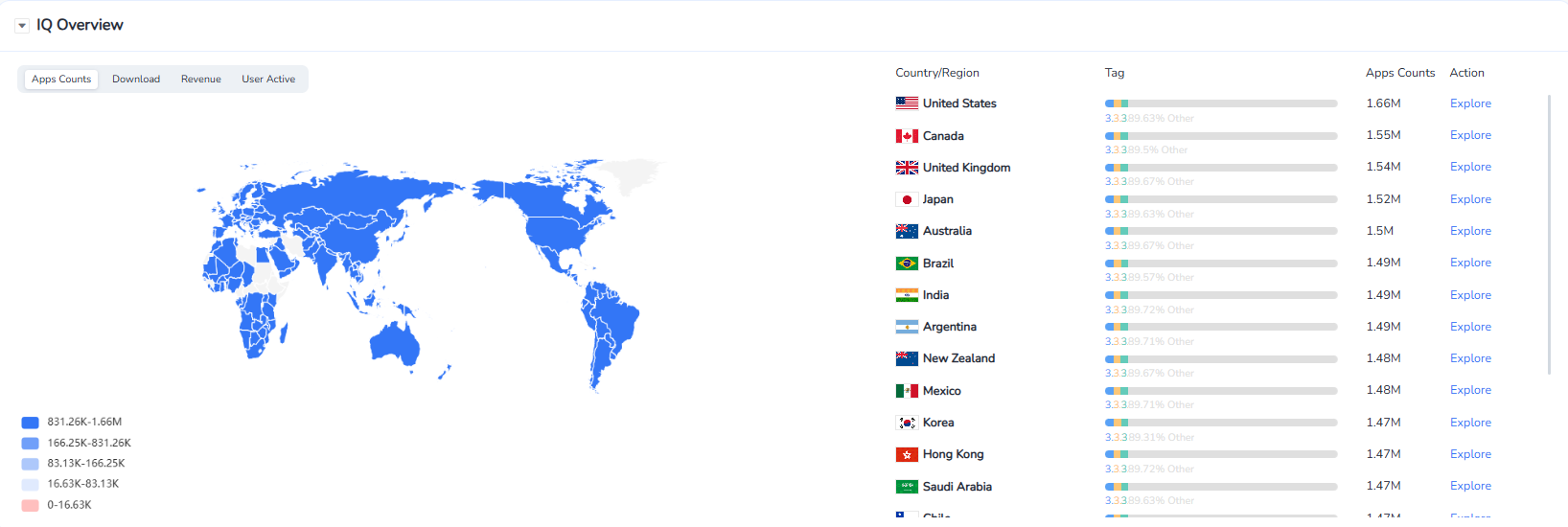
To thoroughly address cross-market insights, the IQ Classification System offers the "Regional-Level Classification Intelligent Map" module, as shown in the figure, allowing you to instantly observe the distribution of app/game stock volumes across countries and regions.
📌 The left map is an interactive global heatmap, shaded by application quantity—darker colors indicate higher local app density. This enables quick identification of:
📊 The right map displays detailed rankings of major markets, including:
Supports toggling among "Application Quantity," "Downloads," "User Activity," and "Revenue" dimensions, with multiple display formats such as pie charts, tables, and line trend graphs, facilitating independent analysis by product managers, operations, business development, and investment teams.
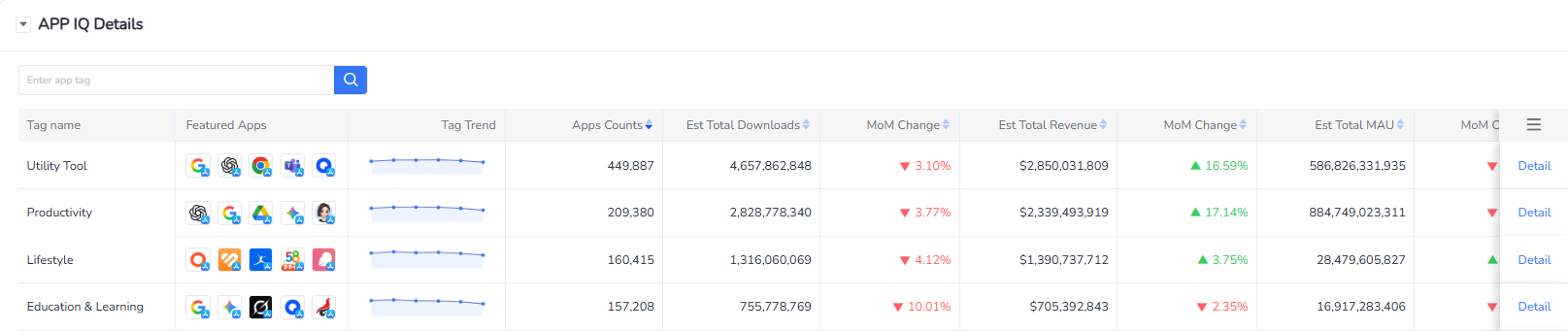
Whether you're seeking precise category opportunities, enhancing product positioning, or developing more data-driven international expansion strategies, the IQ Classification System will become an indispensable strategic tool. Increasingly, leading developers, publishers, and investment research teams are leveraging IQ to gain faster clarity on market structures and shifts in user preferences.
⚠️ Please note: The IQ Classification System is currently an enterprise-exclusive feature module, available only to subscribed corporate partners.
If you are in a critical phase of product acceleration, rising category competition, or expanding into emerging regions, now is the optimal time to strategize.
🎯 Contact us immediately to learn about the enterprise subscription details for the IQ Classification System.
Illuminate your next blockbuster product with smarter categorization from the start.
👉 Click here to inquire about enterprise subscription plans for a demo and customized solutions.
A: Traditional app store categories are often overly broad and inconsistent between platforms, such as labeling a deep tactical RPG as simply “Games” or “Casual.”
IQ provides granular, tag-level classification that's based on actual gameplay mechanics, monetization strategy, target audience, art style, and more. This enables a much more precise understanding of your positioning, competitors, and market trends—especially critical for multi-functional apps or hybrid-genre games.
A: While IQ is designed as an enterprise-level data tool, it's especially valuable for studios preparing for global expansion, competitive benchmarking, category innovation, or investment rounds.
Even smaller teams can greatly benefit by understanding which tags and subgenres align best with current market performance—helping focus limited resources on the most promising directions.
A: IQ leverages a combination of machine learning models, third-party SDK metadata, in-app functionality analysis, and real user behavior signals collected in aggregate.
Each product goes through multiple layers of automated and expert-reviewed categorization to ensure both depth and accuracy at a global scale.
A: Currently, IQ categories are system-generated and standardized to maintain cross-market and cross-product comparability.
However, for enterprise users, we offer a feedback channel to propose reclassification reviews or request deeper label support in new emerging sub-genres. Our team considers developer input seriously during periodic system updates.
© 2020-2026 FoxData. All Rights Reserved.