





Explore More Possibilities for Your Business
Full-cycle scenario construction to meet your needs from App research, development, and release to operation.
Ready for your soaring growth

According to the FoxData: Approximately 74% of new app users on the global App Store and Google Play platforms originate from organic channels. Downloads generated through keyword searches contribute over half of this organic traffic.
Organic traffic, with its low cost and high retention characteristics, has become an indispensable foundation for app growth.
However, with the surge of new entrants, the competitive environment continues to deteriorate:
The value of keywords is undeniable. However, the conventional understanding of keyword growth is falling behind the times.
The logic of selecting keywords intuitively, using popular terms to drive traffic, and employing keyword stuffing to inflate traffic is no longer effective today.
By observing numerous case studies of applications going global, we've identified that keyword growth failure often stems from three typical pitfalls:
Consuming resources in highly competitive, high-volume keywords dominated by industry giants, yet struggling to achieve actual ranking improvements.
Lacking data-driven decision-making, relying on experience for keyword selection; optimization efforts are fragmented, lacking a closed loop of experiment → feedback → adjustment.
Being slow to react to competitors' new keywords, ranking changes, and strategy shifts, thus losing opportunities for overtaking and gaining an advantage.
These blind spots directly lead to a disruption in organic traffic growth and a continuous increase in user acquisition costs.
After systematically reviewing cases such as Duolingo, Lensa AI, and Reflectly, we can distill a positive flywheel model for keyword growth:
Market Trend Insights: Capturing the Burst Window of Emerging Demand Keywords.
Refinement Experiments and Iterative Version Updates: Small-Scale Testing for Strategy Validation.
How should this be done specifically? 📊 Try FoxData now.
Real-Time Monitoring + Automated Optimization Loop: Dynamically Adjusting Your Keyword Array.
Practical demonstration:
According to FoxData, the peak times for keywords within the same category can vary by 6-8 weeks across different countries/regions.
Quickly capturing the rising curve is key to gaining a first-mover advantage.
⮕ Recommended Actions:
Case Study:
In Q4 2023, the keyword "Sleep Tracker Free" saw a 92% increase in search volume on Google Play in the US, with a similar growth trend emerging approximately 5 weeks earlier in Canada.
Leveraging competitor keyword pools offers both a shortcut and valuable intelligence.
⮕ Recommended Actions:
Keyword selection is not merely about comparing search volumes; it requires a multi-parameter, comprehensive decision-making process.
The Keyword Selection Triangle:
Case Study:
Instead of focusing on "fitness app," prioritize keywords like "personal workout planner" and "HIIT tracker for beginners," which have clear user intent and steady search volume growth.
Keyword optimization is not a one-time action but a dynamic process of continuous experimentation → feedback → optimization.
⮕ Recommended Actions:
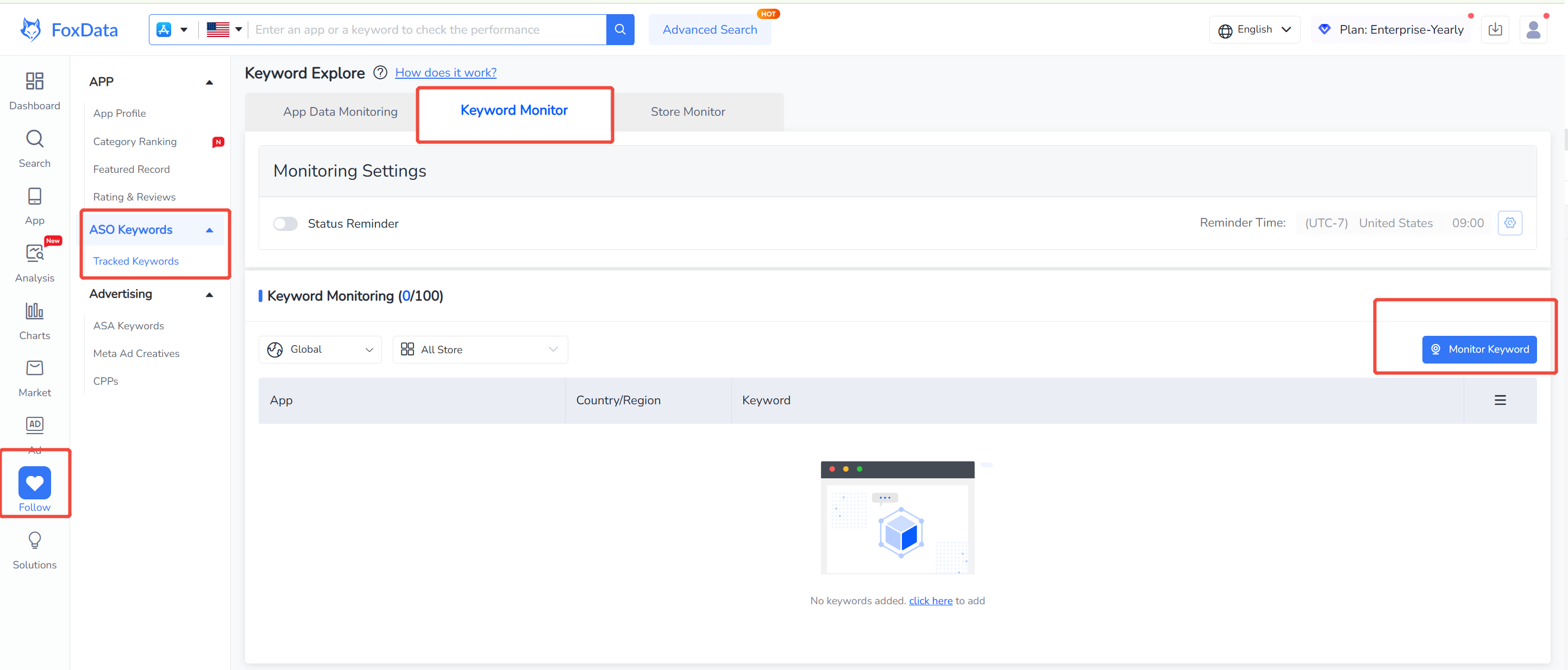
The FoxData "Keyword Monitor" module incorporates a built-in fluctuation alert mechanism, enabling batch monitoring and anomaly notifications, which is well-suited for managing medium to large keyword portfolios.
To utilize this feature:
Navigate to "Follow" → "ASO Keywords" → "Tracked Keywords" → "Keyword Monitor" to oversee your desired keywords. You can customize your analysis by filtering for specific countries and device types (App Store/Google Play).
In the current app ecosystem, where resources are increasingly scarce, keyword deployment is not about short-term gains but about building long-term momentum.
This process requires a systematic methodology, real-time data insights, and continuous optimization.
If you aim to construct your keyword growth engine with a more scientific and agile system, consider leveraging ASO data platforms, including FoxData, to establish your own traffic growth loop.
🎯 Want your keywords to grow systematically instead of relying on chance?
⏳ Stop targeting vague keywords and missing out on traffic opportunities; it's time to upgrade your "keyword arsenal"!
We've prepared competitor keyword pools, trending keyword rankings, and keyword alerts for you.
© 2020-2026 FoxData. All Rights Reserved.