


Explore More Possibilities for Your Business
Full-cycle scenario construction to meet your needs from App research, development, and release to operation.
Ready for your soaring growth
As generative AI continues to sweep across the globe and market competition intensifies, App Store Optimization (ASO) has become a must-have growth engine for AI applications.
When Elon Musk publicly questioned whether Apple was giving preferential treatment to ChatGPT in App Store rankings, it sparked widespread debate around the transparency and fairness of app discovery — and more importantly, how strategic partnerships may influence ASO performance.
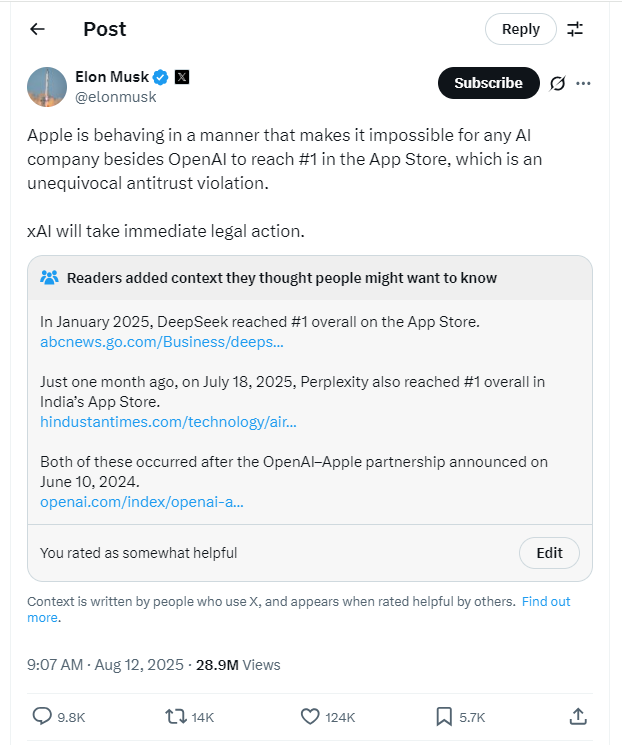
Apple responded with an official denial, asserting that app visibility is determined by algorithms and editorial standards, not favoritism. Yet, at WWDC 2024, Apple officially announced its strategic partnership with OpenAI, integrating ChatGPT deeply into the Apple Intelligence ecosystem.
In light of these developments, how should AI companies interpret the true value of such collaborations? More critically, how can they leverage platform-level shifts to secure sustainable growth in an increasingly competitive landscape?
This article unpacks the Apple–OpenAI alliance in practical terms, and — combined with the latest best practices from the 2025 ASO playbook — delivers six actionable insights and frameworks that are essential for any AI app developer or marketer investing in long-term, organic success.
📌 Further Reading: From Underdog to Top Chart: Mastering Aso via Competitor Keyword Strategies
In response to recent criticism, Apple has stated that App Store rankings and featured placements rely on "algorithmically-driven, heuristics-based models" and do not provide any form of preferential treatment to individual developers — including OpenAI.
However, since ChatGPT was integrated into the Apple Intelligence ecosystem, its visibility has increased significantly. That rise can be attributed to systemic benefits such as embedded platform recommendations, broader use-case integration, and a streamlined user experience.
While Apple denies any ranking advantages rooted in commercial relationships, it's clear that developers aligned with Apple’s strategic direction benefit from more consistent visibility and pushed exposure. These developments challenge non-partnered apps to adapt quickly and reinforce the need for a more sophisticated and reactive ASO strategy.
As App Store search continues to evolve, industry analysis indicates a shift toward NLP-powered, semantic-based interpretation of queries. This means AI app developers must pivot their ASO keyword strategies away from literal phrasing and toward intent-driven, scenario-based modeling.
🎯 Pro Tip: Track emerging keyword shifts following events such as major product partnerships (e.g., WWDC reveals), policy changes (e.g., TestFlight criteria shifts), or regional regulations like the EU AI Act. These events often introduce semantic query volatility — a critical opportunity for metadata updates.
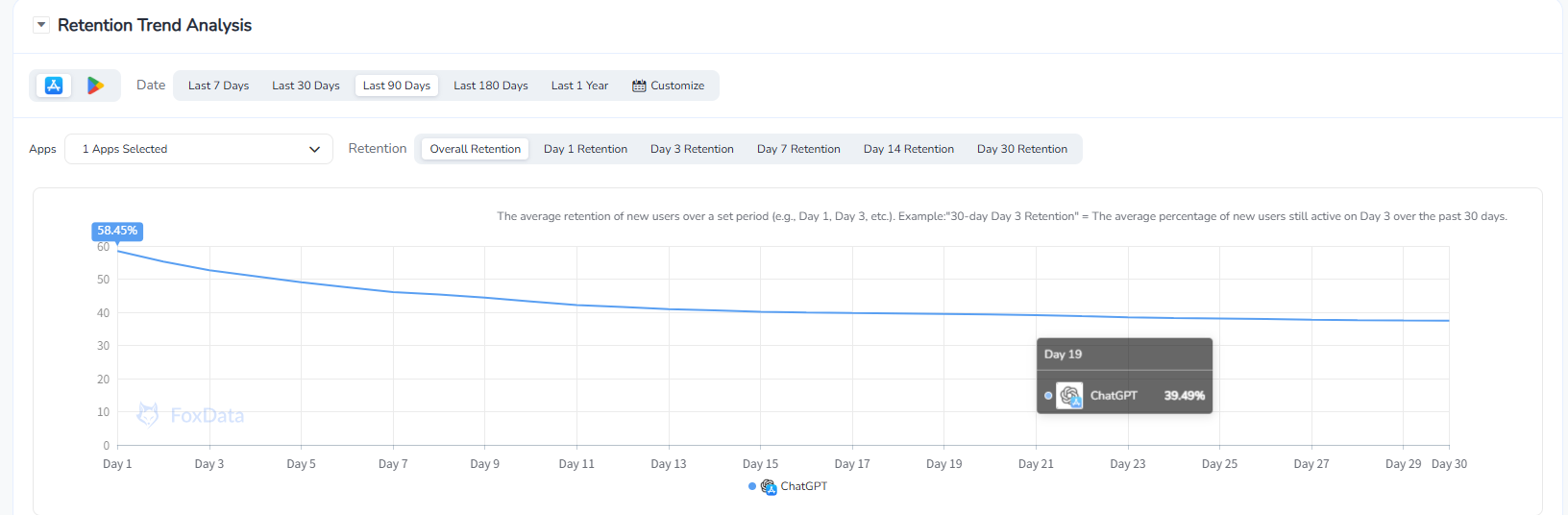
While ChatGPT may have temporarily topped rankings following its WWDC spotlight, long-term positioning depends on far more than exposure. True staying power results from retention strength, conversion performance, and the quality and sentiment of user reviews — factors prioritized by both Apple’s and Google’s store algorithms.
🛠 Tool Suggestion: Use FoxData’s Retention Analytics module to identify behavioral drop-off points and align them with product refinements.
With iOS 18.4 Beta, Apple is introducing AI-generated review summaries — a feature powered by large language models (LLMs) that extracts representative insights from a wide base of user reviews, helping users understand the overall app experience in just seconds.
Although Apple has not disclosed the technical implementation, industry consensus suggests that the summarization model likely accounts for factors such as keyword density, feature-specific mentions, and sentiment polarity when aggregating content.
This shift signals Apple's growing emphasis on the qualitative substance of user feedback — marking a strategic expansion beyond traditional average star ratings and toward a more nuanced, content-based trust evaluation framework.
🛠 Recommended Tool: Use FoxData’s Rating & Reviews to identify negative sentiment trends (e.g., "crashes," "lag," or "misinterpretation") and channel those themes into your product team's next iteration roadmap.
While ChatGPT’s partnership with Apple has amplified its native visibility in English-speaking markets, significant whitespace remains across emerging regions such as the Middle East, Latin America, and Southeast Asia. For AI apps that are not formally integrated into the Apple ecosystem, localized ASO strategies are the essential path to competing and breaking through in these high-growth markets.
🌐 Localization Across Four Strategic Dimensions:
While Apple accelerates AI integration through ecosystem-level initiatives, the relatively open nature of Google Play continues to serve as a critical growth gateway — particularly for small and mid-sized AI developers aiming to scale in high-opportunity markets.
Additional Note:
At WWDC 2024, Apple officially announced that its Apple Intelligence framework will initially integrate ChatGPT, with support for additional third-party models — including Google Gemini and Anthropic Claude — coming soon. This multi-model architecture confirms Apple's open approach to intelligent interface design, highlighting the need for developers to maintain a flexible, model-agnostic integration strategy that adapts to evolving partnership ecosystems.
✅ Regularly refresh keywords, screenshots, and descriptions in line with evolving trends
✅ Establish localized ASO strategies optimized for multilingual and cultural preferences
✅ Deep-dive into review analysis to improve AI-generated summaries (prioritize mentions of speed, accuracy, privacy, etc.)
✅ Leverage A/B testing and CPPs to cater to segmented user cohorts — students, creatives, professionals, etc.
In today’s AI-driven era, ASO is an invisible yet high-stakes battleground. The Apple–OpenAI alliance opens the door to ecosystem-level advantages — but simultaneously reminds all developers that riding the platform wave requires more than strong technology. It demands data-driven growth discipline.
Elon Musk’s critique sparked necessary debate, but stories of non-partnered apps topping the charts prove one thing: strategic ASO execution — not just resources — levels the playing field.
🚀 Ready to unlock your next growth inflection point? Build a closed-loop ASO system for your AI app using FoxData today >>
© 2020-2026 FoxData. All Rights Reserved.