


Explore More Possibilities for Your Business
Full-cycle scenario construction to meet your needs from App research, development, and release to operation.
Ready for your soaring growth
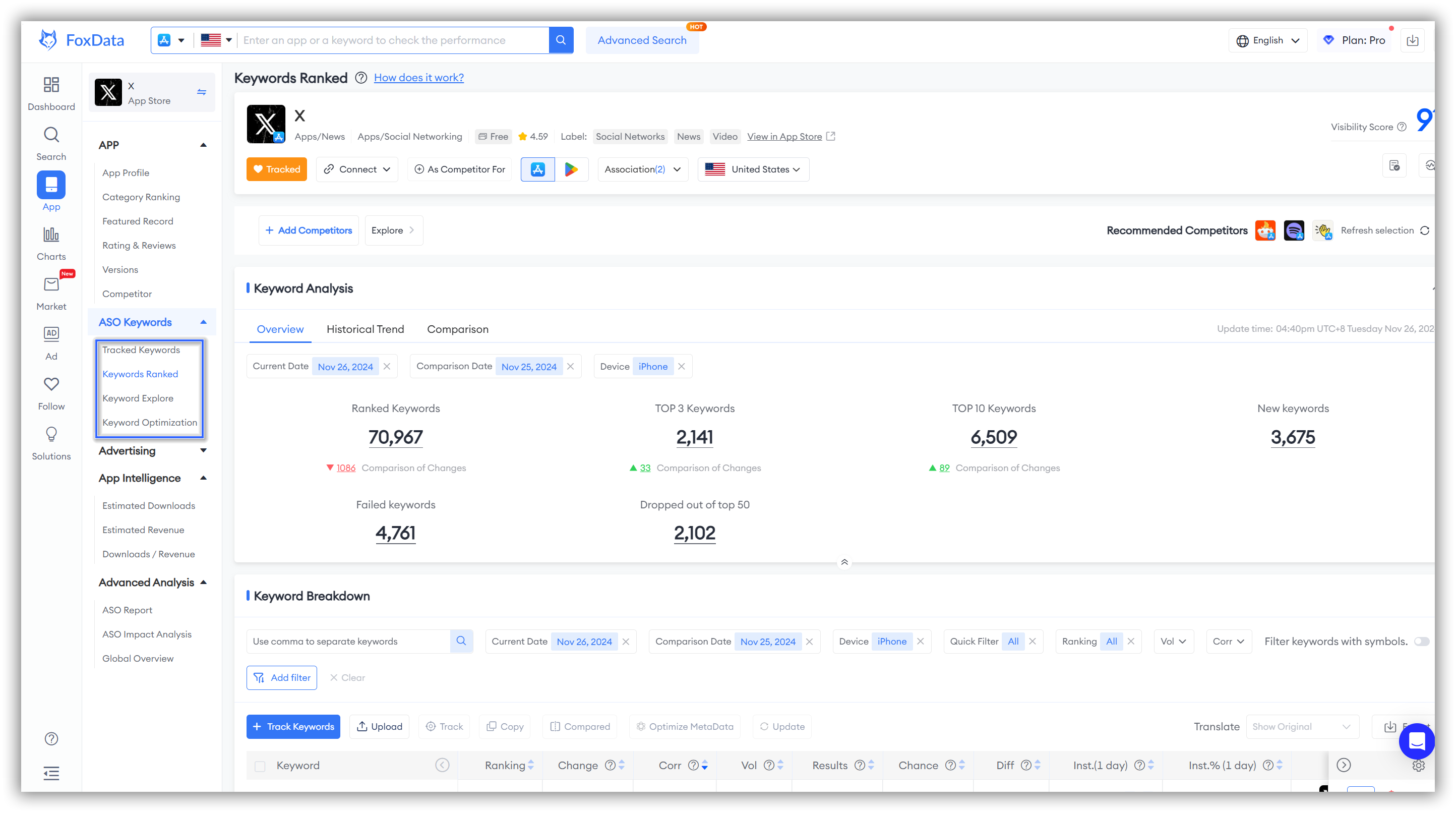
To view key ASO Keywords metrics and insights:
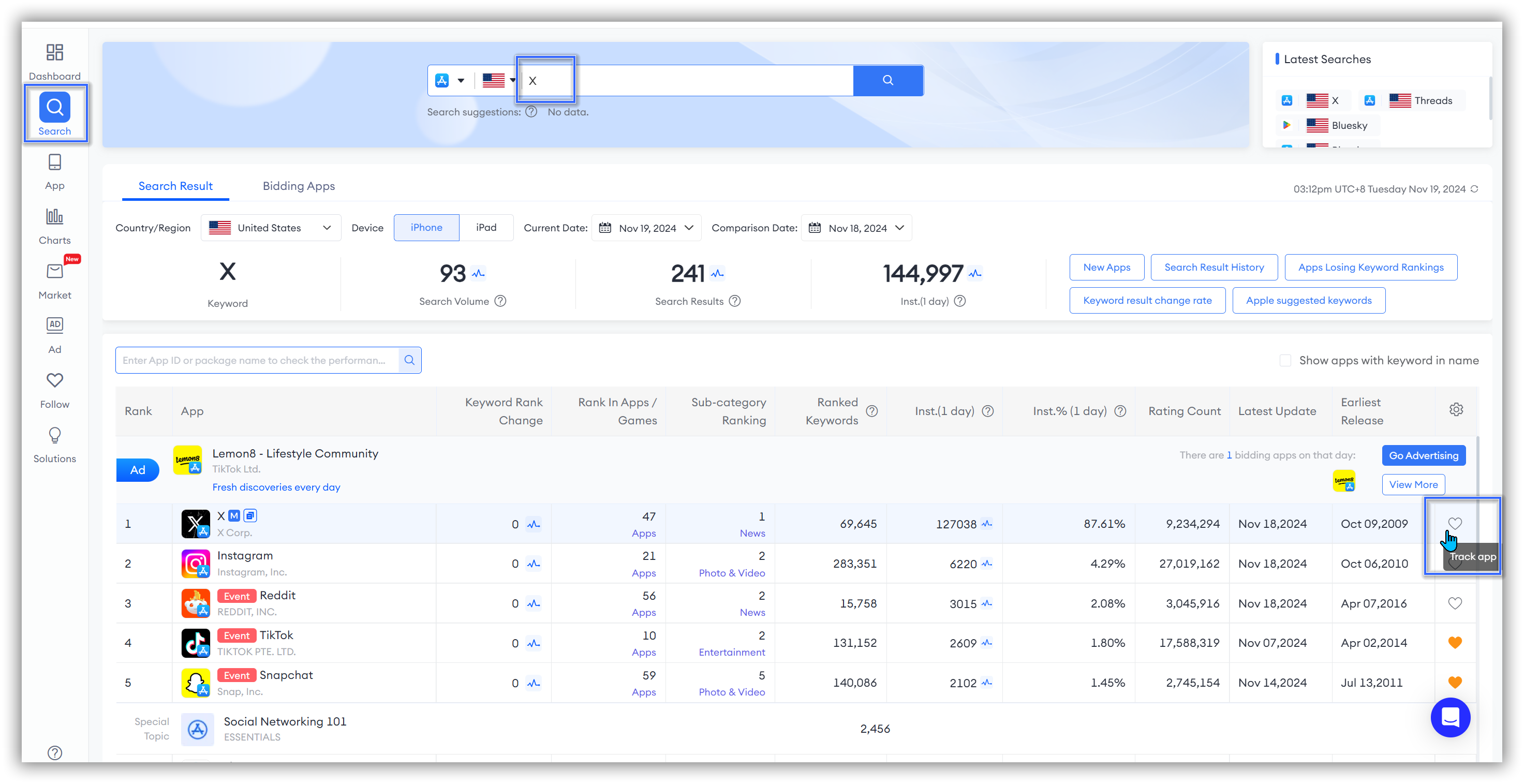
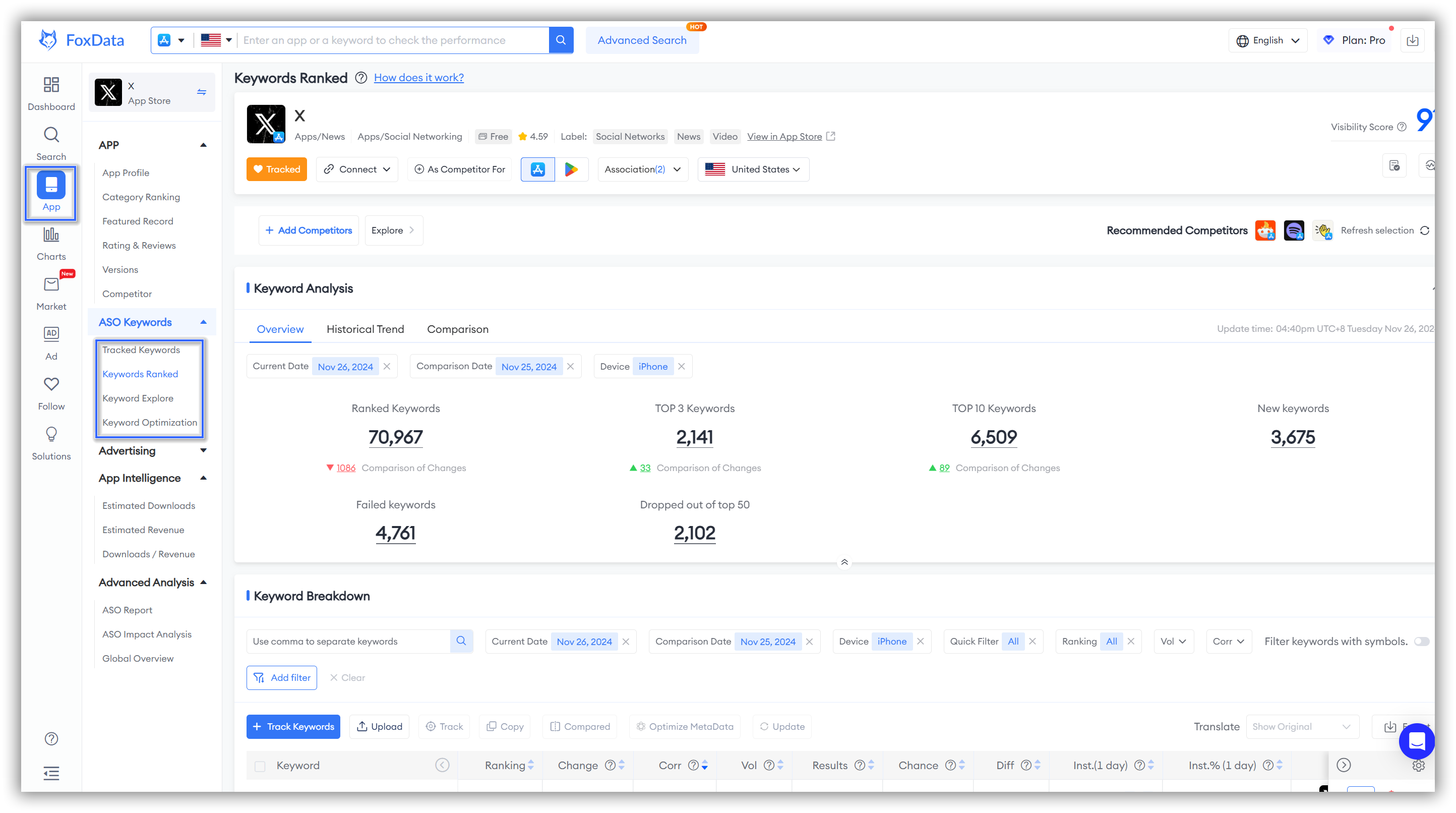
👏Expert Tips: If you want to try the feature first or if the system-recommended keywords happen to interest you, we suggest you choose the first method directly.
If you have specific keywords in mind that you want to explore, we recommend using the second method to search directly.
If you have no ideas or wish to conduct a comprehensive keyword research process using "ASO Keywords," our ASO experts suggest using the third method.
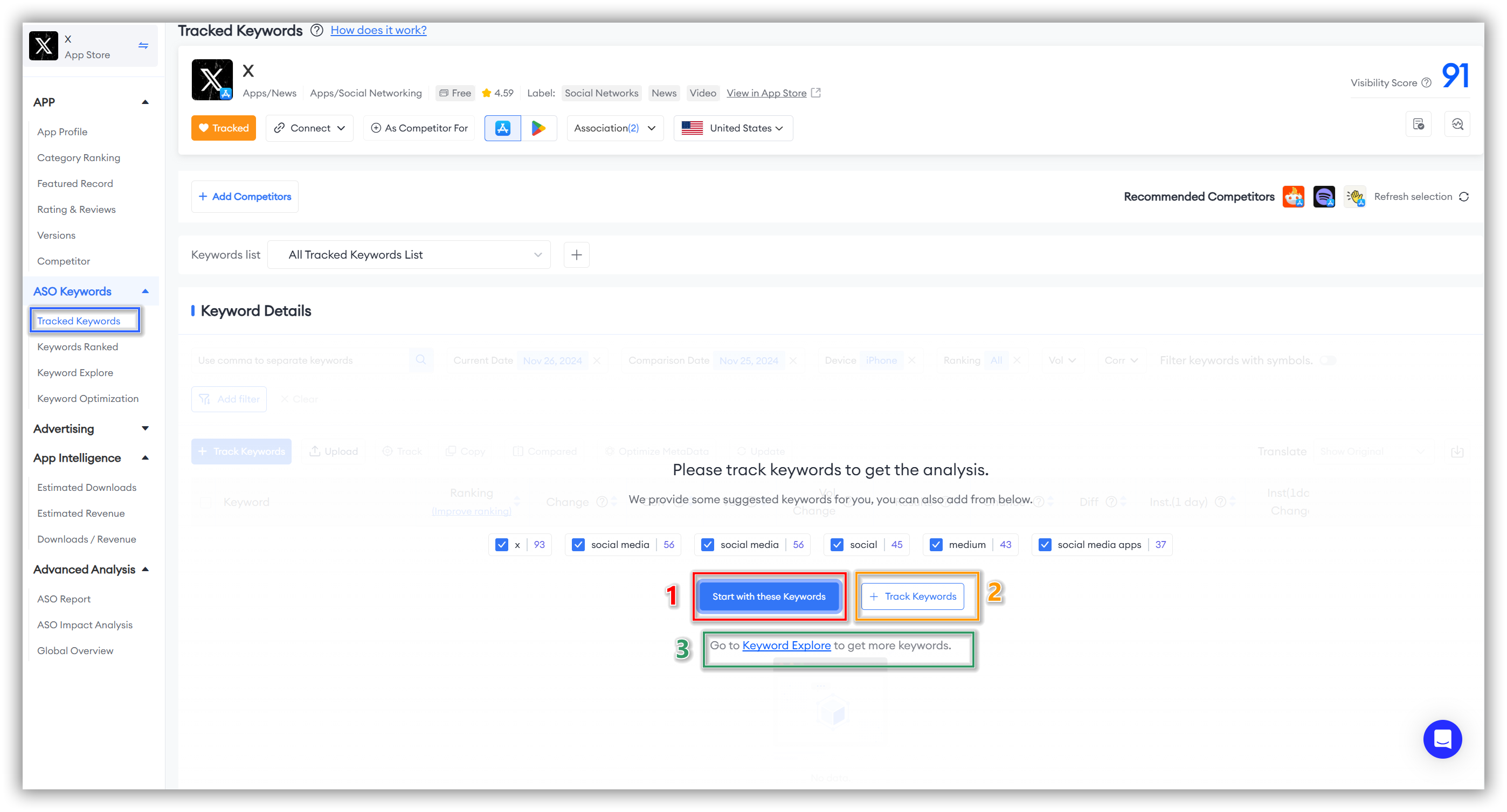
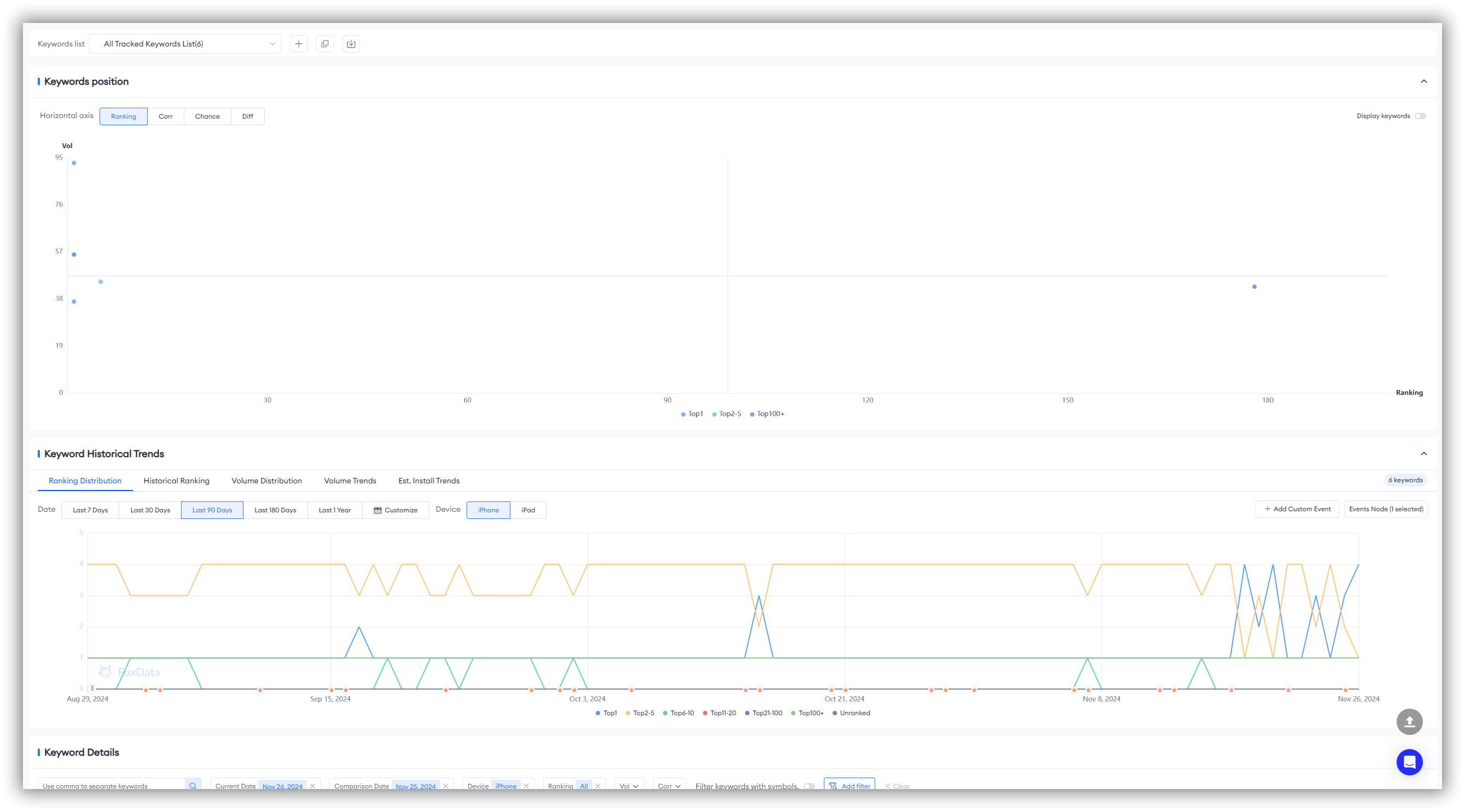
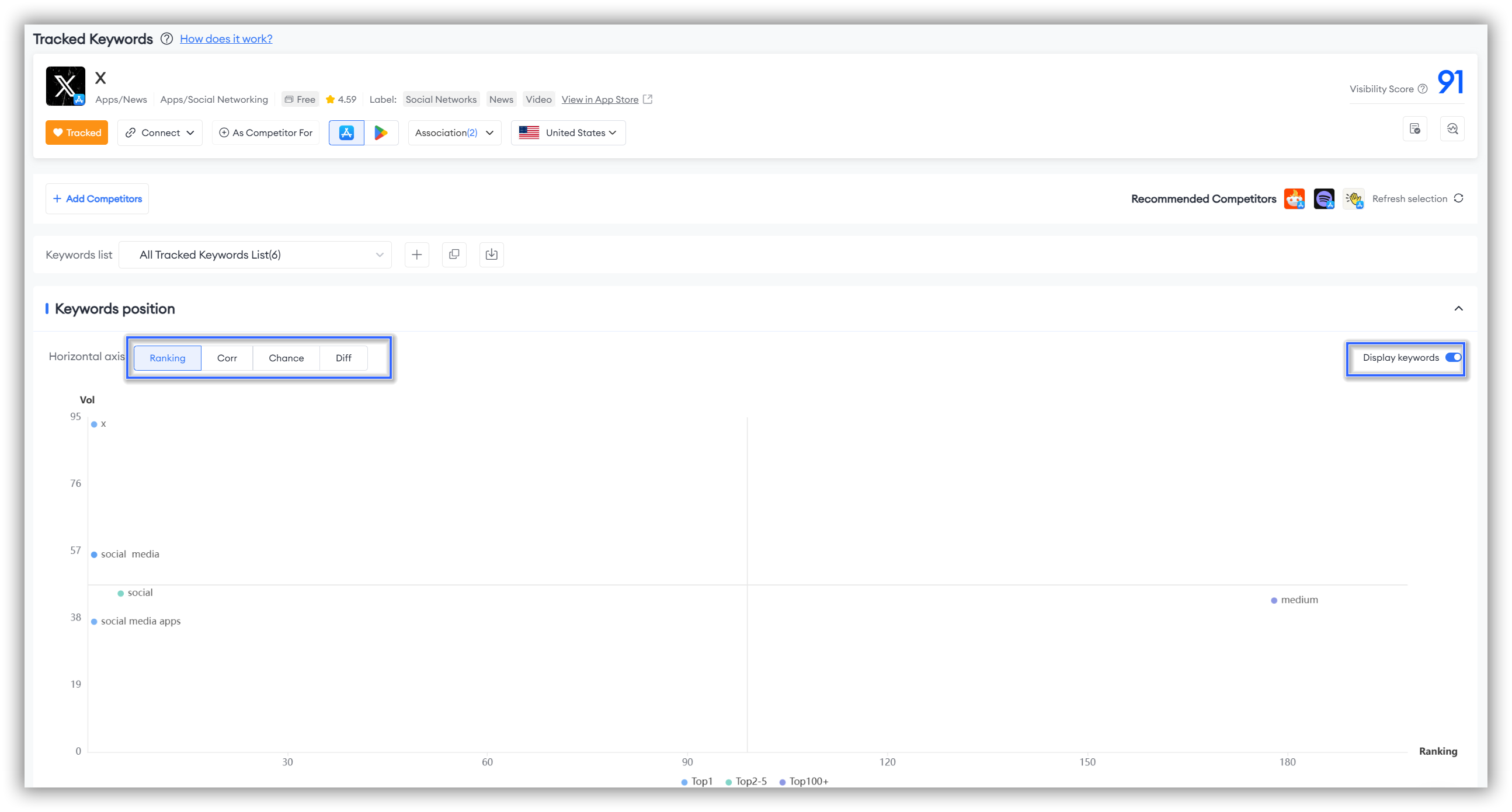
🗒️ Note: To facilitate your in-depth research, FoxData allows you to add, copy, and export keyword lists. If needed, you can select the corresponding icon buttons next to "Keywords List" in the top-left corner to export your list.
The "Keywords Historical Trends" section uses line charts to display the performance of your researched keywords across five dimensions: "Ranking Distribution," "Historical Ranking," "Volume Distribution," "Volume Trends," and "Est. Install Trends." This helps you track the dynamic changes of each keyword.
You can gain a comprehensive understanding of each keyword's historical performance and adjust your app store optimization strategy in a timely manner to enhance your app's visibility and download rate.
By default, the system initially displays data for the "Ranking Distribution" dimension. If you want to explore keywords from the other four dimensions, don't forget to click the specific text in the top-left corner to switch.
Additionally, FoxData allows you to customize the time dimension and filter by device.
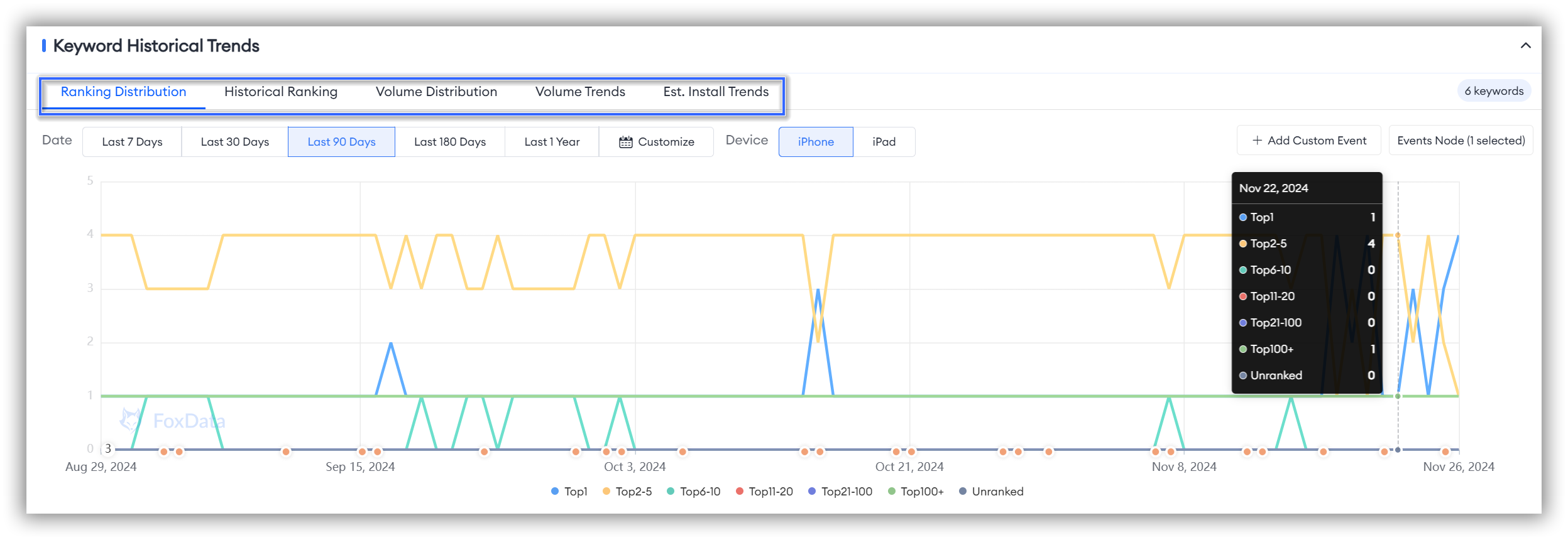
The "Keywords Position" and "Keywords Historical Trend" sections visually present the performance of your keyword list across different dimensions and historical trends, respectively.
However, if you wish to conduct a more in-depth study of specific keywords, be sure to scroll down to the "Keyword Detail" section. This section offers a more detailed and comprehensive analysis of each keyword.
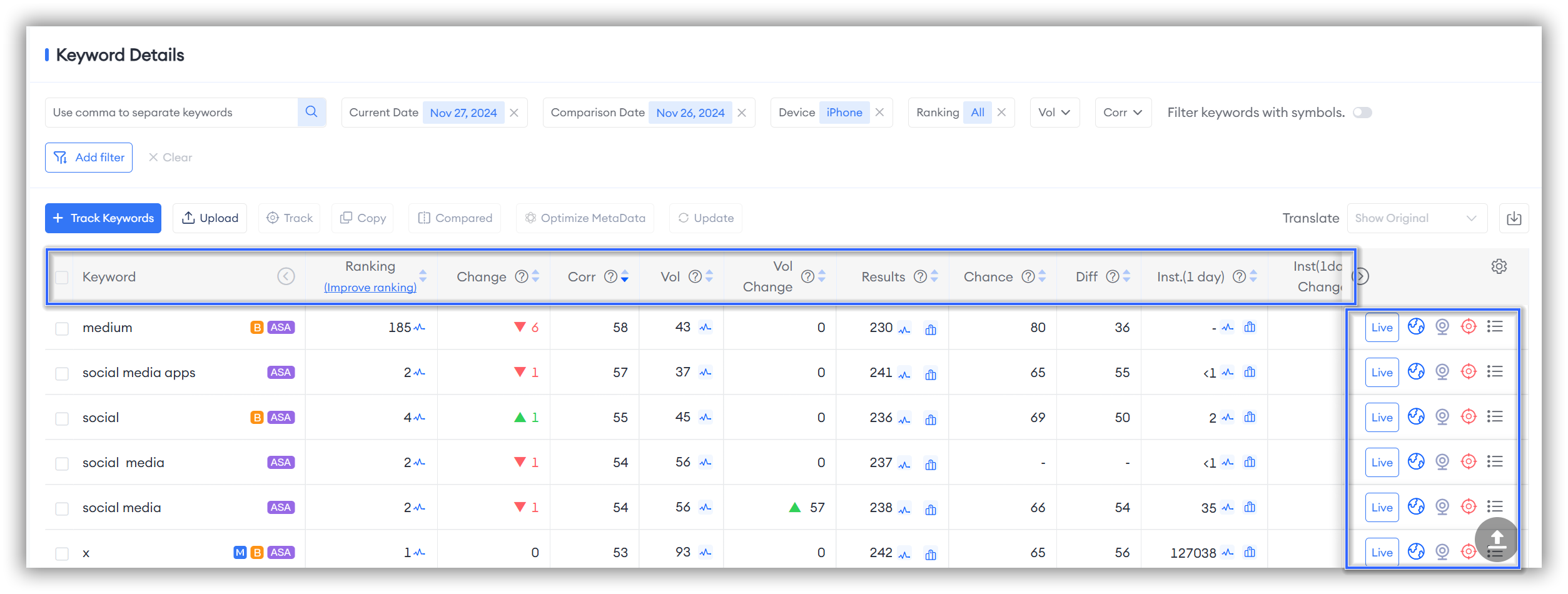
"Keyword Details" allows you to analyze keywords from multiple dimensions, including: "Ranking", "Ranking Change", "Correlation", "Correlation Change", "Volume", "Volume Change", "Results", "Chance", "Difficulty", "Installation", "Installation Change", "Inst.%", "Keywords list", and "Top 5 Apps".
This in-depth analysis can provide valuable insights for optimizing your keyword strategy.
📒Note: If you're unclear about the definition of any dimension, please check the "?" icon next to each dimension text. It provides explanations for each dimension's definition.
In addition to all the dimensions mentioned above, FoxData also allows you to click the "Live" icon or the "globe" icon in the last column of the keyword to view each keyword's "Live Search Insights" or "Worldwide Check." This will help you better understand its influence and potential opportunities in different markets.
You can also click the "gray monitor" icon to monitor a keyword or the "target" icon to track or cancel a keyword.
📒Note: When the "target" icon is gray, clicking it will turn it red, indicating that the keyword is now being "tracked." Conversely, when the "target" icon is red, clicking it will turn it gray, indicating that the keyword has been "canceled" from tracking.
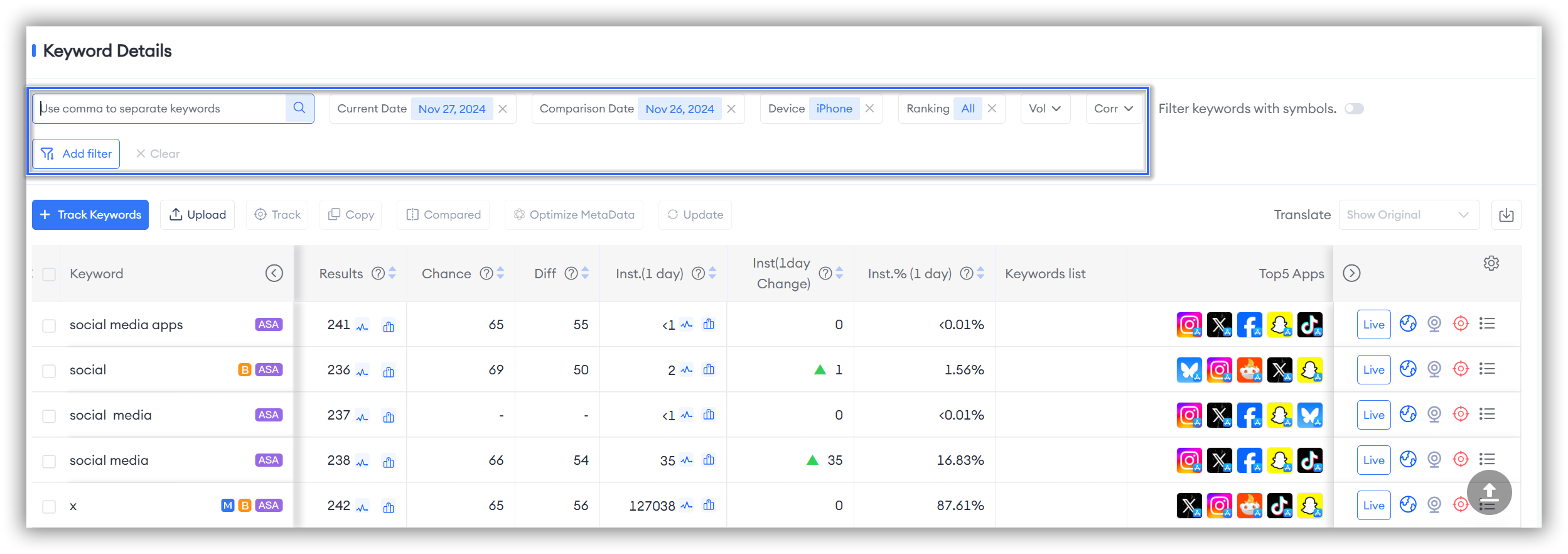
Can I customize some filters according to my needs?
Of course! FoxData allows you to personalize your keyword research by using filters such as "Use comma to separate keywords," filtering by "Date," "Device," "Ranking," and all other dimensions related to keyword research.
If you want to filter by additional keyword dimensions, don't forget to click "Add Filter" in the top-left corner.
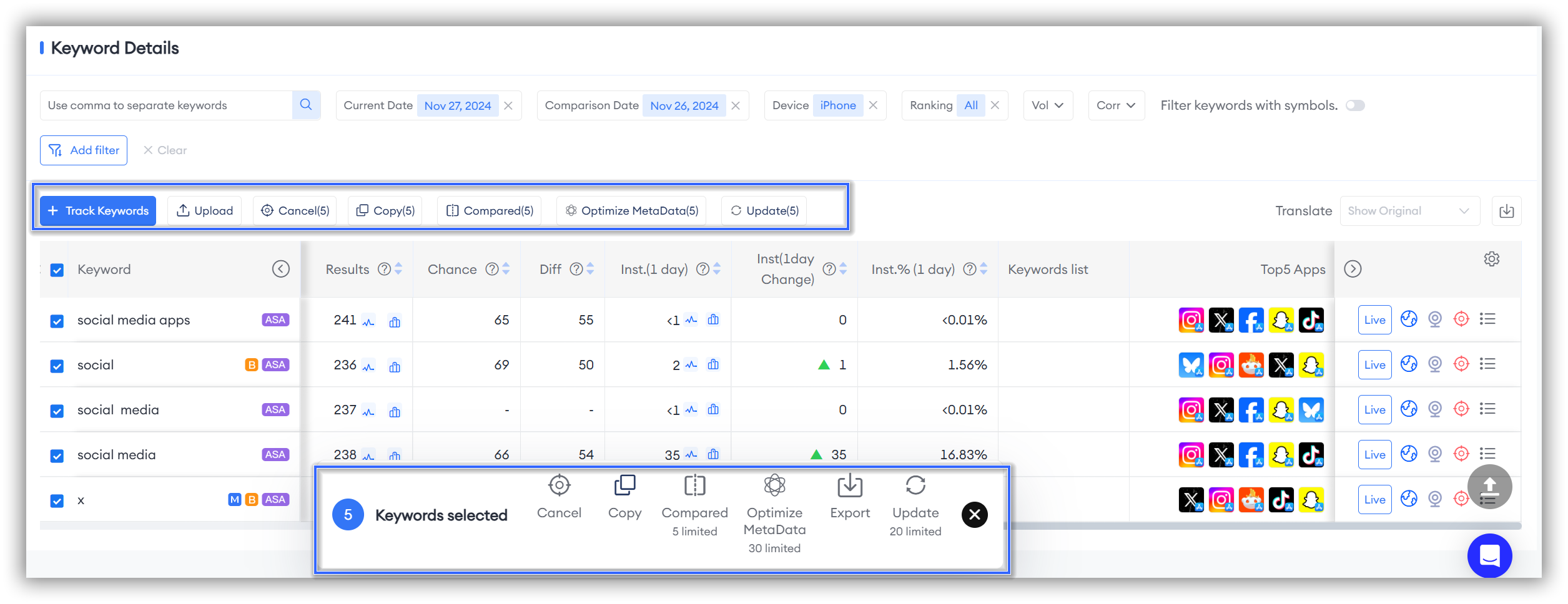
How can I manage or use these keywords?
FoxData allows you to manage and use your keywords in a personalized way.
After selecting the keywords you are interested in, you can click on several options located above or below the keyword list, such as:"Cancel", "Copy", "Compared", "Optimize Metadata", "Export", and "Update".
These options provide flexibility in managing and utilizing your keyword list according to your needs.
Can I perform competitor analysis directly in the "Tracked Keywords" section?
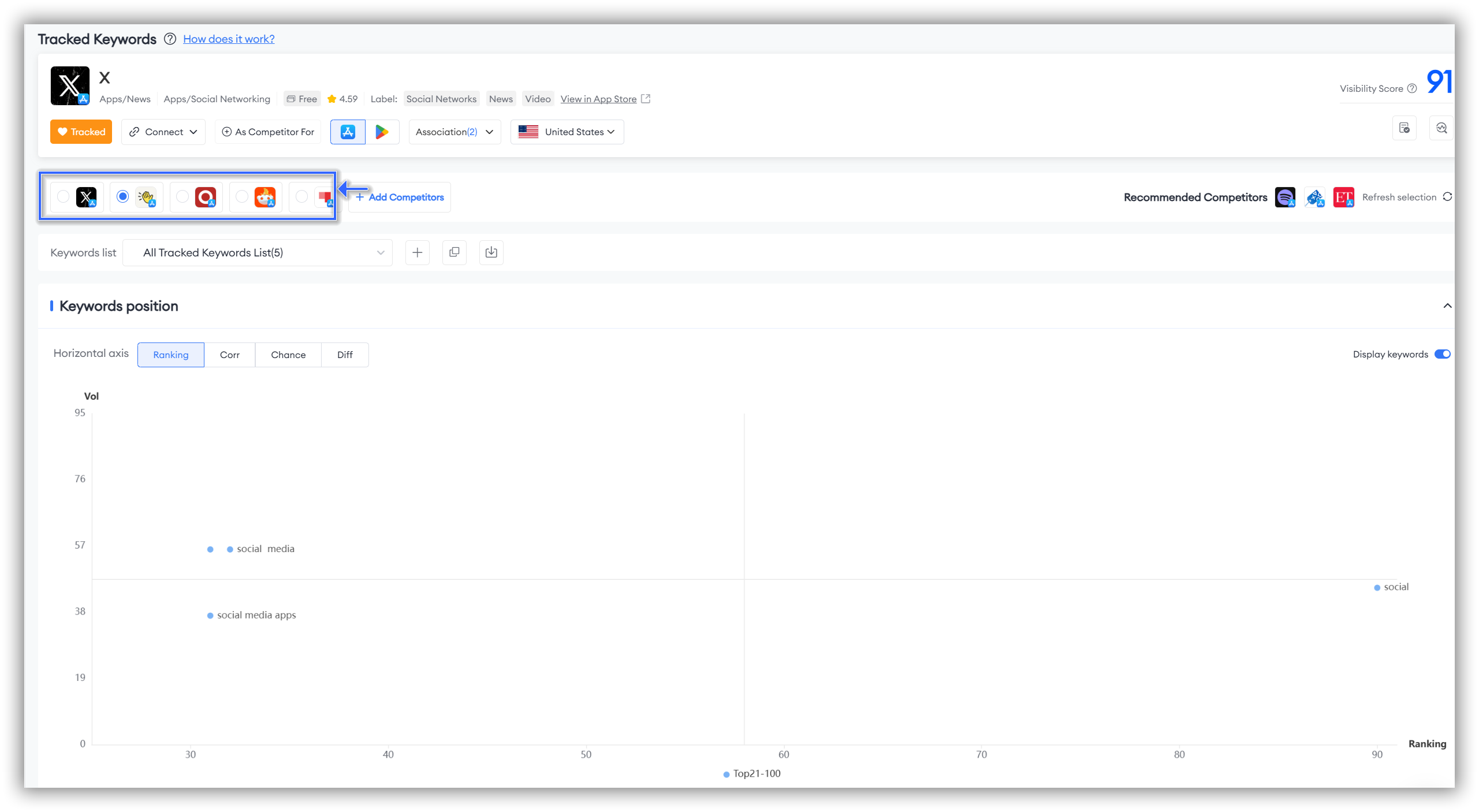
Yes! FoxData allows you to conduct keyword analysis on your competitors directly by clicking the "+ Add Competitors" button at the top left of the page. In the "Tracked Keywords" section, you can select a competitor to view the performance of your tracked keywords under that competitor, including "Keywords Position," "Keywords Historical Trend," and "Keyword Details."
This feature helps you gain insights into how your keywords are performing relative to your competition.
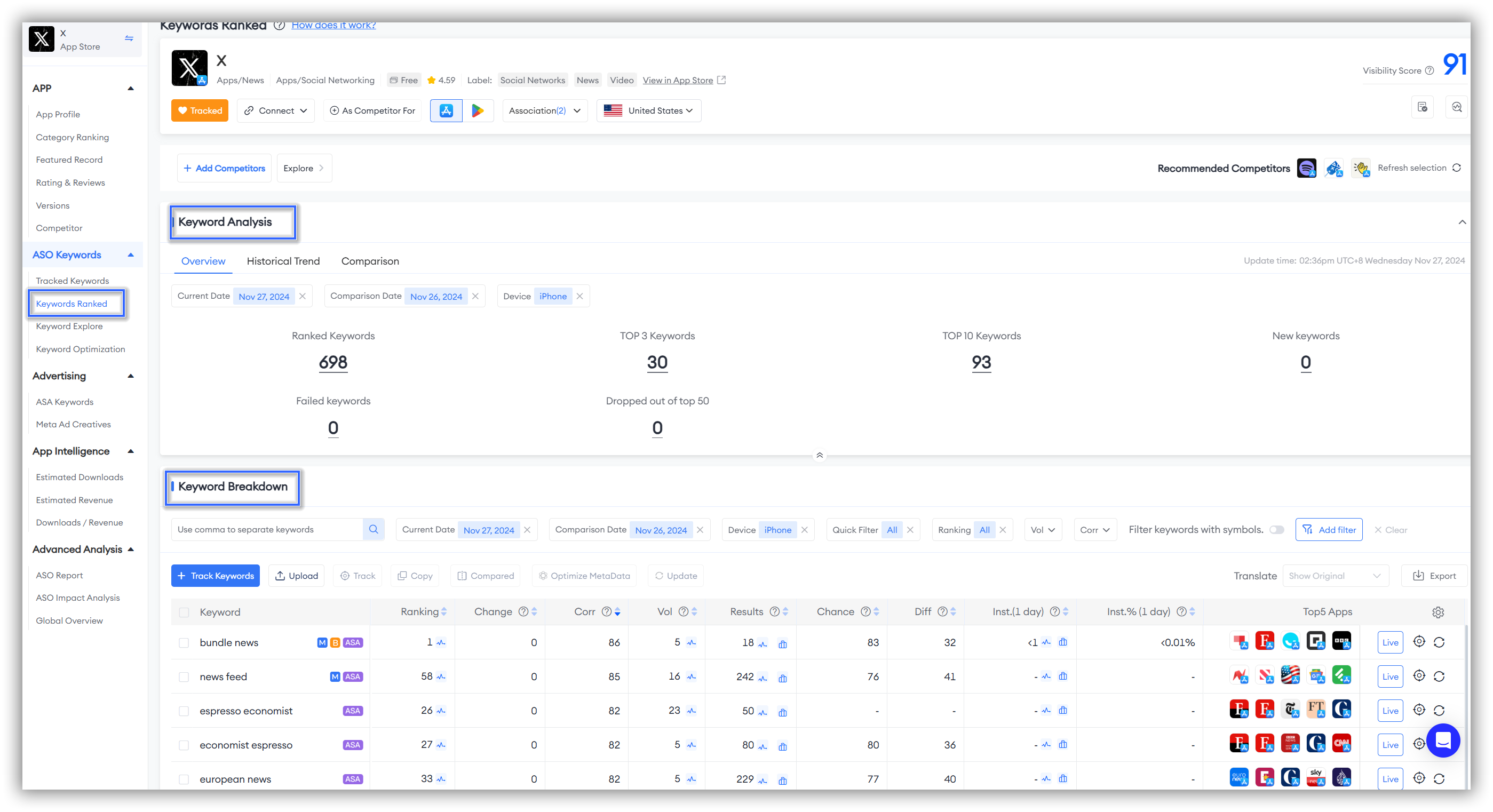
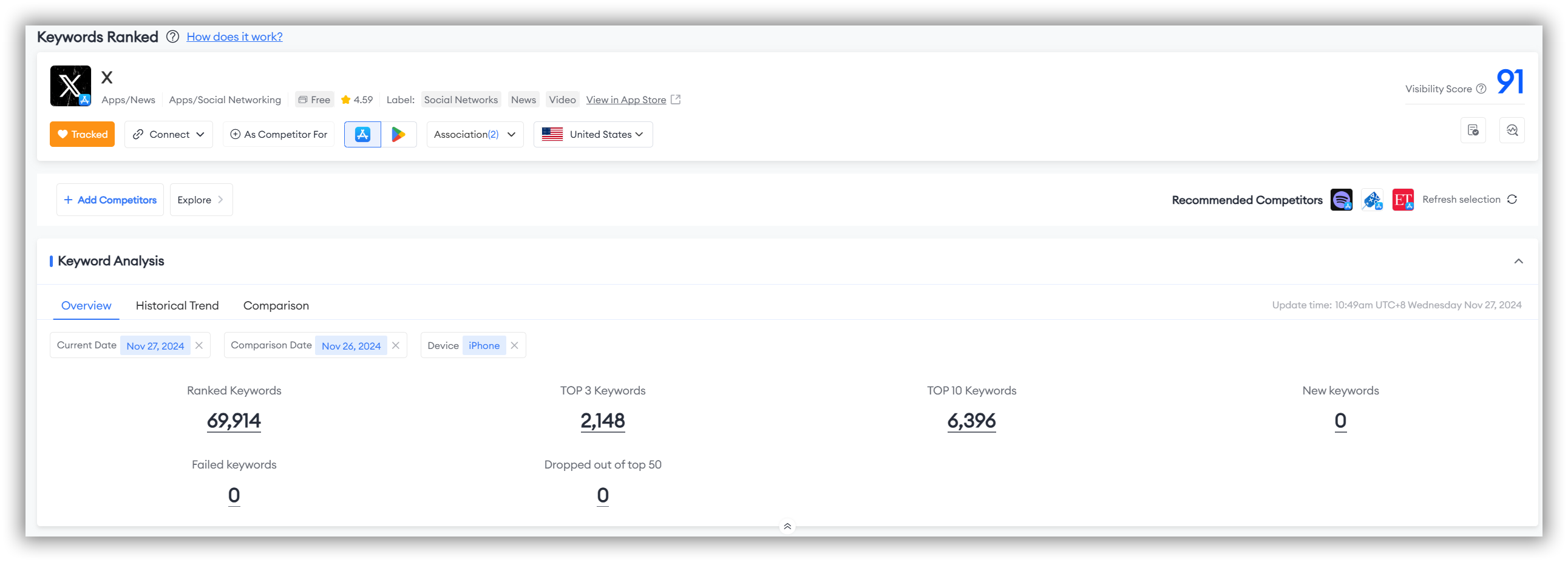
The "Overview" page of "Keywords Ranked" displays the keyword ranking performance of the app you are tracking.
This helps you more effectively evaluate the app and optimize its keyword strategy.
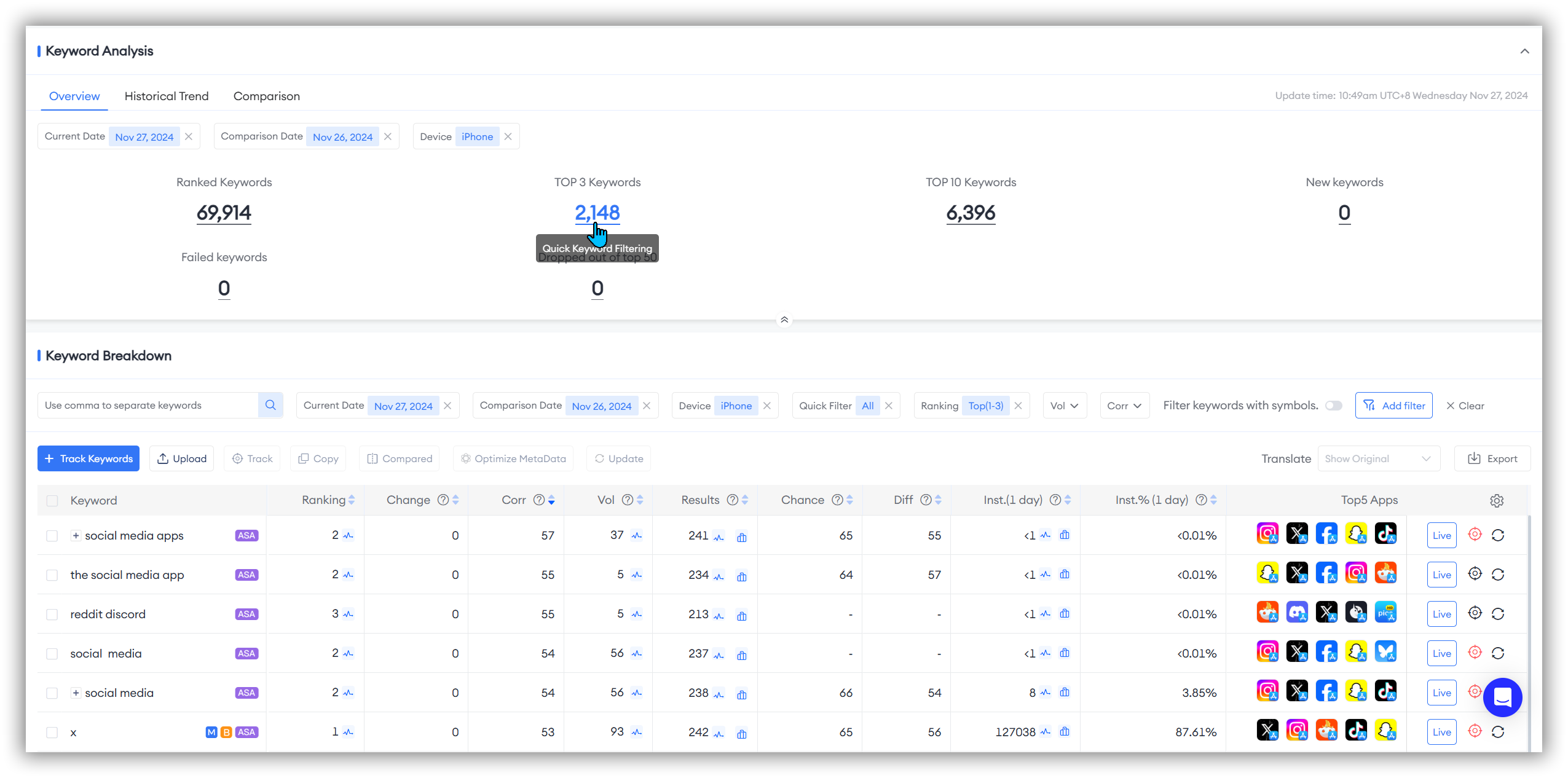
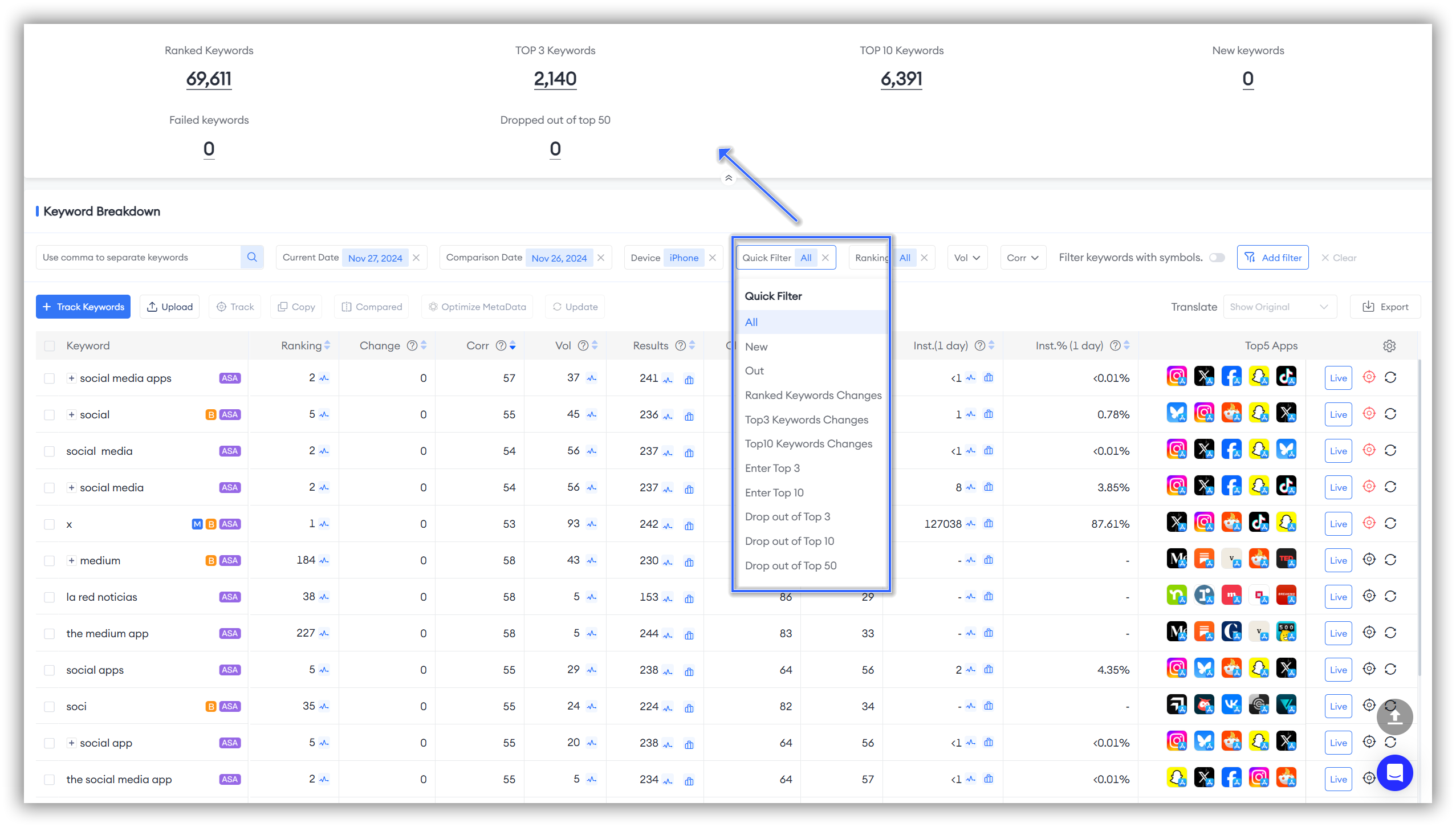
After filtering by "Current Date," "Comparison Date," and "Device," "Keywords Ranked" shows the following metrics for the app: "Number of Keywords Ranked", "Top 3 Keywords", "Top 10 Keywords", "New Keywords", "Failed keywords", and "Dropped out of top 50".
Click on "Historical Trend" in the top left corner to switch directly from "Overview" to "Historical Trend."
This allows you to view the historical trends of the keywords for the app you are tracking. It will help you gain a more comprehensive understanding of the dynamic changes in keywords, enabling you to make more informed decisions to enhance your app's visibility and downloads.
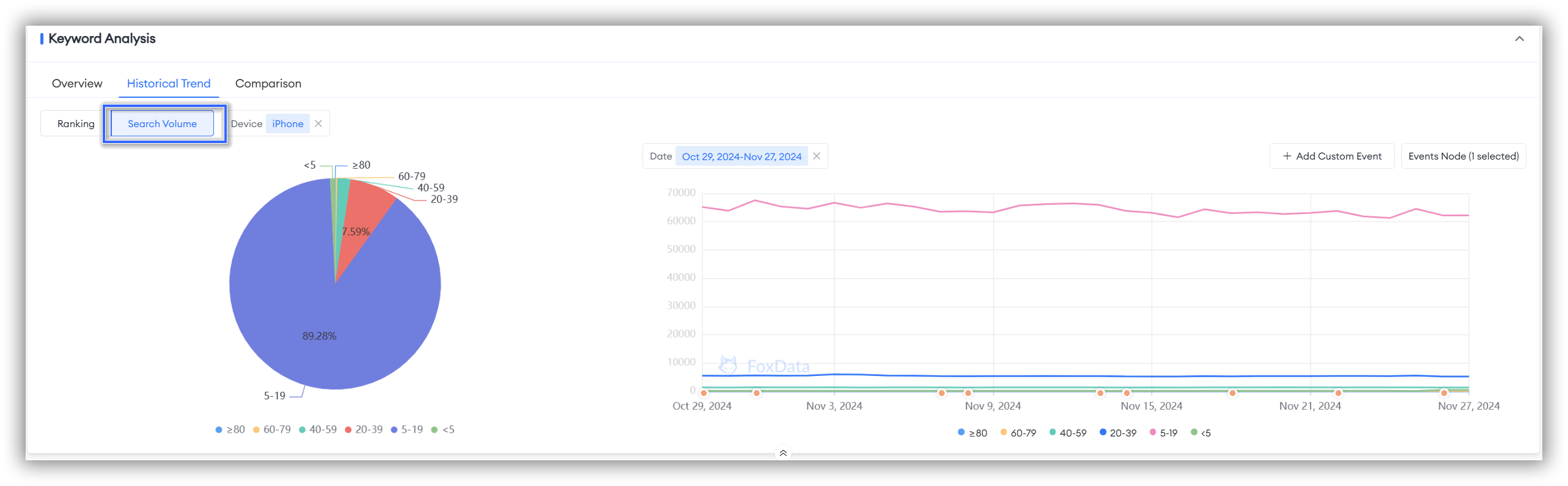
After selecting a specific time frame, FoxData provides visual pie charts and line graphs to present complex data in an intuitive manner, helping you understand and analyze keyword performance more quickly.
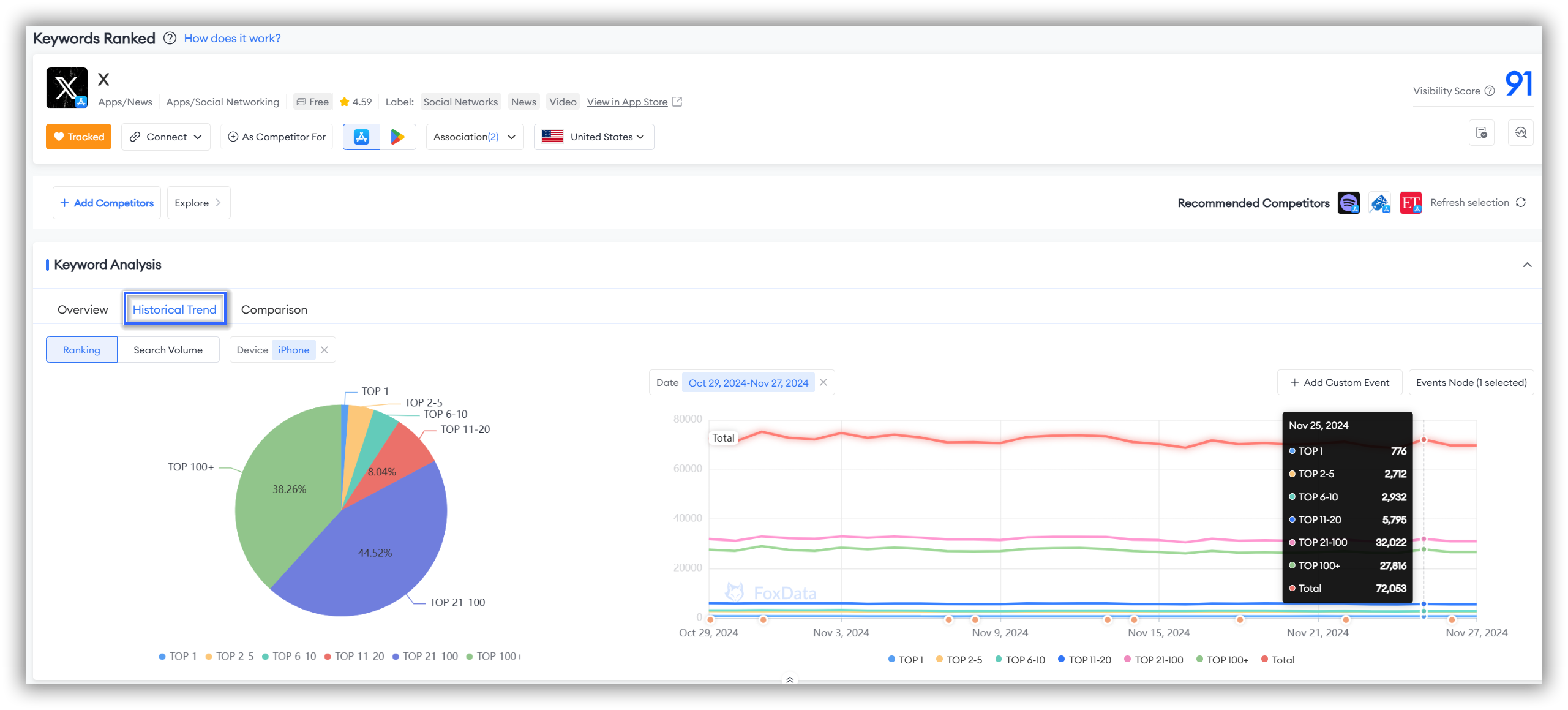
The "Historical Trend" section primarily offers data visualization support from two dimensions: "Ranking" and "Search Volume."
By default, the page initially displays the "Ranking" dimension. If you want to explore "Search Volume," simply click on "Search Volume" in the top left corner.
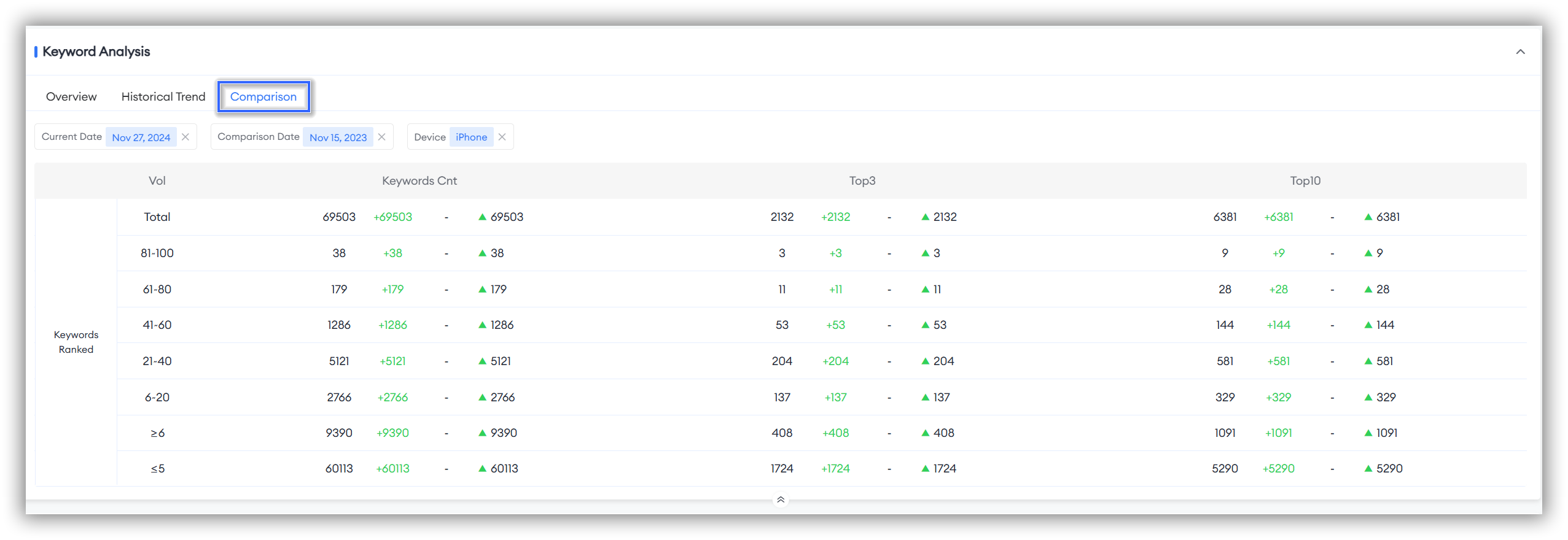
After examining the "Historical Trend," if you're interested in the keyword performance during a specific anomalous time period, don't forget to switch to the "Comparison" filter to view more detailed changes in keyword rankings.
This can help you better understand the changes in keyword rankings for the app you're tracking over different time periods and analyze the reasons behind these changes. By doing so, you can gain deeper insights to optimize related strategies or content.
Can I customize some filter options based on my own needs?
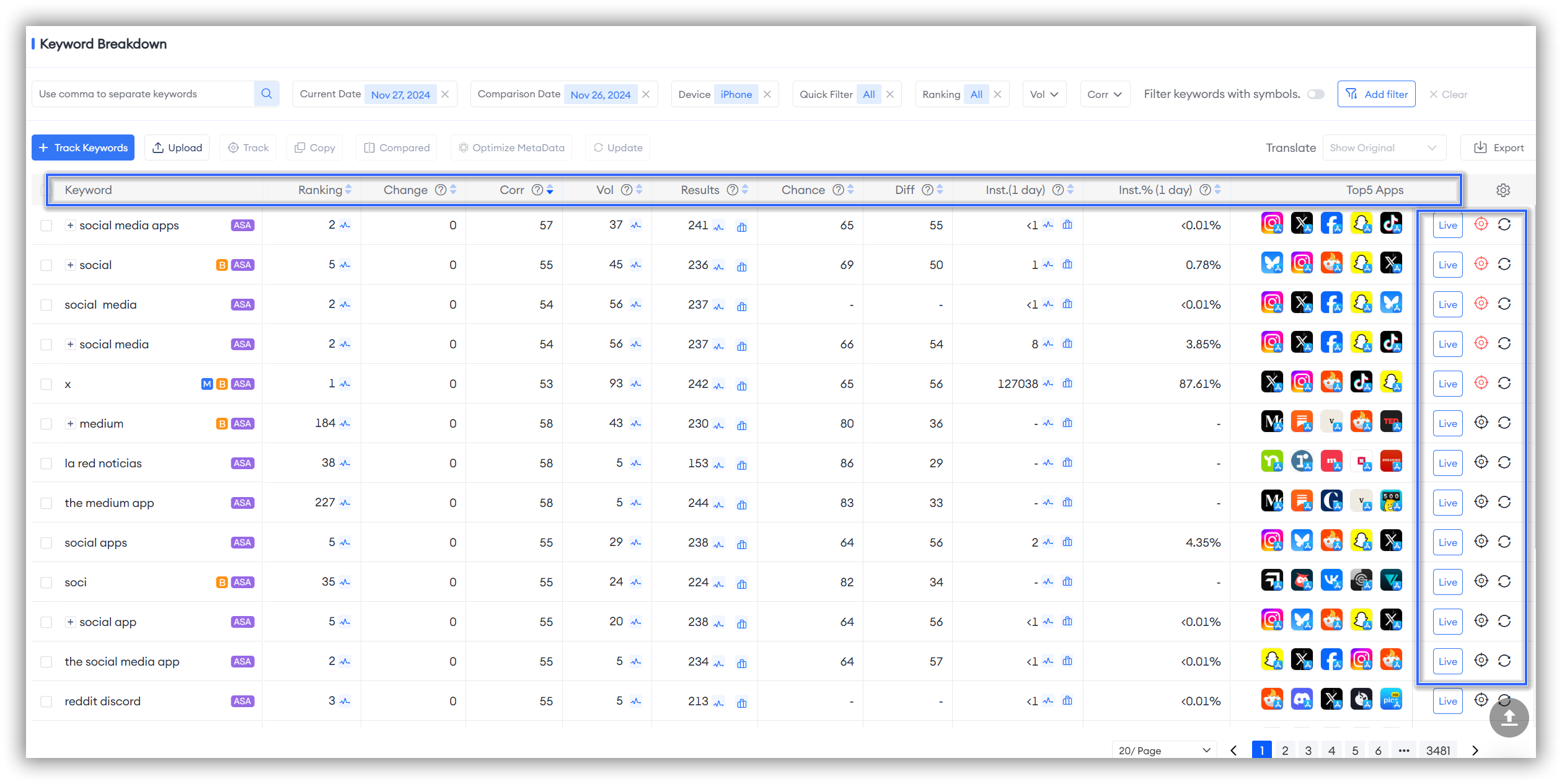
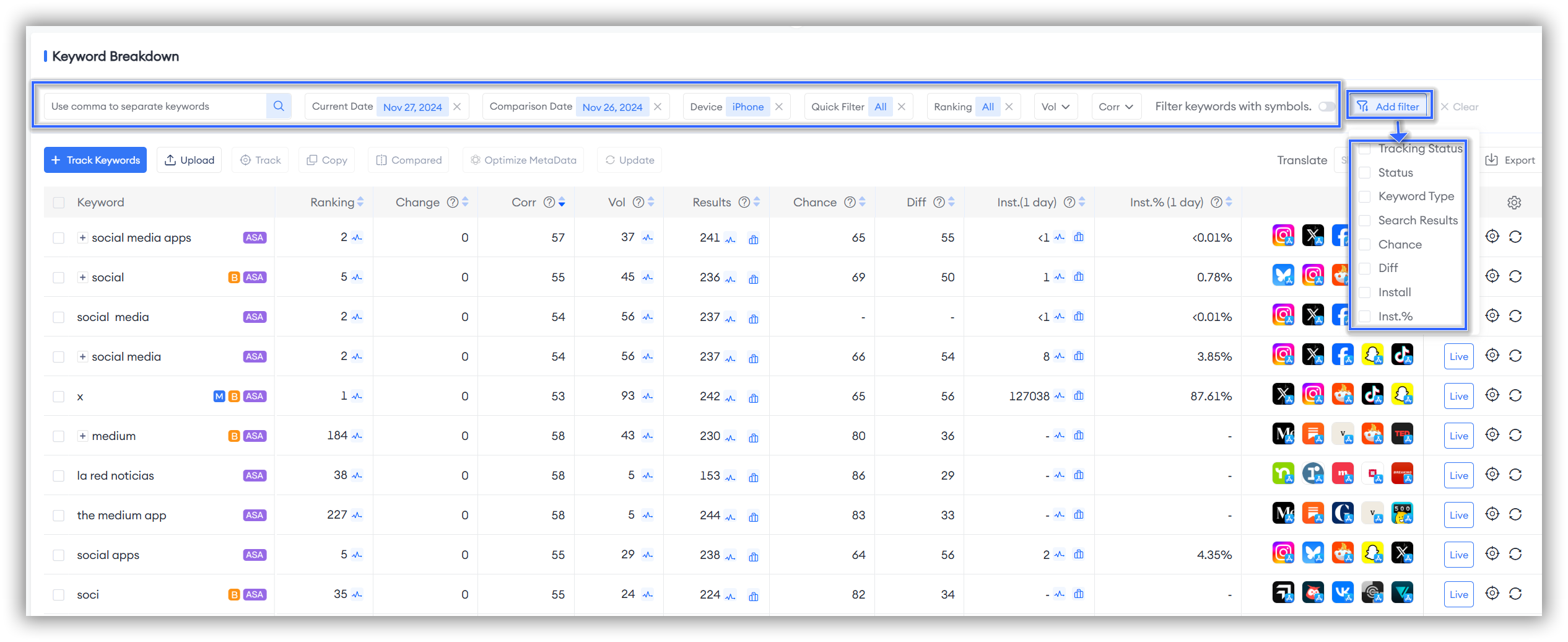
Of course! FoxDta allows you to conduct personalized keyword research by using "Use comma to separate keywords," filtering by "Date," filtering by "Device," filtering by "Quick Filter," filtering by "Ranking," and other dimensions listed below.
If you want to filter more keyword dimensions, don't forget to click "Add Filter" in the top left corner.
How can I manage or use these keywords?
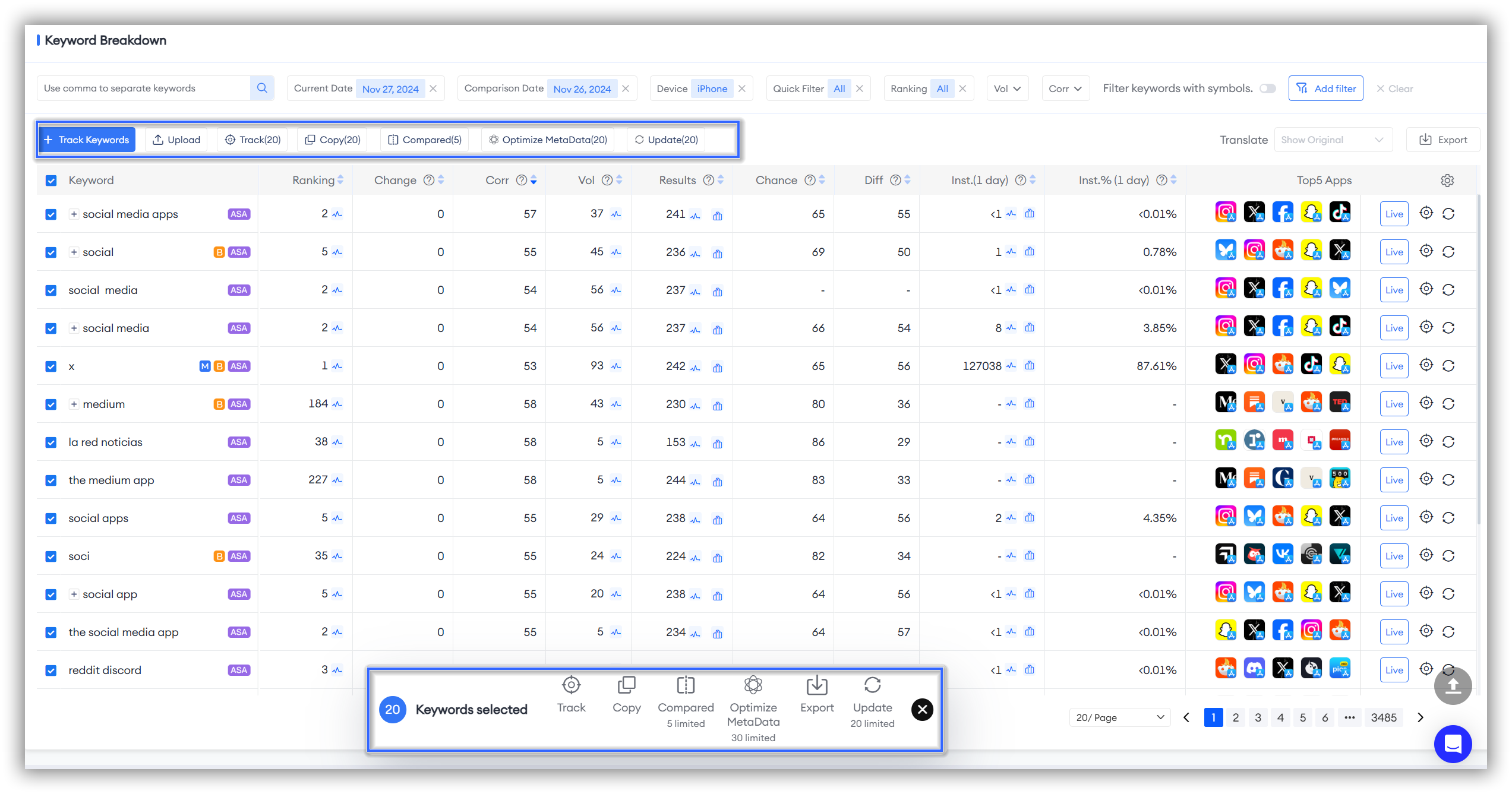
FoxData allows you to manage and use your selected keywords by clicking on several options available at the top or bottom, such as "Track," "Copy," "Compare," "Optimize Metadata," "Export," and "Update," after you've checked the keywords you're interested in.
Can I conduct competitor analysis directly in the "Keywords Ranked" section?
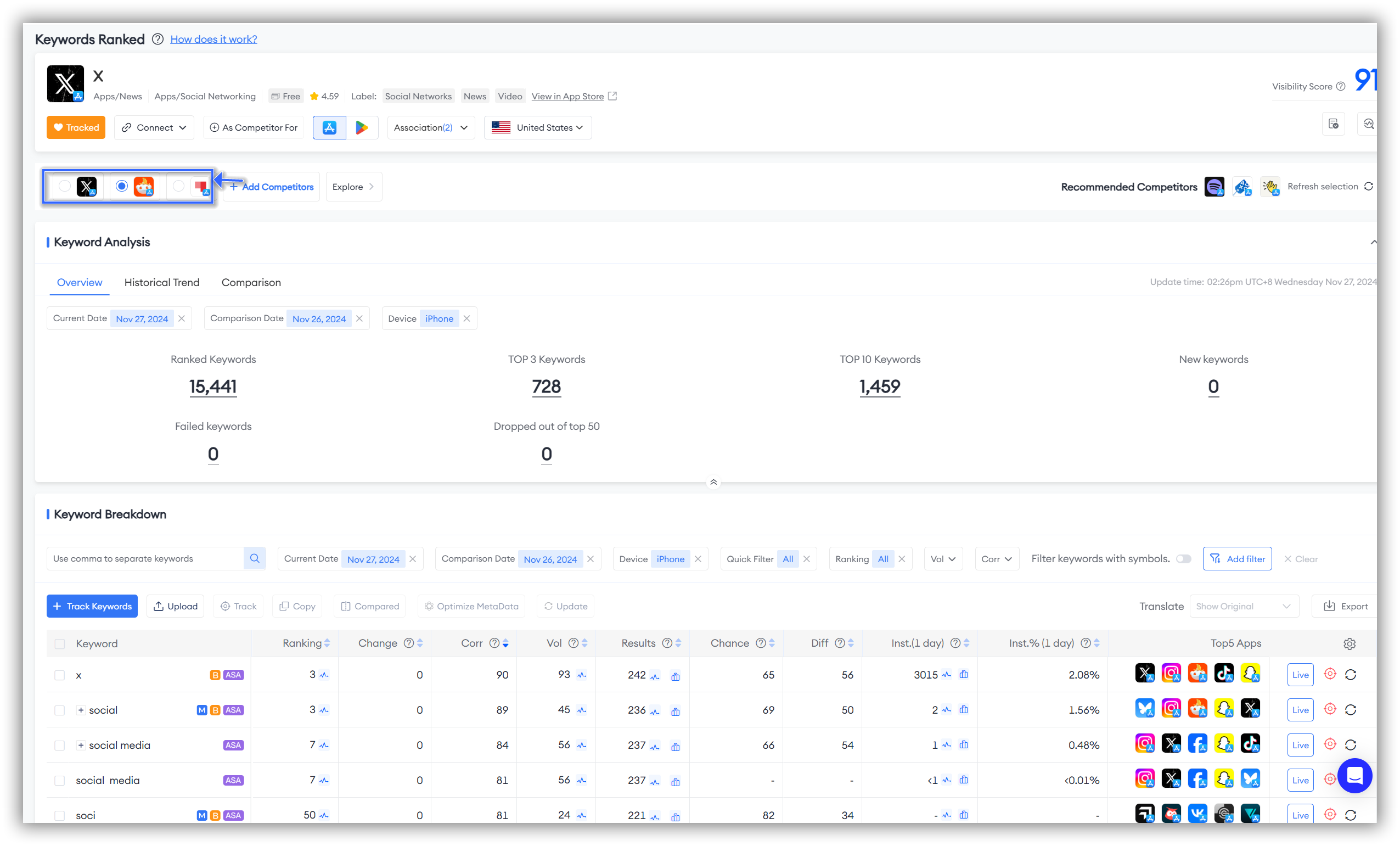
Yes, you can! FoxData allows you to perform keyword analysis on your competitors by clicking "+ Add Competitors" at the top left corner of the page.
In the "Ranked Keywords" section, you can select one competitor at a time to view the performance of your targeted keyword list under "Keywords Analysis" and "Keyword Breakdown" for that competitor.
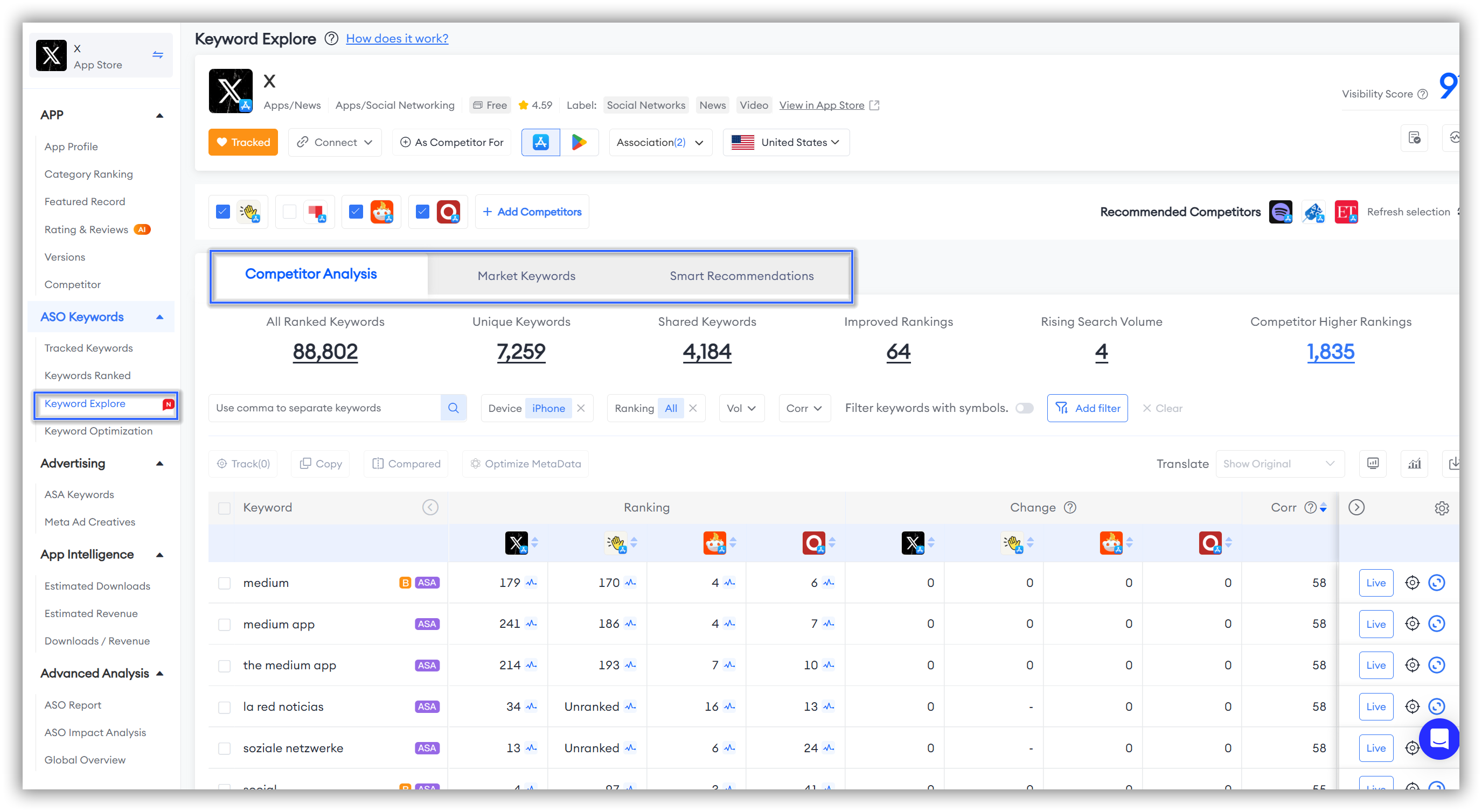
The first section displayed by default when you open the "Keywords Explore" feature is "Competitor Analysis."
You need to first add your competitors to conduct a competitive analysis.
"Competitor Analysis" will help you analyze your competitors' keyword strategies. By understanding the keywords used by your competitors, you can optimize your own keyword strategy.
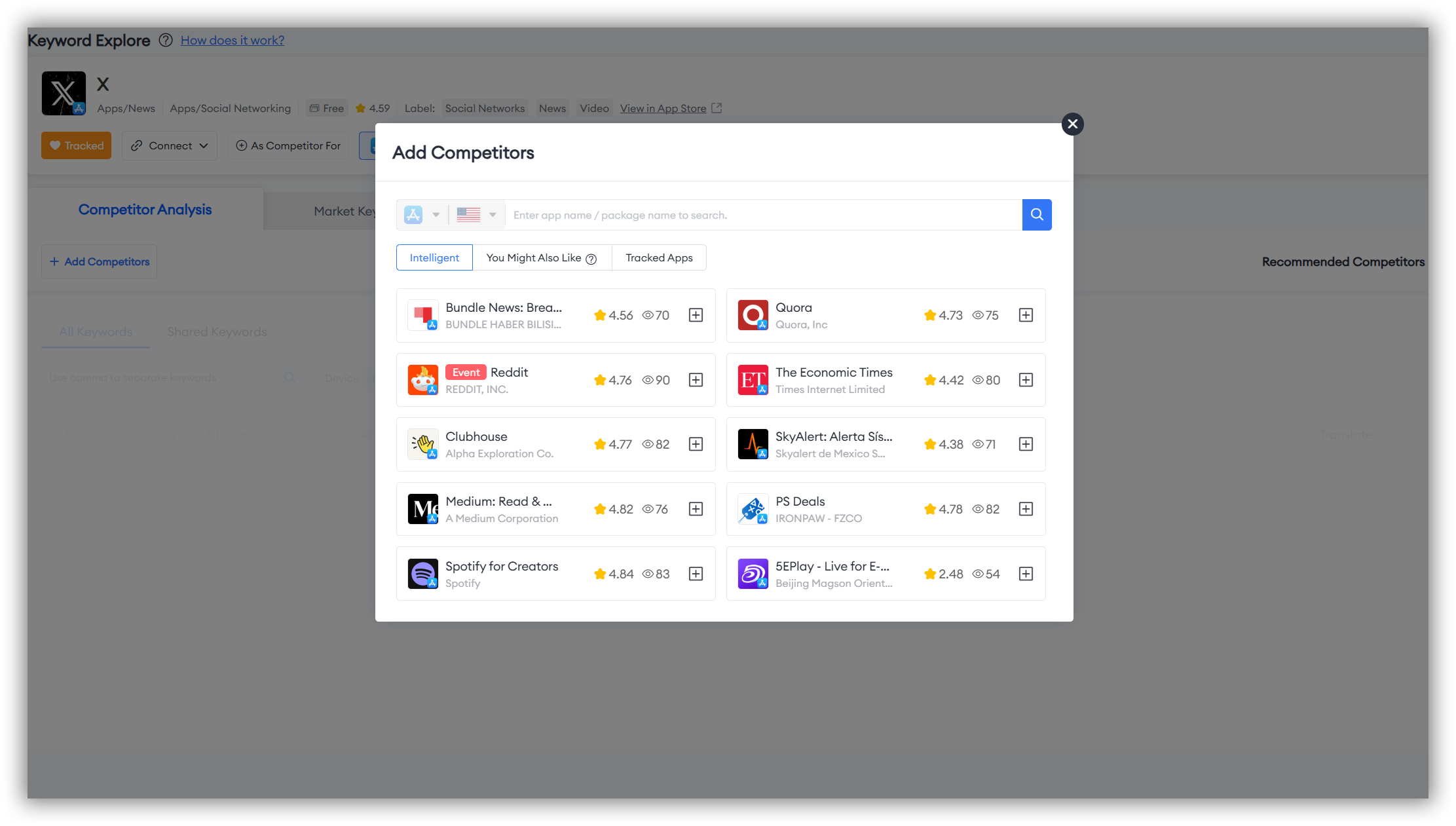
📒 Note: FoxData allows you to compare up to 4 competitors at a time.
The "Competitor Analysis" section includes six parts: "All Keywords," "Unique Keywords," "Shared Keywords,"Improved Rankings","Rising Search Volume", and "Competitor Higher Rankings".
📒Note: You can click on the "data" or "underline" of the data dimension you are interested in. After clicking, the keyword details below will automatically correspond to that data dimension, helping you find the appropriate keywords you want to learn more about.
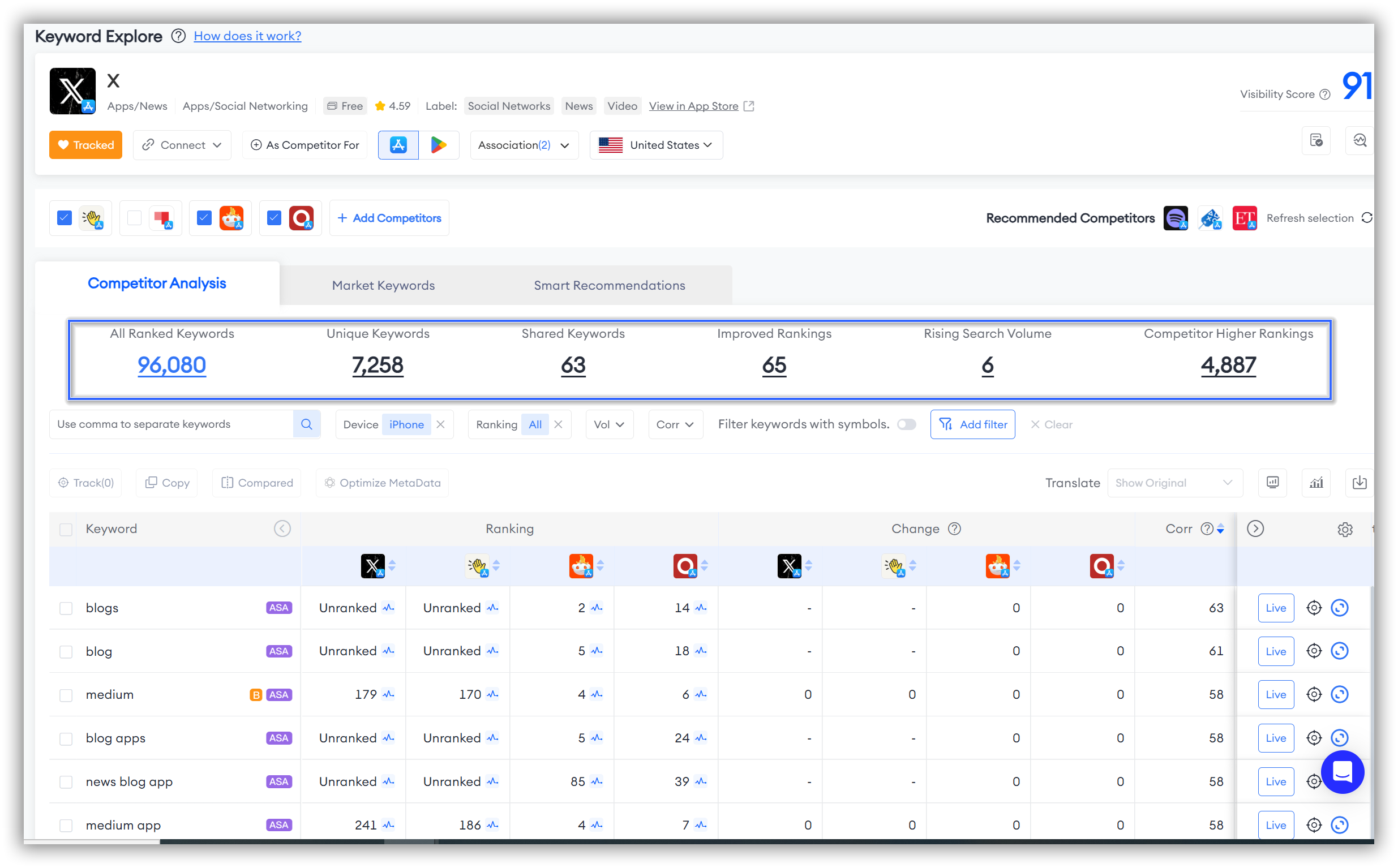
📒 Note: If you want to view keywords unique to your competitors, after choosing the Unique Keywords you can click on "View more competitors" at the top left corner and select the competitor you are interested in.
If you want to view keywords unique to yourself, click "Check my apps" below "View more competitors."
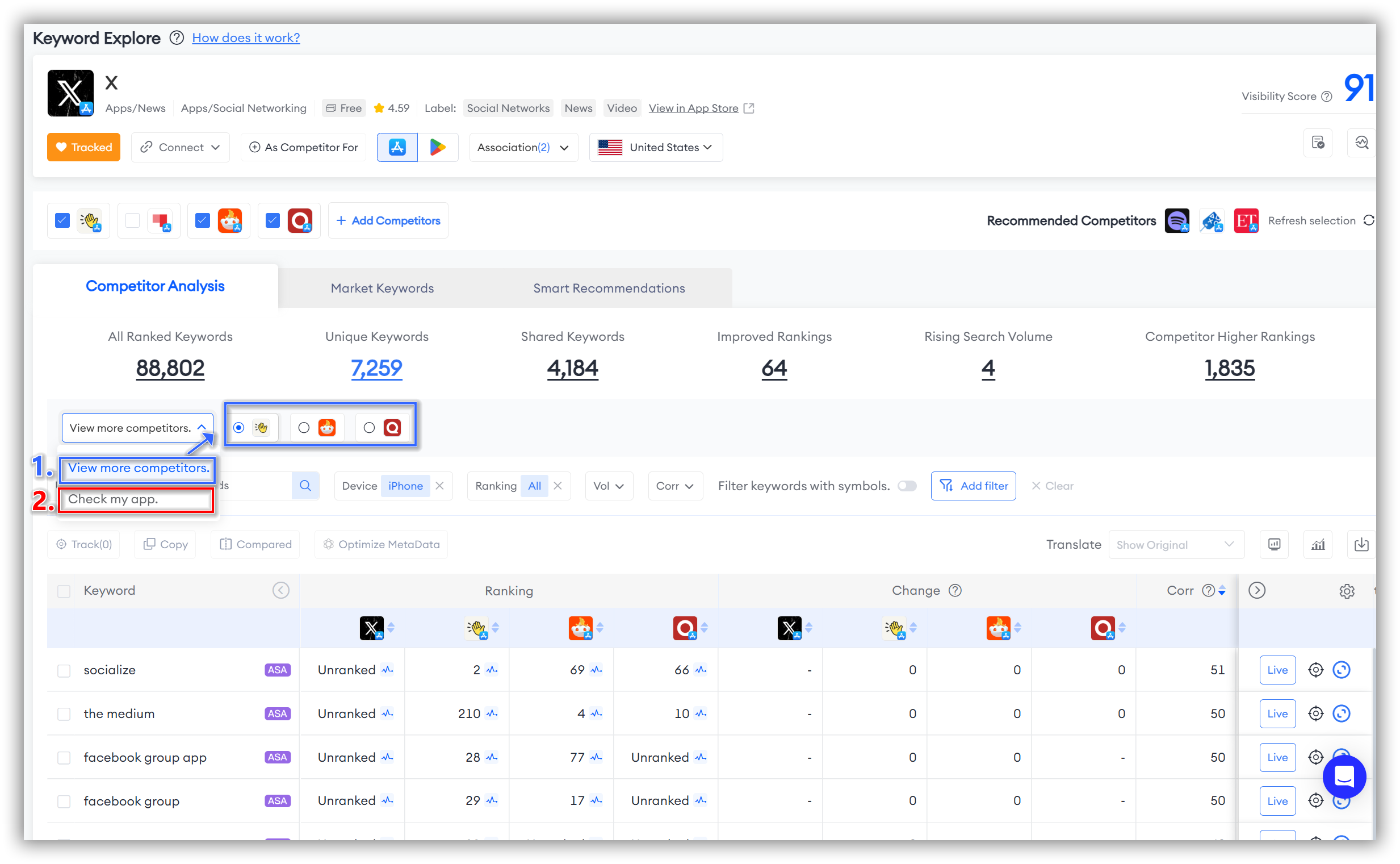
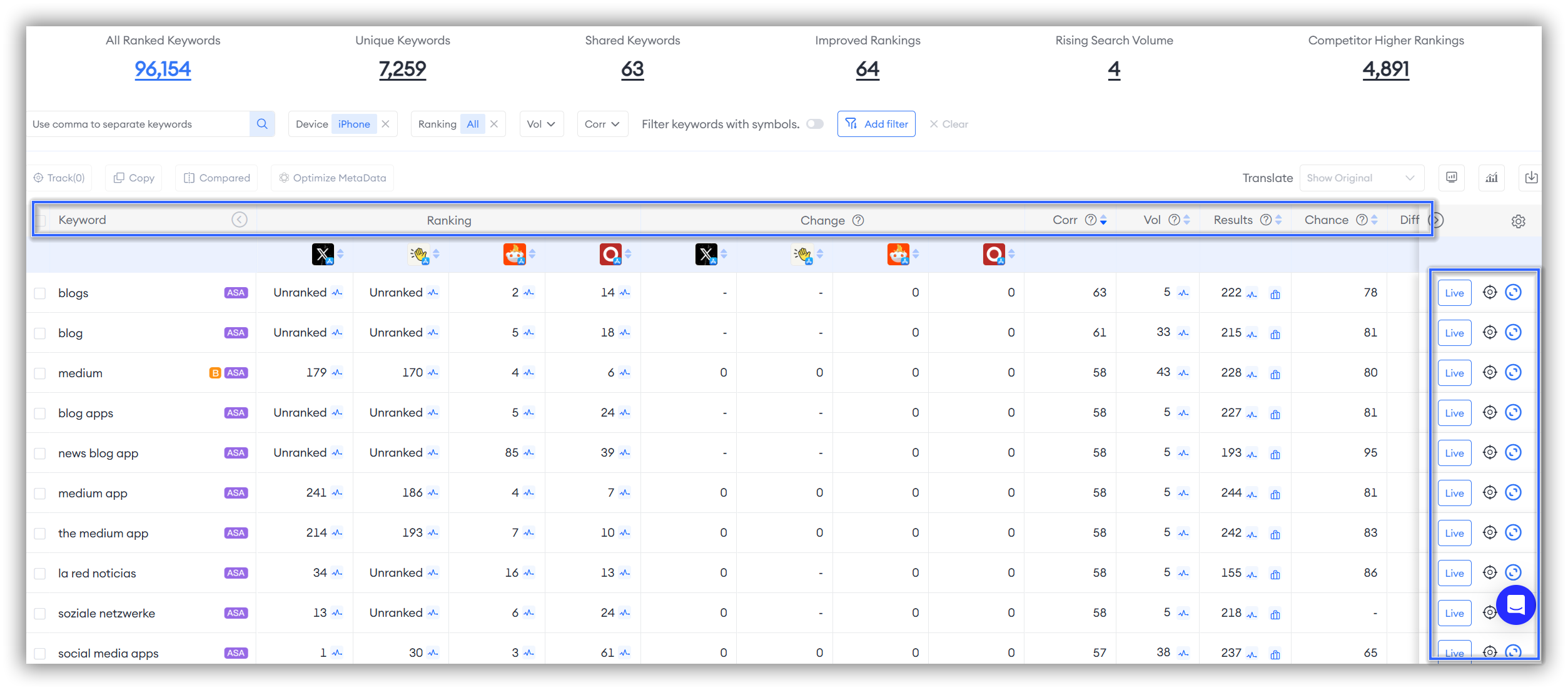
The"All Keywords," "Unique Keywords," "Shared Keywords,"Improved Rankings","Rising Search Volume", and "Competitor Higher Rankings" sections in "Competitor Analysis" display different keyword data, but they share consistent data dimensions.
All six sections allow you to analyze keywords from multiple dimensions: "Ranking," "Ranking Change," "Correlation," "Volume," "Results," "Chance," "Difficulty," "Installation," and "Top 3 Apps."
📒 Note: If you're unclear about the definition of any dimension, check the "?" icon next to each dimension's text for an explanation.
In addition to these dimensions, FoxData allows you to click the "Live" icon in the last column of each keyword to view "Live Search Insights." This feature helps you better understand the real-time value of keywords in the app market.
You can also click the "target" icon to track or cancel tracking of keywords.
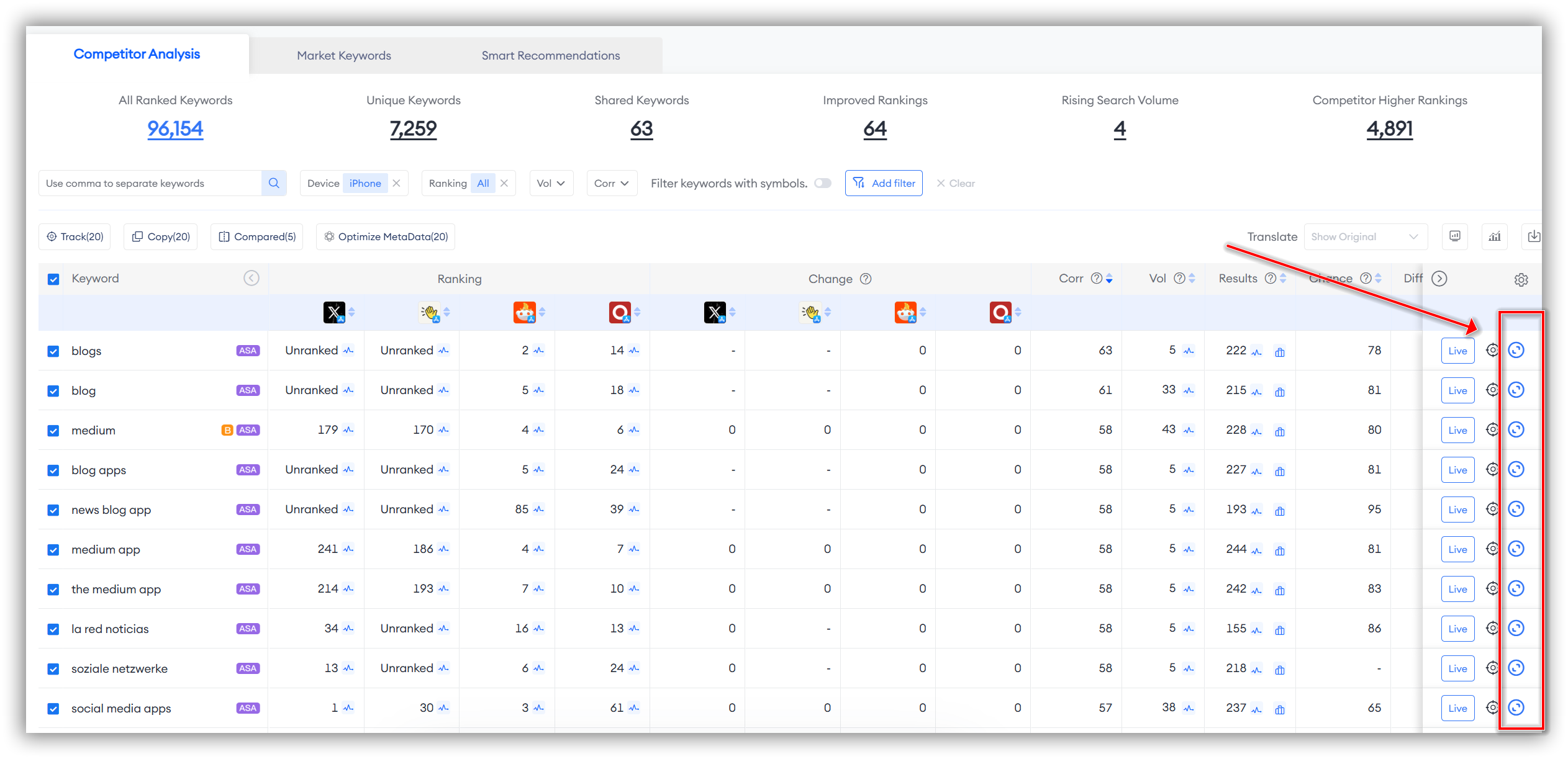
Notably, "Competitor Analysis" has a unique blue icon in the last column of keywords. Clicking it will take you to "Market Keywords" for suggestions based on the searched keywords.
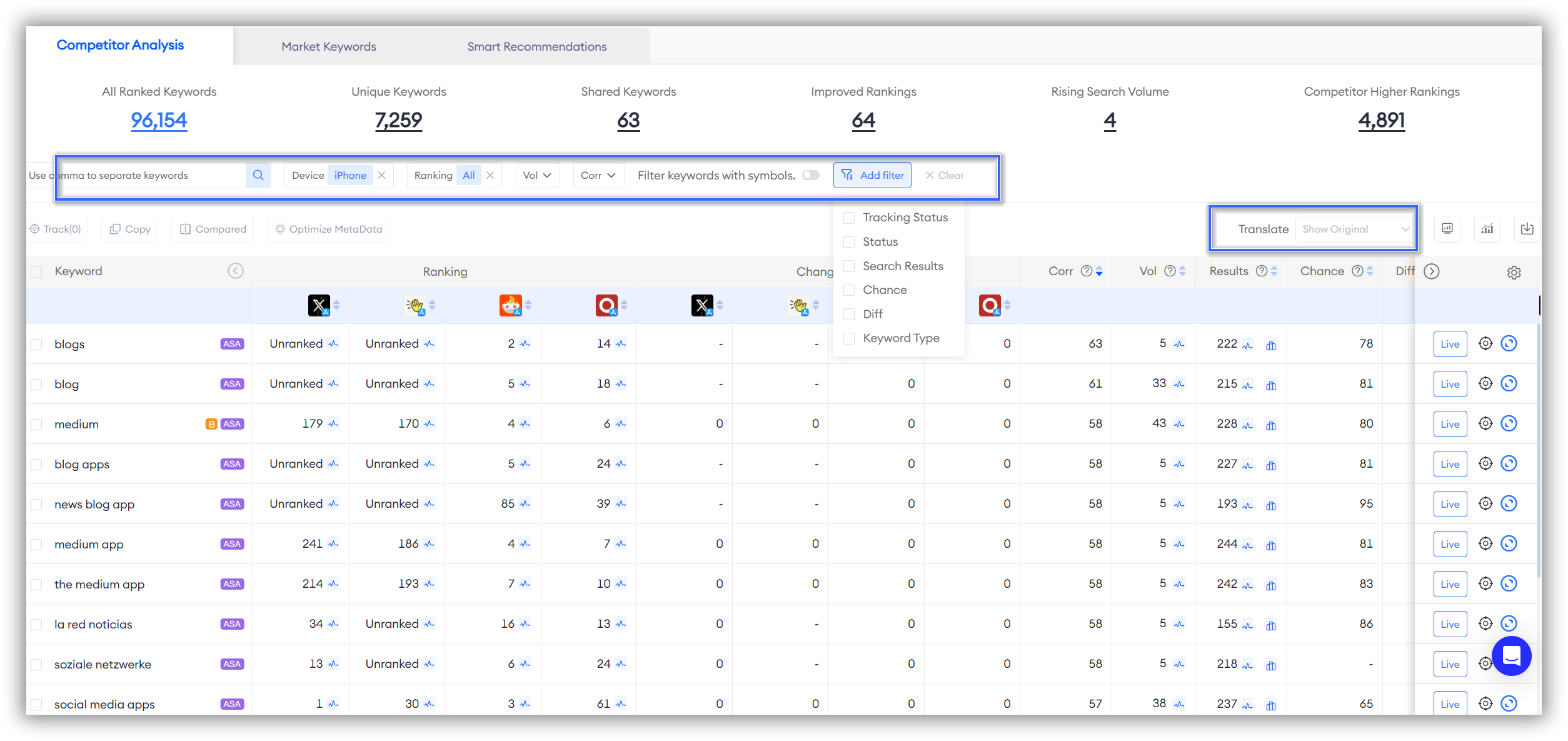
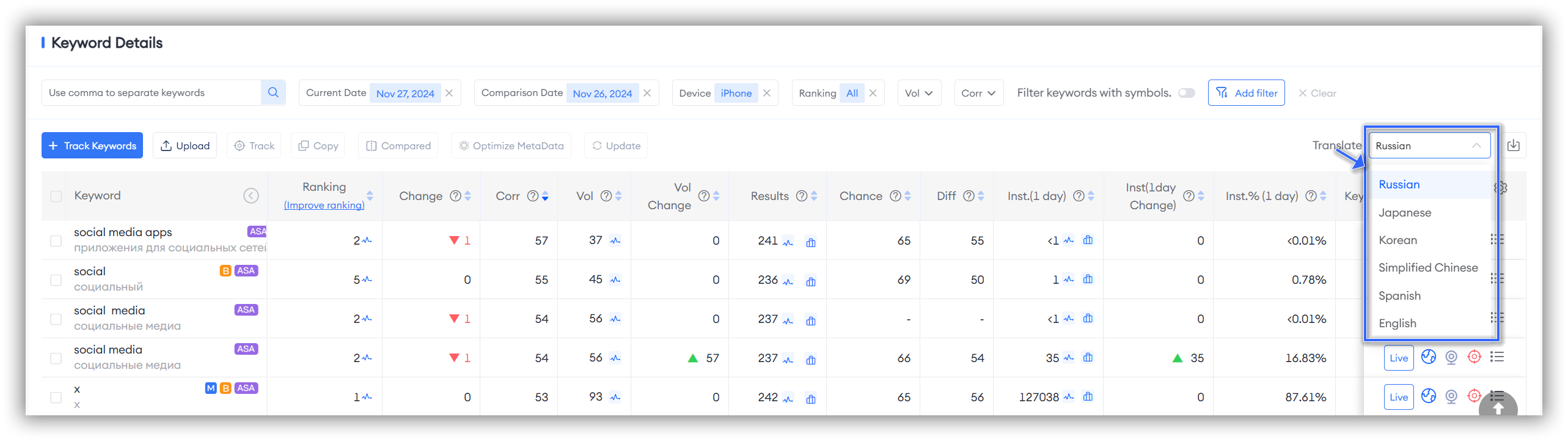
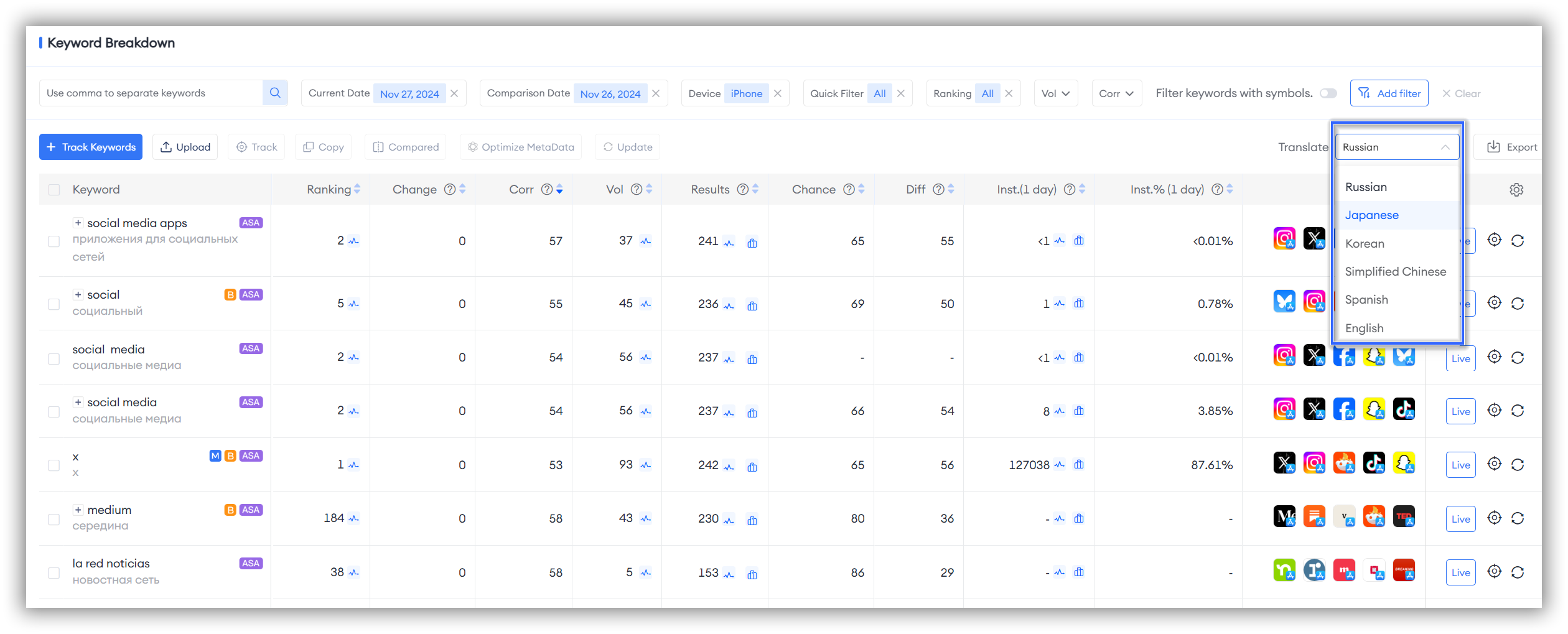
When you encounter unfamiliar languages during keyword research, FoxData allows you to click the "Translate" button in the top right corner to translate all keywords in the "Keywords Detail" section.
Currently, FoxData supports translations in six languages: Russian, Japanese, Korean, Simplified Chinese, Spanish, and English.
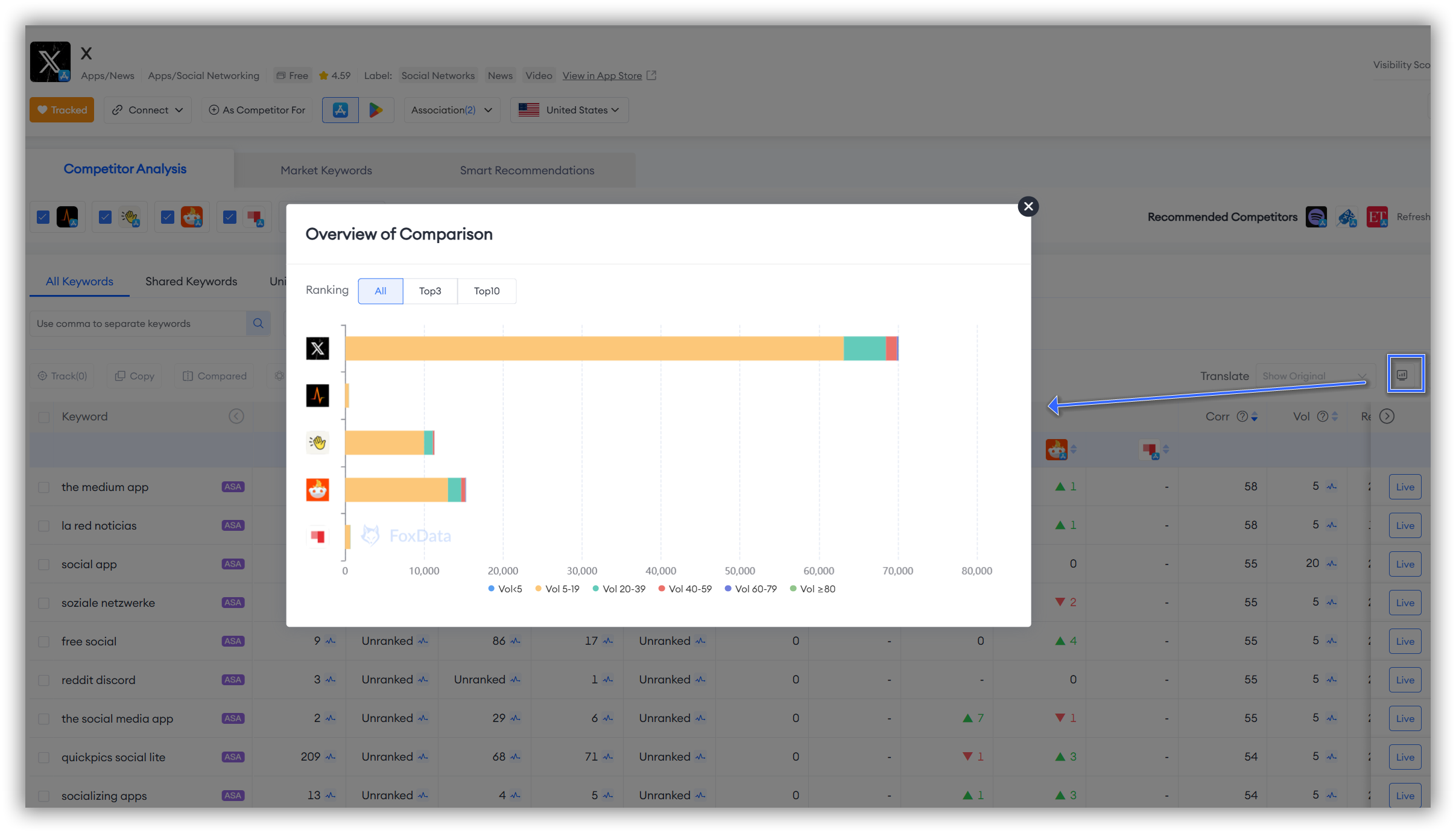
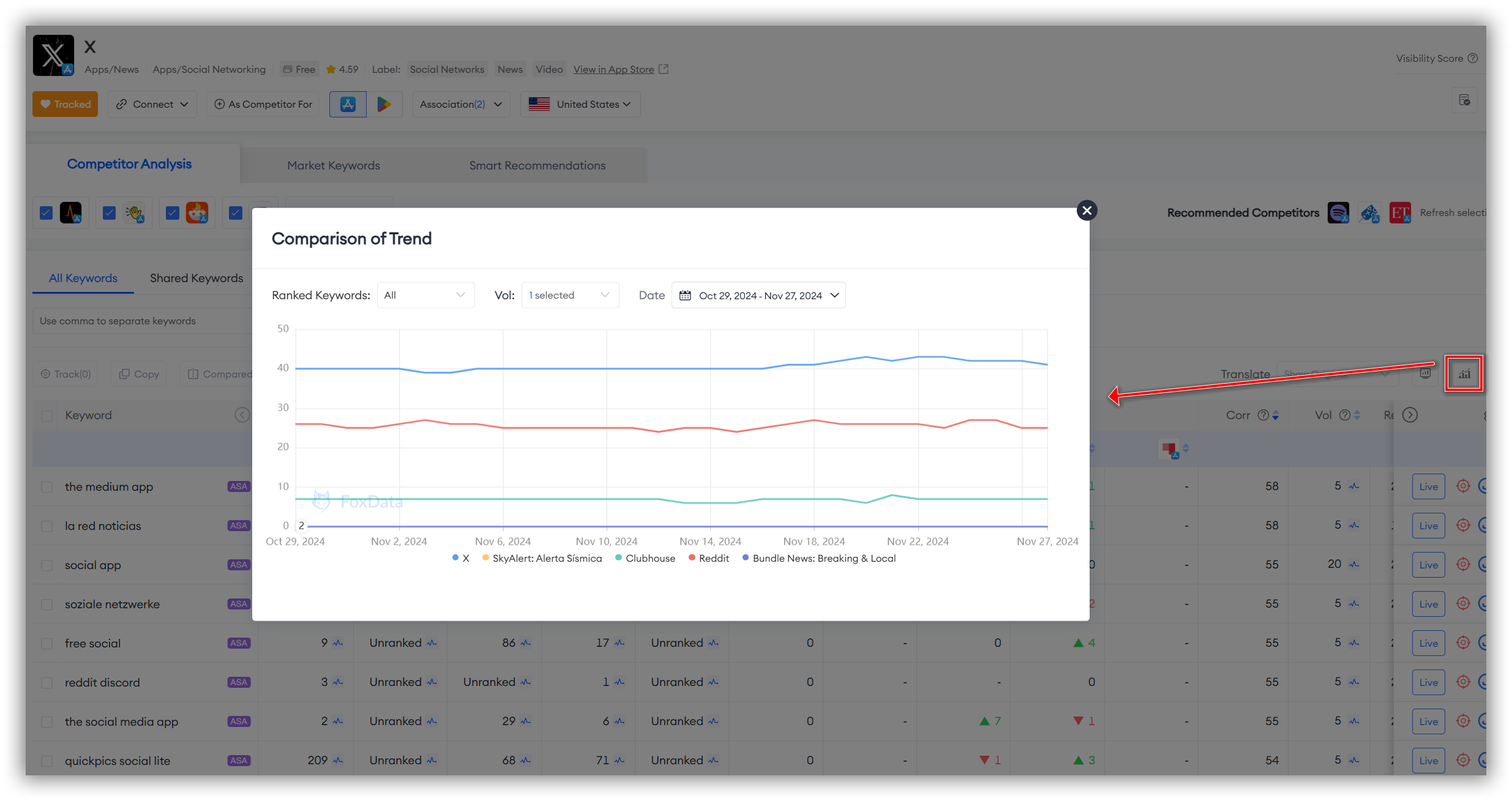
Is there a related competitor keyword comparison chart in "Competitor Analysis"?
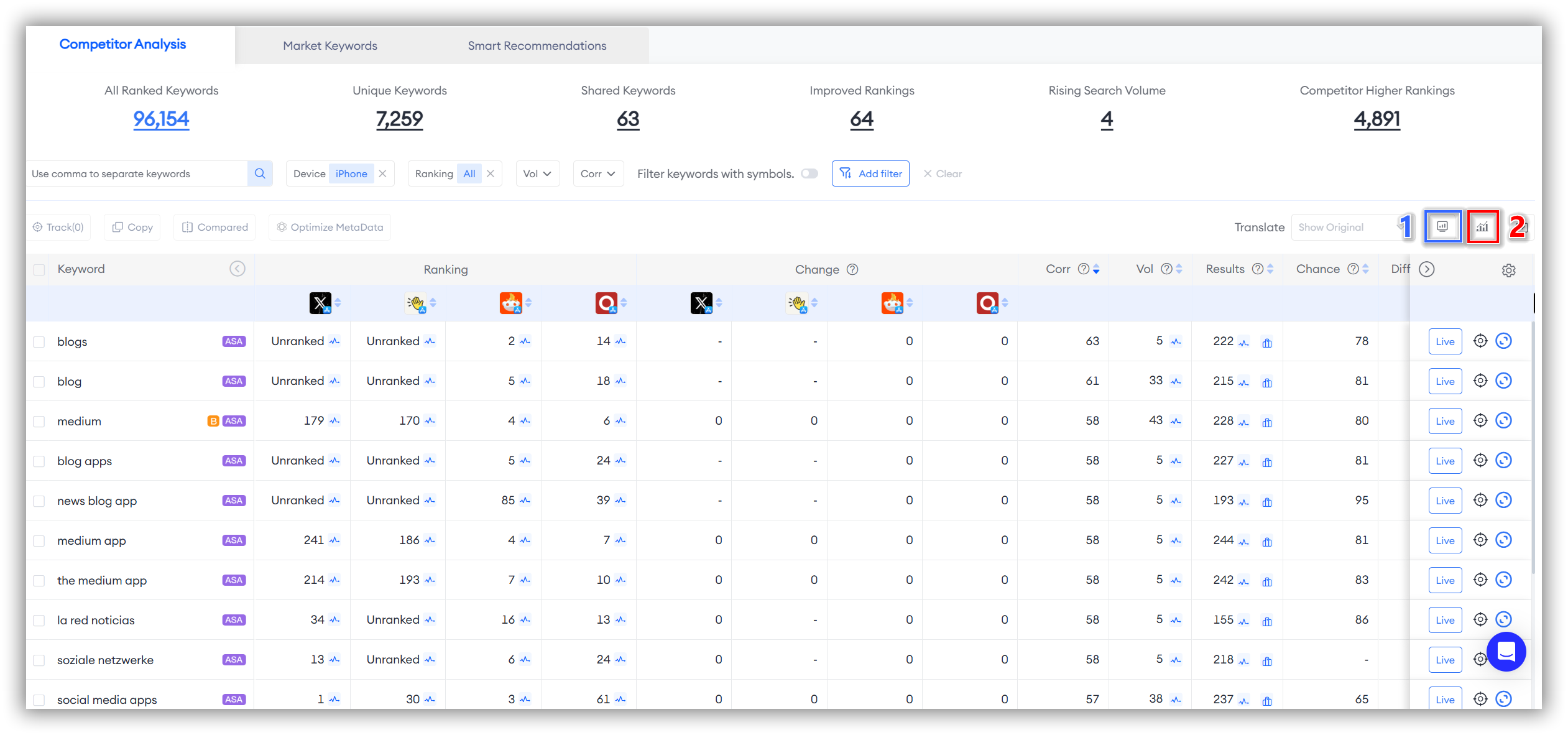
Yes, there is! Have you noticed the two chart icons right after the "Translation" button in the top right corner?
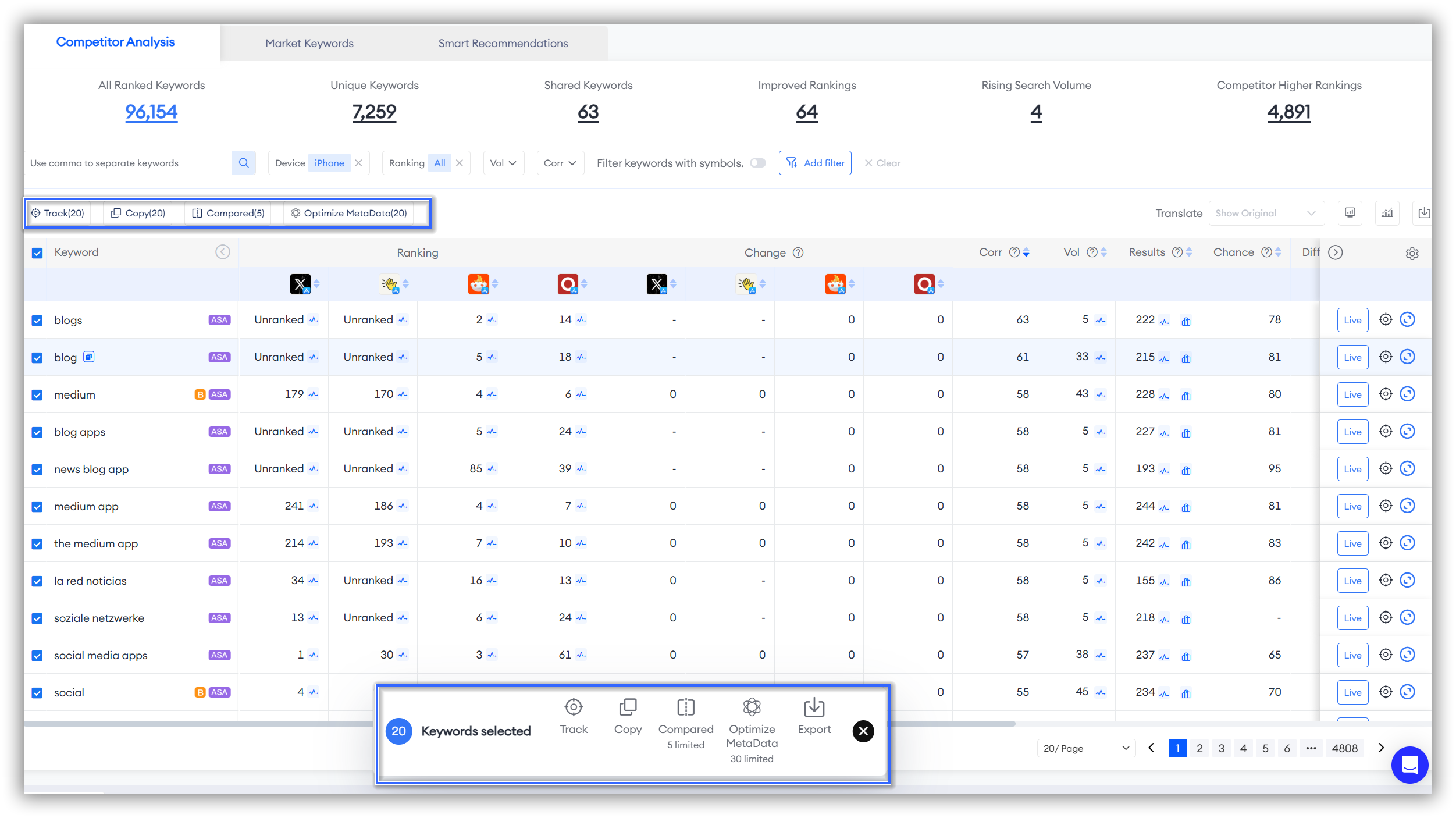
How can I manage or use these keywords?
FoxData allows you to manage and use your selected keywords by clicking on various options like "Track," "Copy," "Compare," "Optimize Metadata," "Export," and "Update" after selecting the keywords you're interested in. This enables personalized keyword usage and management.
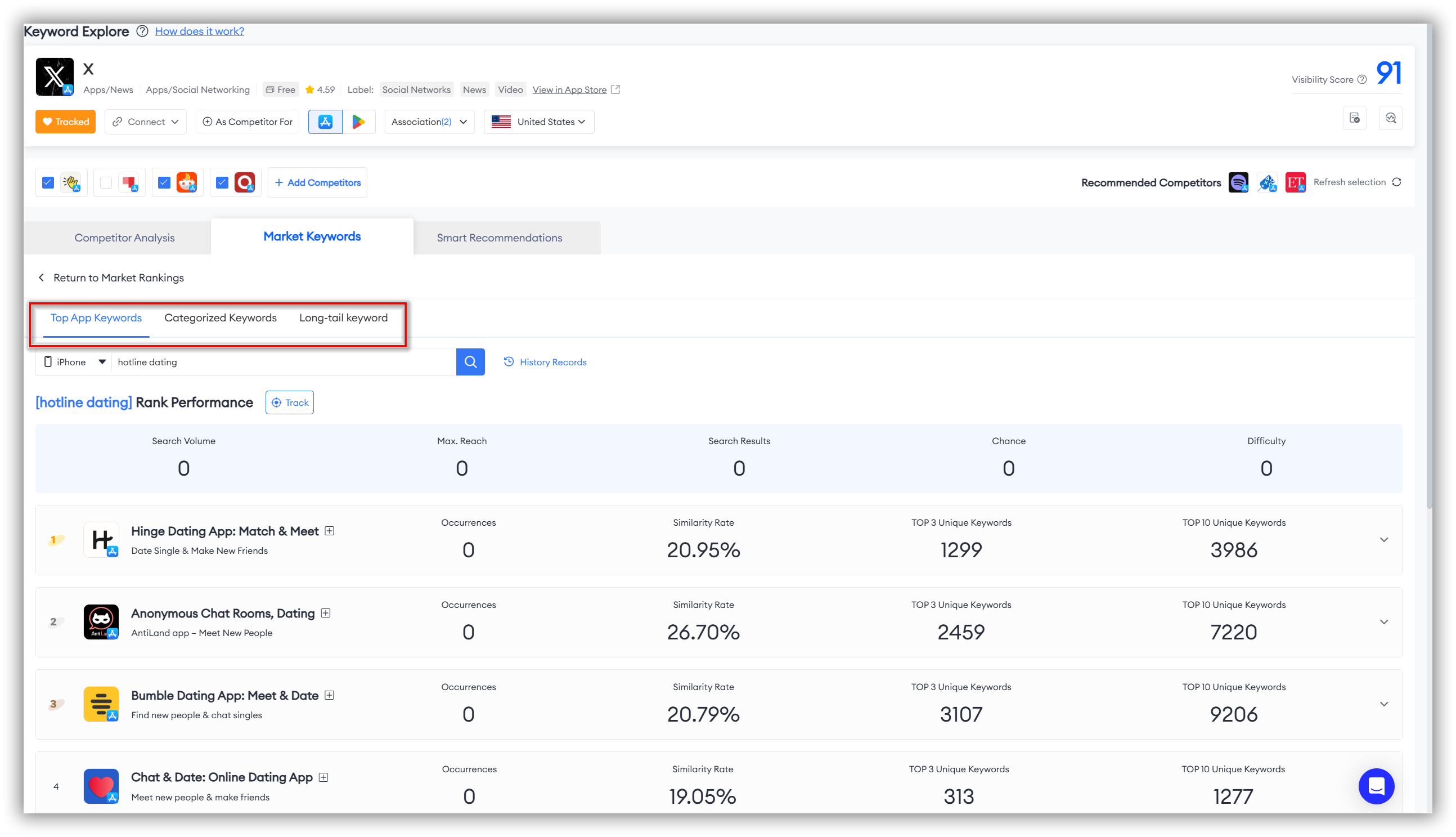
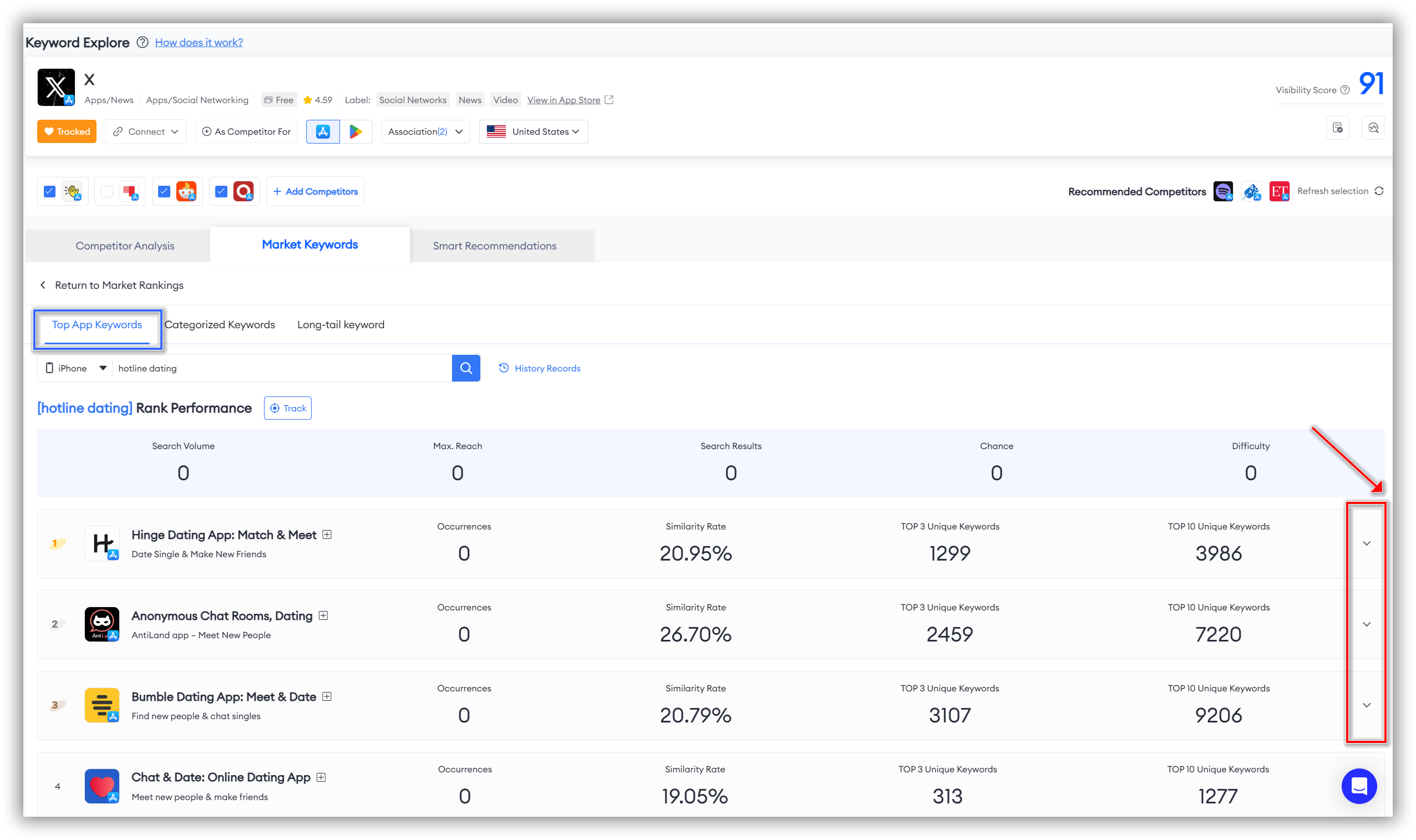
The second section of the "Keyword Explore" feature is "Market Keywords," which will help you gain more keyword suggestions to optimize your ASO keyword strategy.
You have two ways to use the "Market Keywords" section:
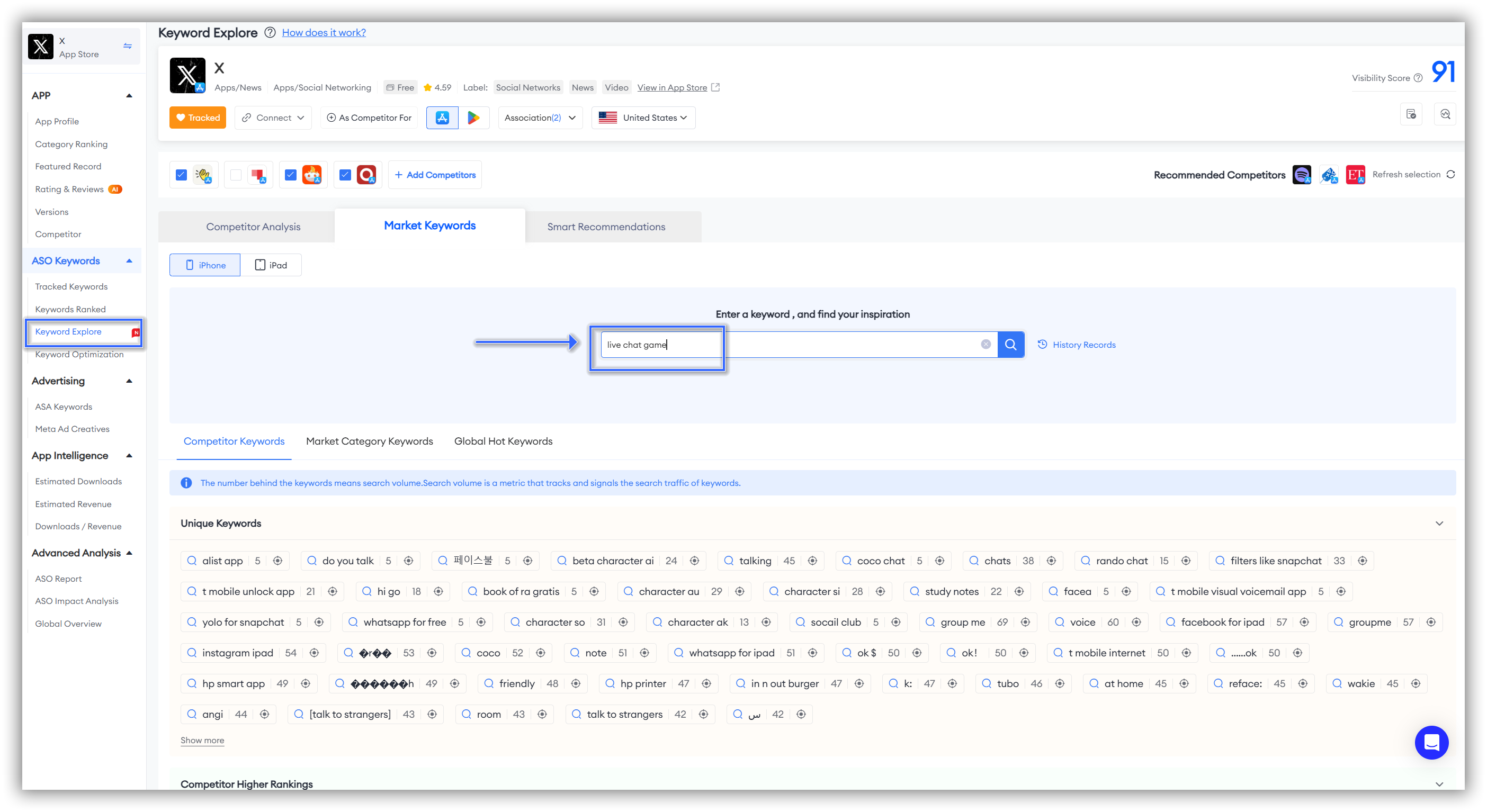
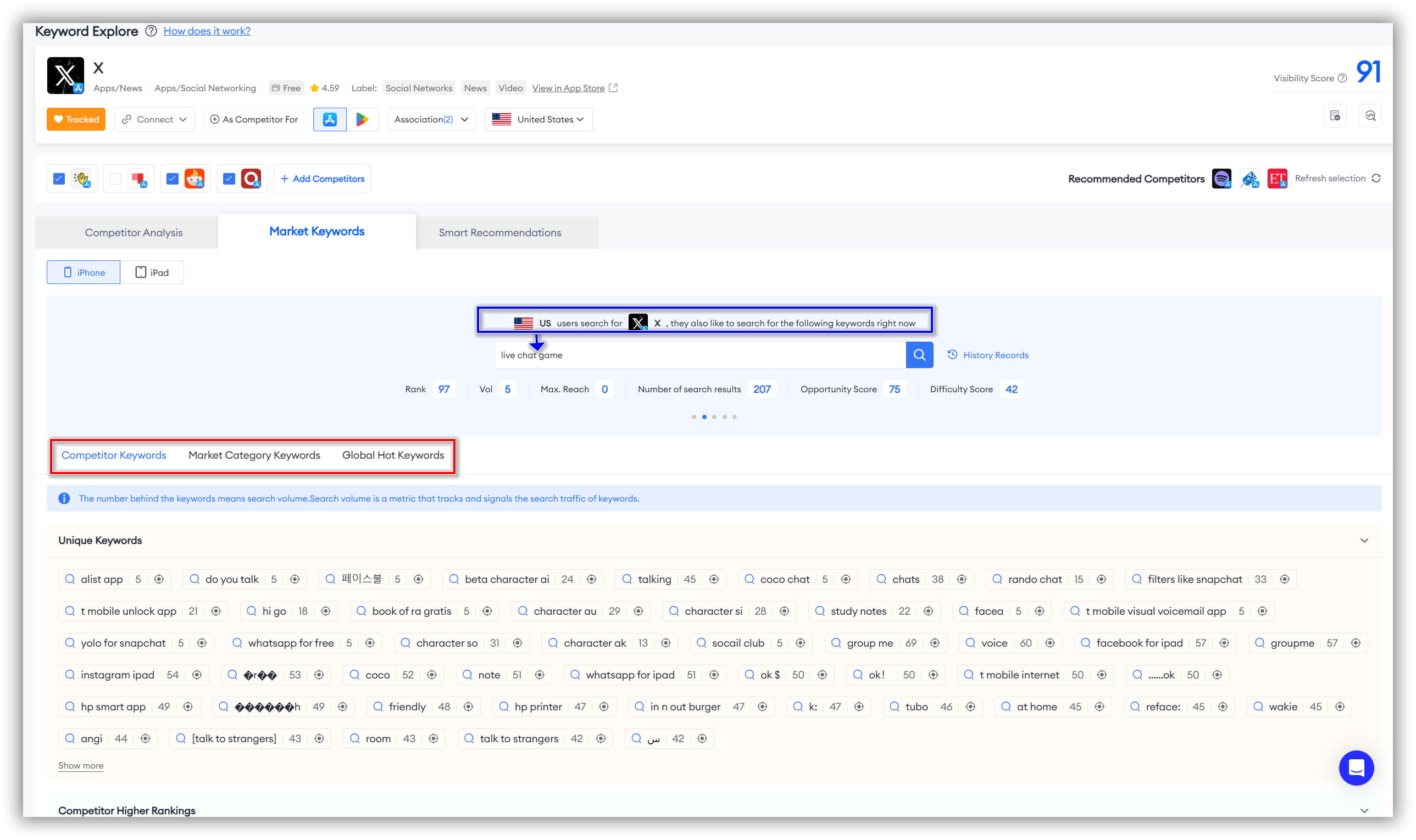
👏 Expert Tips: When using "Top Keywords," we recommend selecting "Compare with my apps" simultaneously. This will help you more comprehensively filter and evaluate high-frequency keywords.
You may discover important keywords that are missing from your app's keyword strategy but have potential value for your app. This insight allows you to adjust and optimize your keyword strategy effectively.
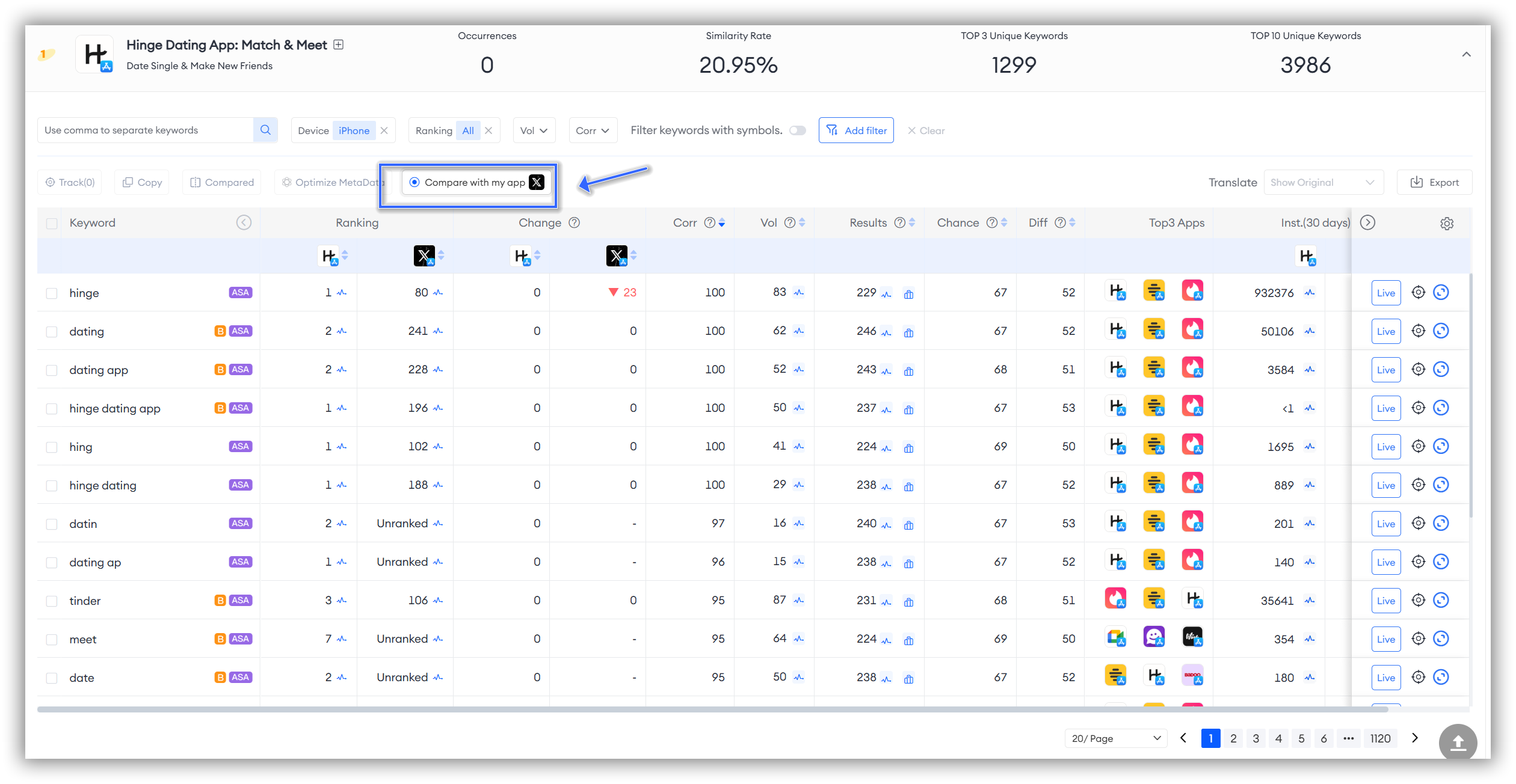
"Top Keywords" supports analyzing keywords from multiple dimensions, including "Ranking," "Ranking Change," "Correlation," "Volume," "Results," "Chance," "Difficulty," "Top 3 Apps," and "Installation."
📒 Note: If you are unclear about the definition of any dimension, please check the "?" icon next to the text of each dimension. It will explain the definition of each dimension.
In addition to the above dimensions, FoxData also allows you to click the "Live" icon in the last column of the keyword to view each keyword's "Live Search Insights." This will help you better understand its real-time value in the app market.
You can also click the "target" icon to track or cancel a keyword.
Notably, "Competitor Analysis" has a unique blue icon in the last column of the keywords. Clicking it allows you to further explore suggestions based on the keywords searched.
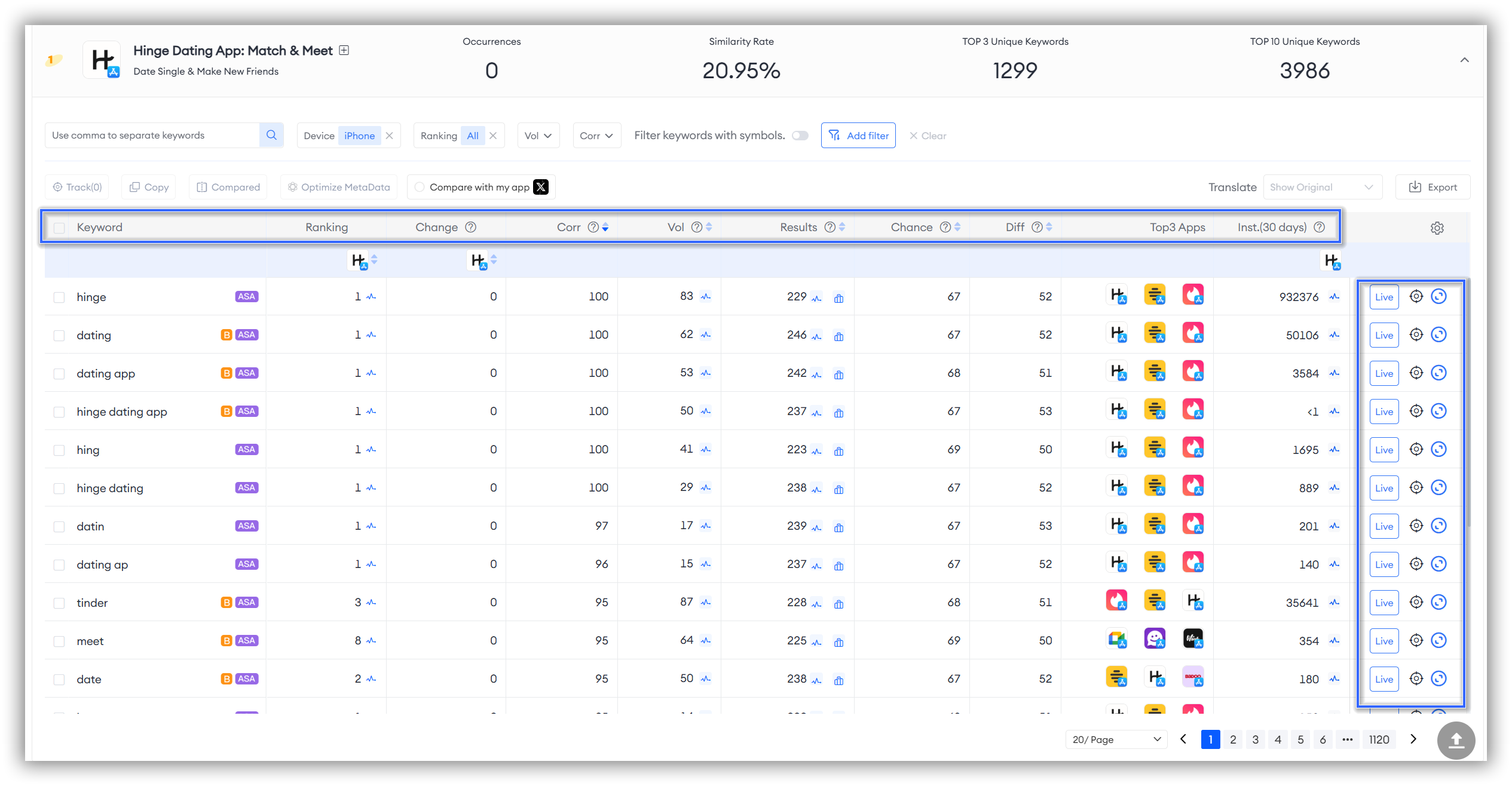
Can I customize some filter options according to my needs?
Of course you can! FoxDta allows you to personalize your keyword research by using options like "Use comma to separate keywords", filtering by "Date", "Device", "Ranking", and other dimensions listed below.
If you want to filter by more keyword dimensions, don't forget to click "Add Filter" in the top left corner.
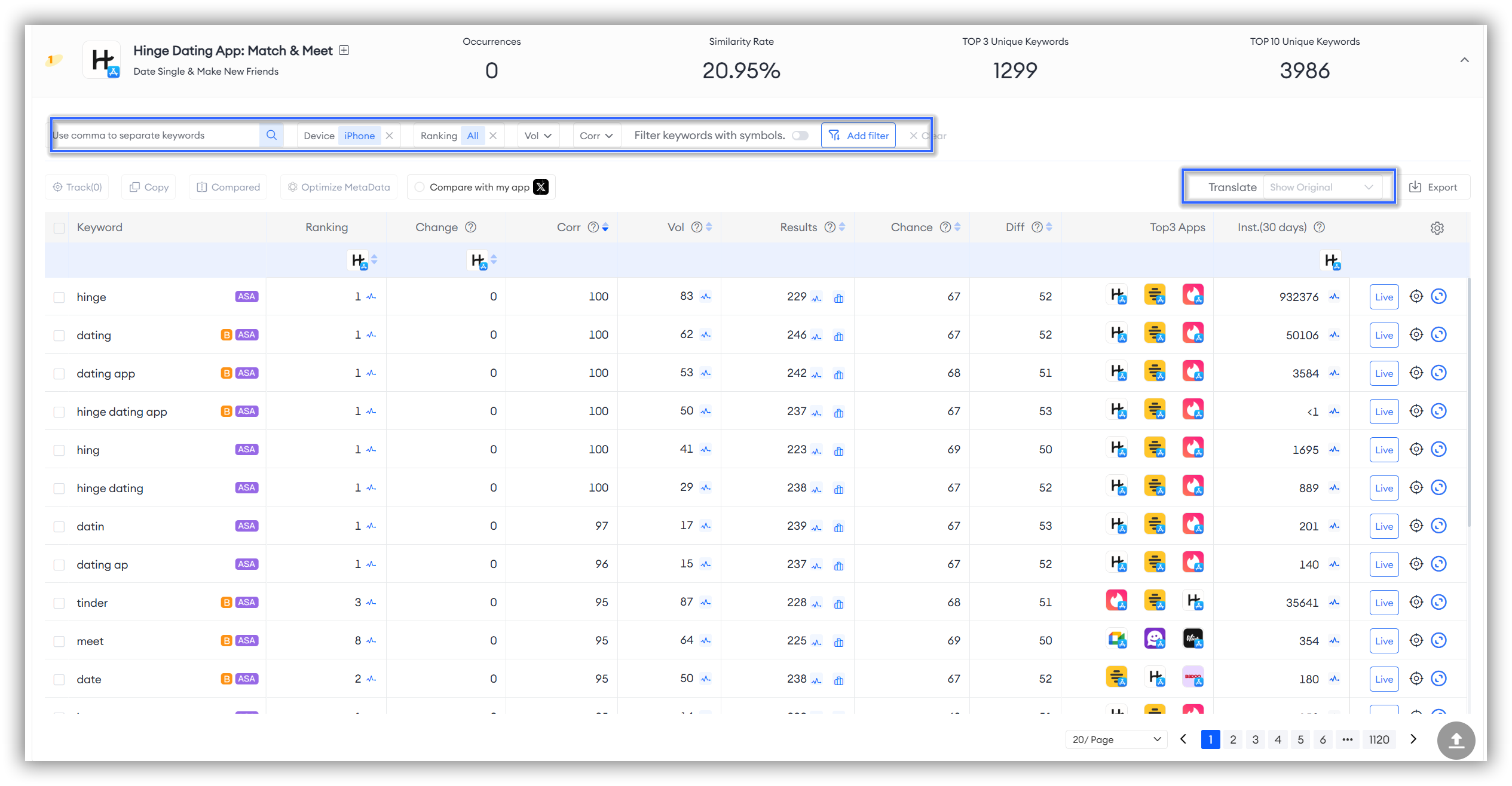
When you encounter unfamiliar languages during keyword research, FoxData also supports translating all keywords in the "Keywords Detail" section by clicking "Translate" in the top right corner.
Currently, FoxData offers translations in six languages: Russian, Japanese, Korean, Simplified Chinese, Spanish, and English.
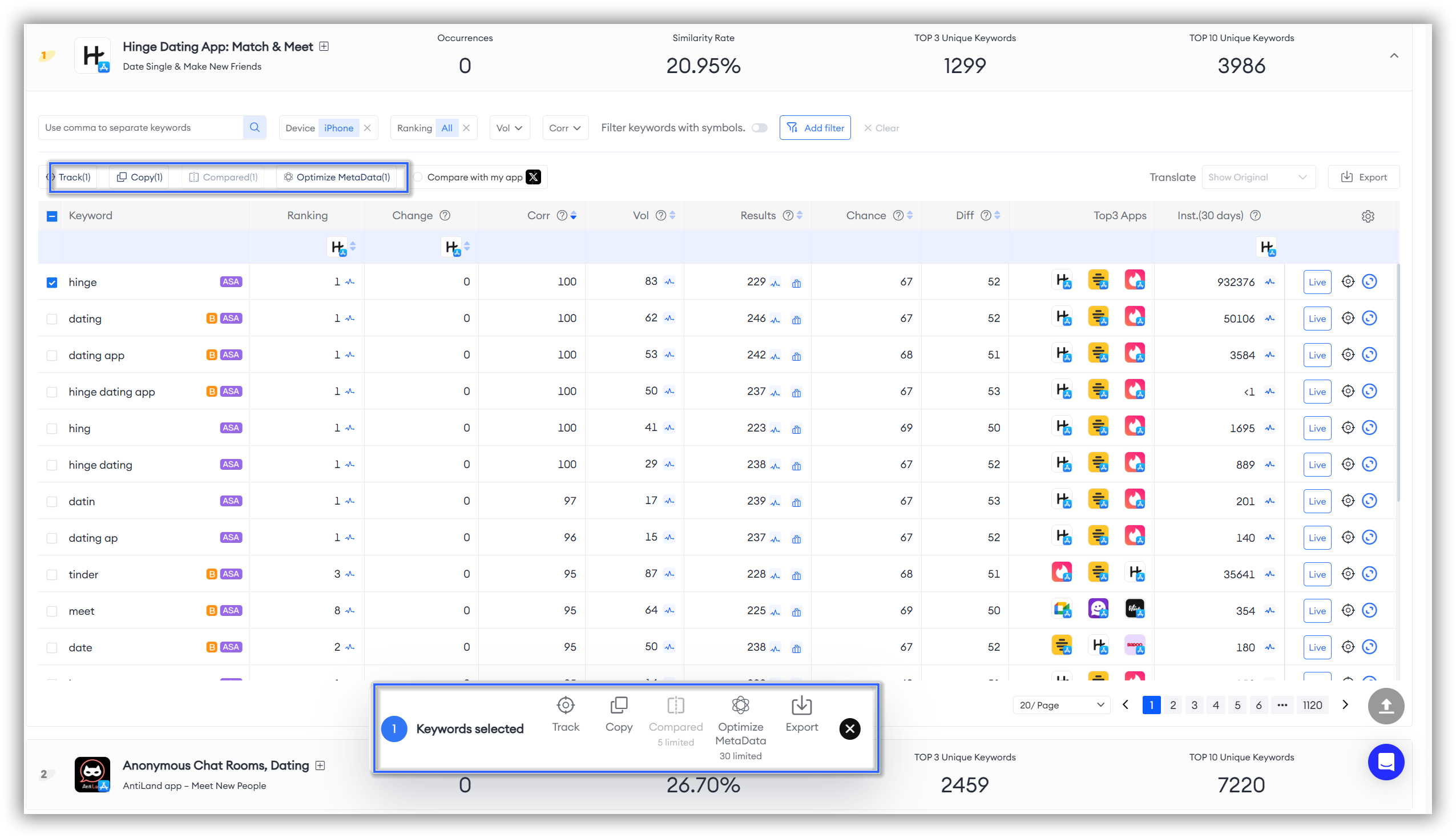
How can I manage or use these keywords?
After selecting the keywords you are interested in, FoxData allows you to manage and use them by clicking on various options above or below, such as "Track", "Copy", "Compare", "Optimize Metadata", "Export", and "Update" for personalized keyword management and usage.
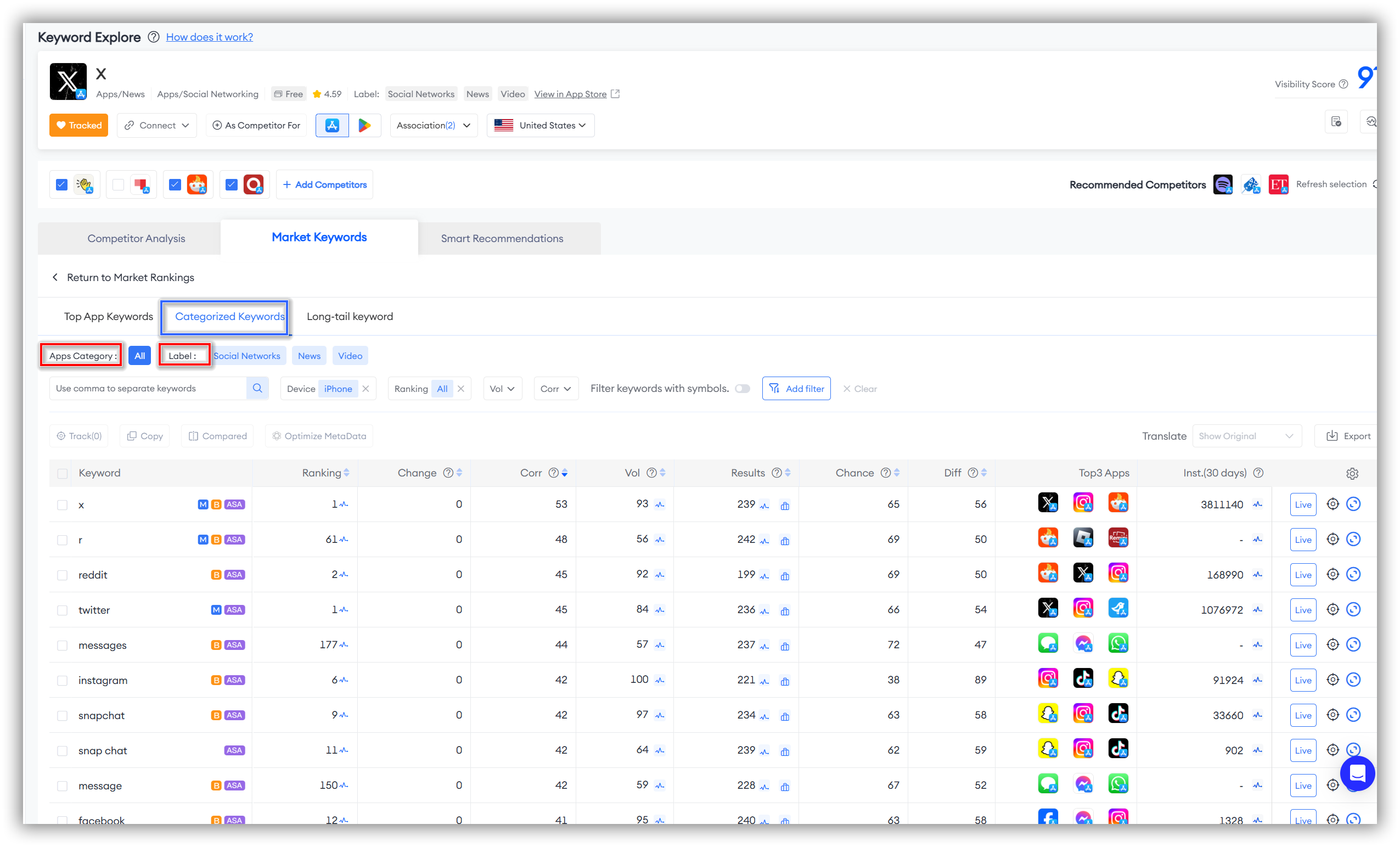
"Categorized Keywords" helps you understand the most popular keywords within the category related to your keyword.
These are typically the terms most commonly used by users during searches, providing valuable insights for optimizing your product or content.
When using "Categorized Keywords," remember to filter by more specific "app category" and "Lable" according to your needs. This will assist you in finding more relevant and valuable keywords.
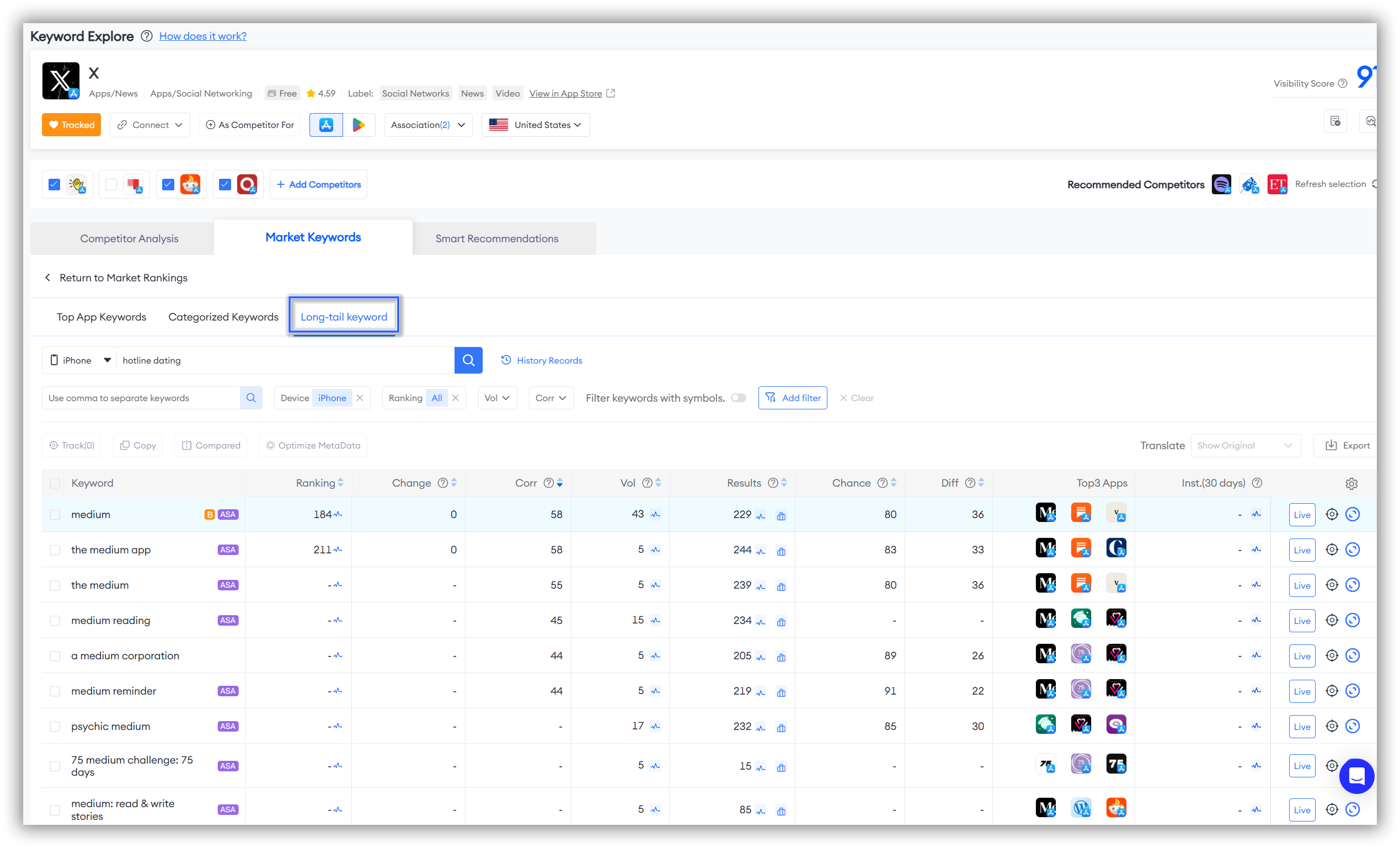
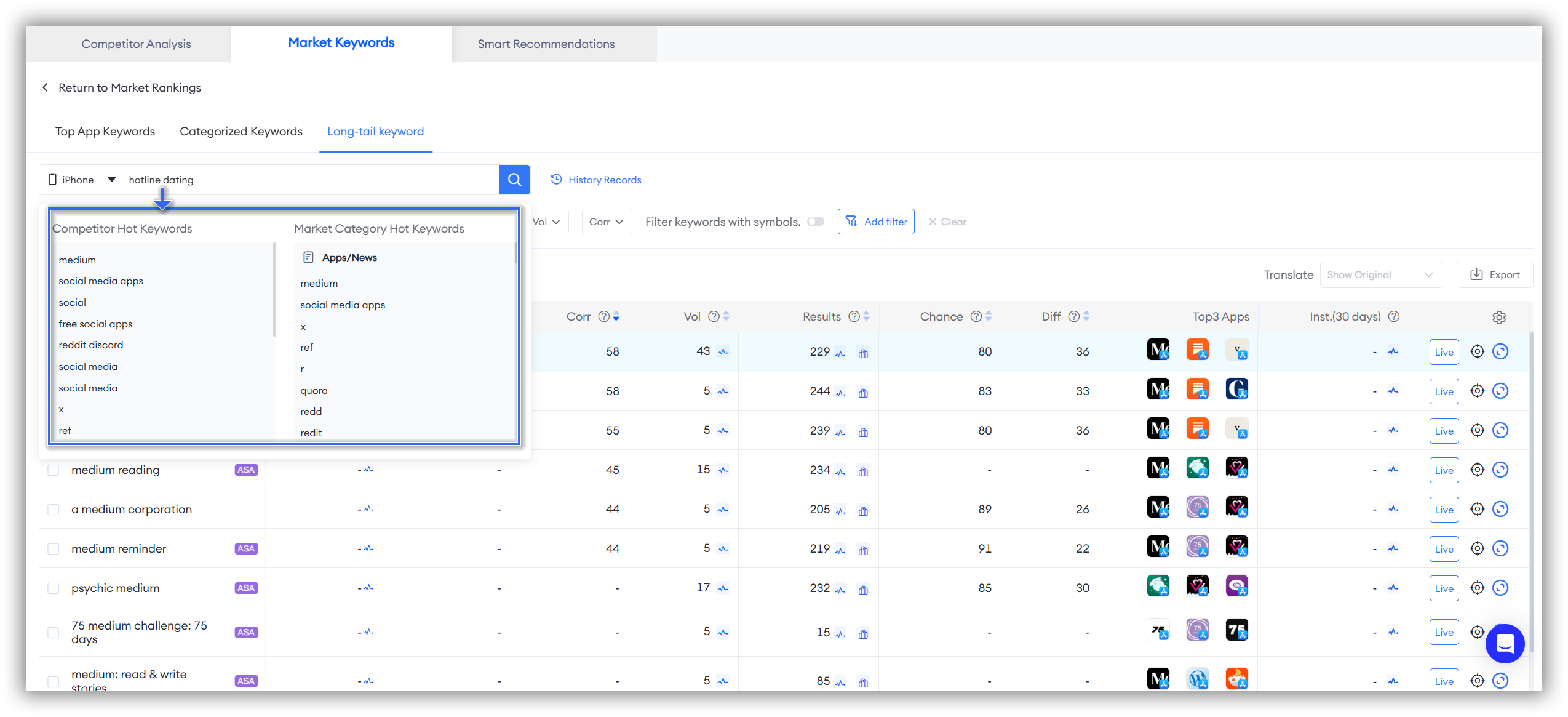
"Long-tail Keywords" aids in identifying more precise and targeted search phrases, which typically encounter less competition.
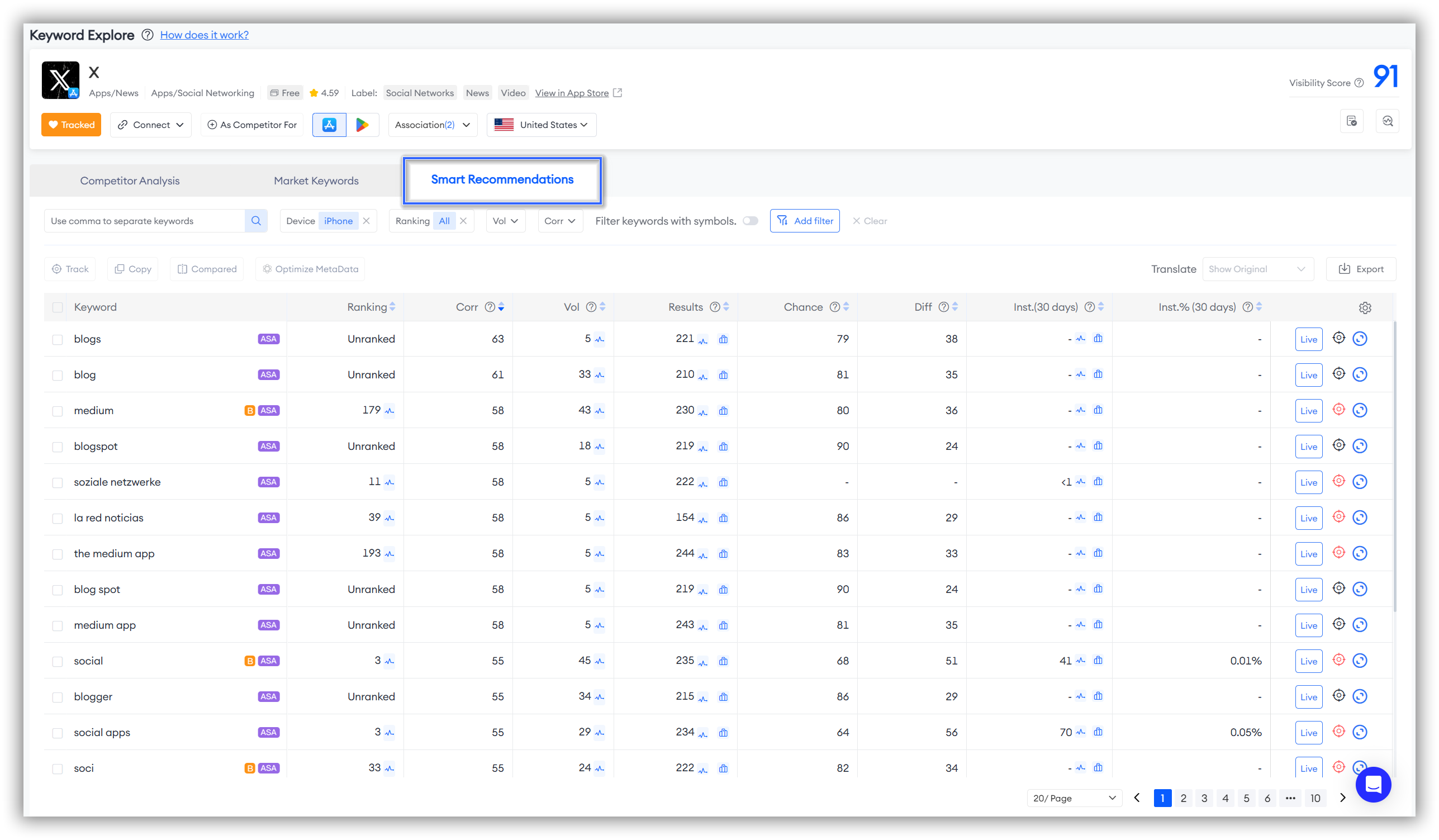
The third section of the "Keyword Explore" feature is "Smart Recommendations." This powerful tool enhances app store optimization efficiency and effectiveness by automatically identifying and recommending high-performing keywords related to your app, helping developers discover keywords they might not have considered.
"Smart Recommendations" allows you to analyze keywords from multiple dimensions: "Ranking," "Correlation," "Volume," "Results," "Chance," "Difficulty," "Installation," and "Installation%."
📒 Note: If you're unclear about the definition of any dimension, please check the "?" icon next to each dimension's text, which explains the definition.
In addition to all the above dimensions, FoxData also allows you to click the "Live" icon in the last column of the keywords to view each keyword's "Live Search Insights," helping you better understand its real-time value in the app market.
You can also click the "target" icon to track or cancel keywords.
Notably, the "Competitor Analysis" section has a unique blue icon in the last column of the keywords. Clicking it will take you to "Market Keywords" to get suggestions based on keywords searched.
📒 Note: For information on the filtering options and management methods for keywords in the "Smart Recommendations" section, please refer directly to the "Market Keywords-Top Keywords" section above.
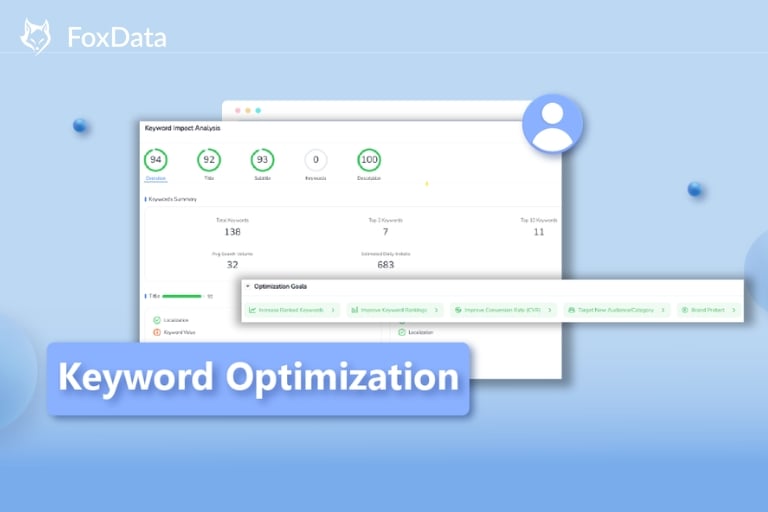
"Keyword Optimization" is the fourth feature of "ASO Keywords," and it includes "Metadata Simulator," "Analysis Suggestions," and "Keyword List."
"Keyword Optimization" helps you accurately select and optimize keywords in the app store, enhancing your app's search ranking.
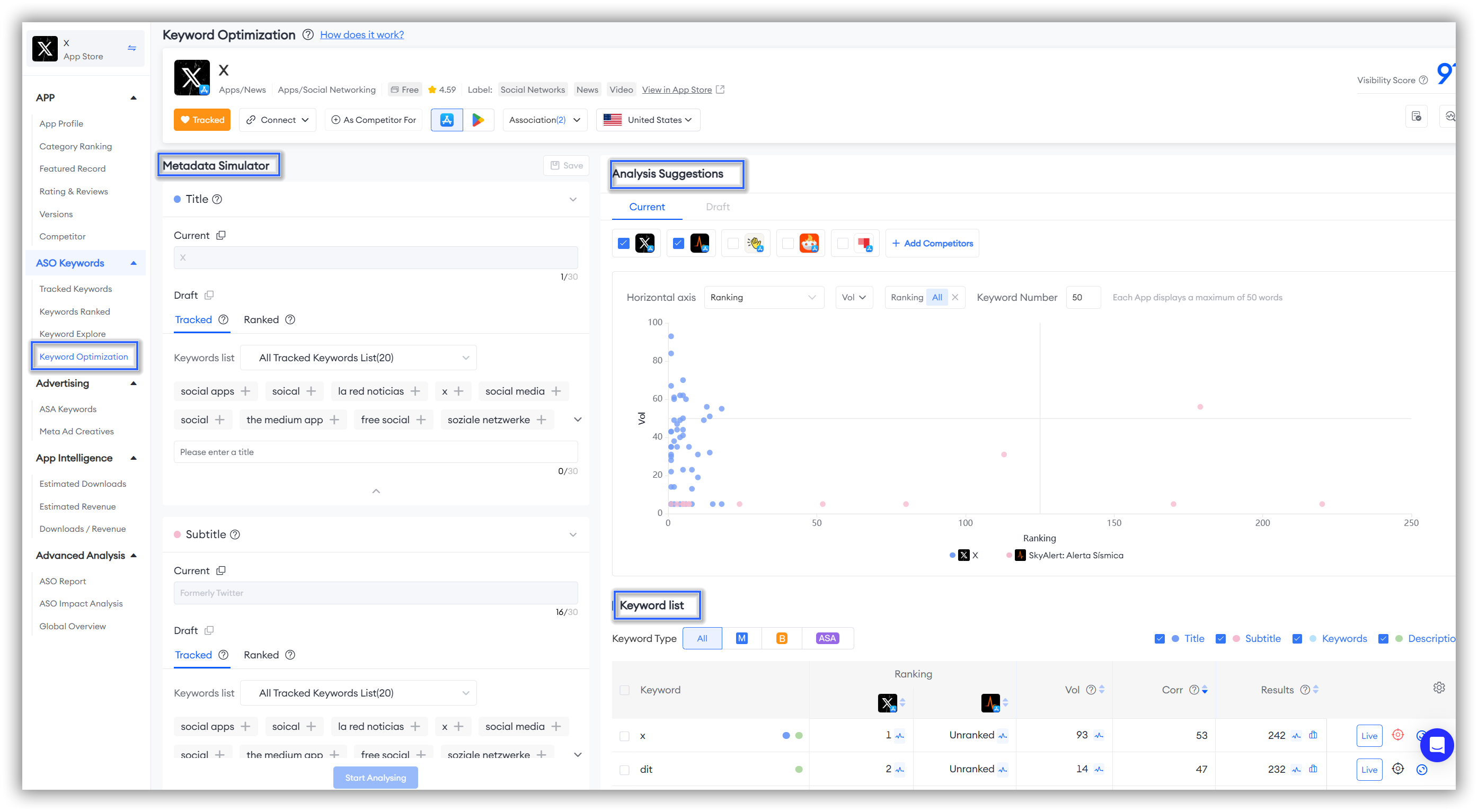
The "Metadata Simulator" tool on the left helps you simulate and preview the effects of metadata, ensuring your keywords are optimally displayed and ranked in the app store.
In the "Metadata Simulator," you can select your desired keywords from the "Tracked Keywords List" you built using the "Keywords Ranked" and "Keyword Explore" sections above. You can then embed these keywords into your "Title," "Subtitle," and "Keywords" to modify them accordingly.
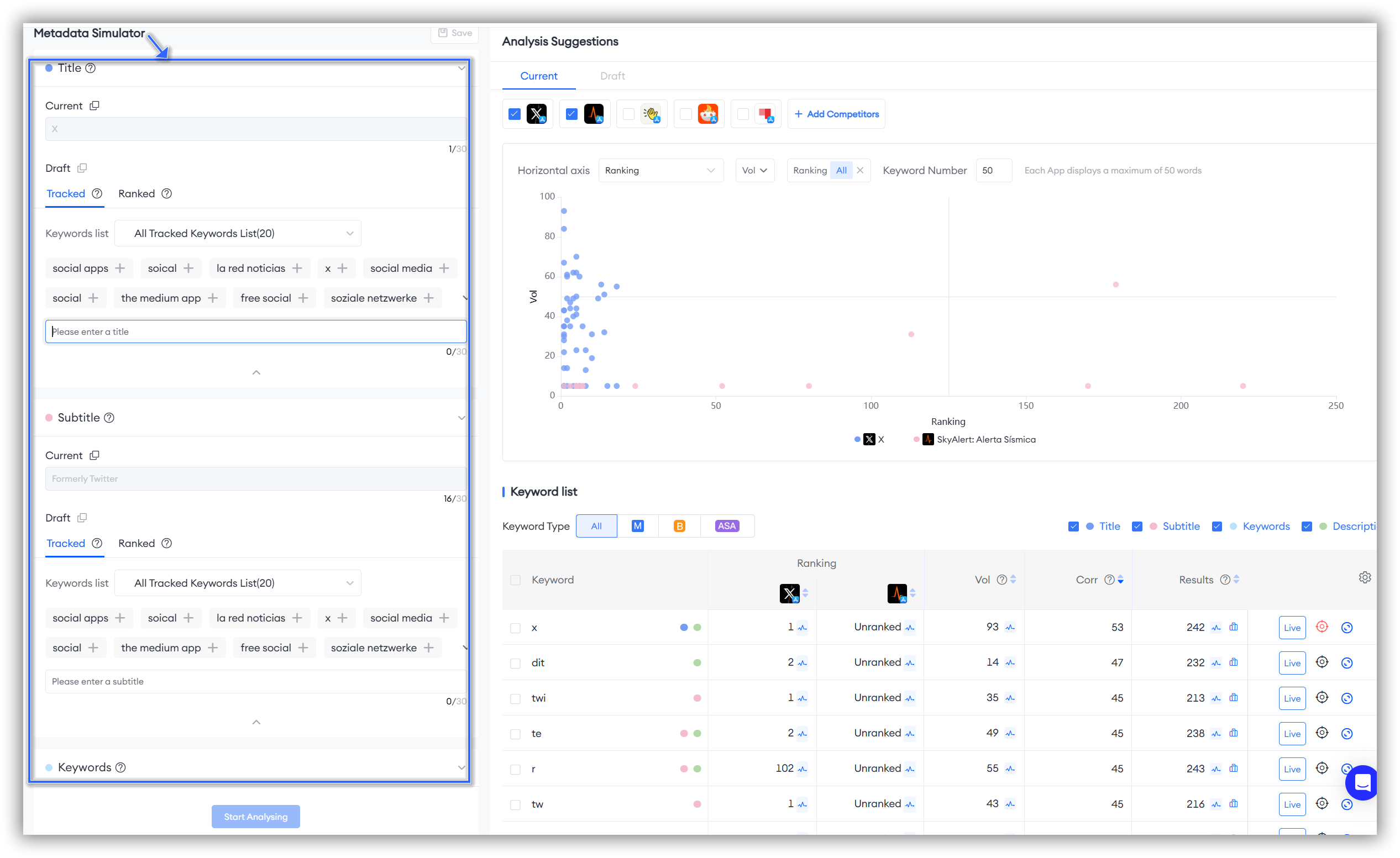
After making your modifications, don't forget to click the "Start Analysing" button at the bottom.
You will receive a "Keywords Summary" and "Keyword List" analysis on the right side, related to your recent draft.
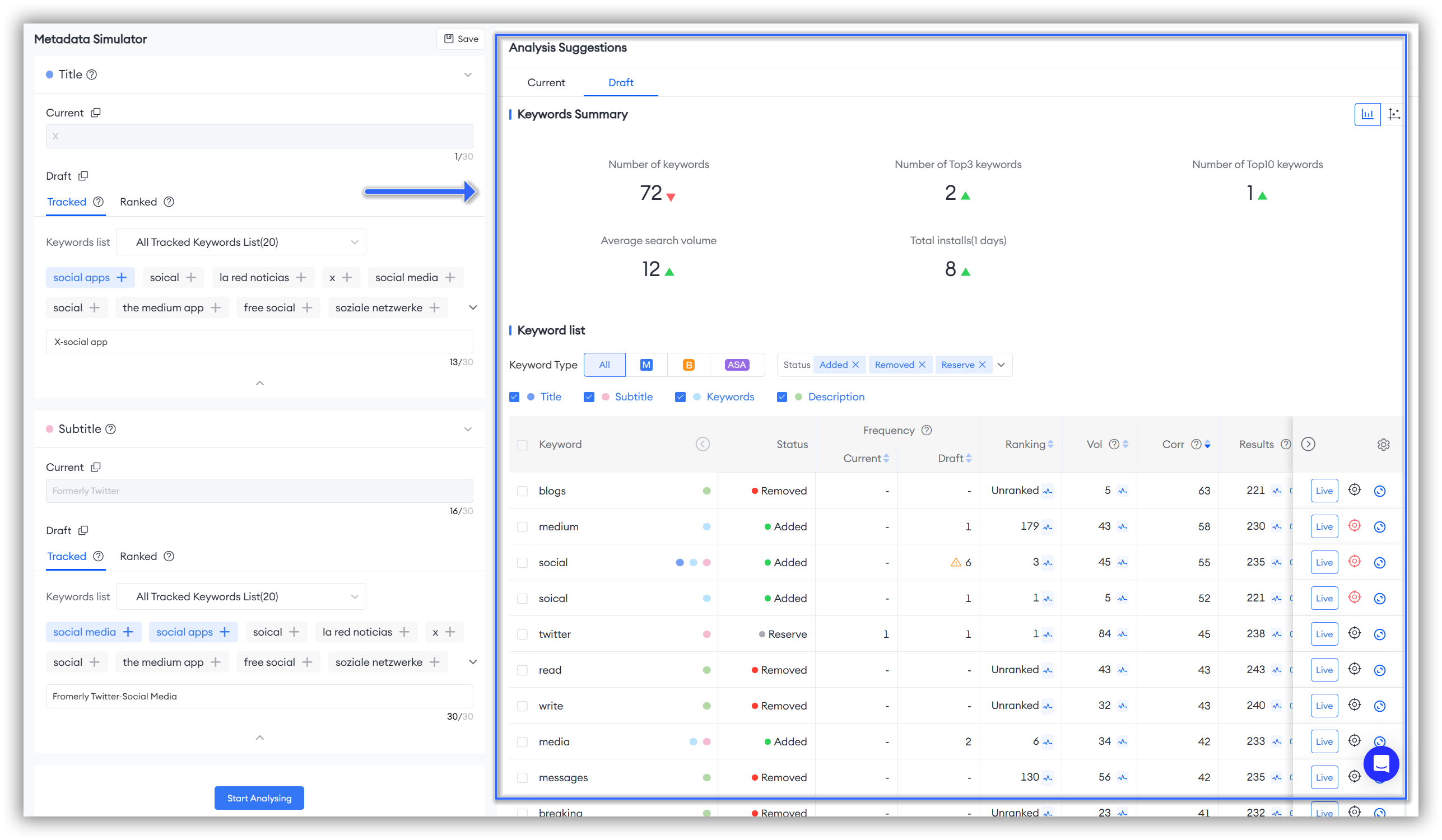
The system initially defaults to displaying an overview of keyword changes across the following five dimensions.
If you're interested in the data for a specific dimension, simply click the "up arrow" or "down arrow" to view detailed change data for that dimension.
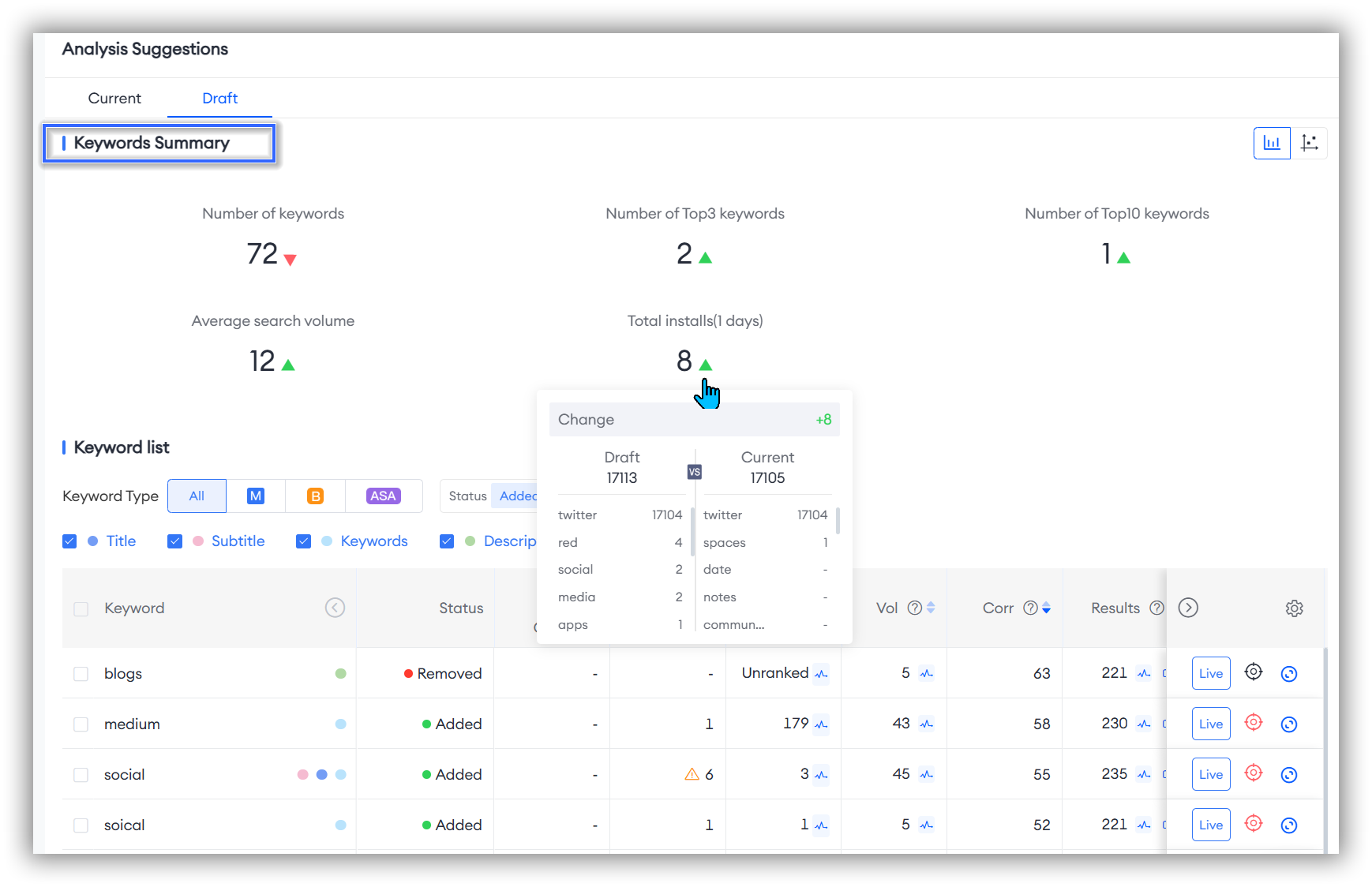
Want to see more intuitive data changes through images?
Click the "scatter plot" icon in the top right corner to get a more visual representation of the changes in the "Draft." This will help you quickly assess and optimize your strategy.
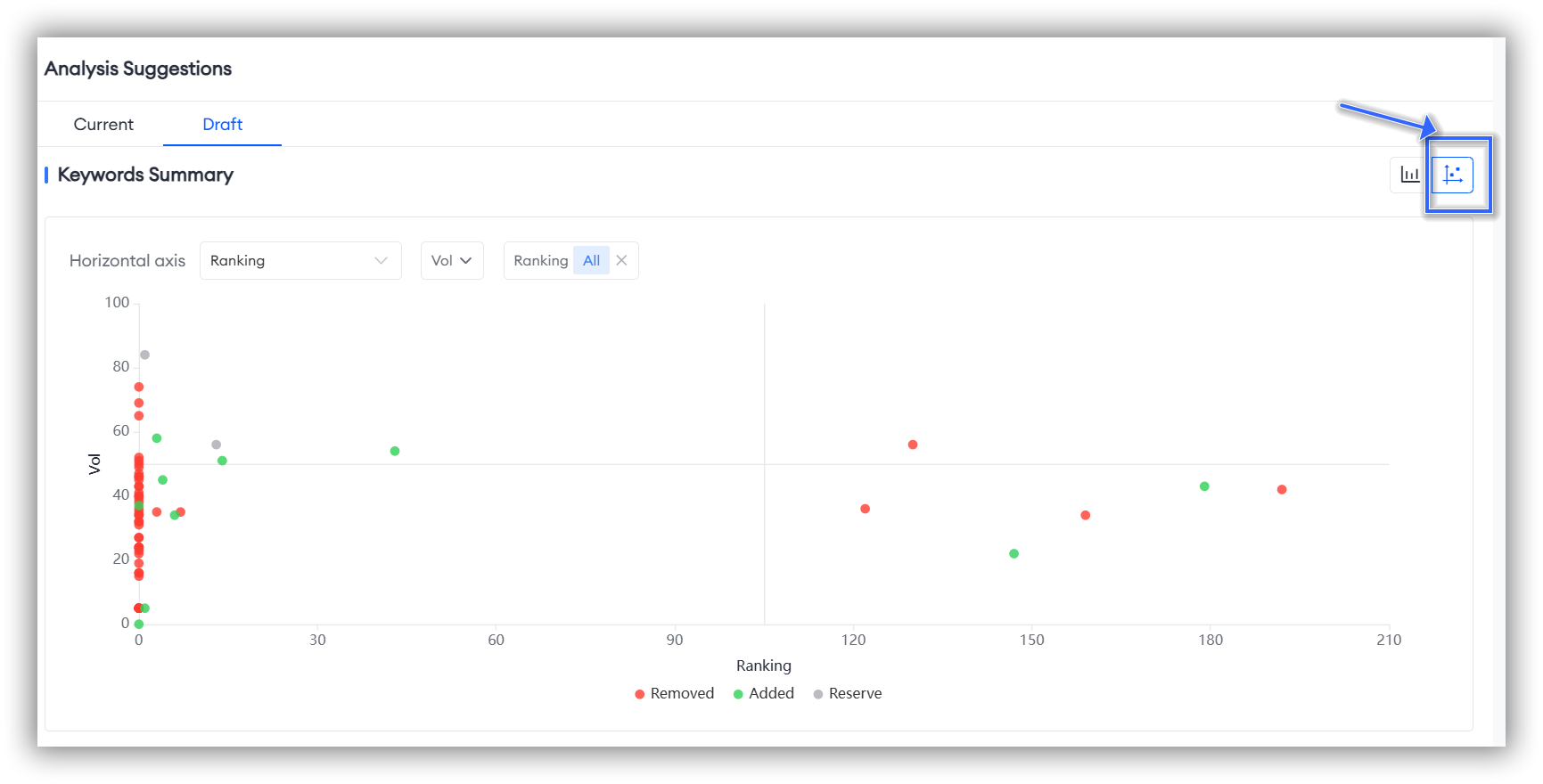
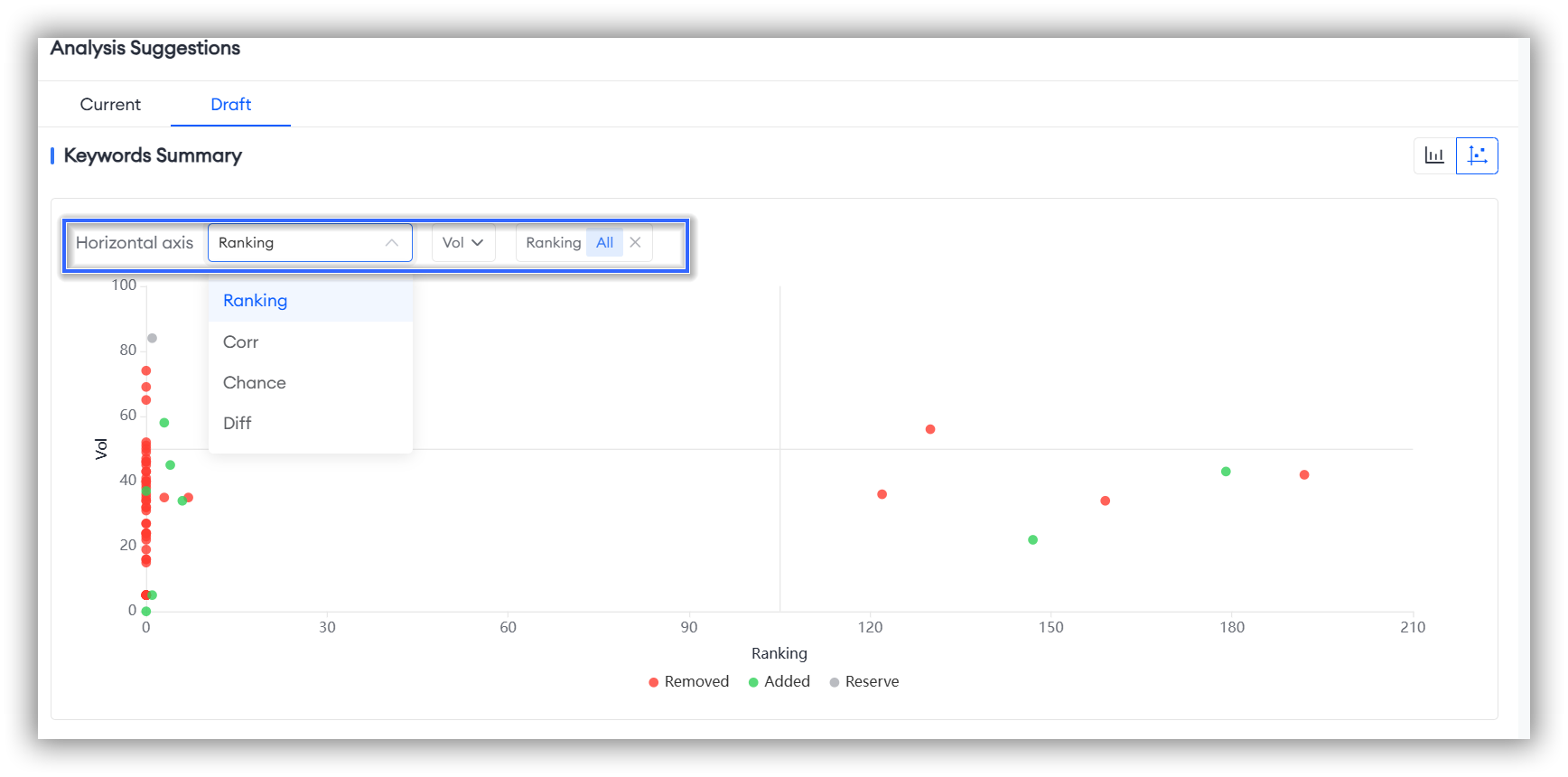
After reviewing the overview of keyword changes following the "Draft" changes, if you wish to conduct a deeper analysis on specific keywords, simply scroll down to view the "Keywords List."
The "Keywords List" allows you to personalize your filtering based on "Keyword Type," "Status," and "Text Metadata." This enables a more in-depth, personalized analysis of the draft generated in the "Metadata Simulator," helping you optimize your Text Metadata.
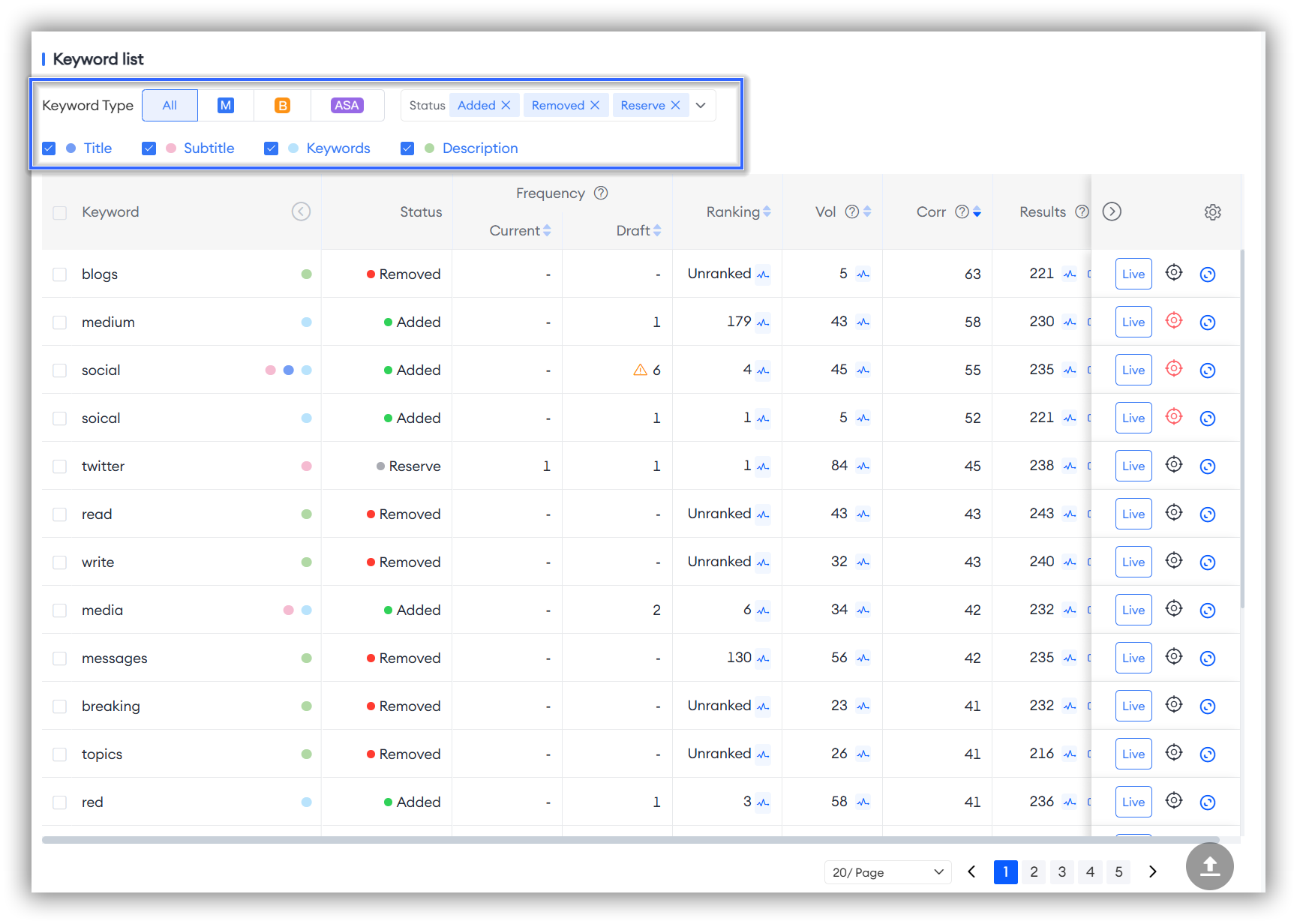
Analysis Suggestions do support viewing the analysis of the original Text Metadata.
Of course!
You can directly click "Current" below the Analysis Suggestions in the top left corner to switch from "Draft" to "Current."
If you are using this feature for the first time and have not used the "Metadata Simulator" to create a draft, clicking into the "Keyword Optimization" feature page will directly display data related to "Current."
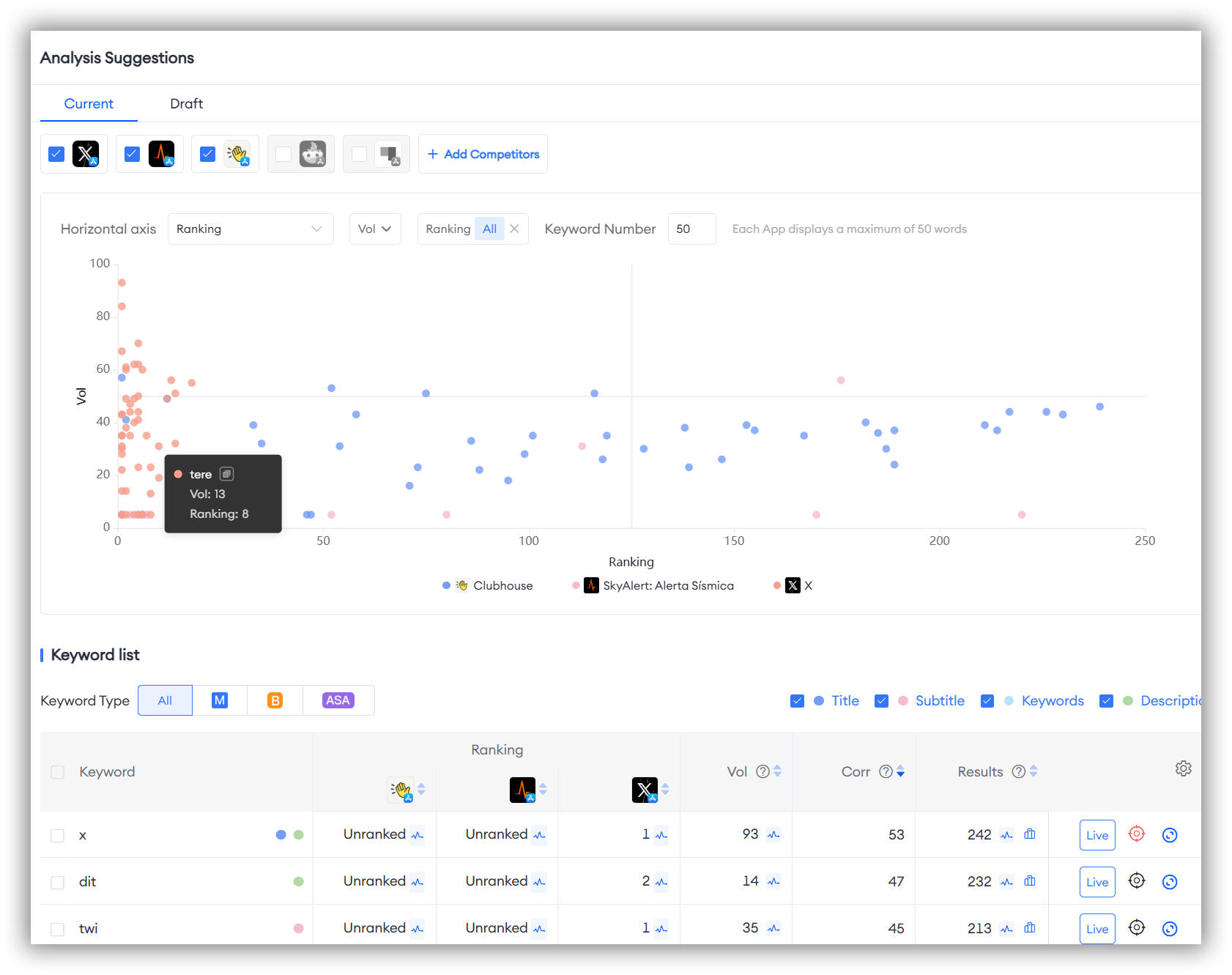
📒 Note: FoxDta allows you to perform more personalized filtering on the four-quadrant chart to meet your keyword optimization needs.
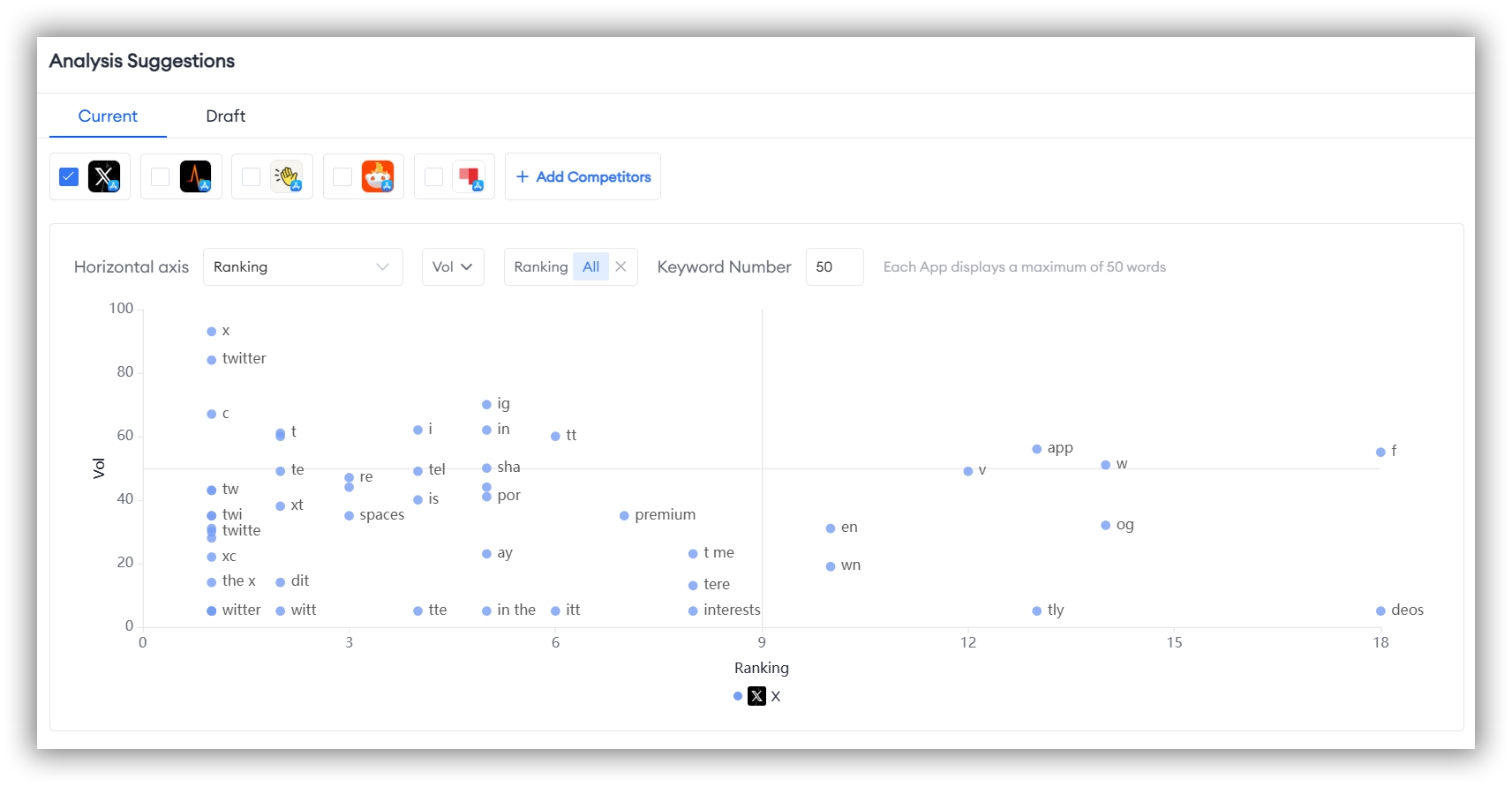
After reviewing the overview of keyword changes in "Current," if you wish to conduct a deeper analysis on specific keywords, simply scroll down to view the "Keywords List."
The "Keywords List" allows you to personalize your filtering based on "Keyword Type" and "Text Metadata." This enables a more in-depth understanding of the performance of your current keywords in Text Metadata.
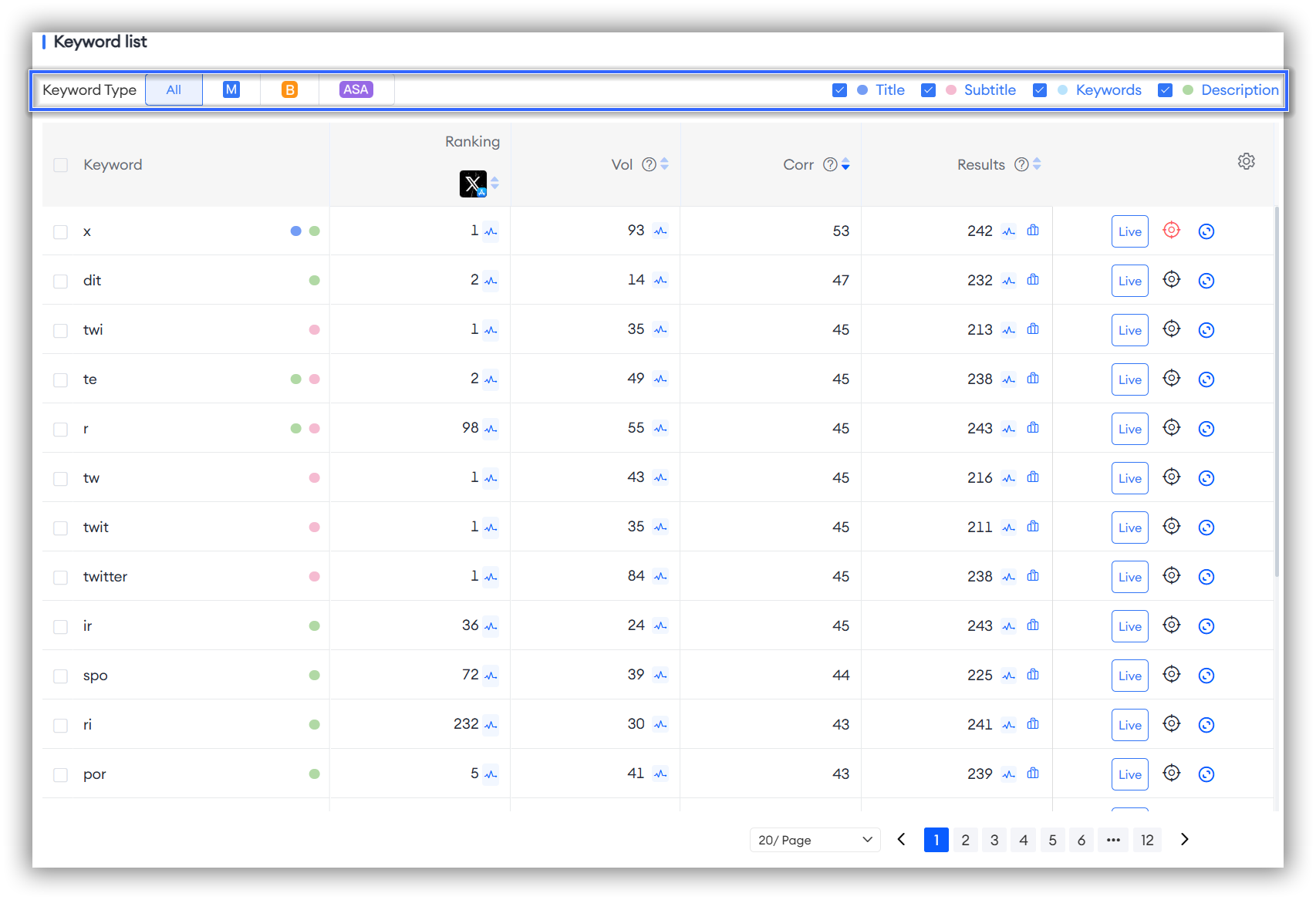
👏Expert Tips:After reviewing the "Current" Analysis Suggestions and Keyword List, our ASO experts recommend using this feature to conduct a competitive "Text Metadata" comparison analysis. This will help you identify valuable or high-potential keywords used by competitors and evaluate their effectiveness and situation in Text Metadata. This will provide you with valuable insights to adjust your own keyword strategy.
You can directly select up to two apps for comparison analysis at the top of the page.
📒 Note: Don't forget to apply your personalized filters in the "Analysis Suggestions" and "Keywords List" to obtain more precise and comprehensive data.
The value of the "ASO Keywords" tool lies in its comprehensive approach to enhancing App Store Optimization (ASO) strategies. It offers four key features—"Tracked Keywords," "Keywords Ranked," "Keyword Explore," and "Keyword Optimization"—that provide robust support for keyword research, ultimately boosting your app's visibility:
The ASO Keywords Tool not only provides strong support for keyword research but also enhances market performance and competitiveness through optimized decision-making and competitive analysis.
© 2020-2026 FoxData. All Rights Reserved.