

Explore More Possibilities for Your Business
Full-cycle scenario construction to meet your needs from App research, development, and release to operation.
Ready for your soaring growth
The mobile app market crossed $330 billion in revenue in 2025. It is projected to reach $391 billion in 2026. Meanwhile, the Apple App Store and Google Play together host over 4 million apps across every category imaginable.
Every day, roughly 2,000 new apps are released on the App Store alone. Your competitors are not standing still. They are refining keywords, testing creatives, and bidding on search ads — while you read this.
In this environment, flying blind is fatal. A thorough app competitor analysis gives you the intelligence to stop guessing and start outranking. It tells you which keywords your rivals are winning, what ad creatives are driving their downloads, and where their strategy has gaps you can exploit.
This guide walks you through a complete competitor analysis for mobile apps — step by step — using FoxData's ASO and app analytics tools. Whether you are an indie developer, a UA manager, or a game publisher, this is the playbook you need.
Before diving into tactics, it is worth asking: why does competitor data change outcomes so dramatically?
Organic search still drives the majority of app installs. Research consistently shows that roughly 70% of app installs originate from app store searches. If your rivals are ranking for keywords you are not tracking, they are capturing users you will never even see.
Paid acquisition is getting more expensive. Global app marketing spend on user acquisition reached $78 billion in 2025, up 13% year-over-year, according to AppsFlyer. Cost-per-install is rising as mature categories become more saturated. Organic discovery through strong ASO is now the most cost-effective growth lever available.
The competition is accelerating, not slowing. In 2025, total global downloads reached 149 billion. Growth has stabilized, meaning developers are now fighting over a relatively fixed pool of users. The winners are not those who launch more often — they are those who make smarter strategic decisions, faster.
App competitive intelligence closes the gap between luck and strategy. When you know what keywords your top competitor ranks for, which screenshots convert best in your category, and what ad copy is driving their installs — you have a roadmap. Without that data, optimization is just guesswork.
This is exactly the gap that structured app market competitor research is designed to fill.
Discover how FoxData enhances data protection and security standards to keep your analytics safe and reliable.
Your most dangerous rivals are not always the most obvious ones.
Start by searching your core category keywords in both the App Store and Google Play. Note which apps consistently appear in the top 10. These are your search competitors, regardless of whether they share your exact feature set.
Look for two tiers: direct competitors (same use case, same audience) and indirect competitors (adjacent categories stealing the same user attention). A fitness tracker app, for example, competes indirectly with sleep apps for the same wellness-focused user.
Build a shortlist of 5 to 10 competitors. Prioritize apps with higher ratings and more reviews — they signal traction, not just presence.
Keyword intelligence is the core of any serious competitor analysis for mobile apps.
For each competitor, you want to answer three questions:
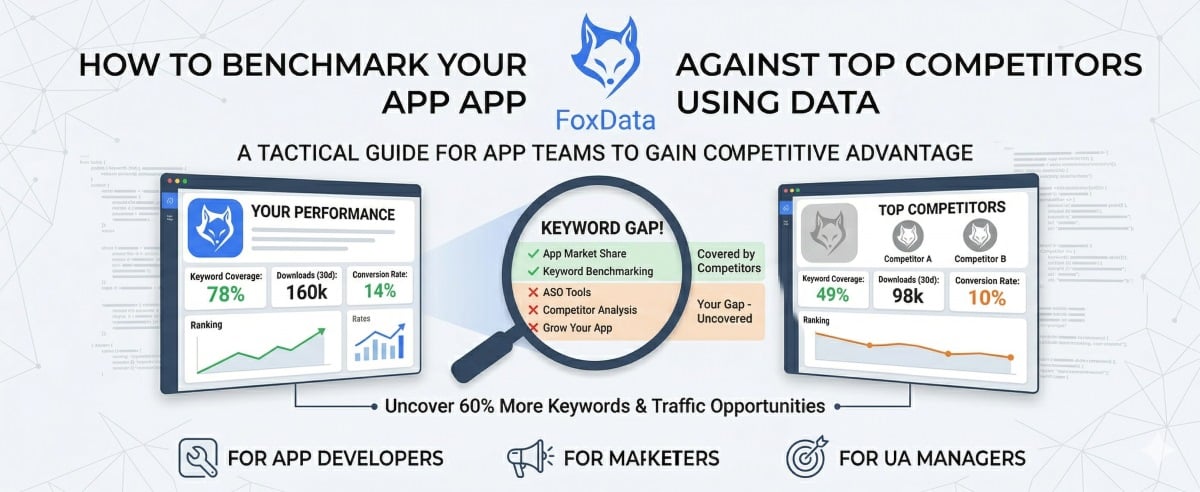
That last question defines your keyword gap — the opportunity hiding in plain sight. Closing keyword gaps is one of the fastest ways to grow organic visibility without increasing ad spend.
Apps that improve ASO-based keyword coverage consistently see measurable download growth. Research based on analysis of nearly 17,000 game apps found that those applying structured ASO strategies experienced a 9% boost in downloads on the App Store and 12% on Google Play — gains achieved purely through metadata optimization.
Ranking is only half the battle. Once users see your app in search results, they decide in seconds whether to tap and install.
Study competitors' listings with a critical eye:
High-converting listings follow consistent patterns. Industry benchmarks show that 90% of featured apps on the App Store had ratings of 4.0 or higher. Apps that improved their rating from 3.6 to 4.2 saw close to a 60% higher conversion rate. These numbers confirm that store listing quality directly translates to installs.
Apple Search Ads (ASA) and Google App Campaigns are major growth channels. Your competitors' paid strategies reveal what messaging, visuals, and value propositions are resonating with users in your category.
Key questions to answer:
This layer of app competitive intelligence is particularly valuable for UA managers planning campaign strategy and budget allocation.
A one-time snapshot gives you context. Continuous tracking gives you competitive advantage.
Monitor how competitor rankings shift after each metadata update they push. When a rival climbs sharply on a keyword you both target, something changed — their title, their download velocity, or their review score. Understanding the "what" behind rank movements is how you stay ahead, not just catch up.
Set alerts for your top 5 to 10 most critical keywords. Check competitor rankings at least bi-weekly.
Theory is only useful when backed by the right tools. Here is how FoxData's mobile app analytics and ASO platform maps directly to each step of the framework above.
Competitor Discovery and Category Intelligence FoxData lets you search by category, keyword, or app name to build a clear map of your competitive landscape. You can view download estimates, revenue trends, and rating trajectories side by side. This removes the guesswork from identifying who your real rivals are.
Keyword Gap Analysis FoxData's keyword intelligence module shows you the exact keywords competitors rank for, their search volume scores, and their ranking difficulty. You can filter for high-volume, low-competition terms that competitors are ranking on but you are not — your fastest path to organic growth. This is the engine behind results like the case study where a fitness app using FoxData increased keyword coverage by 60% and reduced acquisition costs by 28%.
Ad Intelligence and Creative Analysis FoxData's ad creative library surfaces what competitors are running across Apple Search Ads and major ad networks. You can filter by format, duration, and performance signals. For UA managers, this is invaluable for benchmarking your own creatives and identifying visual angles your category is underexploring.
Rank Tracker and Alerts FoxData tracks keyword ranking positions daily across both stores and multiple markets. You receive alerts when competitors make significant moves, so you can respond quickly rather than discovering the gap weeks later.
Free ASO Tools for Getting Started If you are an indie developer or early-stage team, FoxData offers a suite of free ASO tools to begin your competitor research without upfront cost. These include keyword search, basic rank tracking, and app profile lookup — more than enough to build your first competitive map.
For indie developers and small teams, FoxData provides tailored plans that give you enterprise-grade competitive intelligence at a scale that fits your budget and stage of growth.
Even experienced teams make these errors. Avoiding them will save you significant time and money.
Mistake 1: Copying keywords without checking difficulty Seeing a competitor rank for a high-volume keyword does not mean you should target it immediately. If your app has low authority and few reviews, you will not rank. Always cross-reference volume with difficulty before adding keywords to your metadata.
Mistake 2: Analyzing only direct competitors Category leaders often borrow strategy from adjacent verticals. Study the top-ranked apps in related categories. Discover which visual frameworks or keyword clusters are working there and test them in your own listing.
Mistake 3: Doing a one-time audit and walking away Competitor strategy shifts constantly. Metadata updates, new creative tests, and seasonal keyword pushes happen every few weeks. A static report becomes stale within a month. Build a rhythm of reviewing competitor data at regular intervals.
Mistake 4: Ignoring localization signals Industry benchmarks show that 75% of top apps and 96% of top games localized their metadata in 2024. If your competitors are ranking in markets where you have not localized yet, that is an untapped growth lane. Analyze their localized keywords, not just their English listings.
Mistake 5: Treating ASO and paid UA as separate strategies The most effective teams use competitor keyword data to inform both organic metadata and Apple Search Ads targeting. Keywords that rank well organically also tend to convert well in paid campaigns. Integrated strategy reduces total acquisition cost.
At minimum, once per month. For highly competitive categories like casual gaming or fintech, a bi-weekly review is more appropriate. Major algorithm updates or a sudden drop in your own rankings should trigger an immediate competitive audit.
Keyword ranking position is the most actionable single metric. It directly reflects visibility and organic traffic potential. Pair it with download velocity estimates to understand whether a competitor's ranking improvement is translating into real installs.
Absolutely. In fact, competitive intelligence is a force multiplier for smaller teams. You cannot outspend large studios on paid UA. But you can out-research them on keyword gaps, creative angles, and store listing optimization. FoxData's tools are built with indie developers in mind — see the ASO tools for indie developers page for plans and use cases.
Reviews give you qualitative feedback from existing users. FoxData gives you quantitative competitive data: keyword rankings, search volume, download estimates, ad creative libraries, and historical trends. These are two different types of intelligence — both valuable, but reviews alone cannot tell you why a competitor is growing or which keywords you are missing.
The apps that grow in 2026 will not be the ones with the biggest budgets. They will be the ones with the clearest view of the battlefield.
A structured app competitor analysis is no longer a nice-to-have. It is the baseline requirement for any team serious about organic growth, efficient UA spend, and sustainable ranking improvement. The framework in this guide — identify competitors, map keywords, analyze listings, decode ads, track changes — is repeatable, scalable, and measurable.
The only variable is the quality of your data.
Ready to put this framework into action? Explore FoxData's full suite of ASO and app analytics tools to start mapping your competitive landscape today. Whether you are an indie developer or a publisher managing a portfolio of titles, FoxData gives you the intelligence to make every optimization decision count.
© 2020-2026 FoxData. All Rights Reserved.