






Explore More Possibilities for Your Business
Full-cycle scenario construction to meet your needs from App research, development, and release to operation.
Ready for your soaring growth
The mobile gaming industry is no longer dominated by a handful of Western markets.
Emerging regions are now driving the next wave of growth. Turkey led consumer spending with a 28% increase in 2024. Mexico grew 21%. India rose 17%. Thailand climbed 16%. According to Fortune Business Insights, the global mobile gaming market was valued at $121 billion in 2025 and is projected to reach $137 billion in 2026, growing at a compound annual rate of approximately 9.7% through 2034.
For developers and publishers, this signals a significant opportunity.
But entering new markets is not simply about translating your game or running a few ad campaigns. It requires a structured, data-driven approach. You need to understand the market before you enter it, optimize for visibility once you are in it, and measure performance to improve over time.
This article breaks down exactly how global market expansion works for mobile games, and how the right tools can help you execute it efficiently.
Expanding without data is like launching a game with no playtesting.
Most failed international launches share a common thread: teams assume that what worked in their home market will work everywhere else. It rarely does. Player behavior, search patterns, genre preferences, and willingness to pay all vary significantly by country.
Consider this: Simulation and Puzzle games led global downloads in 2024, each accounting for approximately 20% of total installs. Yet on the revenue side, Strategy games command a disproportionately high share, particularly in MENA and Southeast Asia. That gap between download volume and revenue looks very different market by market.
Knowing this before you allocate a UA budget can save tens of thousands of dollars.
Mobile game analytics solutions give your team the intelligence to make these decisions based on real market data rather than assumptions. The most competitive publishers in the world use analytics to identify market readiness, benchmark competitors, estimate demand, and forecast ROI before committing to a new territory.
Data is not just a post-launch tool. It is the foundation of every successful expansion strategy.

Discover how FoxData enhances data protection and security standards to keep your analytics safe and reliable.
Asia-Pacific accounts for the largest share of global mobile game revenue. According to Fortune Business Insights, the region held 47% of total market share in 2024. However, the picture is nuanced. China, Japan, and South Korea remain massive in absolute revenue, but China saw a rare 3% revenue decline in 2024 as a result of regulatory pressure and post-pandemic normalization.
This makes the surrounding markets even more valuable. Southeast Asia generated $5.5 billion in 2025 alone, with Malaysia, Thailand, and Vietnam leading growth in the region.
India recorded 8.45 billion mobile game downloads in FY 2024-25, maintaining its position as the world's largest mobile gaming market by installs. The country has over 568 million mobile gamers as of 2025. However, in-app purchase revenue remains at approximately $400 million, sitting 8th globally.
That gap is closing fast. Rising digital payment adoption, 5G expansion into Tier-2 and Tier-3 cities, and a maturing competitive gaming culture are all accelerating monetization. Publishers entering India now are positioning for strong returns as spending habits mature.
LATAM saw installs grow approximately 8% in 2024, and gaming sessions rise 5 to 7%, the highest of any region globally. Cost-per-install rates in Latin America sit between $0.50 and $2.00, compared to $2 to $5 in North America. Brazil leads regional growth, and the relatively low cost of user acquisition makes LATAM one of the most efficient regions for scaling a mobile game.
The Middle East recorded an 18% year-over-year increase in mobile game player spending in 2024, the fastest growth rate of any region globally. MENA was also the only region to see game downloads rise in 2024, up 1% while other regions declined. Saudi Arabia, the UAE, and Egypt are leading this growth, with MENA's top three markets expected to grow at a 6.8% CAGR from 2024 to 2029.
Female gamers now account for 37% of the MENA player base, opening new content and marketing opportunities that publishers have historically overlooked.
Before you localize, before you spend a dollar on paid acquisition, you need to know what the market looks like.
Effective market research for mobile game expansion includes identifying the leading games in your genre by country, analyzing their download trajectories and revenue estimates, studying their keyword strategies, and understanding the gaps your game can fill.
This is where game market intelligence tools become essential. A strong platform lets you benchmark your competitors store by store, country by country, and surface demand that competitors are not fully capturing.
ASO is your primary driver of organic growth. And it is market-specific.
Directly translating English keywords into another language is one of the most common mistakes teams make. Users in Japan, Brazil, and Germany search very differently. Cultural nuance, regional slang, and local gaming terminology all influence search behavior.
For each new market, your ASO for mobile games strategy should include:
Research consistently shows that metadata-only localization, specifically the title and description, can produce substantial lifts in organic downloads in new markets. Going deeper with full creative localization compounds those gains further.
Consumer preference data reinforces this: 76% of consumers prefer buying products in their native language, and 40% will not purchase from platforms that do not offer their language. For mobile games, this directly translates into install rates and early retention.
Example of meta descriptions in other languages aside from English:
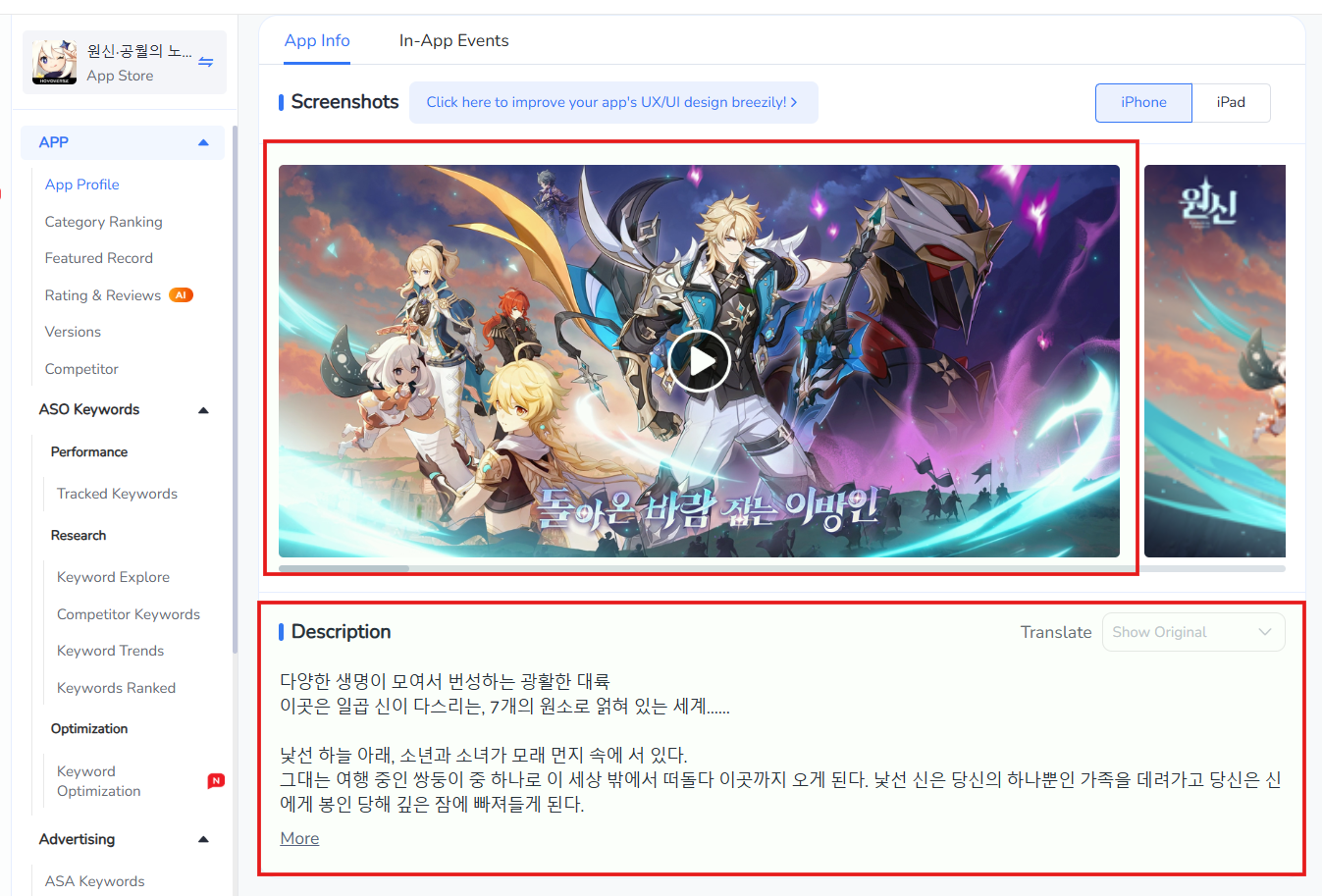
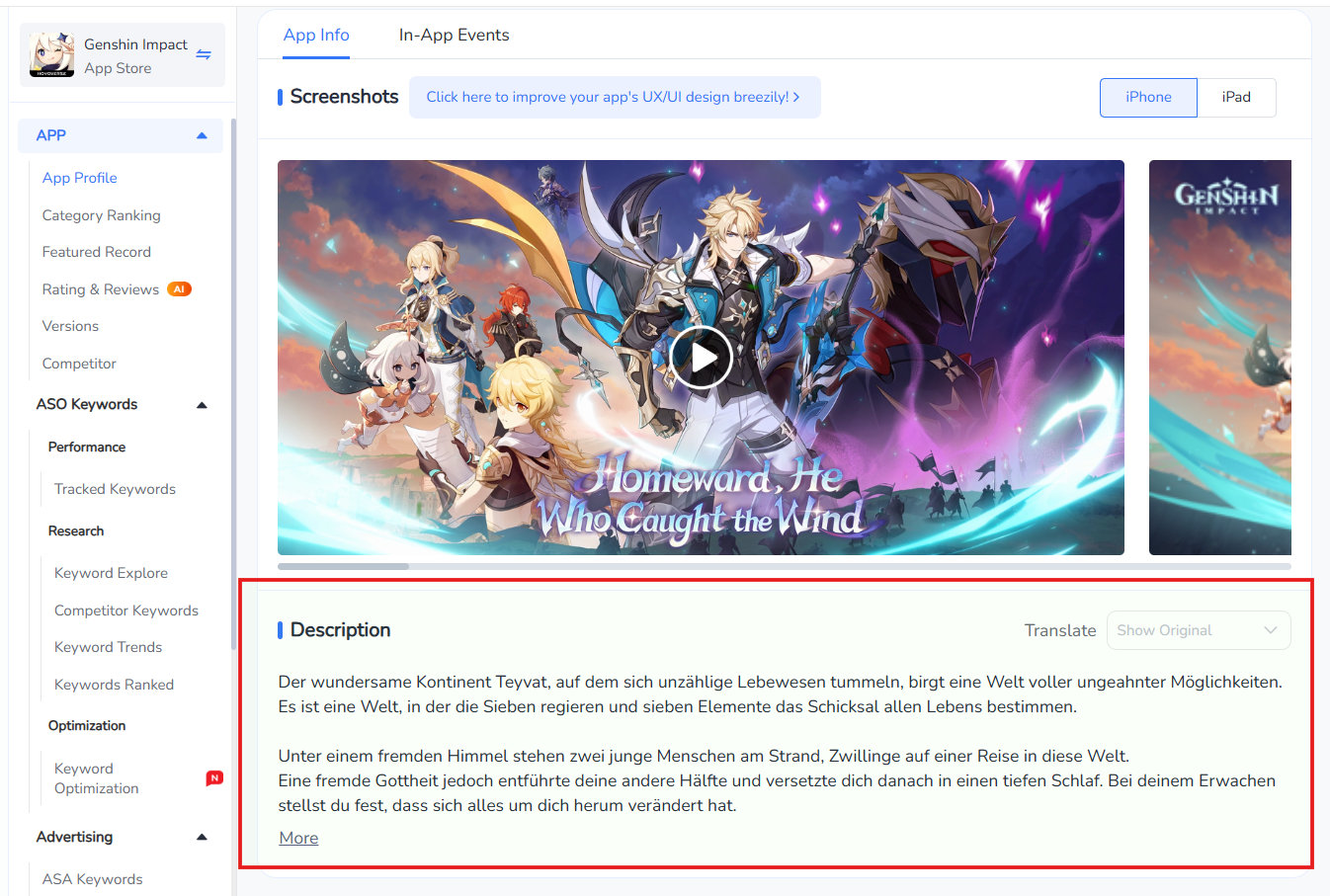
Apple allows developers to configure separate keyword sets for each locale in App Store Connect. Google Play supports flexible staged rollouts. Both stores reward relevance with better ranking, making ASO the highest-leverage organic growth channel for international expansion.
Organic reach takes time to build. Apple Search Ads let you accelerate visibility in App Store search results, placing your game in front of high-intent users the moment they are actively looking.
For global expansion, ASA is particularly valuable because it operates market by market. You can test new territories with controlled budgets, validate demand quickly, and scale what works.
The key is using ASA in combination with strong ASO. Your store page must convert effectively before you invest in driving traffic to it. Pair keyword research from your ASO strategy with your ASA campaign targeting for maximum efficiency.
True localization extends into the game itself.
For simple arcade titles, a translated store page may be enough. But for games with storylines, tutorials, guild systems, or social features, players will expect the in-game experience to feel native to their region. Poor in-game localization leads to negative reviews, low session lengths, and high early churn.
Elements that typically require localization include in-game UI and menus, dialogue and narrative content, in-app purchase pricing and promotional messaging, and customer support content.
In India specifically, a survey found that 70% of mobile gaming businesses believe localized language and culturally relevant content will be a crucial growth driver going forward. Getting this right takes investment. Prioritize based on the revenue potential of each target market.
Scaling globally manually is not realistic for most teams. The data volumes are too large, the markets too varied, and the competitive landscape too fast-moving.
The right analytics platform changes this entirely.
FoxData's mobile game analytics solutions bring together the core data layers your team needs in one place: competitor intelligence, keyword tracking across multiple markets and languages, download and revenue estimates by country, ratings monitoring, and ASA campaign insight.
Here is how this translates into practical workflow:
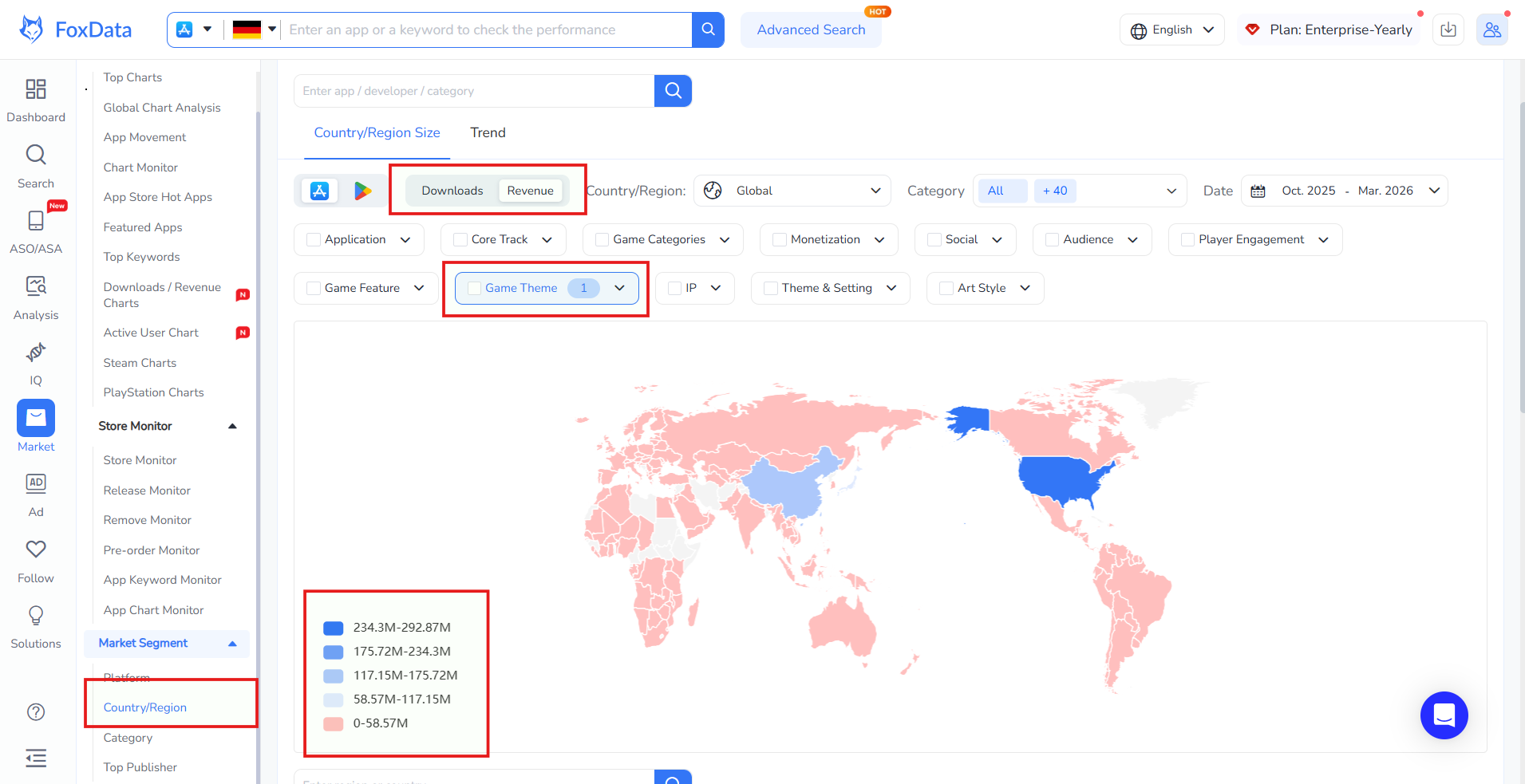
Market validation: Before committing resources to a new territory, use download and revenue data to size the opportunity. Filter by genre and category to see which markets have strong demand for games like yours.
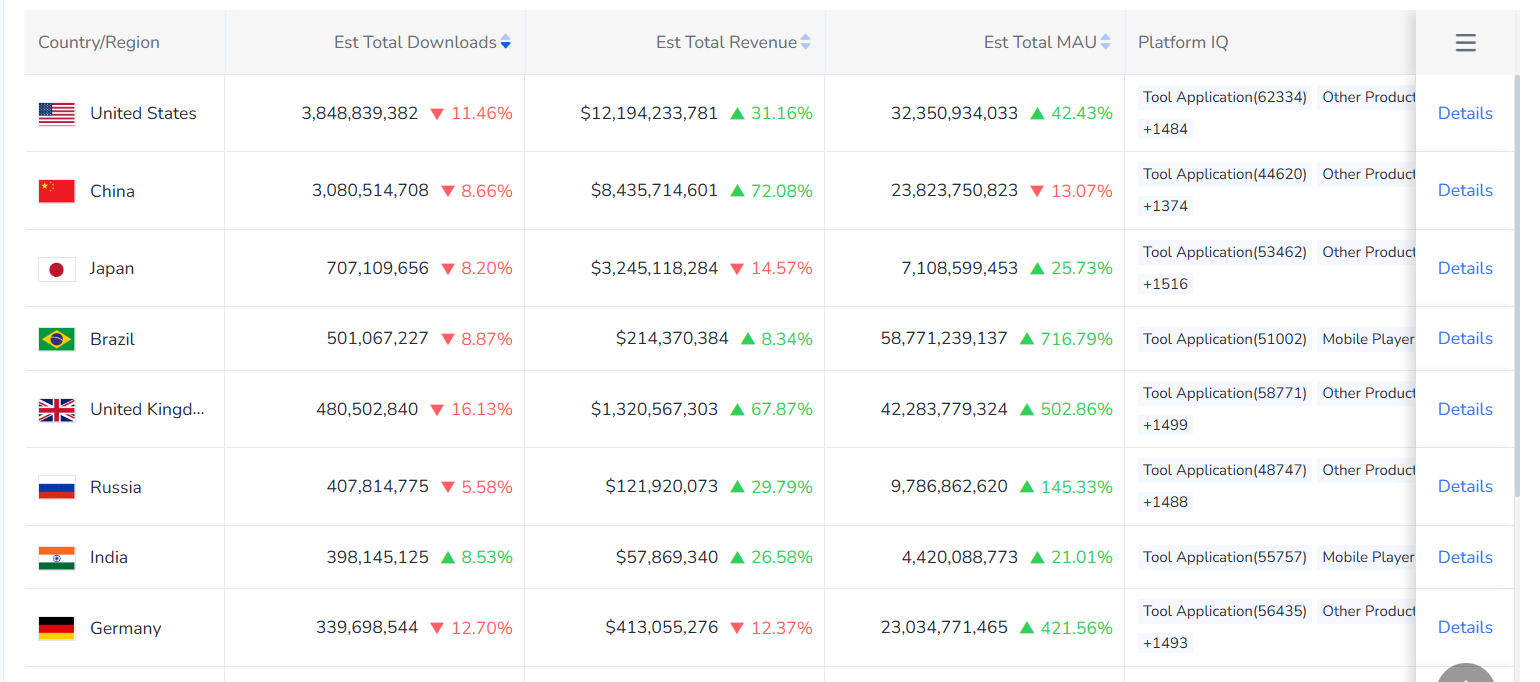
Keyword discovery by market: Build keyword sets for each target country, not just translations of your existing list. Look for high-volume, lower-competition terms specific to each locale.
Competitor tracking: Monitor how your top competitors are performing in each market. Are they gaining or losing ground? What creatives are they testing? What keywords are they ranking for?
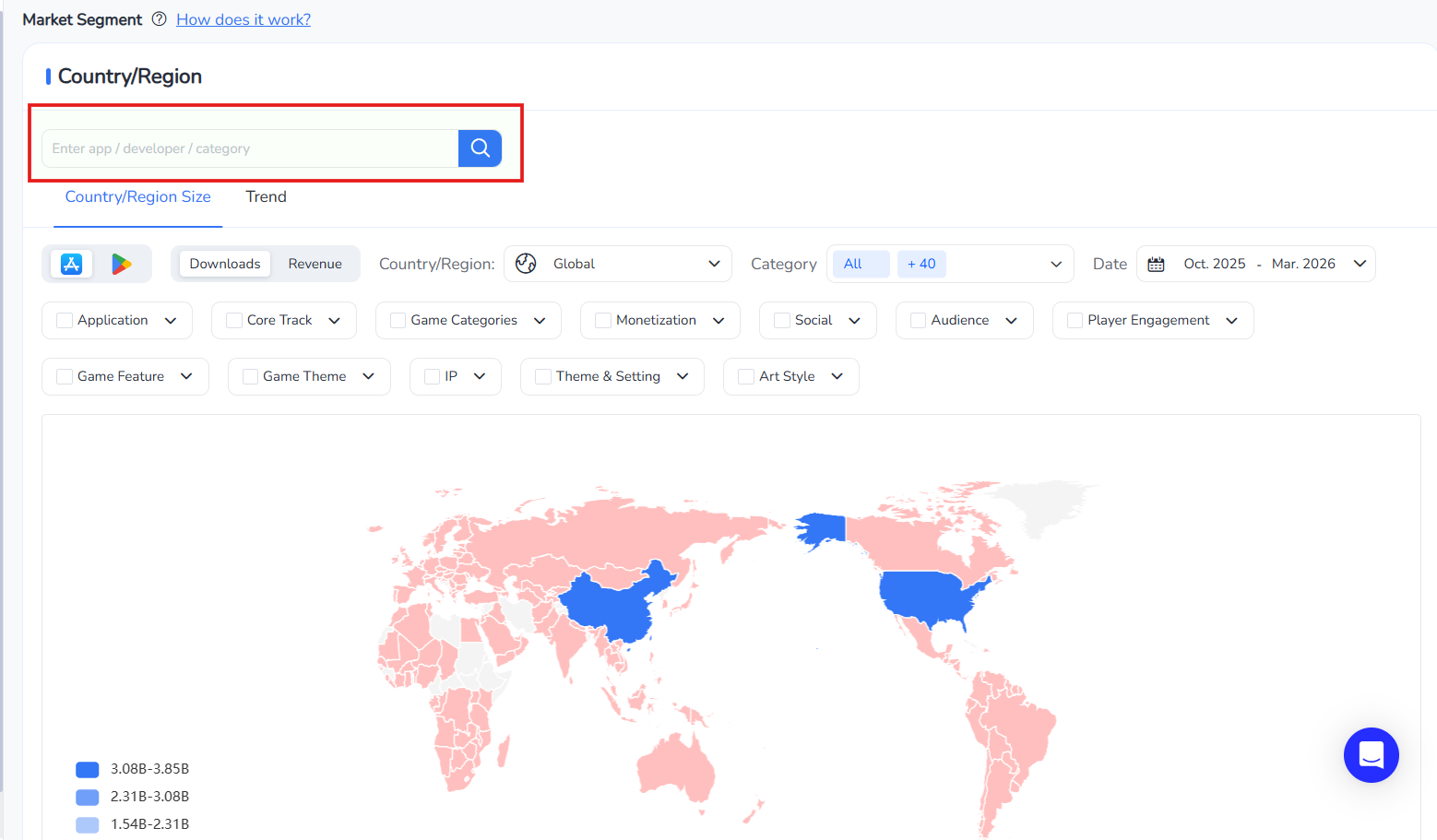
Post-launch optimization: After launch in a new market, track your visibility, conversion rates, and review sentiment. Use this data to iterate on your store listing and creative assets continuously.
Without a centralized analytics solution, this work is fragmented, slow, and expensive. With one, your team can operate at international scale without proportional increases in headcount.
Treating localization as a one-time task. Markets evolve. Player preferences shift. Competitor landscapes change. Your store listing and in-game content need ongoing updates, not a single localization sprint.
Launching too many markets simultaneously. Spreading resources thin across too many countries at once leads to mediocre execution everywhere. Prioritize two to four markets with the strongest fit and execute them well before expanding further.
Ignoring ratings and reviews in new markets. Reviews are one of the strongest signals for app store algorithms and for new players deciding whether to install. Negative reviews in a new market that go unaddressed will suppress your rankings and conversion rates.
Assuming genre popularity is universal. A game that leads in casual puzzle in the US may face very different competitive dynamics in Southeast Asia or MENA, where Strategy and Action titles generate the highest revenue shares. Always validate genre fit with data before investing.
Skipping cultural review of visual assets. Color symbolism, character design, and iconography all carry cultural meaning. An icon that feels neutral in one market may be off-putting in another. Creative assets should always be reviewed by someone familiar with the target culture.
Over-relying on machine translation. Automated translation tools have improved significantly, but they frequently miss regional nuance, gaming-specific terminology, and tone. Poor translations lead to awkward in-game text, bad reviews, and lower conversion on store pages.
Global expansion is the single biggest growth lever available to mobile game publishers today.
But the teams that win internationally are not simply the ones with the most creative content or the largest UA budgets. They are the ones who do the research, optimize for each market with intention, and use data to guide every decision.
The global mobile gaming market is valued at $121 billion in 2025 and projected to reach $137 billion in 2026. The regions driving that growth, from Southeast Asia to MENA to Latin America, are accessible to developers and publishers of all sizes. What differentiates success from failure at this scale is the quality of your intelligence and the discipline of your execution.
Ready to take your mobile game global? Explore how FoxData's mobile game analytics solutions gives you the competitive intelligence, keyword data, and market insights you need to expand into new markets with confidence.
Q: Which markets should a mobile game target first for international expansion?
A: This depends on your game's genre, art style, and monetization model. Generally, markets where your genre performs strongly and where competition is not yet saturated offer the best early-stage opportunity. For many developers, Southeast Asia, MENA, and Latin America offer strong demand with lower cost-per-install than mature markets like the US, Japan, or South Korea. Use download and revenue data from an analytics platform to validate fit before committing.
Q: How important is ASO for global mobile game expansion?
A: ASO is one of the highest-leverage activities in any international expansion. Most new installs in a market start with a search query, and if your game is not ranking for relevant local keywords, you are invisible to that audience. Localized ASO, including keywords, metadata, and creatives tailored to each target country, is essential for building sustainable organic growth in new markets.
Q: How long does it take to see results after launching in a new market?
A: Organic ASO results typically take four to twelve weeks to materialize, depending on how competitive the market is and how frequently you update your listing. Apple Search Ads can drive visibility much faster, often within days of a campaign going live. Most publishers run paid acquisition in a new market during the initial weeks to validate demand while organic rankings build over time.
Q: What role does mobile game analytics play in reducing expansion risk?
A: Analytics reduces risk by replacing assumptions with evidence. Rather than guessing which markets will respond to your game, you can examine real competitor performance data, download trends, and keyword demand for your genre in each target country. This allows you to prioritize the highest-potential markets, allocate budget more precisely, and avoid expensive launches in markets where demand does not support your game's model.
Ready to make your app shine? Optimize your app's visibility with FoxData, the ultimate mobile app analytics and ASO tool! Maximize downloads and rankings by leveraging our powerful insights today.
App Growth & ASO Tools by FoxData
FoxData supports every stage of app growth with specialized ASO and app analytics tools, helping teams improve keyword visibility, user acquisition, and retention through reliable data.
🔍 Store Keyword Research Tools
Research high-intent keywords, search volume, and competition to strengthen your app store optimization strategy.
📈 App Store Keyword Tools
Analyze keyword rankings and performance across the Apple App Store and Google Play to refine ASO execution.
📊 ASO Monitoring Tools
Monitor keyword ranking changes, visibility trends, and ASO impact over time with continuous performance tracking.
👥 User Activity Monitoring Tools
Understand in-app user behavior, engagement, and retention with real-time user activity analytics.
Together, these tools form FoxData’s ASO analytics and app intelligence ecosystem, designed to help developers, marketers, and growth teams make data-driven decisions and scale sustainably.
Explore it today!
👉 Learn more about FoxData here | 👉 Book a demo with FoxData team today!
© 2020-2026 FoxData. All Rights Reserved.