


Explore More Possibilities for Your Business
Full-cycle scenario construction to meet your needs from App research, development, and release to operation.
Ready for your soaring growth
The app economy moves fast. Billions of data points are generated daily across the Apple App Store and Google Play. Knowing how to access and use that data is no longer optional.
For media companies, market research firms, and analytics agencies, app store data APIs have become mission-critical tools. They power investment reports, editorial coverage, competitor benchmarking, and strategic decisions.
Yet many teams still rely on manual research, delayed reports, or fragmented data sources. That is a costly gap. This article breaks down exactly how professional data teams use app store data APIs, and what smart workflows look like in practice.
The mobile app market is at a scale that demands serious data infrastructure. Global consumer spending on mobile apps reached an estimated $540 billion in 2025, with projections pointing to $600 to $620 billion by end of 2026, according to industry analysts. That scale means app performance data carries real financial weight.
Research firms use it to forecast market trends. Hedge funds track download velocity as a proxy for revenue signals. Publishers monitor competitor rankings to time their own campaigns.
App store data is also becoming more structured and accessible. Apple and Google expose certain signals through their developer APIs, but third-party platforms go much further. They aggregate download estimates, revenue trends, keyword rankings, ratings data, and category benchmarks, all accessible via API.
As of December 2025, Google Play hosted approximately 2.14 million apps and the Apple App Store contained around 2.06 million apps, according to app intelligence trackers. That is a vast dataset to navigate without the right infrastructure.
In 2025 alone, users downloaded 149 billion new apps globally, while in-app purchase revenue reached $167 billion, up more than 10% year over year. The teams that win are the ones with reliable, scalable access to this intelligence. That is precisely where a purpose-built solution like FoxData's App Data API becomes essential.

Discover how FoxData enhances data protection and security standards to keep your analytics safe and reliable.
Journalists covering the app economy need numbers they can trust. Download trends, revenue estimates, and category rankings give editorial teams the factual backbone for compelling stories. A tech editor covering the rise of AI productivity apps, for example, needs accurate install data across multiple regions and time periods.
Research analysts at investment firms face similar demands. They track app download momentum to assess company health before earnings calls. A sudden drop in daily active installs can signal churn risk. A spike in a new geography signals international expansion.
These signals only become useful if the underlying data is accurate, fresh, and accessible via API for integration into internal dashboards.
FoxData's mobile app market intelligence platform provides structured API access to exactly this kind of data, covering rankings, downloads, revenue trends, and keyword performance.
Analytics agencies often manage intelligence for dozens of clients simultaneously. Manually pulling competitor data from app stores is not scalable. API access transforms that process entirely.
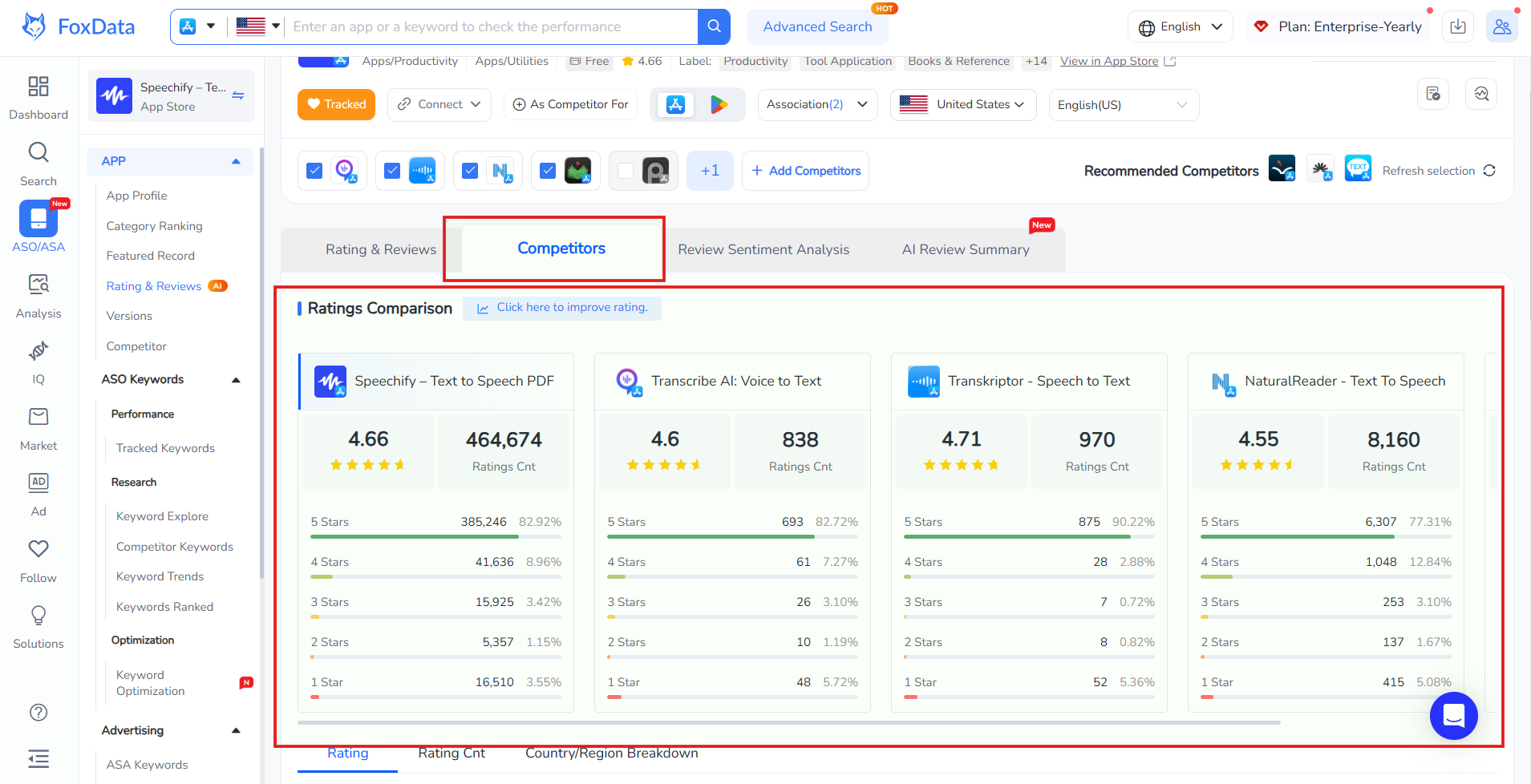
A typical workflow might look like this: an agency sets up automated pulls for a client's top 20 competitors across iOS and Android. They track category rank changes daily. They flag unusual spikes in review volume, which often signal a major update or marketing push. They measure keyword visibility scores week over week.
This kind of systematic benchmarking requires structured data at scale. It also requires reliability. Gaps in data or inconsistent refresh rates break dashboards and damage client trust.
The broader picture reinforces the urgency: gaming apps alone accounted for approximately 60% of total App Store revenue in 2025, generating over $82 billion on iOS. Non-gaming categories are closing the gap fast. Any analytics firm not tracking these category-level shifts in near real-time is operating with a blind spot.
Search is the dominant discovery channel in app stores. Studies consistently show that over 65% of App Store downloads begin with a user searching the store. Apple itself has confirmed this figure when announcing expansions to its Apple Ads platform. That single statistic drives the entire ASO industry.
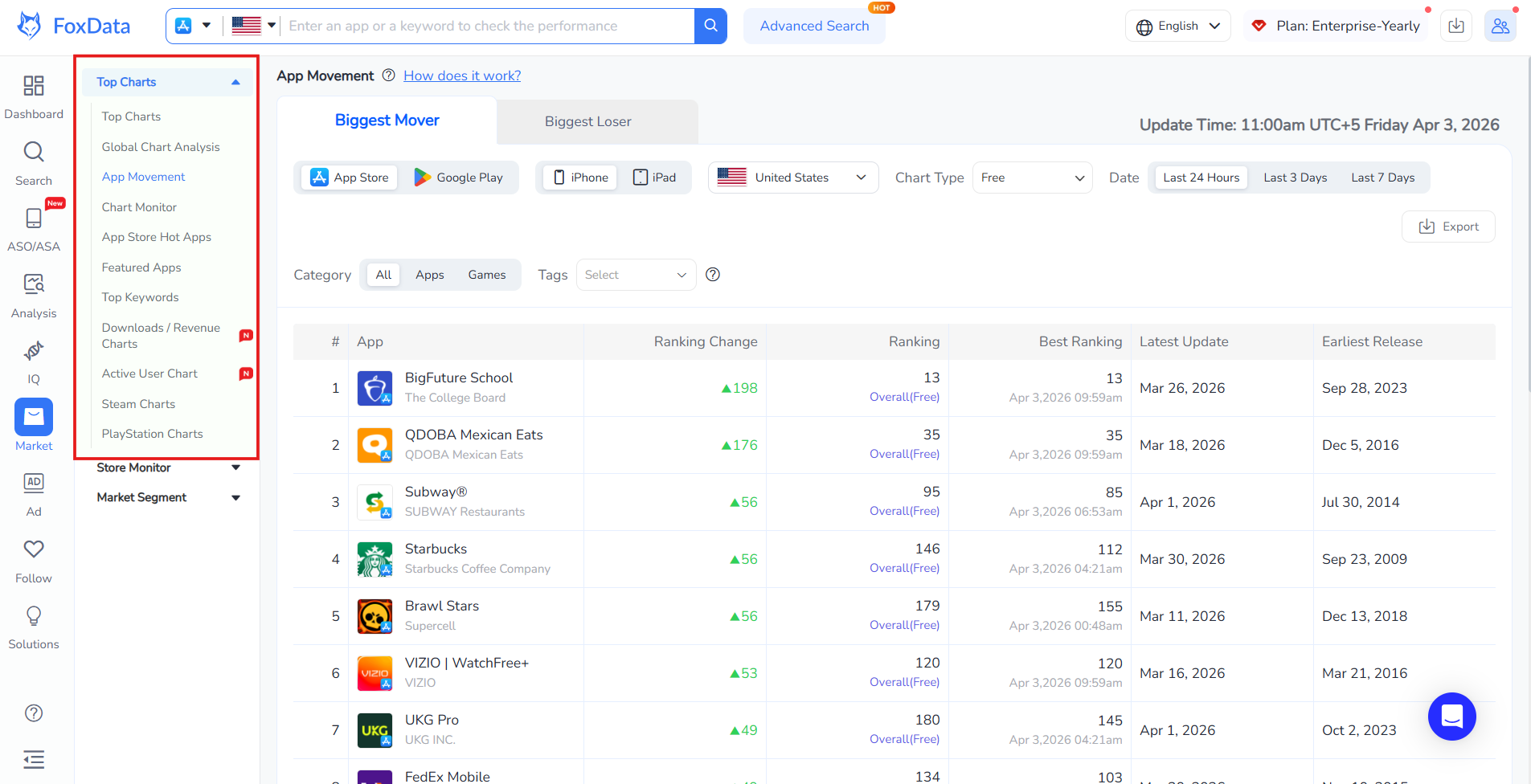
Analytics firms use keyword data APIs to monitor how apps rank for target terms over time. They analyze keyword difficulty, search volume estimates, and ranking velocity. They map competitor keyword strategies to identify gaps their clients can exploit.
This is not a one-time audit. Keyword landscapes shift constantly with algorithm updates, seasonal demand, and competitor activity.
In 2025 and 2026, Apple's search algorithm moved significantly toward intent-based matching, rewarding metadata clarity over keyword density. API access allows firms to automate monitoring and alert clients in near real-time when significant ranking changes occur.
Private equity analysts, venture capitalists, and public equity researchers all use app download and revenue data to evaluate mobile-first companies. App store performance is often the most transparent signal available for consumer apps with limited public disclosure.
Download velocity, revenue per download, and country-level distribution are key inputs into valuation models. The US market remains the highest-value geography for app revenue, accounting for approximately 42% of global App Store consumer spending.
An app generating most of its revenue from Tier 1 markets like the US, UK, or Japan carries a different risk profile than one dependent on emerging markets.
These firms rely on APIs because their models require structured, machine-readable data. They cannot afford delays or manual exports. The data must integrate cleanly into their analytical pipelines.
With iOS users now averaging 4.2 hours per day inside apps, the behavioral signals embedded in app store data are richer than ever for investment-grade analysis.
Before connecting to any API, map out exactly what you need. Do you need daily download estimates or weekly aggregates? Do you require country-level breakdowns or global totals? Do you need historical data going back two years, or is a rolling 90-day window enough?
Being precise upfront prevents overspending on data you do not use and ensures your pipeline is built correctly from day one.
Not all app data APIs are equal in their update frequency. Some platforms refresh rankings daily. Others update revenue estimates on a weekly lag. For competitive intelligence workflows, freshness matters enormously. A week-old ranking snapshot is nearly useless for detecting a competitor's promotional push.
Evaluate your data provider based on documented update cadence, not just data breadth.
If you are building a dashboard for five apps today, plan for fifty apps tomorrow. API-based workflows should be designed with pagination, rate-limit handling, and error retry logic built in. This prevents pipeline failures as your data requirements grow.
The most powerful intelligence comes from combining external app store data with internal metrics. If your client's dashboard shows a 20% drop in iOS installs but their internal MMP shows stable paid UA performance, the organic channel is likely suffering.
That kind of triangulation is only possible when external API data is integrated cleanly with first-party data sources.
FoxData's App Data API is designed with integration flexibility in mind, making it practical for analytics firms to embed it into their existing data stacks.
Mistake 1: Treating Estimates as Exact Figures
App store download and revenue data from third-party APIs are estimates, not official figures. They are powerful directional signals, but should be communicated accurately in reports and presentations. Clients and stakeholders must understand the nature of the data.
Mistake 2: Ignoring Regional Data
Many teams pull global aggregates and miss critical regional nuances. Asia Pacific now commands over 52% of the global mobile app market by revenue, while Latin America and the Middle East are posting double-digit year-over-year growth. Country-level data is essential for accurate market assessments.
Mistake 3: Monitoring Too Many Metrics at Once
More data does not automatically mean better decisions. Teams that track fifty metrics simultaneously often lose sight of the signals that actually matter. Start with three to five core KPIs per use case and expand deliberately.
Mistake 4: Neglecting Historical Baselines
Ranking data only becomes meaningful when compared against a baseline. Teams that start tracking without establishing historical context struggle to interpret trends. Pull 12 months of historical data before building any performance benchmarks.
Mistake 5: Using API Data Without a Clear Reporting Layer
Raw API data needs transformation before it reaches stakeholders. Many analytics teams underinvest in the visualization and reporting layer. Structured data without clear presentation loses impact and credibility.
App store data APIs are no longer a niche tool for large enterprises. Media teams, research analysts, UA managers, and boutique analytics agencies all benefit from structured, scalable access to app market intelligence. With global consumer app spending on track to surpass $600 billion in 2026, the stakes for accurate, timely data have never been higher.
The teams that use this data well move faster, report with more confidence, and build strategies grounded in real market signals. The key is choosing a platform built for professional use, one that balances data depth, API reliability, and integration flexibility.
Ready to bring structured app store intelligence into your workflow? Explore FoxData's App Data API and see how leading analytics teams access the mobile market data they need, at scale.
Q: What types of data can I access through an app store data API?
Most professional platforms provide download estimates, revenue trends, keyword rankings, category rankings, ratings and review volume, and country-level performance breakdowns. The exact scope varies by provider and plan tier.
Q: How accurate are third-party app download estimates?
Third-party download estimates are derived from panel data, store signals, and statistical modeling. They are directionally reliable and industry-standard for competitive intelligence, but they are estimates, not exact figures from Apple or Google.
Q: Is app store data API access suitable for smaller analytics teams?
Yes. Many platforms offer tiered API access designed for teams of different sizes. The key is matching the data volume and refresh frequency to your actual workflow needs, not paying for capacity you cannot use.
Q: Can I use app store data APIs for ASO reporting?
Absolutely. Keyword ranking data, visibility scores, and category benchmarks accessed via API are standard inputs for automated ASO reporting workflows used by agencies managing multiple clients.
Ready to make your app shine? Optimize your app's visibility with FoxData, the ultimate mobile app analytics and ASO tool! Maximize downloads and rankings by leveraging our powerful insights today.
App Growth & ASO Tools by FoxData
FoxData supports every stage of app growth with specialized ASO and app analytics tools, helping teams improve keyword visibility, user acquisition, and retention through reliable data.
🔍 Store Keyword Research Tools
Research high-intent keywords, search volume, and competition to strengthen your app store optimization strategy.
📈 App Store Keyword Tools
Analyze keyword rankings and performance across the Apple App Store and Google Play to refine ASO execution.
📊 ASO Monitoring Tools
Monitor keyword ranking changes, visibility trends, and ASO impact over time with continuous performance tracking.
👥 User Activity Monitoring Tools
Understand in-app user behavior, engagement, and retention with real-time user activity analytics.
Together, these tools form FoxData’s ASO analytics and app intelligence ecosystem, designed to help developers, marketers, and growth teams make data-driven decisions and scale sustainably.
Explore it today!
👉 Learn more about FoxData here | 👉 Book a demo with FoxData team today!
© 2020-2026 FoxData. All Rights Reserved.