


Explore More Possibilities for Your Business
Full-cycle scenario construction to meet your needs from App research, development, and release to operation.
Ready for your soaring growth

When searching for a new app, most users first look at its ratings and reviews before deciding whether to download. These reviews are written by real users and reflect their experiences, expectations, and frustrations with the app.
On platforms like the App Store and Google Play, reviews appear directly on an app’s listing alongside a star rating, typically from one to five stars. Over time, this feedback shapes an app’s public reputation and plays a role in influencing both conversion rates and search visibility within the store.
As review volume grows across regions and app versions, manually tracking this feedback becomes increasingly difficult. This is where platforms like FoxData help by centralizing app store reviews, using AI to analyze sentiment and recurring keyword patterns, and enabling teams to respond efficiently at scale — without reading thousands of individual reviews.
App store reviews are user-generated feedback submitted on platforms such as App Store and Google Play. A typical review includes:
Reviews appear directly on app listings and influence both conversion behavior and store ranking signals. Even small shifts in rating averages or repeated negative terms can affect visibility over time.
While app store algorithms are not publicly disclosed, both Apple and Google clearly factor review-related signals into ranking and visibility decisions. In practice, reviews influence ASO through several mechanisms:
Apps that maintain strong, recent, and consistent review performance tend to rank more competitively and convert more efficiently on store listing pages.
✅️ Key Insight: Reviews aren’t just feedback — they are structured operational data. Teams that treat them as signals, not decoration, gain a measurable growth advantage.
Not all reviews deliver the same value. Categorizing them helps teams respond more effectively.
|
Review Type |
Typical Impact |
Recommended Action |
|
Positive |
Boost conversion & credibility |
Highlight in store, respond to thank users, encourage sharing |
|
Negative |
Reduce installs & rankings |
Analyze root cause, reply locally, fix issues promptly |
|
Bug / Performance |
Affects retention |
Prioritize product fixes, track recurring complaints |
|
Feature Request |
Inform roadmap |
Evaluate trends, consider regional adoption, plan updates |
|
Update-related |
Can spike sentiment |
Monitor immediately post-release, respond to feedback |
💡 Tip: Use AI Review Summary automatically groups large volumes of reviews into categories such as positive feedback, bugs, and feature requests, making patterns easier to spot at scale.
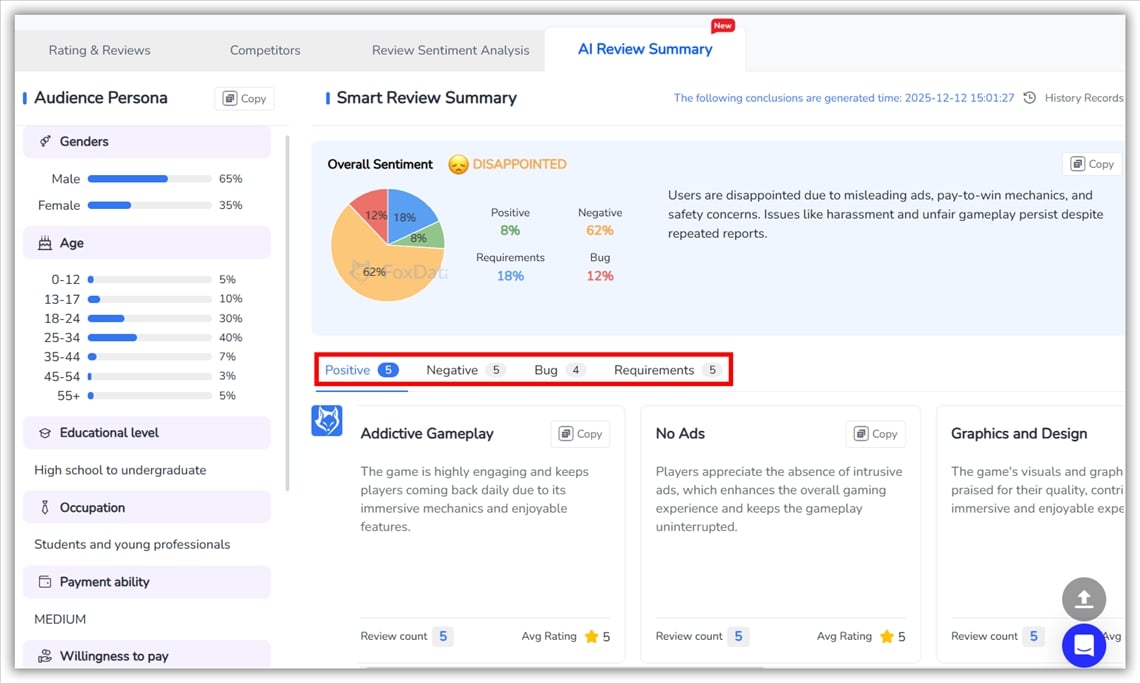
👉 How to Conduct App Market Research with "AI Review Summary"
Reading reviews at scale requires filtering signal from noise.
1. Focus on recent reviews – Apps change quickly. Feedback tied to older versions may no longer reflect the current experience.Even well-managed apps face structural challenges:
Understanding these limitations helps teams interpret review data more accurately.

Discover how FoxData enhances data protection and security standards to keep your analytics safe and reliable.
Review management goes beyond reputation — it directly supports optimization and retention.
FoxData supports this process with AI-generated reply templates, allowing teams to respond consistently across stores from a single dashboard.
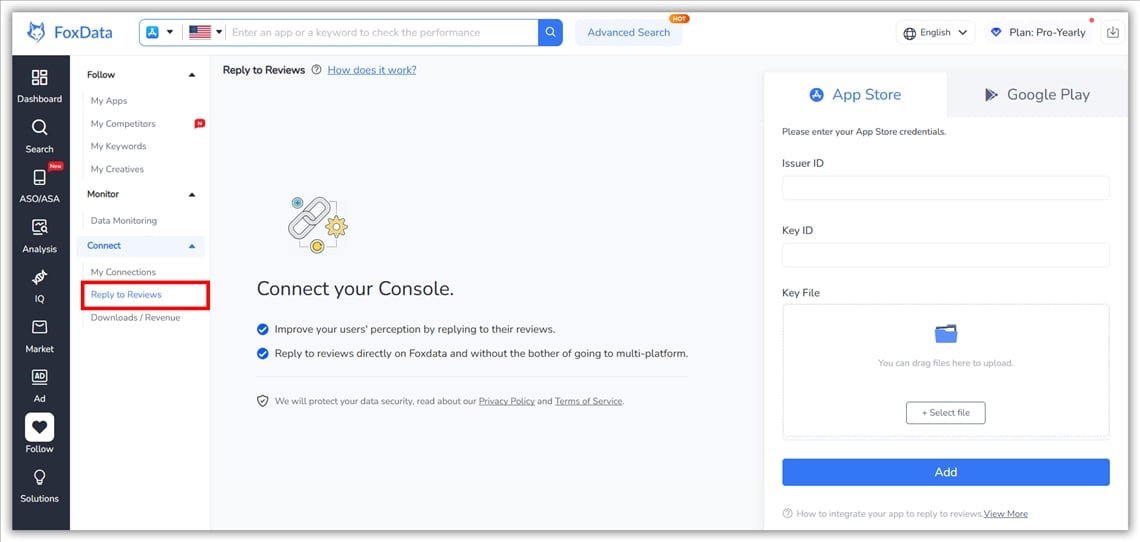
Fast responses demonstrate accountability and reduce churn risk. Delayed responses often signal neglect and erode trust.
As apps expand globally, manual review monitoring becomes inefficient. Centralization and automation are essential for maintaining consistency and speed.
👉 What's Going on Inside Your Users' Minds? Review Sentiment Analysis Helps You Find Out.
Encouraging users to leave reviews requires balancing feedback collection with a positive user experience. Overly aggressive prompts can backfire, generating negative reviews instead of insights.
Ask for reviews after users complete positive actions—finishing a game level, completing a purchase, or reaching a milestone. This maximizes the likelihood of receiving constructive and positive feedback.
Wait until users have engaged with the app over multiple sessions. In-app prompts should feel integrated, not disruptive, to preserve user satisfaction.
Use native review prompts on iOS and Android to allow users to rate the app without leaving the interface. The easier it is, the higher the response rate.
Ensure users gain meaningful value—problem-solving features, entertainment, or personalized experiences—before prompting for reviews. Satisfied users are more likely to leave positive, detailed feedback.
Leverage FoxData’s user sentiment analysis to identify highly satisfied users. Prompt them for public reviews, while directing less satisfied users to private feedback channels to address issues before they become negative reviews.
Tailor language, tone, and incentive messaging to specific regions, respecting cultural norms and compliance rules. This increases review relevance and positivity.
💡 Tip: Automate review prompts based on in-app behavior and sentiment analysis to maximize positive reviews while minimizing disruption.
Even well-managed apps face structural review challenges.
A: App store reviews are user ratings and written feedback on the App Store and Google Play. They influence conversion rates, user trust, and keyword rankings.
A: Reviews remain visible unless removed by the user or taken down for policy violations. Newer reviews usually carry more weight in perception and ranking.
A: Respond quickly, stay professional, localize replies when possible, and address specific concerns with clear solutions.
A: Trigger prompts after positive in-app actions, target satisfied users, and keep requests compliant, localized, and non-intrusive.
A: Centralizing reviews from different app stores allows teams to track sentiment trends, filter feedback by market or version, and identify recurring issues at scale. FoxData helps streamline this process by aggregating cross-store reviews and surfacing high-impact insights through AI analysis.
In 2026, app store reviews are a critical ASO signal that directly impacts rankings, conversion, and global growth. Teams that systematically analyze and manage reviews gain clearer user insights and stronger store performance.
Treating reviews as structured data — not isolated opinions — is now essential for sustainable app growth.
👉 Take the first step: Start your free trial and map review signals into actionable ASO growth.
📚 Editorial Picks:
© 2020-2026 FoxData. All Rights Reserved.