



Explore More Possibilities for Your Business
Full-cycle scenario construction to meet your needs from App research, development, and release to operation.
Ready for your soaring growth

The global mobile app market including ads is projected to exceed $580 billion in 2025, with over $260 billion coming from ad-supported apps alone. On top of that, with billions of active users across iOS and Android, mobile has become a primary lens through which investors, publishers, and growth strategists evaluate market opportunity.
But tracking the mobile market at scale has always been the hard part. Download estimates, revenue trends, keyword rankings, category movements, and competitor positioning change constantly. Without structured, programmatic access to this data, most decisions are made on incomplete information.
That is where app data APIs come in. Rather than logging into dashboards manually or stitching together reports from multiple tools, teams can now pull real-time and historical mobile market data directly into their own systems, models, and workflows. For investors, this means tracking portfolio companies and competitor apps with precision.
For game publishers and UA managers, it means responding to market shifts before they become missed opportunities.
This article breaks down how to use app data APIs effectively for investor research and market intelligence, and why having the right data infrastructure is essential for anyone making decisions in the mobile space.
Investors and analysts who track public companies in the mobile gaming or app space know the frustration: quarterly earnings reports tell you what happened, not what is happening. By the time financial results are published, the market has already moved.
App store data tells a different story in real time. Download velocity, user rating trends, update frequency, keyword ranking shifts, and revenue estimates all serve as leading indicators of a product's health. Research shows that changes in an app's download trajectory often precede revenue changes by several weeks, giving data-savvy investors a meaningful informational edge.
For game publishers and UA managers, the stakes are equally high. The top-grossing charts in any category can shift dramatically within a month. A competitor launching a new feature set, adjusting its keyword strategy, or scaling ad spend can erode your market share before your team notices.
A study found that over 65% to 70% of mobile app installs are influenced by search visibility on the app stores, making keyword and ranking data critical for competitive analysis.
The challenge is volume. The Apple App Store and Google Play together host over 5 million apps. No team can manually monitor that landscape.
App data APIs solve this by enabling programmatic, at-scale data retrieval that feeds into dashboards, financial models, and competitive intelligence systems.

Discover how FoxData enhances data protection and security standards to keep your analytics safe and reliable.
Reliable download and revenue estimates are the cornerstone of mobile market research. Whether you are evaluating an acquisition target, benchmarking a portfolio company, or sizing a new market category, you need this data at the app level across multiple time ranges.
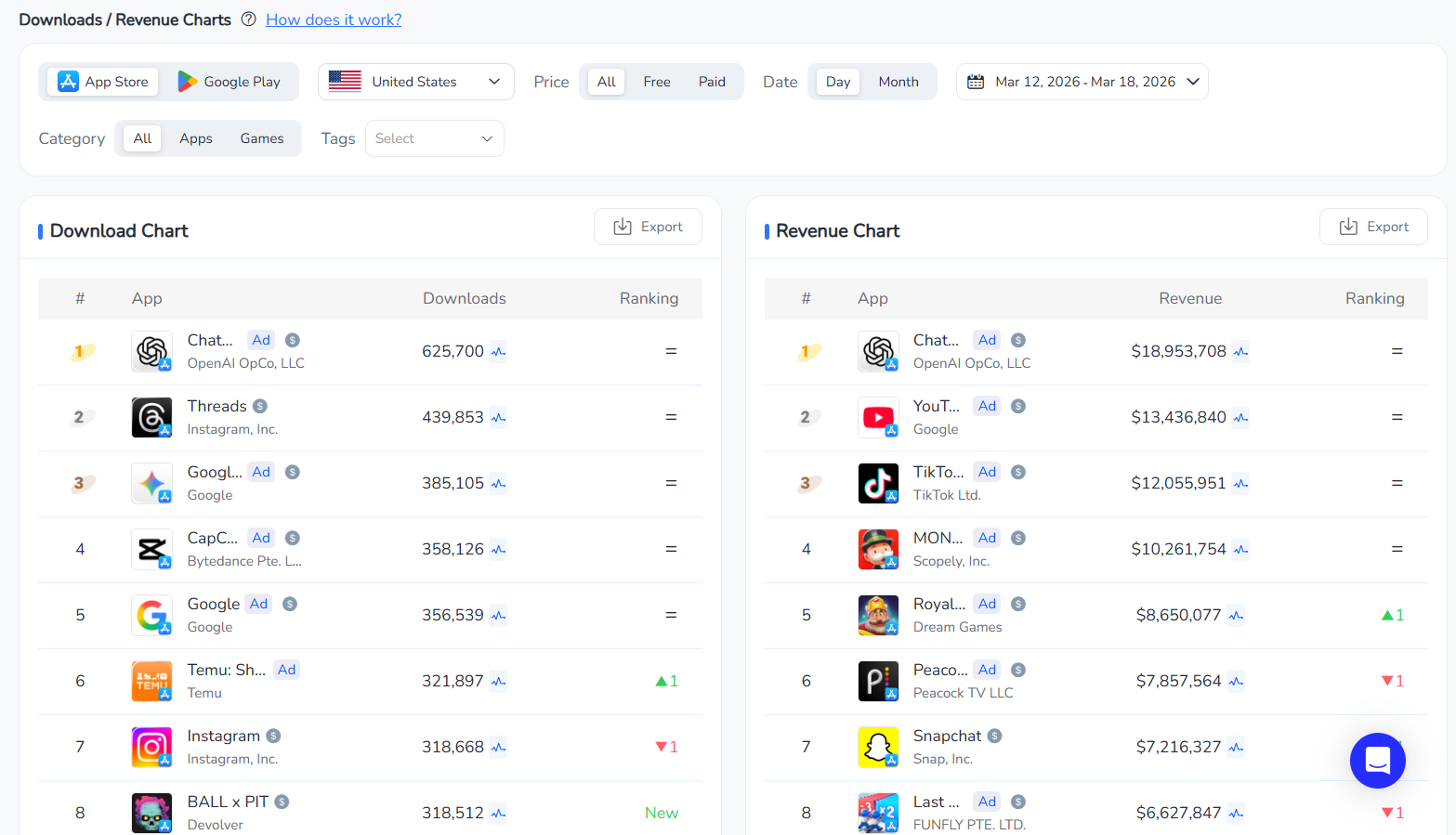
A robust app data API gives you estimated installs by country and platform, revenue trends over time, and breakdowns by paid versus organic acquisition. This allows you to model growth curves, spot deceleration early, and compare performance against category benchmarks.
For UA managers and ASO specialists, keyword ranking data is non-negotiable. An app data API that provides keyword visibility scores, ranking history, and competitor keyword gaps allows teams to make informed decisions about metadata optimization and paid search targeting through Apple Search Ads.
This is not just about optimizing your own listings. Understanding which keywords a competitor ranks for, and how their visibility has changed over time, gives you a clear picture of their strategy and where the untapped opportunity sits.
Rating trends and review volume are often overlooked as market signals, but they carry significant weight. A sharp drop in an app's average rating, or a surge in negative reviews mentioning a specific feature, often correlates with user churn. For investors, this is an early warning system. For product teams, it is a competitive intelligence feed.
Top chart positions in key categories reflect real market momentum. Tracking how an app's category ranking changes over weeks and months reveals whether a product is growing, plateauing, or declining relative to its peers. At scale, this data helps map the competitive landscape of an entire category.
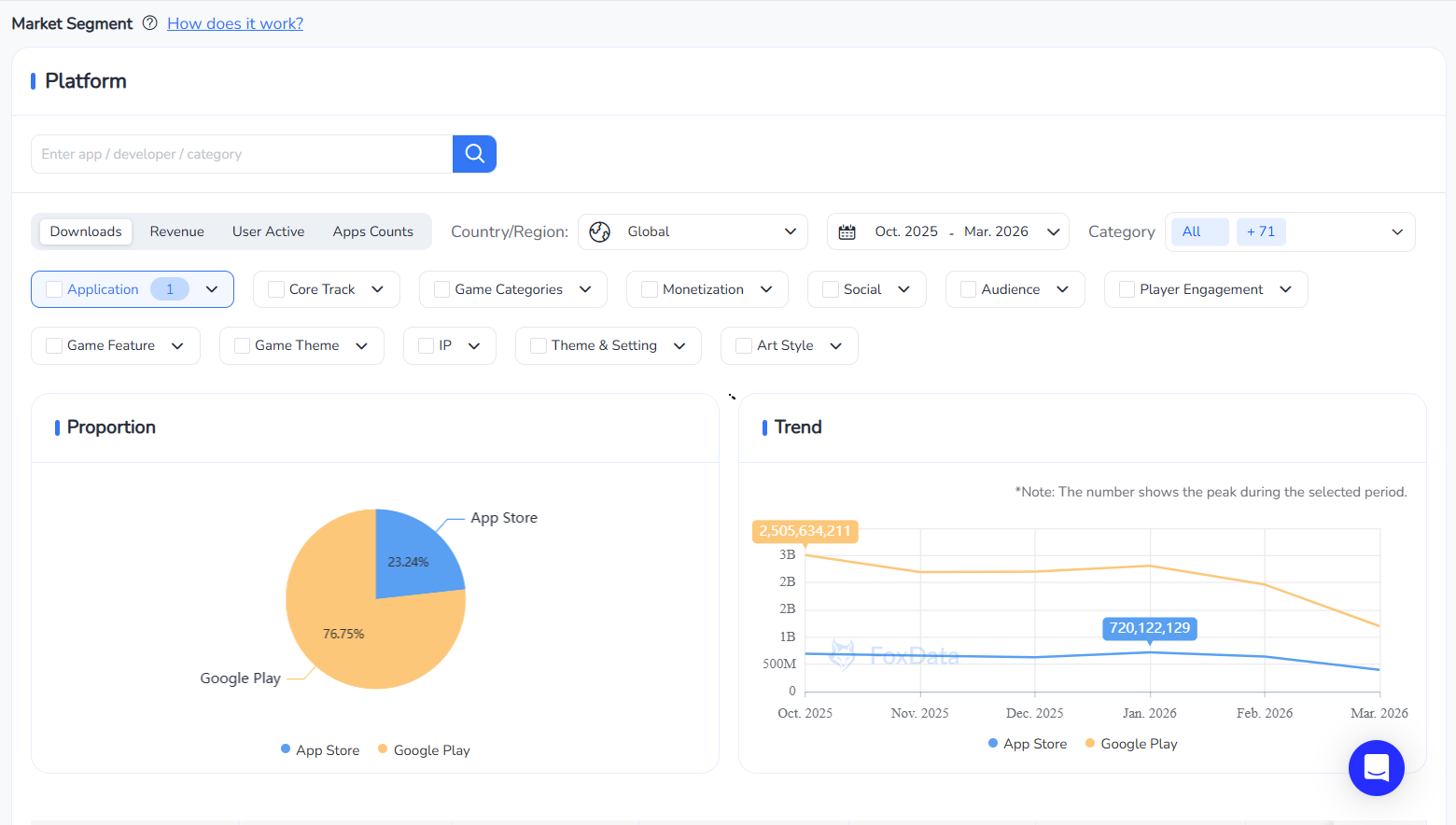
Platforms like FoxData provide structured access to all of these data layers through a single app data API for mobile market intelligence. Rather than building and maintaining separate integrations, teams can access app performance data, keyword rankings, and competitor insights through one programmatic endpoint.
Before making your first API call, map out what you actually need. Are you tracking a specific list of apps for investor due diligence? Do you need keyword ranking data across multiple markets? Are you building a live competitive dashboard for your UA team?
Clarity here prevents scope creep and ensures your data pipeline pulls the right signals. Common use cases include:
An app data API is only as useful as the systems it feeds into. Most teams integrate API data into one of three places: a business intelligence tool like Tableau or Looker, a custom internal dashboard, or a spreadsheet-based financial model.
The integration process typically involves authenticating with an API key, constructing query parameters (app ID, country, date range, metric type), parsing the JSON response, and storing or displaying the data. Most modern app data APIs follow RESTful conventions, which makes them straightforward to integrate with standard data engineering tools.
For teams that want a faster path to market insights without building a custom pipeline, you can start extracting value immediately with FoxData's mobile app data API platform, while building a more sophisticated integration in parallel.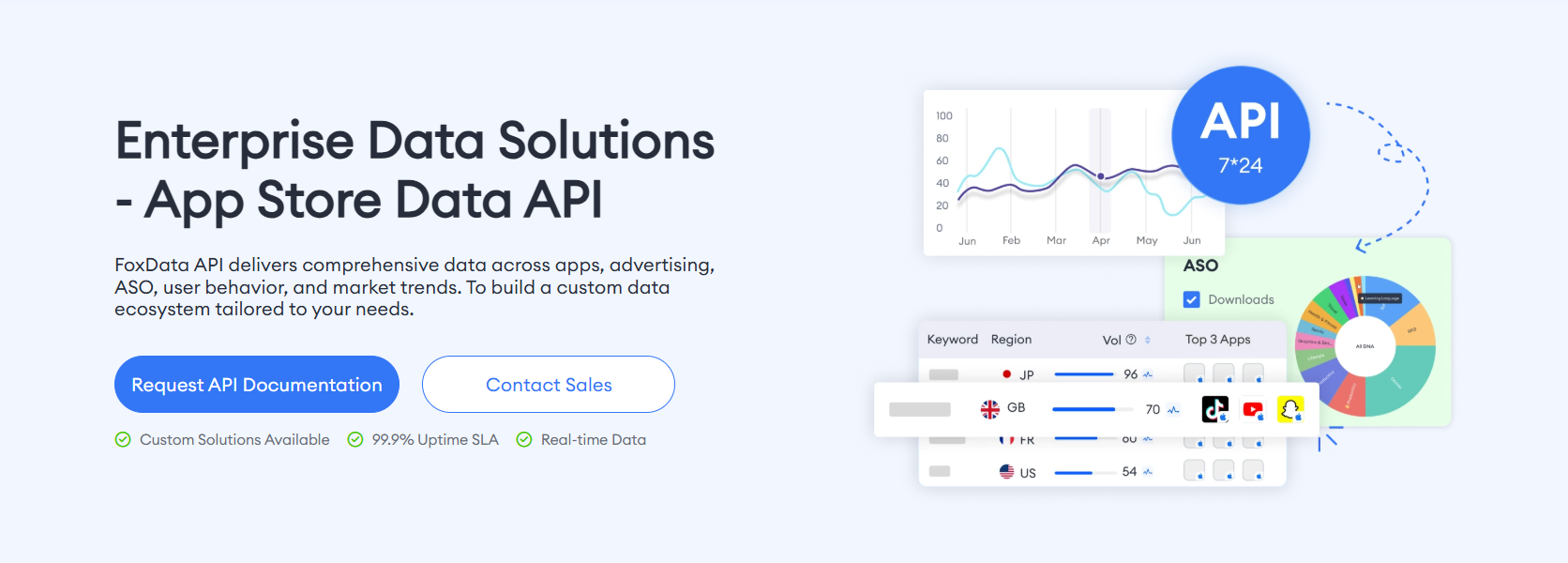
The real power of API-driven market intelligence is automation. Instead of checking dashboards manually, set up scheduled queries that run daily or weekly and flag meaningful changes.
For example, you might configure an alert when a competitor enters your category's top 10 chart, when a target app's download estimate drops more than 15% week-over-week, or when a new keyword breaks into the top 5 rankings for a high-volume search term.
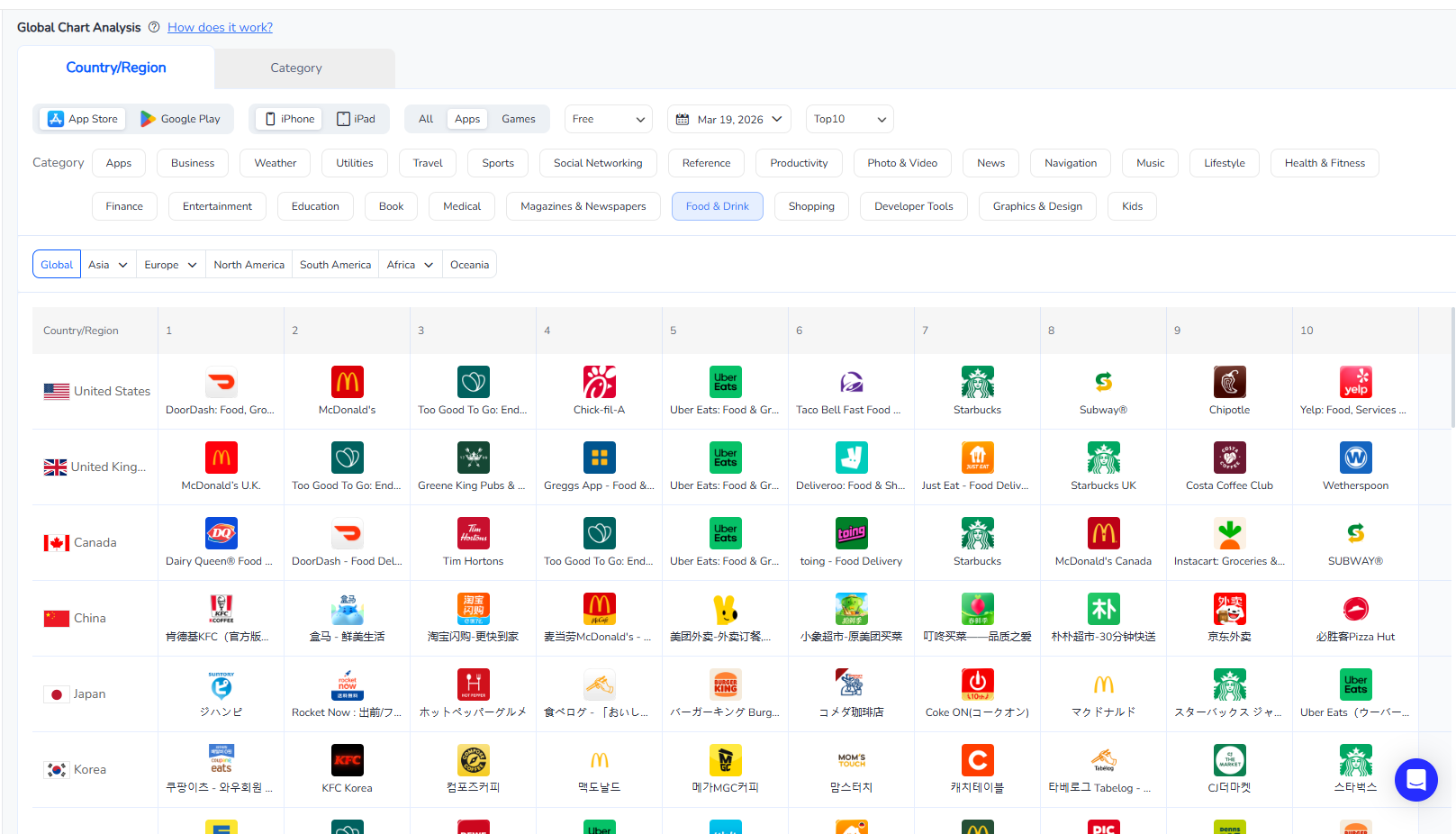
This kind of proactive monitoring transforms app data from a reporting tool into an operational intelligence layer.
App store download and revenue data from third-party APIs are estimates derived from statistical modeling, panel data, and store signals. They are directionally accurate and highly useful for trend analysis, but they should not be presented as precise figures in financial models without appropriate confidence intervals noted.
Global aggregate numbers mask important regional dynamics. An app growing 40% globally might be declining in the US while surging in Southeast Asia. Always segment your analysis by geography, especially for investment theses that depend on a specific regional market.
Many teams connect an API, pull an initial data snapshot, and then let the integration sit idle. App market conditions change weekly. Data is only useful if it is monitored continuously and compared against historical baselines. Build a regular cadence into your workflow from day one.
Download and revenue data tells you what is happening. Keyword and ASO data tells you why. A competitor growing rapidly in organic installs almost certainly has a strong keyword strategy. Ignoring this layer means missing a critical driver of mobile growth performance.
Stitching together data from five different sources introduces inconsistency, lag, and reconciliation overhead. Where possible, consolidate your mobile market data through a single API provider that covers downloads, revenue, keywords, ratings, and category rankings.
The mobile app market moves fast. The teams and investors that stay ahead are not necessarily those with the largest budgets. They are the ones with the best information, updated regularly and integrated into the way they actually work.
App data APIs make this possible by turning fragmented, manual research into a scalable, automated intelligence operation. Whether you are tracking a portfolio of apps for investment decisions, monitoring competitors for a UA campaign, or benchmarking your own app's keyword performance across markets, programmatic access to structured mobile data is no longer optional. It is a strategic requirement.
The good news is that getting started is more straightforward than it used to be. The infrastructure exists. The data is available. The question is whether your team is set up to use it.
If you are ready to build that foundation, explore what is possible through FoxData's app store data API and mobile market intelligence platform. From real-time download estimates to deep ASO and keyword analytics, FoxData gives your team the data infrastructure to make faster, more confident decisions in the mobile market.
Most app data APIs provide access to estimated download volumes, revenue estimates, category rankings, keyword rankings and search visibility scores, ratings and review counts, update history, and app metadata. More comprehensive platforms also offer competitor analysis features, market share tracking, and ASO audit tools alongside their API access.
Accuracy varies by provider and market. Estimates are typically strongest for major markets like the US, UK, Germany, Japan, and South Korea, where larger data panel sizes improve statistical reliability. For emerging markets, estimates are directionally useful but carry wider confidence ranges. Always use estimates for trend analysis rather than absolute benchmarking.
Yes, and this is an increasingly common use case among venture capital and private equity firms evaluating mobile-first companies. Investors typically use API data to validate growth claims, identify concerning trend reversals, and benchmark the target company against category peers.
Key factors to evaluate include data freshness (how frequently the API updates its estimates), geographic coverage, the breadth of metrics available (downloads, revenue, keywords, ratings), rate limits and pricing structure, documentation quality, and the provider's track record for accuracy.
Ready to make your app shine? Optimize your app's visibility with FoxData, the ultimate ASO tool! Maximize downloads and rankings by leveraging our powerful insights today.
App Growth & ASO Tools by FoxData
FoxData supports every stage of app growth with specialized ASO and app analytics tools, helping teams improve keyword visibility, user acquisition, and retention through reliable data.
🔍 Store Keyword Research Tools
Research high-intent keywords, search volume, and competition to strengthen your app store optimization strategy.
📈 App Store Keyword Tools
Analyze keyword rankings and performance across the Apple App Store and Google Play to refine ASO execution.
📊 ASO Monitoring Tools
Monitor keyword ranking changes, visibility trends, and ASO impact over time with continuous performance tracking.
👥 User Activity Monitoring Tools
Understand in-app user behavior, engagement, and retention with real-time user activity analytics.
Together, these tools form FoxData’s ASO analytics and app intelligence ecosystem, designed to help developers, marketers, and growth teams make data-driven decisions and scale sustainably.
Explore it today!
👉 Learn more about FoxData here | 👉 Book a demo with FoxData team today!
© 2020-2026 FoxData. All Rights Reserved.