

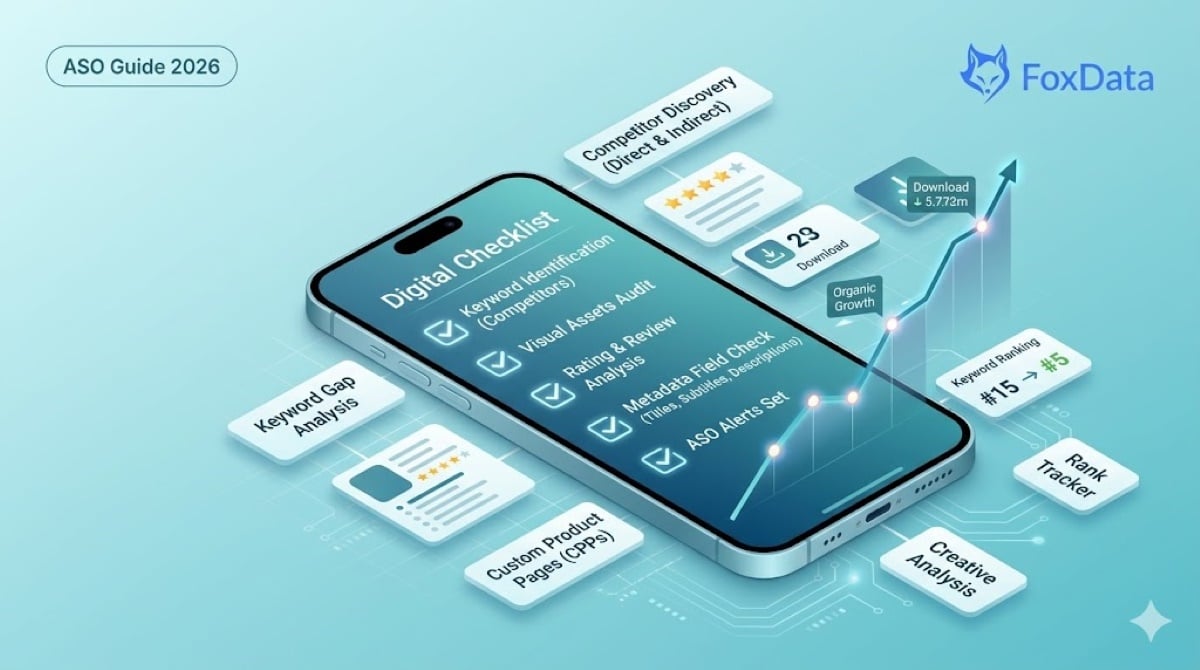
Explore More Possibilities for Your Business
Full-cycle scenario construction to meet your needs from App research, development, and release to operation.
Ready for your soaring growth
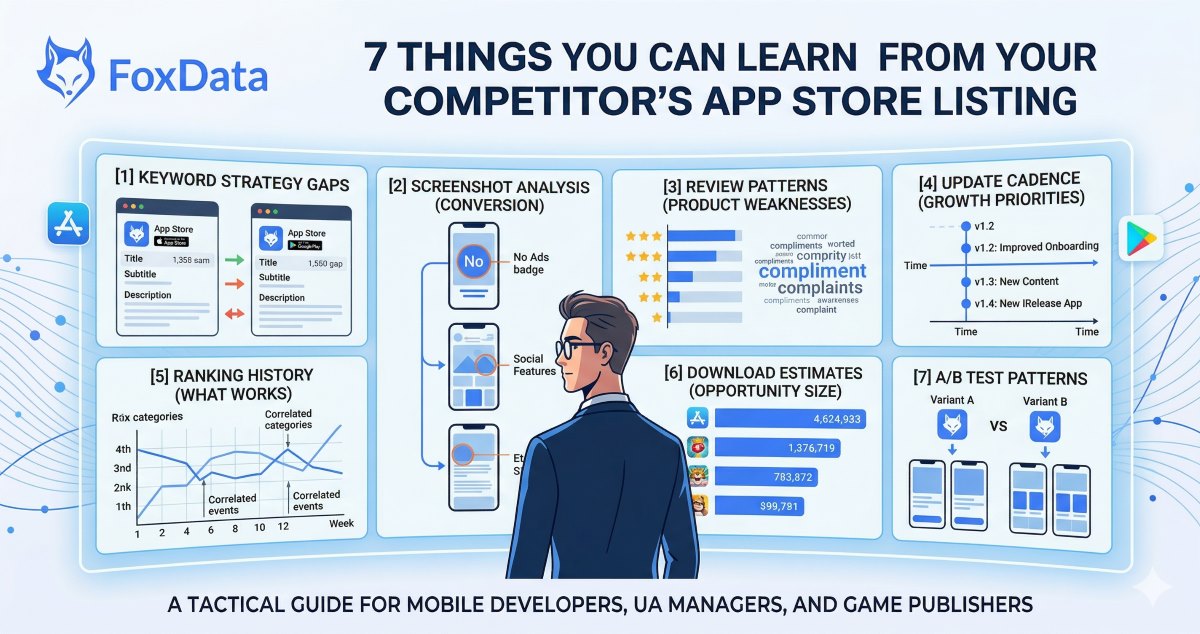
You already know who your biggest competitors are. But do you know why they rank higher than you? The answer is often sitting in plain sight, right inside their App Store or Google Play listing.
Your competitor's app listing is a public document. It reveals their keyword strategy, visual identity, and conversion tactics. Most developers scroll past it casually. Smart marketers study it systematically.
This guide breaks down exactly what to look for, what it means, and how to act on it. Whether you are an indie developer or a large game publisher, these seven data points can sharpen your ASO strategy fast.
Gut instinct is a starting point. Data is what makes it actionable.
According to Apple, there are over 1.8 million apps on the App Store as of 2024. Google Play hosts over 2.2 million apps. In that environment, small differences in your listing can mean significant differences in conversion rates.
Research consistently shows that the App Store product page is one of the highest-leverage touchpoints in the user acquisition funnel. A well-optimized listing can improve conversion rates by 20 to 40 percent, depending on the category and audience. Every element of your competitor's listing, from their icon to their subtitle, reflects a deliberate strategic decision.
The question is: what are they telling you without knowing it?
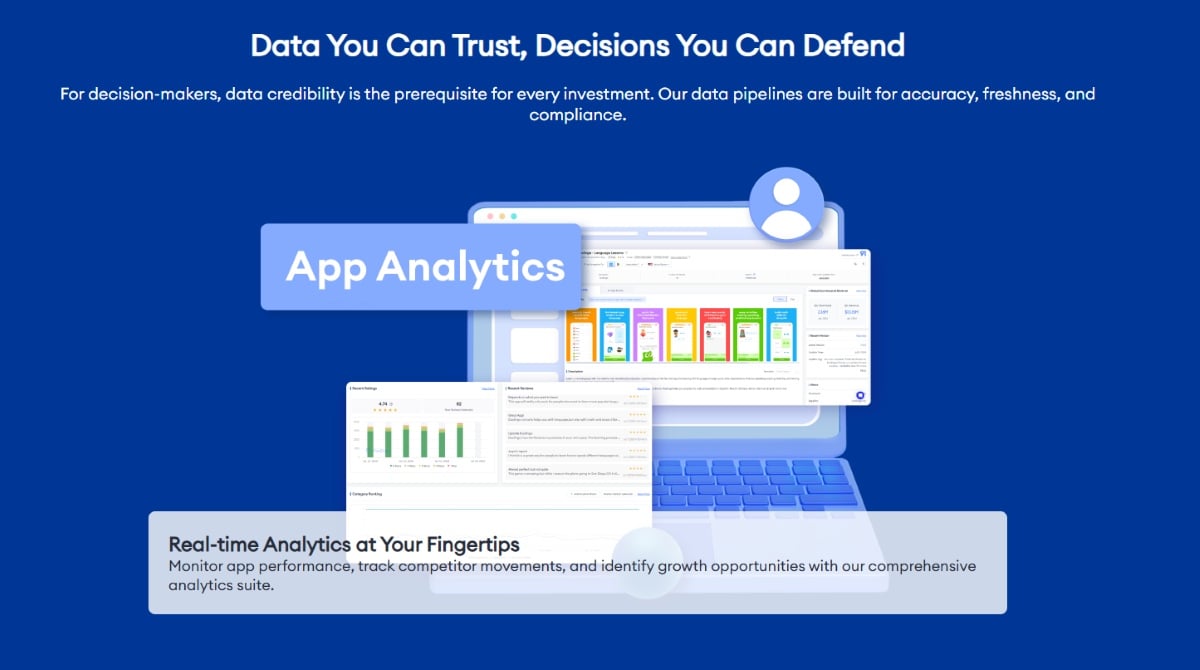
Discover how FoxData enhances data protection and security standards to keep your analytics safe and reliable.
Start with the basics. Your competitor's app title, subtitle, and short description are keyword real estate. Every word placed there is intentional.
Read the title structure carefully. Are they targeting a broad term like "fitness tracker" or a specific one like "HIIT workout for women"? That distinction tells you whether they are playing a volume game or a niche conversion game.
The subtitle on iOS in particular is heavily indexed by Apple's algorithm. If a competitor has placed a high-volume keyword in their subtitle and you have not, they are likely ranking above you for that search. That is a fixable gap.
Cross-reference competitor metadata with your own keyword list. Identify terms they are using that you have not included. Then evaluate search volume and difficulty before deciding whether to incorporate them.
Screenshots are not decoration. They are the most visited element on a product page, and they function as a silent sales pitch.
Studies show that the first three screenshots have an outsized impact on conversion. Users decide whether to download within seconds of viewing the listing. What your competitor chooses to highlight in those first three frames reveals what they believe drives installs.
Look for patterns: Are they leading with features or with benefits? Do they use lifestyle imagery or UI-first visuals? Are they using text overlays to explain value quickly?
If a competitor is showing a "No Ads" badge prominently in screenshot two, it tells you that this is a meaningful decision driver for their audience. If they are highlighting social features, that is what their users care about.
Systematic app store screenshots analysis can surface patterns across multiple competitors, helping you understand category norms and identify opportunities to stand out.
Your competitor's reviews are a free user research study. They did not pay for this data. You can read it for free.
Look for recurring themes in one-star and two-star reviews. What do users consistently complain about? Poor onboarding, too many ads, low-quality content, buggy performance? These are gaps in their product that you can solve.
Also study what users praise. Their five-star reviews tell you exactly what your target audience values most. If users consistently love a particular feature, that feature should be prominent in your own listing and product strategy.
Review velocity matters too. A competitor who received 500 reviews last month was either running a strong UA campaign, running a review solicitation strategy, or launching new content. Each scenario tells you something useful.
Go to the "What's New" section. Read the last six to twelve months of update notes.
Update frequency signals how resourced a team is and how seriously they treat retention. A competitor releasing updates every two to three weeks is likely testing aggressively and responding to user feedback fast.
More importantly, update notes reveal product roadmap signals. When a competitor emphasizes "new social sharing features" or "improved onboarding," those decisions were usually driven by data showing friction in those areas.
If a competitor ships a major overhaul to their onboarding, that is a signal. It likely means their data showed high early churn. If they introduce a new monetization mechanic, they likely A/B tested it and it won.
A competitor's current ranking is a snapshot. Their ranking history is the story.
Ranking spikes often correlate with specific events: a featured placement from Apple or Google, a major PR moment, a new content drop, or a paid UA push. When you can identify these events and correlate them with their listing changes, you start to build a model of what drives growth in your category.
For example, if a competitor jumped from rank 80 to rank 12 in the Puzzle category in a specific week, and you also know they updated their screenshots that week, that is a meaningful data point. Their new creative may have significantly improved their conversion rate.
Understanding this pattern is exactly why mobile market intelligence tools exist. They give you the historical view that a single listing visit cannot provide.
Raw download estimates for competitor apps are available through market research tools. These numbers are not perfect, but they are directionally accurate enough to inform decisions.
If your nearest competitor is generating an estimated 50,000 downloads per month in a category where you are generating 5,000, that gap is not a discouragement. It is a benchmark. The market has proven it is large enough to support that volume. The question becomes what you need to do differently to capture a larger share.
Download data also helps validate your keyword investments. If a competitor with strong keyword coverage in a specific cluster is generating high download volume, that cluster is worth targeting. If a high-ranking competitor in a niche is generating low downloads, that niche may not have the search demand you assumed.
Both the App Store and Google Play allow developers to run product page experiments. When a competitor tests multiple icon variants, different screenshots, or alternative descriptions, the winning version eventually becomes the default.
If you monitor a competitor's listing over time and notice that their icon changed but their screenshots stayed the same, that was likely the result of an A/B test. If their short description changes in tone but keeps the same keyword density, they may be testing emotional framing.
Tracking these changes gives you a window into their optimization playbook without running the tests yourself. Over time, you can identify patterns: which creative styles tend to win in your category, which calls-to-action outperform others, and which value propositions resonate most with shared audiences.
Reading a competitor's listing manually is a start. Acting on it systematically requires a platform designed for this purpose.
FoxData's ASO and analytics platform provides keyword intelligence, competitor tracking, download estimates, ranking history, and metadata analysis in one place. Instead of manually checking listings and recording changes, you can track competitors continuously and get notified when meaningful shifts occur.
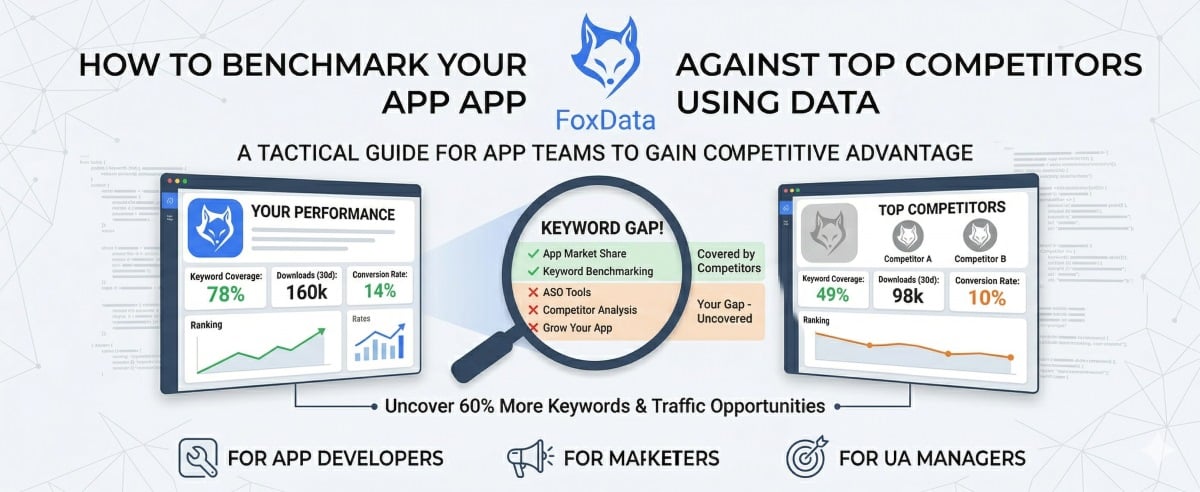
For keyword gaps, FoxData surfaces terms your competitors are ranking for that you are not targeting yet. For creative intelligence, the platform helps you benchmark your visual assets against category norms. And for indie developers with smaller budgets, FoxData's tools for indie developers provide these same insights without requiring an enterprise-level spend.
One concrete example: a fitness app using FoxData's competitor tracking and keyword intelligence strategy increased keyword coverage by 60 percent and reduced user acquisition cost by 28 percent. That result came from identifying competitor metadata gaps and systematically filling them, combined with improved creative performance informed by app store screenshots analysis.
If you want a step-by-step process for running a full competitive analysis, this guide covers how to conduct mobile app competitor analysis with FoxData's ASO tools.
Copying instead of interpreting. The most common mistake is seeing what a competitor is doing and simply replicating it. Copying their keyword list gives you their strategy, not a better one. Use their data as a signal, then build something differentiated.
Looking at rankings without context. A competitor ranking in the top ten does not mean their listing is optimal. They may be benefiting from brand strength, paid UA, or seasonal trends. Always look at multiple signals together.
Ignoring small competitors. Niche competitors with smaller download volumes often show the most innovative ASO strategies. They cannot compete on scale, so they win on precision. Pay attention to them.
Treating research as a one-time activity. App store optimization is not a set-and-forget process. Competitor listings change weekly. Rankings shift. New entrants appear. Build competitor monitoring into your regular workflow, not just your quarterly review.
Ignoring regional variation. A competitor may use a completely different keyword strategy in Japan versus the United States. If you are targeting multiple markets, analyze their listing in each region separately. FoxData's global market research tools make this cross-market analysis practical.
Competitor app listing analysis means systematically reviewing a competing app's metadata, screenshots, reviews, and ranking history to identify patterns and opportunities. It matters because it reveals what strategies are working in your category, so you can make more informed decisions about your own listing rather than guessing.
For active competitors in your category, weekly monitoring is ideal. App store rankings and listing elements can change quickly after a major update, paid campaign, or editorial feature. Monthly reviews are a minimum for mid-sized teams.
Yes. Research shows that creative assets, including screenshots and videos, are among the most influential factors in an app's conversion rate. Studies in the mobile marketing industry have found that optimized screenshots can improve install conversion rates by 20 to 40 percent depending on the category.
Yes. Most professional ASO platforms, including FoxData, support both platforms. Because Google Play and the App Store use different indexing algorithms and metadata structures, it is important to analyze competitors separately on each platform.
Your competitor's app listing is one of the most underused sources of strategic intelligence in mobile growth. Every element, from their keywords to their screenshots to their update notes, reflects real decisions backed by real data.
The developers who grow fastest are not the ones who work in isolation. They are the ones who study the market continuously and use what they learn to make sharper decisions about keywords, creative, and positioning.
You do not need a large team or a large budget to do this well. You need the right tools and a systematic approach.
Ready to start turning competitor data into growth? Explore FoxData's ASO and mobile analytics platform and see what your competitors are telling you without knowing it.
© 2020-2026 FoxData. All Rights Reserved.