




Explore More Possibilities for Your Business
Full-cycle scenario construction to meet your needs from App research, development, and release to operation.
Ready for your soaring growth
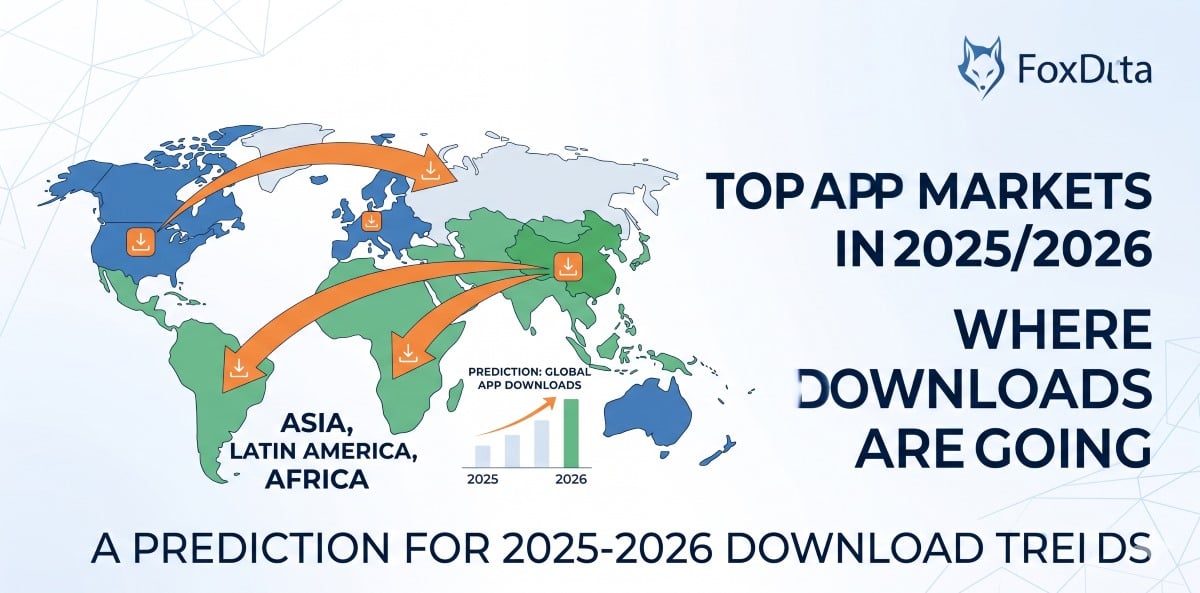
The global mobile app ecosystem is undergoing a fundamental shift. While overall download volumes on the App Store and Google Play have plateaued - declining roughly 1–2% year-over-year - the story beneath the surface is far more nuanced. Certain regions and categories are surging, user spending is deepening, and the battle for visibility has never been more expensive or more strategic. For developers, marketers, and publishers, knowing where downloads are going in 2025–2026 isn't just interesting — it's existential.
The mature markets - the United States, Western Europe, Japan, and South Korea - are no longer the growth engines they once were. Download growth has largely plateaued in these regions as smartphone penetration approaches its ceiling. However, revenue per user in these markets remains the highest in the world, meaning competition for top-chart positions has intensified dramatically.
ASO and Apple Search Ads (ASA) expenditure jumped 35% year-over-year, a clear signal that organic discovery alone is no longer sufficient. Top apps are monopolizing user spend, and newcomers must fight for every impression.
But here's the opportunity: the edges are electric.

India continues to dominate raw download volume, driven by an enormous and still-expanding smartphone user base, affordable data plans, and a young demographic hungry for digital services. Utility apps, short-video platforms, fintech tools, and casual games are seeing explosive installs.
The challenge? Monetization. Average revenue per user (ARPU) in India remains low compared to Western markets, meaning success requires scale - and scale requires precision in ASO and user acquisition strategy.
Southeast Asia - led by Indonesia, Vietnam, Thailand, and the Philippines - has emerged as one of the two primary growth engines for mobile apps in 2025 . The region's fragmented payment landscape and cultural diversity demand localized UX and marketing approaches, but the reward for those who get it right is significant.
E-commerce apps, ride-hailing, digital wallets, and mobile gaming are particularly strong performers here. According to market data from FoxData's H1 2025 Global E-commerce App Market Insights, total global e-commerce app downloads reached approximately 9 billion in H1 2025 - and Southeast Asia is a disproportionate contributor to that figure.
Brazil and Mexico are increasingly on the radar of global publishers. Growing middle-class smartphone adoption, improving payment infrastructure, and a passionate gaming culture make Latin America a compelling expansion target. Localization - both linguistic and cultural - is the key unlock here.
With relatively low app market penetration but rapidly improving connectivity, the Middle East and parts of Africa represent genuine early-mover opportunities. Publishers who invest in these regions now - building ASO presence, localizing metadata, and establishing brand recognition - are positioning themselves ahead of the inevitable growth curve.
Mobile gaming remains the single largest category by both downloads and revenue. However, the landscape has shifted. The hypercasual boom has given way to hybrid-casual and mid-core games that balance low friction with deeper engagement mechanics.
In East Asia - China, Japan, and South Korea - anime-style mobile games generated a combined revenue of USD 801 million in H1 2025, with success increasingly hinging on differentiated content, timely updates, and sustainable IP ecosystems.
The competitive intelligence required to succeed in gaming is profound. Understanding a competitor's keyword strategy, monetization model, update cadence, and player demographics is no longer optional - it's table stakes. If you want to go deeper on this, FoxData's comprehensive guide on how to deconstruct a competitor's game is essential reading for any mobile game publisher.
The e-commerce app market is undergoing a structural transformation. While downloads have plateaued, in-app purchase revenue, user engagement, and session depth are all surging. Temu, SHEIN, and AliExpress dominate globally, but the real story is the shift from user-acquisition-led growth to retention and value-driven competition.
This means that winning in e-commerce apps in 2025–2026 is less about getting the install and more about keeping the user — a dynamic that rewards sophisticated analytics and ASO Impact Analysis to understand which metadata changes and campaigns are actually driving long-term value.
Health and fitness apps have proven remarkably durable post-pandemic. The category continues to attract high-intent users willing to pay for subscriptions, making it one of the highest-ARPU categories outside gaming.
The playbook for growth here is instructive. A real-world case study shows how a fitness app used FoxData's intelligence tools to increase keyword coverage by 60% and reduce acquisition cost by 28% - a result that demonstrates exactly what's possible when data strategy is executed well. You can read the full breakdown here: How a Fitness App Increased Keyword Coverage by 60% and Reduced Acquisition Cost by 28% with FoxData.
Productivity apps - note-taking, task management, PDF tools, VPN services - are steady download performers with strong subscription conversion rates. The category benefits from strong search intent: users know what they want, and ASO keyword precision directly translates to installs.
For indie developers in this space especially, the efficiency of ASO tools matters enormously. When you can't outspend the giants, you need to out-think them.
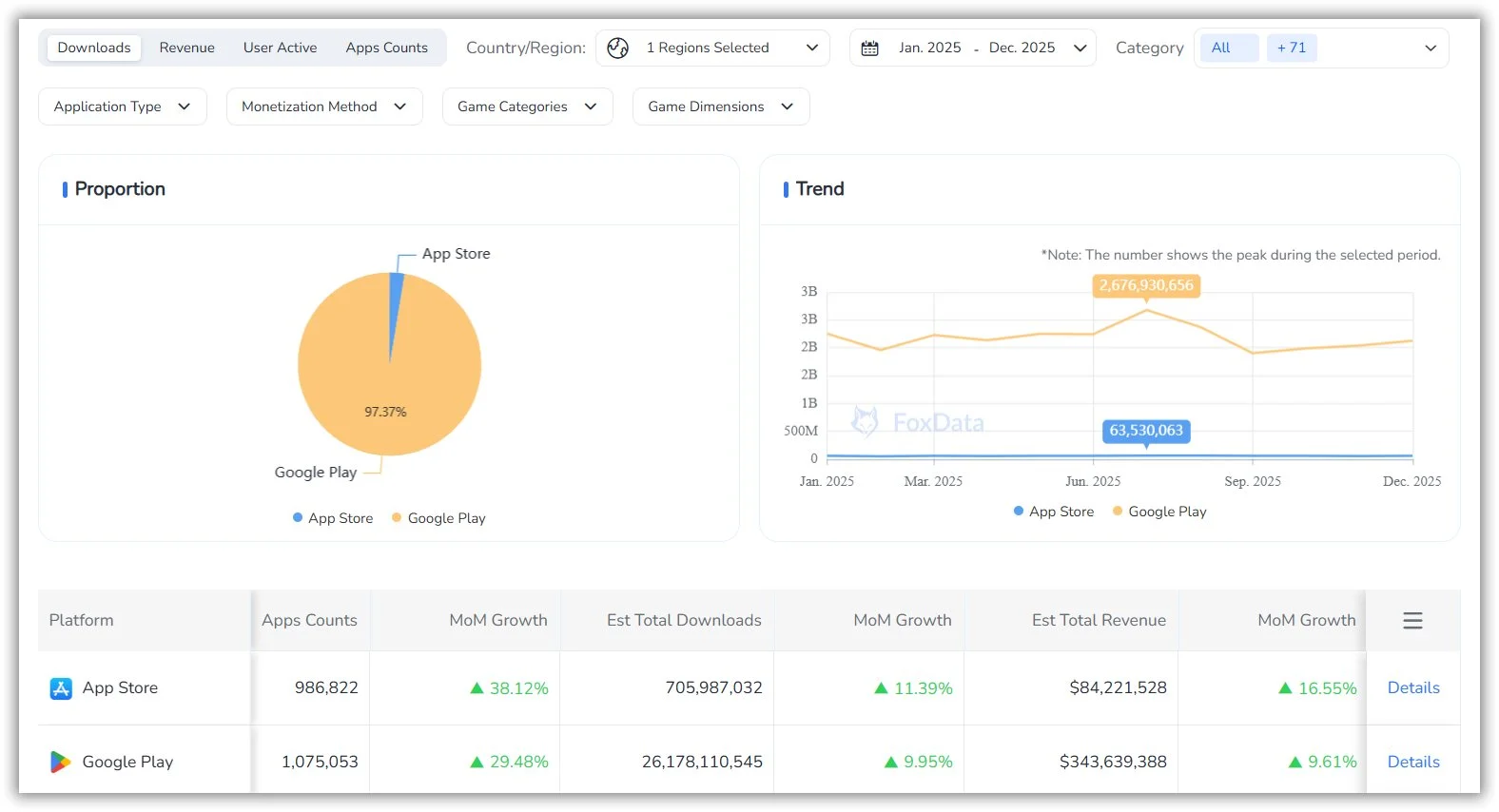
Understanding where downloads are going also means understanding the platform dynamics:
Savvy publishers track both platforms simultaneously, comparing revenue and download metrics globally to identify high-potential platforms and markets before competitors do. FoxData's Global Mobile App Market Research Tools provide exactly this capability - enabling you to track market size, growth trends, and saturation levels across both stores, from emerging markets to mature economies.
With over 13 million apps tracked across the App Store and Google Play, the average app faces brutal discoverability challenges. The top 1% of apps capture a disproportionate share of organic traffic, and the cost of paid acquisition continues to climb.
This is why ASO - App Store Optimization — has become the most important lever in the modern app growth stack. But effective ASO in 2025 looks very different from keyword-stuffing exercises of years past. It requires:
For teams looking to measure and optimize the impact of their ASO activities with precision, FoxData's ASO Impact Analysis Tools offer exactly this kind of event-driven analytics capability.
And for teams who need a comprehensive view of their app's performance metrics - from keyword rankings to revenue trends to competitive positioning — FoxData's App Analytics and ASO Performance Metrics Research Tools provide the full picture in one place.
Not every publisher has the resources of a Tencent or an EA. For indie developers, the 2025–2026 market presents both an opportunity and a threat.
The opportunity: niche markets remain genuinely underserved. There are categories and regional markets where a focused, well-optimized app can still win organically without massive paid acquisition spend.
The threat: the tools and data required to find and exploit those niches have historically been expensive and complex.
FoxData has specifically addressed this gap with a solution designed for independent creators. FoxData's ASO Tools & App Analytics for Indie Developers brings enterprise-grade intelligence to individual developers - keyword research, competitor analysis, download estimates, and more — at a scale and price point that makes sense for smaller teams.
Based on the market dynamics above, here are the strategic imperatives for any app publisher heading into the next 18 months:
Prioritize emerging markets with localized strategies. India and Southeast Asia are where the volume growth is. But localization isn't just translation - it's UX, payment methods, cultural relevance, and pricing strategy.
Shift investment from acquisition to retention. The e-commerce market's transformation is a leading indicator for the whole industry. Users are harder to acquire and easier to lose. Deep retention analytics matter more than ever.
Treat ASO as a continuous discipline, not a launch activity. The apps winning in 2025 are those with keyword strategies that evolve weekly, metadata that's tested and optimized, and competitive intelligence that informs every update.
Use competitive intelligence systematically. Your competitors' keyword strategies, ad creatives, update cycles, and revenue trends are all visible - if you have the right tools. The publishers winning today are those who treat competitive analysis as a core ongoing function, not a one-time exercise.
Measure everything against market benchmarks. Knowing your downloads are up 10% is only useful if you know the market grew 25% - in which case you're actually losing share. Benchmarking against category and regional baselines is essential for honest performance assessment.
The global app market in 2025–2026 isn't defined by one story - it's defined by many. Saturation in some regions, explosive growth in others. Declining downloads in some categories, surging revenue in others. The winners will be those who can read these dynamics in real time, adapt their strategies accordingly, and execute with precision.
The intelligence infrastructure to do this exists. The question is whether you're using it.
Whether you're a global publisher tracking market shifts across 150 countries, an indie developer trying to find your niche, or a growth team trying to squeeze more efficiency from your ASO and ASA spend - the tools and data you need to compete in this market are available.
Explore how FoxData can help you navigate the 2025–2026 app market:
Data references in this article draw on FoxData's 2025 market analysis and industry reporting. FoxData tracks 13M+ apps across the App Store and Google Play, monitoring 90M+ keywords in real time across all major global markets
© 2020-2026 FoxData. All Rights Reserved.